I mean I empathize with the YIMBY point of view -- I make about $56,00 a year as staff at a state university. That's right on the edge in the bay area. There will come a time when I can no longer afford to live here. I'm OK with that. That's how the market works. I don't think you have a right to live in San Francisco, or Malibu, or Los Gatos, etc. if you can't afford to live there. Everyone can't own a Ferrari. Everyone doesn't get to live where they want to.
"It is ironic to tell service workers that, in the name of democracy, they can’t vote for the councils who decide the zoning in any of the cities where they spend their economic lives because they happen to live across a town border."
I don't think this is a problem at all. These people are pursuing a very rational arbitrage strategy between place of work and place of living - and it is paying off for them. It is not the "service workers" who are clamoring for less regulation in trendy housing markets - it is overeducated, underemployed hipsters whose self identity is tied to living in a certain type of place and whose life script no longer accommodates the steps their parents took to climb up the housing ladder.
If fancy coffee and cute stores are so important that one would sacrifice the basic building blocks of wealth building and family stability then so be it - but I am not giving up the progressive wins of the past[1] to enable this (bad) strategy.
[1] Which, in my neighborhood, are quite profound. The Pt Reyes National Seashore, the Mt. Tam watershed and accompanying open spaces, agricultural zoning throughout west marin, etc. Remember that all of these were all achievements of the progressive left.
I agree that parkland should be preserved. But communities that preserve a lot of park land should be even more eager to upzone residential land to accommodate regional growth needs. If a city wants to preserve land from development but refuses to upzone to make the remaining housing accessible, then this is indistinguishable from an exclusive gated community and I don’t think I would call it progressive.
Edit: Also, I don’t think I agree with your “very rational arbitrage strategy” point. If my city provides jobs, amenities, and increasingly upscale housing while a town an hour away provides housing for the service workers, I don’t think the existence of the arbitraging town would reduce the moral responsibilities of the city in any way.
I'm not so much referring to upzoning which, in general, I am in favor of.
I am referring to the much more general notion that I deserve to live anywhere at prices that preserve my relaxed lifestyle and refined tastes. This is false.
I am open minded about housing being a basic human right. However, I am flabbergasted by the ridiculous notion that anyone deserves to live in any particular place.
"If a city wants to preserve land from development but refuses to upzone to make the remaining housing accessible, then this is indistinguishable from an exclusive gated community and I don’t think I would call it progressive."
You're correct. It is an exclusive community and it's not necessarily progressive in that manner. There is a place for exclusive communities and they are not necessarily negative.
This kind of thinking is what leads to insulated wealthy neighbourhoods with good schools, amenities and low pollution. If everyone with access to nice stuff thinks this way, they just push poor people into the only other areas which are left, like down near the local power plant, where the air and water and soil have been ruined.
This sort of shit is how Flint happens and how "bad neighbourhoods" stay bad neighbourhoods for generation upon generation. That is, until some investor sees an opportunity to gentrify and pushes the poor people to a new and shittier part of town if not completely out of town altogether.
I dont think i saw anyone argue that. Do you have a source?
>> (I live in Marin County, in the SFBA, and I employ quite a few service workers from Sonoma/CC/Napa counties)
How long are some of your service workers commutes?
Now image if the people living where the pipes come along, decided not to have them in their backyard..... because of democracy, they vote to tear them away.
No water for you....
Democracy can't exist without limits, otherwise you run the risk of 51% controller what the other 49% do in every way...
Zoning laws are restriction on the rights of what can be build in a property, and they should exist in a Macro scale,
Otherwise, your neighbors might decide against water pipes to come in your house, because democracy...
That's just not how the world should work. Every major city in the country gets its water and power from other areas outside their town boundry.
I presume you feel the same about power? Again, I looked up my closest major power source, and it's a nuclear plant about 30 miles away the other direction.
You realize that unless you're getting your water from a well in your backyard it's being piped from somewhere?
And the backyard well option is used virtually nowhere in the developed world, and vanishingly few places with robust economic opportunity.
They don't have natural gas lines either. Or sewer lines. You'd be quite surprised how things still are in some places.
San Francisco itself has next to no indigenous lakes or (fresh)waterways. Lake Merced, Laguna Honda, and Mountain Lake. A handful of springs. Already in the 19th century, water was in limited supply and brought in from the Peninsula. Much of San Francisco (the Richmond and Sunset districts) were sand dunes. The part that wasn't was in large part wetlands (Marina, Financial District, SoMa, Bayview).
Rainfall ranges from about 12 in (30 cm) in a dry year to about 30 in (75 cm) in wet, but that's strongly concentrated in the winter months, meaning you need a large amount of water storage for the summer (and, again: no lakes).
If you look at a population density map of the U.S., or one with higher levels of detail showing urbanisations, you note that the pattern devolves from very regular in the east to almost a desert-island scattering in the west. Much of that is accounted for by water availablility, and the water shadow of cities. Look at the map below, which shows the Colorado River, and realise that Los Angeles's watershed reaches very nearly to Denver. In many ways, it is effectively preventing any other cities from emerging throughout that region (not that several haven't tried).
http://www.ancientrails.com/wp-content/uploads/2014/10/US_Po...
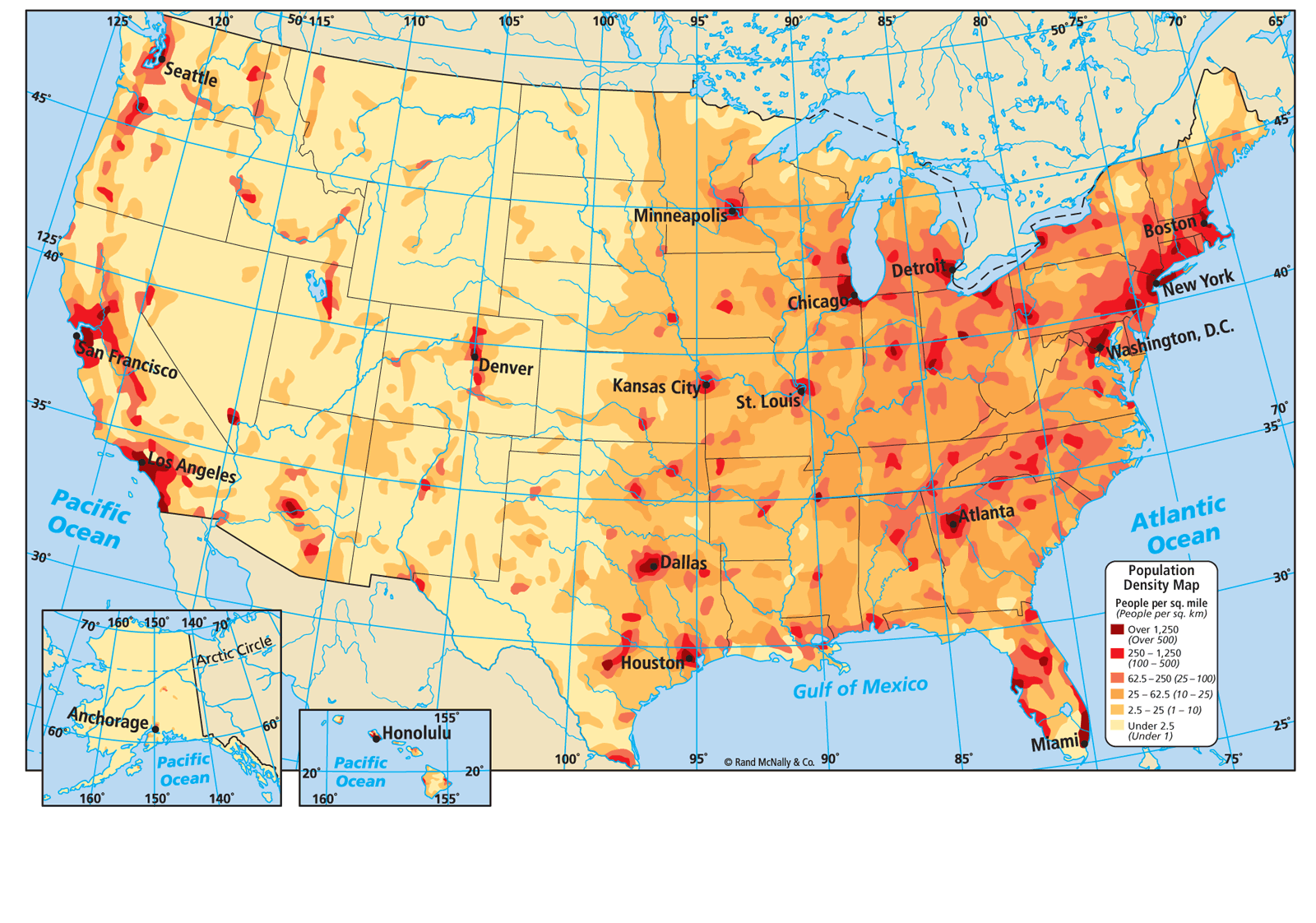
A precipitation average map shows very nearly the same distribution. (Not precisely, of course, but close.)
https://i.pinimg.com/originals/88/51/cc/8851cc3ed4f7e048b217...

in SFBA it's almost entirely either unaffordable and/or dangerously crime infested and the semi-affordable options that aren't require an insane commute.
While there are some topological issues, the main differences between NYC and SFBA are transit infrastructure + density.
SFBA[0]: 8.75m people at 859/square-mile density.
Greater NYC[1]: 23.7m people at 1,781.3/square-mile density.
[0] https://en.wikipedia.org/wiki/San_Francisco_Bay_Area
[1] https://en.wikipedia.org/wiki/New_York_metropolitan_area
When Google/Facebook moved into Santa Monica and Playa Vista, house prices in near by cities shot up like 100% to 150% in about 4 - 5 years.
https://www.google.com/amp/www.ocregister.com/2017/06/23/how...
So many aspects of our society seem forced to either-or situations when some compromise would benefit all parties more.
Land value tax, please.
Granny gets to stay in her house and the market isn't distorted by perverse incentives. A win for everyone!
Moreover, granny might be a paper millionaire based on the current valuation of a principal asset but otherwise be eating cat food.
Why doesn't she just cash out? I think the below linked blog post has some insight into how each asset of a person isn't an isolated atom but represents a structure of complements.
For example, maybe Granny can't drive and walks down to the community center every day to help immigrant kindergarteners learn to code. If she moved maybe she loses exercise and a reason to live and her lives and those of others are negatively impacted in ways money from selling a house can't fix. Or maybe, since Halloween is coming up, she is a sadistic cat killer and if she sells her house and moves the whole neighborhood is overrun with feral felines reducing everyone's property value due to fears of cat scratch fever.
http://marginalrevolution.com/marginalrevolution/2017/10/sel...
> Your feelings don’t matter
They do when the argument begins and ends with tugging at my heart strings. And I honestly don’t see these Jarvis arguments from the 70s holding up for much longer. Not when everyone else is hurting.
1) an empty lot, 2) a single family home, and 3) a 30 floor residential tower,
presuming they're equally-sized lots with equal land value.
If granny's taxes are high, the answer is to put her land to productive use like by adding rental units instead of growing zucchini. Or sell and buy better land for hobby zucchini gardening (or grow it on the roof of her new tower).
Regulations don't allow her to add rental units? Then it's the regulations that are bad, and finally land value taxes are aligning land owners' and renters' interests instead of dividing them.
Faux compassion for granny is how prop 13 got passed though, so sure, people fall for this shit.
Perhaps not in California, but it's worth noting that some places, England being among the forefront in this[0], do recognize the right to light is an important property right.
For Georgia: https://law.justia.com/codes/georgia/2010/title-44/chapter-9...
For a well-functioning market that doesn't get bothered by protests and other political machinations, the government needs to provide an easy mechanism to pay for whatever it is you care about. Any market which is restricted to folks who can afford high-cost lawyers and custom legal contracts, that market will be inefficient. Saying, "put a building-height covenant on it" in effect means "let's spend money and time on political advertisements and protests so neither of us are happy."
Compromises can only be found where all parties are to gain something. If one group are to gain something - housing in this case - and whatever they can offer will reduce negative impact to others - local residents - there is simply no compromise to be found because whatever the state of neighborhood was when they moved in, it was the best compromise in their view.
But the radius within which homeowners gain is wider than the radius in which homeowners bear inconveniences (e.g. shade on their garden). So of course it's rational for a homeowner to be pro commercial development in their city and near their neighbourhood (as it would increase demand for housing, and hence increase property value), but against commercial development near enough to affect traffic and noise levels.
While increasing property value may seem rational to probably the majority, but given certain circumstances, preferences and goals the opposite can be easily argued to be rational. With modern metropolis lifestyle of changing home every some years based on workplace location, family size, etc. one is always in the market and increased real property value is quite favorable economically. For some groups changes in property value are seen as irrelevant in face of non-economic values.
OT, but:
"Taking actions toward increasing property value are only rational with intention to put the property into market"
No, even if you intend to die in your current home, increasing property values are great if (i) you can borrow against the value, to fund current expenditure and (ii) property taxes don't go up as a result (yay California).
"lifestyle of changing home every some years based on workplace location, family size, etc. one is always in the market and increased real property value is quite favorable"
I think that depends on whether you're trading up or trading down. If you want to buy a place double the size of your current one (e.g. to raise a family), then you'd want prices to be lower. As the differential between the sale price of your existing home, and the purchase price of the new one, would be lower.
Exactly, certain things can be argued to be either advantageous or disadvantageous, depending on mindset/worldview, focus duration (long-term vs short-term goals), focus population (single individual vs average/median of population), etc. and these are core to public policy making.
And that is my point: attempts to maximize quality of life for a single individual/family for a few years naturally lead to NIMBYs. And they are not inherently wrong - annoying with different focus (e.g. median citizen after few decades), but not wrong.
Reminds me of that lady in SF who opposed a housing development recently because she said it blocked the sunlight to her zucchini garden. Now many YIMBY groups are adopting the zucchini as their logo...