"It is ironic to tell service workers that, in the name of democracy, they can’t vote for the councils who decide the zoning in any of the cities where they spend their economic lives because they happen to live across a town border."
I don't think this is a problem at all. These people are pursuing a very rational arbitrage strategy between place of work and place of living - and it is paying off for them. It is not the "service workers" who are clamoring for less regulation in trendy housing markets - it is overeducated, underemployed hipsters whose self identity is tied to living in a certain type of place and whose life script no longer accommodates the steps their parents took to climb up the housing ladder.
If fancy coffee and cute stores are so important that one would sacrifice the basic building blocks of wealth building and family stability then so be it - but I am not giving up the progressive wins of the past[1] to enable this (bad) strategy.
[1] Which, in my neighborhood, are quite profound. The Pt Reyes National Seashore, the Mt. Tam watershed and accompanying open spaces, agricultural zoning throughout west marin, etc. Remember that all of these were all achievements of the progressive left.
I agree that parkland should be preserved. But communities that preserve a lot of park land should be even more eager to upzone residential land to accommodate regional growth needs. If a city wants to preserve land from development but refuses to upzone to make the remaining housing accessible, then this is indistinguishable from an exclusive gated community and I don’t think I would call it progressive.
Edit: Also, I don’t think I agree with your “very rational arbitrage strategy” point. If my city provides jobs, amenities, and increasingly upscale housing while a town an hour away provides housing for the service workers, I don’t think the existence of the arbitraging town would reduce the moral responsibilities of the city in any way.
I'm not so much referring to upzoning which, in general, I am in favor of.
I am referring to the much more general notion that I deserve to live anywhere at prices that preserve my relaxed lifestyle and refined tastes. This is false.
I am open minded about housing being a basic human right. However, I am flabbergasted by the ridiculous notion that anyone deserves to live in any particular place.
"If a city wants to preserve land from development but refuses to upzone to make the remaining housing accessible, then this is indistinguishable from an exclusive gated community and I don’t think I would call it progressive."
You're correct. It is an exclusive community and it's not necessarily progressive in that manner. There is a place for exclusive communities and they are not necessarily negative.
This kind of thinking is what leads to insulated wealthy neighbourhoods with good schools, amenities and low pollution. If everyone with access to nice stuff thinks this way, they just push poor people into the only other areas which are left, like down near the local power plant, where the air and water and soil have been ruined.
This sort of shit is how Flint happens and how "bad neighbourhoods" stay bad neighbourhoods for generation upon generation. That is, until some investor sees an opportunity to gentrify and pushes the poor people to a new and shittier part of town if not completely out of town altogether.
I dont think i saw anyone argue that. Do you have a source?
>> (I live in Marin County, in the SFBA, and I employ quite a few service workers from Sonoma/CC/Napa counties)
How long are some of your service workers commutes?
Now image if the people living where the pipes come along, decided not to have them in their backyard..... because of democracy, they vote to tear them away.
No water for you....
Democracy can't exist without limits, otherwise you run the risk of 51% controller what the other 49% do in every way...
Zoning laws are restriction on the rights of what can be build in a property, and they should exist in a Macro scale,
Otherwise, your neighbors might decide against water pipes to come in your house, because democracy...
That's just not how the world should work. Every major city in the country gets its water and power from other areas outside their town boundry.
I presume you feel the same about power? Again, I looked up my closest major power source, and it's a nuclear plant about 30 miles away the other direction.
You realize that unless you're getting your water from a well in your backyard it's being piped from somewhere?
And the backyard well option is used virtually nowhere in the developed world, and vanishingly few places with robust economic opportunity.
They don't have natural gas lines either. Or sewer lines. You'd be quite surprised how things still are in some places.
San Francisco itself has next to no indigenous lakes or (fresh)waterways. Lake Merced, Laguna Honda, and Mountain Lake. A handful of springs. Already in the 19th century, water was in limited supply and brought in from the Peninsula. Much of San Francisco (the Richmond and Sunset districts) were sand dunes. The part that wasn't was in large part wetlands (Marina, Financial District, SoMa, Bayview).
Rainfall ranges from about 12 in (30 cm) in a dry year to about 30 in (75 cm) in wet, but that's strongly concentrated in the winter months, meaning you need a large amount of water storage for the summer (and, again: no lakes).
If you look at a population density map of the U.S., or one with higher levels of detail showing urbanisations, you note that the pattern devolves from very regular in the east to almost a desert-island scattering in the west. Much of that is accounted for by water availablility, and the water shadow of cities. Look at the map below, which shows the Colorado River, and realise that Los Angeles's watershed reaches very nearly to Denver. In many ways, it is effectively preventing any other cities from emerging throughout that region (not that several haven't tried).
http://www.ancientrails.com/wp-content/uploads/2014/10/US_Po...
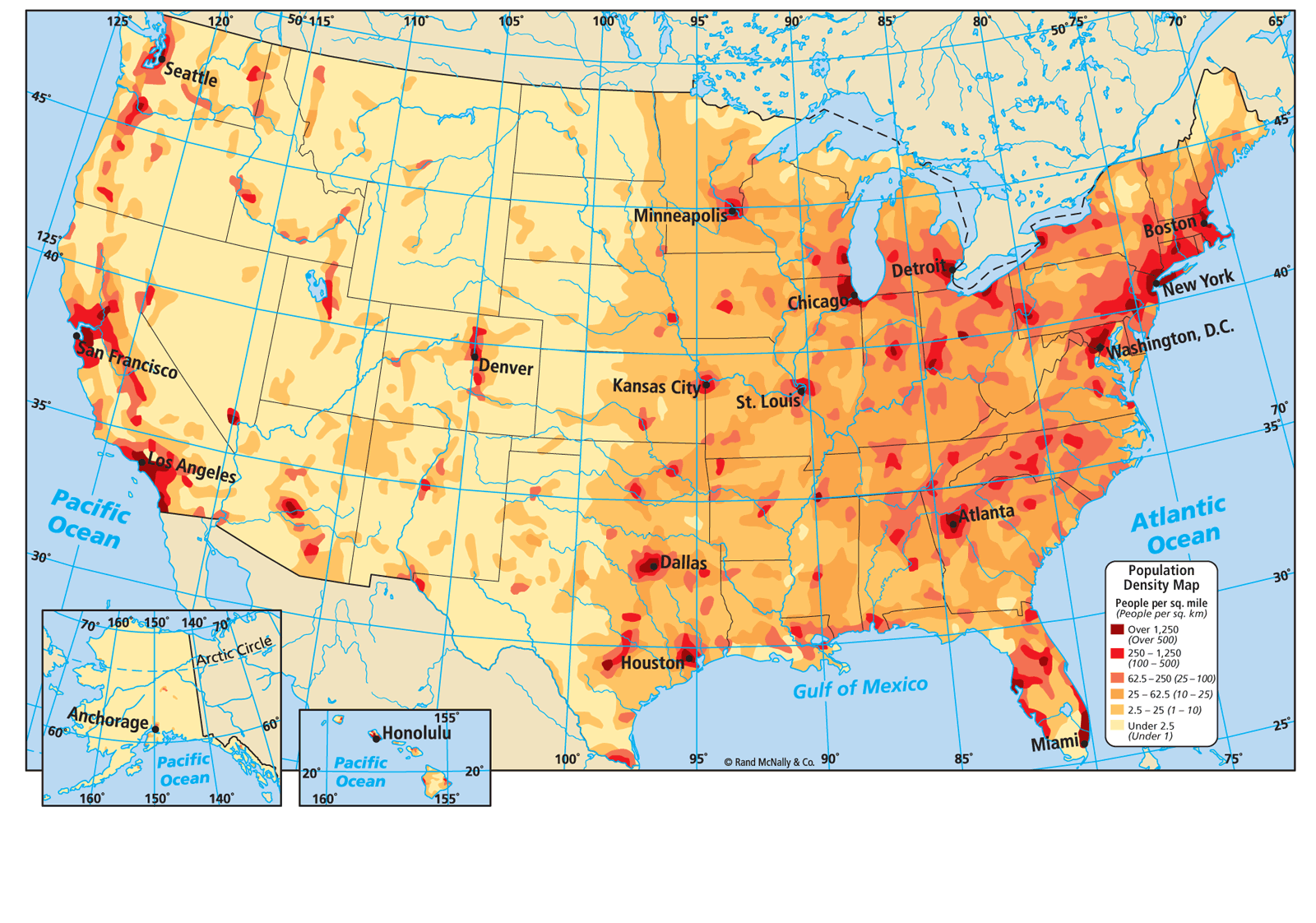
A precipitation average map shows very nearly the same distribution. (Not precisely, of course, but close.)
https://i.pinimg.com/originals/88/51/cc/8851cc3ed4f7e048b217...

in SFBA it's almost entirely either unaffordable and/or dangerously crime infested and the semi-affordable options that aren't require an insane commute.
While there are some topological issues, the main differences between NYC and SFBA are transit infrastructure + density.
SFBA[0]: 8.75m people at 859/square-mile density.
Greater NYC[1]: 23.7m people at 1,781.3/square-mile density.
[0] https://en.wikipedia.org/wiki/San_Francisco_Bay_Area
[1] https://en.wikipedia.org/wiki/New_York_metropolitan_area
When Google/Facebook moved into Santa Monica and Playa Vista, house prices in near by cities shot up like 100% to 150% in about 4 - 5 years.
https://www.google.com/amp/www.ocregister.com/2017/06/23/how...
I mean I empathize with the YIMBY point of view -- I make about $56,00 a year as staff at a state university. That's right on the edge in the bay area. There will come a time when I can no longer afford to live here. I'm OK with that. That's how the market works. I don't think you have a right to live in San Francisco, or Malibu, or Los Gatos, etc. if you can't afford to live there. Everyone can't own a Ferrari. Everyone doesn't get to live where they want to.