Ideally the application should read the system regional setting and use that. For example, my macOS uses English as language and Finnish as region. (I've no idea if the system provides an API for reading regional settings, though.)
The MacOS system, of course, provides APIs to get language and locale settings (for dates, number formatting, etc.) separately.
The JavaScript environment, on the other hand, doesn't really have any good APIs that properly separate preferred language from other things like units (metric vs. imperial), formatting dates and times, currencies, and so on.
I was hoping this would be an improvement to the state of JavaScript wrt. locales. Sadly, it looks like this build of Firefox Nightly still doesn't do dates correctly on MacOS, and this is just as broken as everything that came before it.
I have language, dates, number formatting, and everything set up just the way I like it in the OS settings, why the web/JS world just doesn't use those settings is beyond me.
You could implement the locale-less Intl.DateTimeFormat or Intl.NumberFormat such that they get the current formatting settings regardless of locale data.
The browser ought do that automatically, that it does not is the issue at hand. I was just pointing out that the Intl API does not seem to preclude implementing this behaviour, it still needs to be implemented. Which first means that it should be reported to Firefox's bug tracker (I have not seen a single link to FF's bugzilla in any of the subthreads).
It makes no sense whatsoever and the US seem to be the only place in the world to use mm/dd/yyyy excluding a few countries in Africa (and even there it's not the most popular format):
https://i.guim.co.uk/img/static/sys-images/Guardian/Pix/pict...
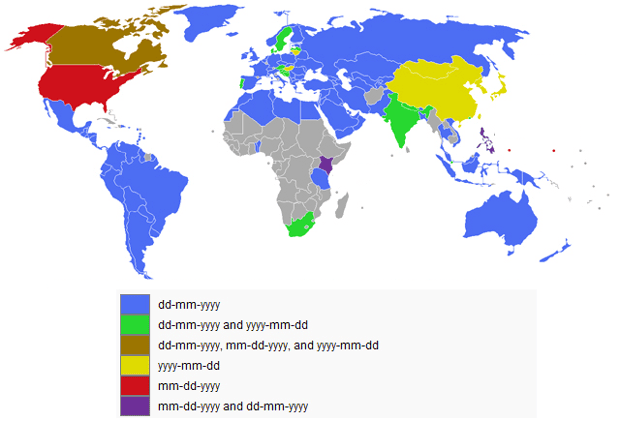
And for this reason the ISO standard is yyyy-mm-dd, big endian just like writing numbers; and it sorts (numerically not lexigraphically) properly too!
I'll dub this "the year 10000" problem.
http://longnow.org/about/ "The Long Now Foundation uses five-digit dates, the extra zero is to solve the deca-millennium bug which will come into effect in about 8,000 years."
ps.: Thursday is also Jupiter's day, so it will probably prevail on any colony / permanent human station orbiting it/it's moons.
pps.: I hope they get over the stupid imperial vs. metric divide though.. that one is really annoying.
Other formats don’t make sense.
"Dates: Put the day before the month (eg: 12 April 2001)”
http://www.bbc.co.uk/academy/journalism/article/art201307021...
Because of the way you say it in English?
" English is the official language of 32 states; English and Hawaiian are both official languages in Hawaii, and English and 20 Indigenous languages are official in Alaska. Algonquian, Cherokee, and Sioux are among many other official languages in Native-controlled lands throughout the country. French is a de facto, but unofficial, language in Maine and Louisiana, while New Mexico law grants Spanish a special status."
Nothing that you have said has explained why anybody should make a change to the date format.
If I understand you correctly, this is something I strongly disagree with. Many people are bilingual if not more, so when I have two tabs from different sites I prefer the dates to be consistent. At least on my Linux machine I want those to be driven by my locale settings, which lets me choose UK English, US English or 50 other conventions if I so desire.
I routinely run terminals with different locales set on the same screen and I would like programs started from those not get smart about locale choices but rather do exactly as I ask. Just my poor user 2c.
I am bilingual myself, and I strongly prefer each context to be self-consistent. When reading English text I find Norwegian date formatting confusing, and vice versa. I routinely have open tabs in different languages.
Why must it then be in Danish? Because we would rather optimize for Danish users who for some reason have gotten the wrong browser version / localization settings and don't know how to change it.
An English speaking user would be much better served with a dedicated English version than just the date format being correct - if they can overcome the language barrier, surely they can overcome the date format.
Otherwise the page isn't in Norwegian. This is a UX question only.
The standard Norwegian date format is DD.MM.YYYY, _easily_ confused with MM/DD/YYYY. Why is it a feature to include this confusion?
[1]: This is pretty common, either deliberately or by accident. If you actually want to serve content localized in multiple ways (eg. you want to serve both an English and a Norwegian version) you have to sidestep browser localization anyway and offer the user a way to select which version they want.
Completely agree - that should not happen. Consistency is most important. So if a Norwegian user has an en-US browser and the rendering uses this control which uses default browser locale then all date rendering in all markup has to be en-US. That is: this control can't be used on a web site unless the site already uses browser locale for all date input and output.
If the web page already has custom date formatting (e.g. the user chooses locale/format in the site preferences) or if the page has elements rendererd DD.MM.YYYY already from the back end - then this control can't be used.
(Also: TIL Norway doesn't use ISO 8601 like Sweden. I honestly thought ISO 8601 was norm in Europe, but apparently mostly in Sweden).
According to [2]: "All members of CEN[3] (all of Western Europe and Scandinavia, and most of Eastern Europe) are required to adopt the EN 28601 European Standard. Most have now done so"
It's not obvious what this really means though.
[1] https://en.wikipedia.org/wiki/ISO_8601#Related_standards [2] http://www.qsl.net/g1smd/isoimp.htm [3] https://en.wikipedia.org/wiki/European_Committee_for_Standar...
That's the difference to sweden, we'd actually us an ISO 8601 type format as our everyday format.
I read web content in several languages and expect date formats in ALL applications my application to follow my OS locale which is Finnish.
My Windows operating system is in English, yet my locale is Finnish, so that the date format is Finnish. This is the standard way of using locales. Why would web sites be any different?
Firefox serves localized downloads by default, and you can also manually get the right one (IIRC it lets you override it on the download page)
This isn't configurable (yet; I'm trying to make it configurable), but you can download a localized release for en-GB and it should work.
I can change my OS locale settings just by opening up a panel. Firefox wants me to install a new official locale or a new browser bundle to do the same.
Btw, content language is not a locale preference, it's contextual. Browsers could have a standard dropdown in their UI to change that header on the fly, sure, but that wouldn't make language selection unnecessary. Take something like Wikipedia, the contents are widely different across languages, and switching is common for multilingual readers.
See also: "you can't fix the user".
Language preferences are a totally separate thing, although they could be used as a fallback if date format is somehow not offered by the operating system. E.g. de-CH for a swiss date format, de for a german date format.
Plus there are no way to distinguish month-day to day-month in a lot of cases
Edit: If you downvote it, be nice enough to let me know what you disagree with.
The issue is not about the possibility to have a weird format, the issue is that the format is automatically adjusted to the "weird" one that a lot of people don't like, and that it is not easily configurable.
I agree, though. Browsers allow users to customize fonts and zoom levels, so the date formats should probably be a user-configurable setting, too.
EDIT: oh I see, automatically adjusted, but not configurable. Bad choice it is, then.
EDIT2: I mean, there are so many more better and easy solutions to that problem. You could display a date with a month name in the selected language - "Oct 1, 2017" - or start with a year "2017-10-01" which would be instantly recognizable by anyone regardless of the country.