Eventually customers started revolting, and now there are plenty of very tasty tomatoes available. They're more expensive, though, and not everybody can afford them. To a lot of people, cost is still a factor. And maybe even more so for export.
During my student days in the early 1990s, I started buying organic whenever possible, and organic potatoes weren't bintjes. When fellow students came over to eat, they were stunned at the taste. "What did you do with your potatoes?" I just boiled them, nothing more. (I'm a pretty mediocre cook.) They just had no idea that potatoes could taste like that. Tasteless crap was the standard. Even when people could afford better, they didn't know it existed.
Now you can buy everything every time, but even the meat is less tasty. Personally, I'd still rather buy food according to the season.
Do you have a citation for or more info about this? Were genetically modified tomatoes introduced after the war? I would have thought that came much later with the rise of Monsanto[1].
Just regular evolution with human selection still works fine, with no need to directly interfere in the genetic makeup.

It's the same reason people tell me that bananas in banana-producing countries are way better than what you can find here: our bananas ripen during transportation, and the end result is very different.
PS: it's much easier to find very tasty cherry tomatoes, but they're also much more expensive.
The Germans are extremely interesting in this respect deriding the lowest quality Dutch vegetables with all kinds of name-calling ('waterbombs') but at the same time they keep buying them because they are cheap.
If you want quality you will simply have to be prepared to pay for it, this goes for many more things than just vegetables.
Also the per capita household expenditure on food[1] is above the average of European countries. Higher for example than in the UK or Austria, which have comparable incomes.
[1] https://www.eea.europa.eu/data-and-maps/daviz/per-capita-hou...
You don't have to go far to see the difference either: Austrians and south Germans are already much more "food-oriented" than north Germans, so this may be a regional thing rather than encompassing the whole country.
I guess you're talking about various prejudices of others. But that's a whole other topic.
I think the locals wouldn't joke about themselves that way cause to them the way they are is just "normal".
And surely you've heard Berliners say that Berlin's local food tradition is the Döner (i.e. there is no "local food")? I guarantee you no Bavarian or Austrian would say that about their own food tradition.
(And BTW I have no ill will towards Berlin or Berliners, I think it's one of the best places in the world to live in)
But the quality of basic food stuff was amazing. The real black bread with honey (razowiec) at every shop, good white bread, fresh milk delivered to your door by 6am every morning, cheese, cottage cheese, butter, potatoes, tomatoes, apples. Most people were first generation city dwellers and they knew how to select good potatoes and tomatoes. And it was all dirt cheap.
Now tomatoes - imported or grown in Poland are tasteless and potatoes are just a commodity - you cannot find any tasty variations. Sausages are mostly disgusting and unhealthy - few years ago it had been discovered that multiple companies are using chemical salt (for de-icing roads in winter) in sausages. Ham is mostly water.
The comparable black bread, good cheese, real sausages etc. one can buy in fancy, hipster, organic shops but at prohibitive prices. Prices that lower class cannot afford.
The income levels in dollar term over last 30 years had grown expotenially in Poland, farms are heavily subsidies also through EU CAP.
So how can one explain that the economy cannot deliver relatively cheap and tasty basic food products (at much higher profit margins as the consumers are now more wealthy and more health conscious) - a task that ineffective, communist economy fulfilled with relative ease.
That's pretty simple: Poland is now importing a lot of stuff that it used to grow at home. And since Poland is not the wealthiest country it doesn't get the high priced quality stuff.
A lot of stuff that worked under communism does not work equally well under capitalism until a long period of leveling has passed. And on that front Poland has done exceptionally well compared to some of the alternatives, even so there is still a long way to go.
Incidentally, I lived in Poland before the wall fell, and of course what you should add to your story is that if tomatoes were available they tasted better, but they really weren't available all that often.
Isn't over 30 years of market leveling enough in case of tomatoes? If the choice is between growing tasteless tomatoes or importing similarly tasteless tomatoes then I am under impression that market isn't working well in that case. At least not for a consumer.
If you are telling me that growing tasty tomatoes at large scale is absolutely impossible under capitalism then I will cry "Komuno wróć" :)
The article that started this discussion is about super modern technology used in farming. It reminds me of old joke about modern farming in USSR - they plow with tractors, they sow with airplanes and they watching bread on TV.
I always think of us as having two eyes, two ears for stereo vision and sound but never think of us as having 'two noses' to determine the direction of a small or two different smells at the same time.
Doing that in supermarkets here is also looked upon as a bit weird. But I don't care, I prefer to look weird and eat the best tomatoes ;)

They won't beat summer sun grown tomatoes in warmer climates, but they're available all year round.
A bit of sugar and a bit of acidity can boost the flavor of sub-par tomatoes, for example for a sauce.
- smell them. Smell is part of flavor and also correlates with the other parts of flavor. Odorless tomatoes are 90% of the time tasteless
- choose tomatoes which are still attached to a part of the plant when possible. They keep their flavor a bit longer.
And then this gets exacerbated when the varieties are selected for shipping and shelf life rather than flavor.
Unfortunately, many people are okay with this and expect it. I honestly can not imagine Netherlands farmers and engineers unable to simulate that stress. So its a purely lack of customers knowing the difference.
Fungi-Symbosis: http://orgprints.org/12844/1/12844.pdf
But yes, i was wrong on the water tomato. They simply have been bred to look good and be transportable, disregarding taste.
US greenhouse tomatoes are generally bland and watery too.
My garden tomatoes got severely damaged by some fungus this year and barely produced and I'm still not at all tempted to buy store tomatoes.
Tomatoes from the Netherlands are almost always tasteless.
Tomatoes from Spain are often tasty, but sometimes tasteless.
Tomatoes from Morocco are sometimes tasteless and sometimes horrible.
So I look for Tomatoes grown in Spain and wish for the best...
There is a huge difference in taste between in vine ripped tomatoes and the one they are picked up still green.
The northeast US has the same problem. Tomatoes in California are usually pretty good, tomatoes in Boston taste like crap. (the joke is that Boston is the last stop for a tomato truck, before they get thrown in the ocean as trash).
Here's what they look like: http://www.desteptarea.ro/wp-content/uploads/2017/03/rosii-p...
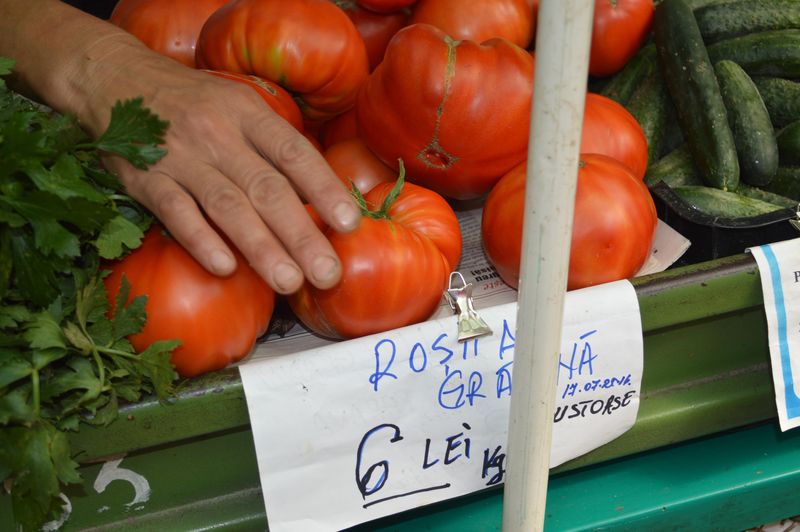
Note: 6 LEI (RON) is 1.2 GBP, but can find them as cheap as 0.8 GBP, depending on the city, market or seller.
The problem is that I don't think we produce enough of them for export as they're only grown naturally, they don't last more than a few days, even when in the fridge, and they are seasonal. Households tipically pick them as they ripen for immediate consumption, sell any surplus on the local markets and, by the end of the season, harvest them for around 10 gallons of tomato juice for winter.
The countryside folk also lack the education to seriously market them, lack the money to produce in larger quantities, etc. Which leads to supermarkets being chock full of import tomatoes though (we also have the Dutch ones) :/
Actually, most vegetables seem to be a lot better in Spain. And I tend to go for the best quality organic veggies I can actually buy in Belgium.
https://it.wikipedia.org/wiki/Pomodoro_cuore_di_bue
https://www.youtube.com/watch?v=Y-j3ZxGnMC8
#foodporn
In next door Albania they are called "Zemërkau", which it translates "cuore di bue". Very delish, and fortunately local farmers like to grow them for themselves, so you will always find cheap good ones during the season.
The reason they are really good as they are the most similar to the original wild tomatoes, and less likely to have been modified just because their color and shape as most grocery common tomatoes are.
I've had amazing tomatoes of this species, but I've also had many watery ones...so I'm guessing the greenhouse-to-supermarket waterbombing effect is more important than the actual species.
the Vorlon is also very tasty
OTOH, if I buy the $5-$6 per pound heirloom varieties, the flavor is better.
even better: tomatoes grown in people's backyards.
Best tomatoes I've ever had were indeed grown in a backyard. In volcanic soil.
Unfortunately that's not a particularly efficient way to farm and also fruit is only available in season this way.
It's also common for cows to graze outside for part of the day (true of Ireland and Sweden too). It's subjective, but I think it makes for much nicer tasting fresh milk (compared to the UHT variety that is more of the norm in other European countries).
I'd read even as a kid, in English novels, that greenhouses were somewhat common in the UK. Do tomatoes not grow well even in greenhouses there?
I feel like the UK supermarket industry took The Paradox of Choice too seriously.
The UK produces more varieties of cheese (about 700) than any other EU country. A lot of that is from small independent producers. Obviously, you'll find a narrow(ish) selection at the supermarket, but it's pretty easy to find a wider variety from specialist or online retailers.
I speak as an Irishman who had a terrible time merely finding decent bread when I moved here (there is zero good soda bread in any British supermarket, I actually imported and froze mine for the first few years, then I went the bread maker route, until I made my peace and stopped eating bread at home), with a German partner for the past ten years who feels even more strongly about it than I do.
I am asking because I've moved back/forth a couple time between the US and Canada, and tomatoes made in the USA or central/south America are tasteless in the US. When I see tomatoes made in Canada in a US store that's what I buy, no matter what the price is, organic or not. Savoura is the brand that I prefer, but then again, I am not sure it is Canadian, and they make it all over the world and it taste different depending where they come from...
So they're plentiful and cheap, but generally lack flavor.
I think this also comes down to the trouble with transporting those types of tomatoes without loss due to spoilage.
The tomatoes you describe are exact the same as tomatoes sold here in Australia.
These Australian tomatoes have been genetically selected for characteristic that allow them to be picked green, ripen on the way to the supermarket and hit the shelves blemish free.
They look great on the supermarket shelf but their skin is as tough as nails and they pretty much tasteless.
The only
Interesting, as the Netherlands would be closer geographically! But maybe the UK is just far enough from the south-med to make shipping vegetables from there not as economical.
1. Homegrown (in good soil) 2. Italian 3. Albanian (heirloom) 4. Spanish
Smaller, darker and more aromatic are generally better (cherry a good bet), and they're all best in the summer. Did I forget anything?
http://www.seriouseats.com/2016/10/why-you-can-and-sometimes...
Unfortunately, they are quite flavourless. The type of tomato (and price) makes no difference (organic, vine-ripened, salad). Most of them are usually semi-ripe. Even if you allow them to ripen at home for a few days, they are still quite tasteless.
Presumably, Italy keeps its best tomato produce for themselves and I don't blame them (although Italian tinned tomatoes are widely available in the UK, just not the fresh variety).