https://www.documentcloud.org/documents/3914586-Googles-Ideo...
I strongly believe in gender and racial diversity, and I think we should strive for more. However, to achieve a more equal gender and race representation, Google has created several discriminatory practices:
- Programs, mentoring, and classes only for people with a certain gender or race [5]
- A high priority queue and special treatment for “diversity” candidates
- Hiring practices which can effectively lower the bar for “diversity” candidates by decreasing the false negative rate
- Reconsidering any set of people if it’s not “diverse” enough, but not showing that same scrutiny in the reverse direction (clear confirmation bias)
- Setting org level OKRs for increased representation which can incentivize illegal discrimination [6]
These practices are based on false assumptions generated by our biases and can actually increase race and gender tensions. We’re told by senior leadership that what we’re doing is both the morally and economically correct thing to do, but without evidence this is just veiled left ideology[7] that can irreparably harm Google.
I've seen smart people pointing at 'evidence' on both sides of the discussion. Your claim that can 'irreparably' harm google is equally baseless IMO.
let me know what industry you work in where you can poison the well so badly and not get canned.
Policies that are effectively affirmative action are by definition lowering the bar for diversity candidates. His statement that it can lower the bar is correct but still not something people like to be reminded of. Google (and others) not recognizing this distinction and treating his lack of discretion as hate speech is irrational mob PC rule or just plain cowardice (if he was fired for PR reasons).
In an n-dimensional space where we take into account all the factors that go into whether or not a candidate is given an offer, you're actually complaining about "lowering the bar" when the bar is already lower for people (for people that's not being targeted for affirmative action) due to systemic effects? You're actually complaining that we're lowering the bar by tweaking other variable so that the bar will be effectively the same obstacle for everyone?
Please explain your rationale for doing so.
Or sued, seems like this would be an easy basis for a hostile work suit. Couple promotion denials, a documented complaint and this manifesto would probably be an easy lawsuit, though INAL.
Then maybe you should just not make that assumption and work with them as a peer?
> or if your referral would have still gotten rejected had they been a person of color
This is utter bullshit. As someone who used to work for Alphabet, gender and ethnic background never came up during interviews, simply because the interview process does not account for that. You are either able to solve the technical problems you are presented with during the interview or not. "Culture fit" - which is the one item that might be influenced by things related to gender or ethnic background - is actually a liability for minority groups.
> Then maybe you should just not make that assumption and work with them as a peer?
Sorry, forgot to mention that I'm a human in my post.
He knows them. Everyone knows them. The average Alphabet employee does multiple interviews a month, sometimes multiple interviews a week (complaining about how many interviews you have to do is of the favorite pastimes in the company.) We are trained for this, and - surprise - none of the training says (or even suggest) 'you should lower your standards for minority candidates.' In fact, none of the interviewing training even mentions gender or ethnicity.
I feel that this guy is coming from a disgruntled conservative-leaning position where he feels the company values don't represent his. That's a valid concern, but there's plenty of companies out there. He should just leave and find one that has values matching his.
> This was not the case at the company I worked for and it was a very negative thing
That's sad. Hope you had better luck with the next one!
> Sorry, forgot to mention that I'm a human in my post.
Sorry, didn't meant to be offensive. I just know intrigue (which this memo tries to stir up) is the shortest path to a dysfunctional workplace.
People should feel free to exercise their voting privilege.
This has nothing to do with the company, but rather with the individuals working for it. How many people, do you think, felt free to discuss their support for a Democratic candidate in the Alabama?
> People should feel free to exercise their voting privilege.
And they did! Heck, Google encouraged everyone to vote, not just Democrats. Maybe your anger should be directed to the companies and governments that did their utmost to stop their own citizens from voting. North Carolina is a good place to start, move South from there.
I'm sure you could imagine walking in with a Hillary/Pussy Hat no problem whatsoever. But you would not walk with a Trump hat even as a joke. Ok, maybe in Moncks Corner or some boonie office.
Please stop trying to bring the "librul intolerance" right-wing talking point. It's pretty pathetic to paint yourself as a victim, even when you have everything in your favor.
On to voter fraud!
    But those numbers likely don't indicate
    anything nefarious like widespread voter
    fraud. It's actually pretty common for
    voter rolls to be a mess. In fact,
    Judicial Watch threatened to sue 11 other
    states in April for the same reason.

    A 2012 Pew Research study found around
    2.75 million people were registered to
    vote in multiple states and more than
    1.8 million deceased people were still
    registered to vote.

    Oftentimes, people don't realize they
    need to notify local voting officials
    when they move or when a loved one dies.

    But outside of a few isolated incidences,
    those extra numbers don't generally lead
    to voter fraud.
Q: How big a problem was voter fraud in the 2016 election?
A: There have been just four documented cases of voter fraud in the 2016 election https://www.washingtonpost.com/news/the-fix/wp/2016/12/01/0-...
Carter won in '76 and it's been within +-10% R/D till 2000. So not that lopsided as you might suppose.
"Hiring practices which can effectively lower the bar for “diversity” candidates by decreasing the false negative rate"
Lowering the rate of false negatives does not lower the bar. If anything, it just improves the process and yields more qualified candidates. If you increase the rate of false positives, then you would in fact lower the bar.
It's muddled thinking like this that makes me doubt his ability as an engineer, not to mention his ability as a social scientist.
Edit: Another way to say this is, if an applicant simply meets the bar, the person is most likely not hired. Conversely, an applicant needs to far exceed the bar in order for interviewers to vouch for the person and improve odd of hiring.
On the other hand, applicant that fits into the targeted demographics are probably afforded additional consideration, even if the person's interview did not wow the interviewers as much, hence the "lowering the bar" argument. It is not lowering the standard bar, but rather the "score", if you will, the applicant needs to clear the bar.
The best analogy I've read so far is that the candidate's score and its error bar must clear the bar. But affirmative action applicants are extended the courtesy of second look, which reduces the error bar, hence lower score is needed for the score and error bar to clear the Google bar.
Well now I just doubt his ability as an engineer, social scientist, and writer of the English language... ;)
> Hiring practices which can effectively lower the bar for “diversity” candidates by decreasing the false negative rate
> decreasing the false negative rate
(Again! This is from his POV): The false positive rate has not gone up. The diverse candidates are, in fact, qualified and should have their jobs. They are excellent. I am going out of my way to make sure no one interprets this deluge of text as me questioning my peers ability; something that I will fail at in spectacular fashion.
> lower the bar
(His POV don't pin this on me): However, diverse candidates may now have a lower bar than non-diverse candidates.
How is it possible that some candidates have both a "lower bar" and yet are still qualified?
> Hiring practices
(still his POV folks): Because for diverse candidates we have different hiring practices. Practices which are tailored to diverse candidates. It's not a lower bar, it's a different bar. A bar specifically designed to help us discover the best side of these diverse candidates.
(Speaking for myself now): I think the author is saying that going out of your way to create specific affordances for _some_ and not for _all_ is discriminatory. I _don't_ think he's a horrible monster for thinking this. I _do_ think that this way of thinking fails to acknowledge the fact that an organization that is already steeped to the brim with a specific group of people is likely to _already_ have built in affordance for that group.
He fucked up. Hard. Like so hard that I find it kind of funny (wtf was he thinking?). I, personally, don't think that the ideas that he espoused merit firing, I think they merit careful correction wherein the person doing the correcting attempts to read his meaning charitably, carefully, truthfully and fully. I feel that most of the public responses have failed in this regard. Most of what I've seen start with "he's basically wrote: {$straw_man}". Some are pandering to an audience, some are more interested in winning than in being right, but some people who retort in this way just have limited time and patience. I can understand why the straw man is appealing. I've just written three paragraphs about a single sentence, who has time for this shit?
Here's the thing though, careful correction, truth, charity—that's my "ideal world" case for him. The simple matter of fact is that Google is not the ideal world, they have no incentive to apply my ideal to him. He's a professional and the fuck up alone (separated form the ideas) represents enough potential harm to Google that he had no hope of keeping his job. Maybe one of his friends can give him the careful walk through of how his ideas are flawed. Hell, maybe a good friend will do that and he'll decide that he was right all along.
Edit: After further reading I realized I had made a mistake when I (speaking from his POV) said: "it's not a lower bar, it's a different bar". He did actually use the words "lower the bar", something I failed to fully account for. One could, with liberal amounts of charity, imagine that he meant that the bar was lower but still sufficient? We're getting into logical acrobatics. That said, logical acrobatics are part of the point. The goal in reading someone whose world view is different to your own is to better understand their logic. To imagine how, within their world view, their ideas are consistent. We could be reading the words of a monster who doesn't care about logic. Or we could, and I think this is much more common, be reading the words of someone with flaws and ignorances and prejudices. Someone not so unlike ourselves.
Slavery and Jim Crows laws no longer on the books? Therefore there is no systemic racism!
Are there laws discriminating against women? No? Therefore they have all the same opportunities as men!
Why are Black Entertainment Television and Gay Pride okay, but White Entertainment Television and White Pride not!
Black Lives Matter is Racist!
Not all Men are Rapists!
This essay started from precisely this set of emotions and found data to justify it after the fact.
Did you read the essay? He certainly did not make that claim. Population averages are not statements about individuals. This is pure censorship.
I also sometimes think about topics that would be inappropriate in an office environment (such as sex) and I censor myself by not saying what I am thinking. We even have an Internetism for that concept - NSFW.
None of this is new - we are expected to conduct ourselves appropriately for the current situation. It's just how society works.
I didn't even read the document in question, I just have a very hard time with people getting riled up about being "censored" at work. It's work, what exactly do you expect?
Regardless, your clever analogy doesn't apply. Companies are welcome to be political in their own environment. They own it. Employees are not. They're employed at-will.
Anyway, the financial benefits of diversity are almost certainly overstated. I don't know why we can't just say, "we're hiring diverse people because we think it's the right thing to do".
As a society we've been trained or perhaps tricked to suppress our sense of justice and fairness In Gabor of money.
Hence the studies promoting the idea that diverse companies are more profitable, as if that should make any difference. It's a sick obsession with viewing just about everything through a financial lens even when money shouldn't come into it.
However, I sympathize with younger people because it's a double-edged sword at places like Google, where your work and your life are very intentionally blurred. You eat breakfast, lunch and dinner at work. You go out and socialize with your friends from work. You do laundry at work (I'm not sure if Google still does this or not). It's not like the 1980s where people check in at 9am and leave at 5pm.
Then why are you assuming you know what it said?
---
I did skim it and it seemed like the pseudo intellectual mumbo jumbo people who think they are being really smart but really are just being obnoxious write; since I read way to much of that sort of thing already I didn't care to read further.
This is the kind of behavior that woke me up (in my early teens) to the dangers of adopting my values from my religious background/peers. I never thought I'd have to deal with witch hunts for wrongthink in tech.
> I strongly believe in gender and racial diversity, and I think we should strive for more. However, to achieve a more equal gender and race representation, Google has created several discriminatory practices:
> * A high priority queue and special treatment for “diversity” candidates
> * Hiring practices which can effectively lower the bar for “diversity” candidates by decreasing the false negative rate
^ Isn't that exactly what the author is saying?
He says that Google 'has created' (past tense) a discriminatory hiring practice.
Presumably his coworkers were hired in the past and not the present or future.
Thus, the hiring practices that prevailed when his coworkers were hired were discriminatory, per the author.
I believe that everyone should have a fair shot at a good career. I can't even begin to talk about how that is not the case in America - if we disagree here, I'm not sure we'll ever come to agreement.
It's not clear that the workers favored in this alternate pipeline are incompetent (which is really the implication that everyone is making). What is clear is that people with their perspectives are not as prevalent in the technology field.
Perhaps companies are recognizing a) the value of multiple perspectives or b) the structural difficulties that deny some people the same 'fair shot' we all have.
I'll leave you with this. The SAT should be a test of one's aptitude, perhaps readiness for college. If some individuals receive years of tutoring, but others have to go to the library to get test preparation, is our metric for college readiness fair? Maybe you'll say yes, but if we were talking about any other thing (cars, experimental models, you name it) we would clearly recognize these two groups had different pre-test levels of preparedness.
If you look through my post history, you'll see that I made this account to talk about another article about a week ago.
EDIT:
I can't respond to you, unfortunately.
I'm sorry we've resorted to name-calling - however, I stand by my earlier statement. Irrespective of your identity, there has been a noticeable trend of discussions about 'reverse racism'.
I have not referred to you with a pronoun nor made any mention of your race/sex/anything else. I apologize if you feel that I did this.
On a totally separate note, thanks for assuming my gender, race and minority status. Also that of whomever wrote the Google piece. You are doing a really great job making yourself seem like less of a bigot.
If you must spew hate, could you at least choose a more interesting criteria than skin tone or genitals? These have been done to death.
No, it is not censorship. He can say those things. He just can't pretend to be an effective team member if this is what he believes about his coworkers and he is unwilling to learn from others.
For some, it's simply a critique of ineffective hiring practices.
For others, it's veiled sexism dressed up with statistics to lend it an air of legitimacy.
Seen that way, this is a pretty interesting social science experiment, albeit at the expense of his job (if not his career)...
But that's the point of being more cautious at work than you are in your personal life. You don't know how people will react. Most people are uncomfortable even identifying their choice of political party at work.
What about the behaviour before / during / after publishing it?
What kind of post-truth, post-logic universe is this? I want off this fucking planet.
I understand you would like to live somewhere that context does not matter and documents are self-contained.
Until you live in that world, please consider that there is an external world relevant to what an author's intentions are, whether they are lying or exaggerating, whether they are deliberately misleading or naively misinformed.
Does he have good intentions or bad intentions? Well, you would want to look at the other opportunities available to him to reason about that.
"This is what he believes about his co-workers" You: He did not write this
If he did not think that the performance of the women around him was holding back Google, then he wouldn't write the memo.
Can you give an explanation of how this was the best choice available to him if he did not think this was the case?
"He is unwilling to learn from others" You: He did not write this
Is it your position that he did not have any options for taking his opinions to others inside the company and getting feedback before circulating broadly?
He knows that this is sensitive - that definitely gets mentioned in the document - but there is no indication that he has gone to the people responsible for diversity policy to discuss the intentions, metrics or organisational concerns that shaped the policy.
If you don't know the functional and non-functional requirements for a system, you should find them out and if you disagree go to the stakeholders. Choosing not to do so is not high-performing employee behaviour in any organisation.
Come on now, which one do you think he believes? He made it pretty clear, clear enough that pretty much no one would want to work with the dude.
That’s in his own words, and I would have fired him a hell of a lot faster than Google did, because I will not have my team disrupted by a prima donna.
> Hiring practices which can effectively lower the bar for “diversity” candidates by decreasing the false negative rate
The author deliberately narrows the scope of this sentence stating that the hiring practices decrease the false negative rate, not increasing the false positive rate. Stating that the false negative rate is lowered for diverse candidates is to say that qualified, non-diverse, candidates are rejected at a greater rate than qualified and diverse candidates. It is not stating that unqualified, diverse, candidates are accepted at a greater rate.
"...decrease the false negative rate, not increase the false positive rate."
The interaction between type I and type II errors virtually always have an inverse relationship. You cannot decrease one without increasing the other. It is, for example, one of the difficulties in making good medical diagnostic tests.
without dumping in a lot more money or w/e...
The final hiring decision is almost entirely entirely on the on-site interview, the phone interviews essentially act as a first-pass filter. And we don't do any sort of weighting of diversity in the final hire decision. From my experience, the phone screen has the highest false-positive rate. In this system the false negative is reduced considerably for diverse candidates, while the false positive remains mostly the same (since the on-site is pretty rigorous).
For what it's worth, while I can understand the author's opposition to this system I think it's an okay way of increasing diversity. I don't think this system has ever caused us to take on a diverse candidate of insufficient skill or experience. Does it mean that non-diverse candidates get filtered out on the phone interview step at a higher rate? Yes. But not so much that I'd consider it an issue - and this is coming from a (mostly) non-diverse guy. And while it does cost the company more money, in the sense that we spend more time interviewing some candidates than we normally would, it's money well spent.
Sure, maybe he's saying that the bar for white/Asian men is higher than intended rather than that the bar for women and minorities is lower than intended, but you can't honestly argue that he isn't saying that women and minorities could be clearing a lower bar than white/Asian men.
This is not necessarily the case. This is a vast oversimplification of a tech company's hiring process, but for the sake of simplicity let's say that phone interviews have a 50% rate of generating a false negative and on-sites have a 0% error rate.
Say a company does one phone-interview, and if passed, moves on to on-sites. But for diverse candidates they do two phone interviews and if either passes they move on to on-sites.
* Unqualified candidates always fail, since neither phone interviews or on-sites have a false-positive rate.
* Qualified non-diverse candidates have a 50% chance of getting the job.
* Qualified diverse candidates have a 75% of getting the job.
At no point do any unqualified candidates receive offers. But at the same time, qualified non-diverse candidates are still rejected at twice the rate as diverse candidates.
The "bar" so to speak isn't always something that people have a higher chance of passing the better their skills are. A working knowledge of data structures and concurrency is all that's necessary to pass all of my company's coding interviews. Practice and luck is probably a greater asset than skill in many interviews. But getting into the efficacy of technical interviews is opening a whole 'nother bag of worms.
If I've understood that correctly I really appreciate your effort in explaining it. Your comment should be higher so more people could see it :)
Also, if I understand you correctly, the phrase "lower the bar" might have gotten him fired for something he wasn't intending to say.
I also agree with your point around phrasing. I agree that lot of people took away the wrong meaning due to the phrase "lower the bar" (which is a very loaded phrase). This piece probably could have been better received if the author sought out proof-reading with trusted co-workers and friends beforehand. In particular the author should have:
* Dropped the awkward and monolithic generalizations of "Left" and "Right" at the beginning.
* Stayed way the hell away from talking about biological differences, just say that men and women have different preferences for working hours, fields, etc. and don't touch on possible causes.
* Don't emphasize on the benefices diversity initiatives have on diverse candidates, but rather the possible negative effects for the group as a whole. The point about OKRs contingent on hitting a certain percentage of diverse team members turning hiring and transfers into a zero sum game was actually a really good point that potentially hurts diverse groups themselves by limiting cross-team mobility.
* At the end, don't try to turn this into a Conservative vs. Liberal issue. Just point out that affirmative action is not nearly as uniformly supported as people make it out to be. For reference 42% of the population opposes affirmative action for race in the workplace, and 33% for gender [1].
[1] http://www.gallup.com/poll/184772/higher-support-gender-affi...
* Mentioning of left echo chamber was pandering to the right. And he got huge support form right leaning and centrist media and personalities.
* Biological differences he mentioned were sourced, so not his personal opinions. He knew this will trigger outrage from pro feminist camp that will start witch hunt against him, based on unproven accusations that he holds misogynistic beliefs.
* Emphasize on the benefices diversity initiatives have on diverse candidates, was another passive aggressive attack on one of SJW/PC/regressive-left sacred cows.
I dont really know if he planned this, but if you spend any time following anti-SJW sphere, then you should agree that reaction was totally predictable.
Basically he just said that google created environment where people who dont perfectly align with left leaning echo chamber agenda (here he was pandering to anti-SJW anti-PC / centrists, conservatives...) cant safely express their opinions anymore. And he was fired for doing exactly this. Proving his point on himself. Google HR had two bad choices, not fire him and cause outrage among many of their left leaning (snowflakes); or fire him and prove his point that they re indeed left leaning echo chamber.
I base my speculation on fact that he put his full name on memo, instead of pseudonym and this quote:
> Damore plans to sue Google; he had previously complained to NLRB and wants to argue that his dismissal was a revenge which would be illegal. See a Damore's defiant answer to Reuters.
If he wants to argue that Google should lower the false negative rate for men too, I am totally on board with that! They should lower the false negative rate for everyone. They are bad at high-signal interviewing.
But the meaning of the phrase "lower the bar" is that less-qualified people are being let in, that people are being held to lower standards, etc. The entire point of the phrase "lower the bar" is to convey that the bar should have been be left where it was.
Honestly even if he wrote something like "Hiring practices which are more likely to improve outcomes for individual 'diversity' candidates by decreasing the false negative rate" I'd have much less of a problem with it. (I called out this specific sentence on Twitter yesterday; it was one of the things that particularly bothered me about the document.) But he used words with a specific meaning.
If he used words by mistake that his colleagues reasonably interpreted to mean that he thinks they're unqualified, that's all the more reason he shouldn't have his job. At a company at the scale of Google, a huge portion of effective engineering is effective communication.
The copy on the documentcloud link floating around this thread shows that "effectively lower the bar" is a link to an archived thread from the internal Google Group "coffee-beans-discuss".
I am curious if that post, or a summary thereof, has been leaked: I find the use of this phrase just baffling and technically incorrect (in addition to being insulting) and it seems like the author did have some specific intention here. Is he quoting someone else who's arguing that false negatives "effectively lower the bar"?
You should read what he wrote more closely. He said that Google was creating hiring practices that "lowered the bar by decreasing false negative rate." That last bit is important because it fundamentally changes what he's asserting and means you've entirely misrepresented what he was saying.
Anyone familiar with the Google hiring practices knows that, unless you're famous to some extent, there's an element of luck to getting hired. A lot of qualified candidates get rejected because Google just gets a lot of applicants and they can't hire everyone that's qualified. Those candidates are the false negatives...people they could have hired without making a mistake but didn't.
What he's saying is that while a white male needs to be qualified, pass his interview and not be one of these false negatives, the minority candidate just needs to be qualified and pass his/her interview. That is a lower bar for entry, but it isn't what everyone is accusing him of having said...that his minority colleagues aren't qualified or are less qualified. They still passed all the merit parts of the process, they just never had to undergo the arbitrary part of the process that non-minorities are subjected to.
argumentum ad populum [1]
> In it effort to save myself some time (seriously, you're asking me for about 20 minutes worth of work)
Making a worthwhile, intellectual contribution to a public forum should take more than 20min of work/preparation. Being familiar enough with the contents of the paper to make an informed arguement should mean that you could easily pull quotes (maybe with ctrl+f to save time) in less than a minute. Especially when your comments have the potential to destroy someone's reputation/career.
> Also, do the other replies to you make things a little clearer? Please keep in mind I'm not trying to be passive-aggressive
Congratulations, you can make fallacy ridden, condecending, and harmful comments without even trying!
> I come from similiar intellectual stock to you.
Irrelavant and you most likely do not.
> That's why I'm in disbelief that you need pullquotes and an explanation to tie them together, I'm sure it'll click for you without that.
argumentum ad hominem [2]
I know it's easy to write off when someone pulls up latin fallacy names, but please do read those wiki articles. Formal arguementation is important. Your reply to me was disrespectful and added absolutely no value to this thread.
He believes neither. We don't need to speculate, because the author writes quite deliberately to communicate his point. Here's the quote you're likely referring to, the one that mentions "lowering the bar":
> Hiring practices which can effectively lower the bar for “diversity” candidates by decreasing the false negative rate. (emphasis mine)
The author is not stating that Google's hiring practices result in unqualified diverse candidates receiving offers at a higher rate than non-diverse candidates. The author is stating that a greater portion of qualified, non-diverse, are being rejected. In other words, the author is not stating that diverse employees at Google shouldn't be there. Rather he's claiming that there are a substantial number of non-diverse candidates who should have received offers, but didn't.
It looks like the author is talking about setting a threshold, as in the context of creating a test. Please have a look at [1].
In this setting, it is not possible to decrease the false-negative rate without increasing the false-positive rate. I think the author is phrasing things this way simply as a matter of rhetoric, not to express the point you are suggesting.
Are you saying he's wrong for pointing out that Google has affirmative action policies? Or that the policies themselves are bad? I don't understand.
I'm really having trouble finding anything to be upset about in his "manifesto". He's literally being fired for trying to start a serious conversation about a delicate issue.
We have numerous studies which how simple biasing factors, such as a person's name, can dramatically decrease interview rates.
Arguing against diversity policies can be coached in the language of equality, but the objective results show that the outcomes would not be.
The outrage, fairly or unfairly (it is impossible to know what's in a person's heart) comes from many readers believing that the person is not arguing for equality, but coaching an argument against it's outcome in language that assumes that goal.
For many people, they see a cheap rhetorical trick made in bad faith.
At worst, if you can read his mind, it was cover for his conscious motive to discriminate against women but I really don't believe he knows it.
The thing is, if you don't believe those assumptions, you will view the the unconscious bias and diversity programs as discriminatory. And many people don't believe those assumptions. They see companies discriminating against them and they don't like it.
There are not "assumptions" at this point. They are a factual reality.
It's a fairly common tactic inside of the RedPill community, and within White Power/Pride groups. Arguing that by fighting sexism/racism you are being sexist/racist.
He very explicitly is arguing that policies designed to correct the natural state are sexist/racist on their own, and have to be discarded.
He then hints at having a strong bias towards believing sexist/racist conclusions from a limited reading of a limited amount of information.
These are complex issues that will take decades to fix starting with programs at the elementary school level and fundamental shifts in the messaging and feedback our society gives to children, young adults and all the way up to college students. And yet people are expecting Google to make significant progress on the issue within a couple of years. It's not really a realistic expectation to have of Google, but there are real market consequences for Google if they're seen not to care enough.
Google can make it look like they truly care about it and are solving it, but only if people don't look too closely or start pointing out flaws. This manifesto is an exercise in looking too closely and pointing out flaws. Whether his points, themselves, are flawed or whether they have merit is entirely beside the point.
he'd have been better off if he said
> "we should expect to see people with certain characteristics in tech, in the same way we see people with certain characteristics in race-car driving. that's no reason to discriminate positively or negatively against race car driver candidates."
I think he did make a point similar to that. Unfortunately he stirred the hornets nest (most, I think) by pointing to the gender-wage relationship.
It could have been a forwarded email instead of a Google Doc. Who cares? Same difference.
in fact he pointed directly to the flawed logic that supports them.
poor guy had no idea what was coming.
you're saying he was putting it forth, or addressing it?
I've come across a few people from these companies and it's not that hard to come across people who have strong biases against whites and white men in particular. Sadly it's become a way to signal you're in the in-group.
Diffusing hostilities isn't achieved by becoming the thing you're trying to overcome.
A minority can complain about a majority, but the reverse is frowned upon. The amount of "frowned upon" is amplified by the degree to which the minority the majority impugns has been historically hurt by similar opinions.
See: dynamics of older and younger siblings.
The idea "well, no one can punch!" is rhetorically clean, but pragmatically problematic. There is a long history of people who had to punch up to break a ceiling that should never have existed.
So, while it looks like punching up, having a group "punch up" at someone is actually punching down at an indiv.
But it's near impossible for a collective group of people to perfectly balance their outrage in just the right way, at precisely the right people, for exactly the right amount of time.
We just accept the tradeoff that progress is messy.
You see massive disconnects.
But still, people "punch up", and progress gets made.
Assuming a person's privilege based on race, gender or other immutable characteristics is imprecise and counterproductive.
You don’t have to “lower the bar” at all, because it turns out that the average “bar” is the wrong standard for anything but the most independent of programming (which is not modern software engineering, thanks). My own hiring standard looks for people who love learning, don’t mind shifting contexts and languages, and can work well in a group. Some of the “smart guys” who have interviewed with us have been poor choices because they are bad culture fits—cowboys and jerks.
Could you be more specific with what you mean by "bar"? Because if it's purely meritocratic/skills-based then your second point is very off-putting to me, it seems you're implying that minorities love learning, shifting contexts and languages, and work well in groups, but some of the actual skilled people you interviewed were all white, and cowboys/jerks. That implication is in and of itself pretty inflammatory, minorities are just as capable of being "smart guy" cowboys/jerks.
…which is only true if removing of unearned privileges is discrimination. (It isn’t.)
By “bar”, I mean that most hiring practices are crap. There’s a bunch of nonsense talked through on a whiteboard that has nothing to do with day-to-day programming or anything you’ll find on a job…and white men tend to do exceedingly well at that sort of crap. There’s an overrepresentation of specific skills required to pass the “technical” interview that are equally underrepresented in the technical execution of day-to-day work.
People pretend that it’s skills-based, but it’s skills-based with a bias toward people like yourself. What I’m saying is that in my own hiring practice, I do have a technical exercise. But it’s not one that requires that a developer “complete” it successfully, because the folks who measure the success are not looking for amazing technical solutions… they are members of the team who you’d be working with. They are assessing whether you listen to technical instruction; if you know more, how you express yourself to someone junior to you; if you know as much, how well you work with them. It’s a soft-skills developer test, because if you can demonstrate the ability to work through this problem with the other people in there with you—even if you don’t complete the test, you will probably fit on the team.
And the reality is that in ~40 interviews over the last two years, the real jerks have been white men (maybe two interviews total), including one who questioned the value of the technical exercise that I developed. (It’s valuable in part because I’ve had to implement the exact exercise for a job once because a language runtime did not have the data structure I needed.)
If you’re only measuring on what you think is a meritocratic skills-based solution, you are supporting the systematic discrimination against women and minorities, because they are always judged as less capable than white men.
> By “bar”, I mean that most hiring practices are crap.
Agreed.
> People pretend that it’s skills-based, but it’s skills-based with a bias toward people like yourself.
Presumably, you mean the bias is toward white males. But then you go on to say your preferred method is a soft-skills developer test that the team who'd be working with the hire evaluates.
Great--that's how hiring should be done anyway.
> And the reality is that in ~40 interviews over the last two years, the real jerks have been white men (maybe two interviews total), including one who questioned the value of the technical exercise that I developed.
Okay, if that's how it worked out for you, great. The whole point of any hiring process is to determine which people will be the best fit for your needs. If your method does this, then it's a good method.
> If you’re only measuring on what you think is a meritocratic skills-based solution, you are supporting the systematic discrimination against women and minorities, because they are always judged as less capable than white men.
This is where your argument breaks down. You started out talking about unearned privileges, but your whole argument is about how you test for desired skills, and then somehow in the end, you make it about race again (but this time as it relates to meritocratic hiring, not unearned privilege).
So...where does race fit in to your hiring process? To me, that part of it just sounds like pandering, since your actual process sounds like it's all skill-based anyway.
I think what they were trying to get across was that BECAUSE of the broken testing, tests that were supposed to be meritocratic are just checking for certain groupthink.
My response there was if that's the case, the problem is just making better (actually strictly meritocratic) tests.
I also agree that most hiring practices are crap, and that interviews don't properly reflect day-to-day work. I also agree with a point (I think) you made that a bunch of the "meritocratic" tests that are developed today are a lot of the time just checking if one was groomed in the same way (learned about algorithms the same way, learned the same practices, etc) and not necessarily pure can-you-get-shit-done tests.
Your point gets a little hazy towards the bottom, for me, I can't tell if you're against supposedly meritocratic tests altogether and suggesting that people test for team-fit more. Your last sentence seems to have that same off-putting insinuation, just crystalized, but I think I understand your point, maybe I can rephrase it:
"If you're measuring a candidate with what you think is a meritocratic skills based tests, it's easy to be blinded by inherent bias and support systematic discrimination against women and minorities, because many seemingly meritocratic skills based tests have more to do with confirming shared experiences/biases than checking actual skill."
If I did indeed read your point well, my response would be to conduct better interviews, and create an actually meritocratic interview process, the onus is on the company.
As an analogous situation, men often claim that women talk too much. There’s fairly strong evidence that the claim is merely sexist nonsense[1].
So forgive me if I’m unwilling to give a crap about whether people who look like me (white men) feel like they’re getting the short end of the stick because there are people like me working to end the special privileges that they have gotten literally for decades. Especially since so many of them really aren’t all that. The London School of Economics makes it clear that gender quotas actually improve meritocracy by squeezing out mediocre men[2].
Your rephrasing is mostly correct, but I would go so far as to say that if you don’t know how to see your own biases, you cannot design a meritocratic interview process that doesn’t inherently have bias against women and/or minorities. As this entire discussion on the firing of the author of the screed shows…there’s a lot of people who can’t see that they have biases.
(And yes, I have biases. I have to work very hard to prevent those biases from causing me to discriminate. This is largely why I involve my team in hiring and constantly discuss the problems with bias blindness with them, too.)
[1] http://thejunglenook.tumblr.com/post/75517868909/do-women-ta... … but also see [3] as an extension because it actually gets to the heart of just why the (now-ex) Googler at the top of this was just so wrong.
[2] http://blogs.lse.ac.uk/businessreview/2017/03/13/gender-quot...
[3] http://allthingslinguistic.com/post/145374253955/do-women-ta...
Asians people are over-represented in Silicon Valley, yet I don't hear anyone demanding we hire less Asian people.
Some Asians are foreigners, hired by SV firms at lower-than-market salaries. They may be hired because they're less expensive (because they need sponsorship so badly). These types of people make this a much more complicated analogy.
> yet I don't hear anyone demanding we hire less Asian people
Affirmative action policies sometimes do impact Asian applicants, making it less likely for them to be hired.
Those things seem discriminatory to me.
There's another question then of why are there only white men available for hire?
Asian/Indian males and females who can barely speak english says otherwise. You can't just drop this controversial statement without any proof
You're right though, and it's actually really insulting to insinuate that certain groups need help passing the bar. You can easily identify people who think like this if you ask a question (politely) like "would you hire a candidate that was more 'diverse' but less technically skilled than another candidate?". People who would choose the more "diverse" candidate but without a principled reason are probably just virtue signalling.
Note that 'diverse' can mean anything -- like comparing a developer who used to work in construction before being turned on to programming to a developer who came out of an ivy school (assuming they have comparable skill levels).
(The automatic doors on Star Trek were being pulled open using ropes by hidden prop guys. The actors had to walk confidently forward as if they expected them to open when this was not guaranteed. They sometimes smacked right into them)
Is it how smart you are? That sounds a lot like eugenics, and we know where that slippery slope leads. Besides, most humans have a loved one who isn't very smart, so we're not going to be happy in a world that defines merit as intelligence.
Is it how hard-working you are? Many of the same issues apply. Why does someone have less merit if they're born with mutations that make them able to produce 80% of the value of someone else?
Is it how humanitarian you are? Again, that's a totally subjective standard.
Even if you could decide what dimensions to measure merit on, these are all impossible things to quantify.
But, currently, women, people of color, etc, seem to be "last hired, first fired" plus generally paid less for reasons that appear to be something other than their objective ability to do the job. I would like to see people hired because they can do the job and paid what they are worth and not some discounted value based on skin color or gender. To me, that would be a meritocracy.
What if you have an employee who works in your data center and averts 3 days of downtime? Maybe that person provided $100,000 of value and no one will ever know except for her.
My partner was a female chip designer who after 25 years got out of the business (in start up, saved up for early retirement..) Being an early employee well compensated. She loved her work, but not the environment, which while not outright hostile, wasn't good. She's got thick skin. Its the environment thats keeping women out, not the work. If you don't think your getting a fair shake, you aren't going to stick around.
No, he started that Google's hiring practices are biased towards certain candidates. If that causes offense, it should be directed at those in charge of hiring practices, not the guy who reported them.
The people who decided to implement this braindead idea are at fault for this. Not the guy who decided to voice what everyone else was thinking.
Why is it always scorched-earth and never something like retraining? You bemoan hostile environments, but then demand termination if a foot is ever put wrong.
I hope we never become colleagues.
[1]http://quillette.com/2017/08/07/google-memo-four-scientists-...
This crosses into personal attack, which is not allowed here. Please don't do that again.
> "Sex researchers recognize that these differences are not inherently supportive of sexism or stratifying opportunities based on sex. It is only because a group of individuals have chosen to interpret them that way, and to subsequently deny the science around them, that we have to have this conversation at a public level." -- Dr. Debra W Soh
The problem is the author is repeating a pattern common in these discussions, where some kernels of empirically supported science are used to justify opinions unsupported by them. That we can measure some differences in MRI in no way establishes that under-representation of women in tech is a result of biological inevitability. We know for certain this isn't the case due to history itself, as well as variation in representation by location and culture.
> As a woman who’s worked in academia and within STEM, I didn’t find the memo offensive or sexist in the least. I found it to be a well thought out document, asking for greater tolerance for differences in opinion, and treating people as individuals instead of based on group membership.
> Within the field of neuroscience, sex differences between women and men—when it comes to brain structure and function and associated differences in personality and occupational preferences—are understood to be true, because the evidence for them (thousands of studies) is strong. This is not information that’s considered controversial or up for debate; if you tried to argue otherwise, or for purely social influences, you’d be laughed at.
> Sex researchers recognize that these differences are not inherently supportive of sexism or stratifying opportunities based on sex. It is only because a group of individuals have chosen to interpret them that way, and to subsequently deny the science around them, that we have to have this conversation at a public level.
Look at this and explain to me how evolutionary psychology or biology explain what happened to women in CS in the US:
https://developers.hp.com/sites/default/files/Intl%20Womens%...
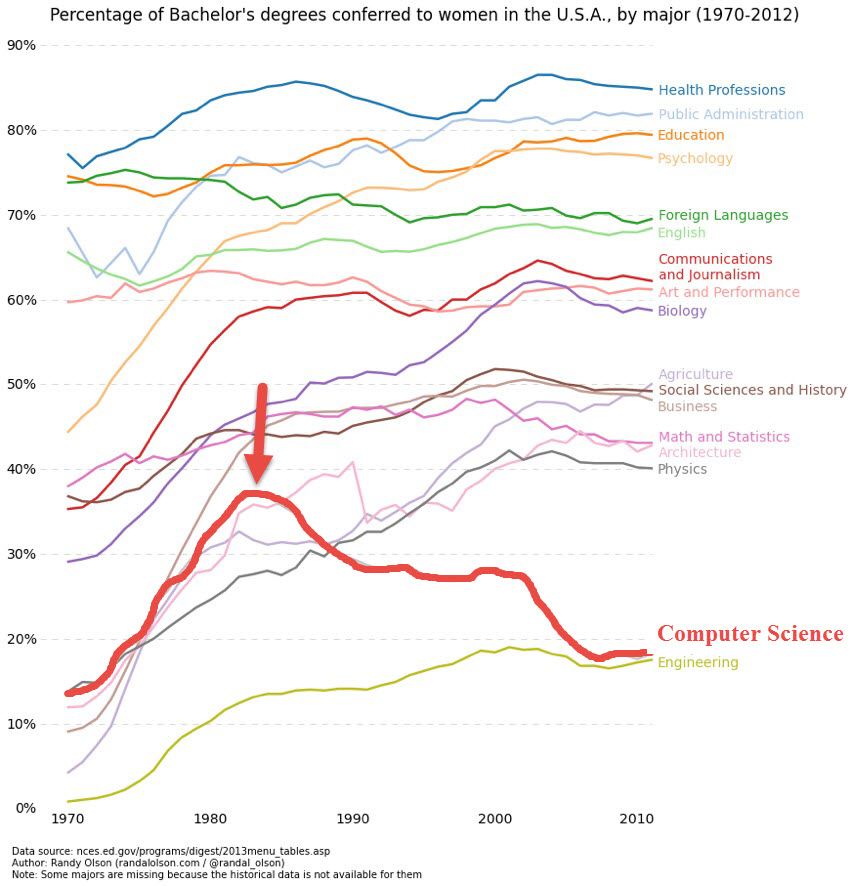
If the author's positions sound mild or plausible to you, I don't believe you've actually read the science on this issue. What the original author said simply isn't supported in the way they claim. That we can measure slight differences in aggregate between women and men in no way explains what's going on as a sole factor.
And again, I'm pointing out that the author advanced biological and evolutionary psychology as mechanisms for explaining away this, despite them operating on time scales that make this impossible.
Not as much as men. See a study [1] and Steven Pinker's slide [2], and many more studies. It's a well established scientific consensus.
> despite them operating on time scales that make this impossible.
The author isn't claiming that men evolved within 100 years, but simply that men have in thousands of years evolved to have skills more suitable for programming by a small margin. When considering the 99%tile, this small difference becomes quite big. According to [3], you find 4-10 times more men in the top 1% bracket than women in certain skills.
[1]: https://is.muni.cz/el/1423/jaro2011/SPP457/um/23632422/Hakim...
[2]: https://www.edge.org/3rd_culture/debate05/images/pinker.slid...
[3]: https://www.psychologytoday.com/files/attachments/56143/sex-...
not to say that chart couldn't be related to what's going on now, but it's not helpful to simply point there and say "look science!".
The assertions of the author of the screed are not well-accepted, and they are not facts. They are conjecture, and the author attempted to make universals out of primarily American ways of thinking and ingrained ways of discrimination.
Most arguments against the manifesto (sic) I have seen, seem to be either ad hominem or claiming some form of "discrimination" .. as in prejudice. In the light of the current discussion around gender, mostly in the US, I am just not convinced. And it seems that many people who actually are qualified agree (no, a group of self referencing "gender studies" professors does not convince).
Anyway, it's coming up 5AM here and I will not bother you further with my slave-owner-descendant misconceptions.
Several of the studies he cites on biological differences in genders are well accepted, so far as I know the field. But the key conclusions that he draws from those studies (and really, the entire point of the memo) don't have any direct scientific support that I know of. Perhaps I am missing some key references. Care to provide citations for some of these?
"Women generally also have a stronger interest in people rather than things ... These two differences in part explain why women relatively prefer jobs in social or artistic areas. More men may like coding because it requires systemizing and even within SWEs, comparatively more women work on front end, which deals with both people and aesthetics."
There's a citation for the first part. What's the evidence for the conclusion drawn?
"Neuroticism ... This may contribute to the higher levels of anxiety women report on Googlegeist and to the lower number of women in high stress jobs."
Citation for why neuroticism leads to fewer women in high stress jobs?
How about the entire "Non-discriminatory ways to reduce the gender gap" section? That contains stuff like this:
"Women on average show a higher interest in people and men in things"
"Women on average are more cooperative"
"Women on average look for more work-life balance while men have a higher drive for status on average"
Each of these statements (which at least hit my radar of being scientifically supported from the literature I know) is followed by some suggestions on how to improve the workplace for women. Implicit, of course, is that these aggregate scientific differences are somehow responsible for the gender gaps in tech. Any citations for why the quoted statements explain anything at all about gender differences in tech, rather than say, other STEM fields (biology? medicine? they have very different gender gaps).
It would be great to have the references I'm missing, because without them it sure appears the author is citing well accepted studies in order to make it look like his unsupported conclusions have "evidence".
At the end of the day, he told a just-so story; in this, he's no different than the "blame discrimination" camp. At least this story is an empirical one backed by self-reported work place surveys, cross-cultural analyses, etc. The fundamentalists opposing him just have some anecdotes, some unreproducible stereotype threat studies, and a healthy dose of religious conviction.
Scott Alexander covers some of the most salient points here:
http://slatestarcodex.com/2017/08/07/contra-grant-on-exagger...
See Steven Pinker's The Blank Slate for a book-length treatment.
(all male, all white) scientists
This is both ad hominem and wrong (the fourth scientist featured, Dr. Debra W. Soh, is an East Asian woman).
Happy where I am now, but future interviews will include me asking what management would do about this, and termination is the only correct answer. This is textbook hostile environment. Anyone saying otherwise should look hard at why they value this person's desire to speak without consequence over their colleague's right to a workplace where they're not judged by their sex, race, sexual orientation, or any other innate attribute irrelevant to their job performance.