> As a woman who’s worked in academia and within STEM, I didn’t find the memo offensive or sexist in the least. I found it to be a well thought out document, asking for greater tolerance for differences in opinion, and treating people as individuals instead of based on group membership.
> Within the field of neuroscience, sex differences between women and men—when it comes to brain structure and function and associated differences in personality and occupational preferences—are understood to be true, because the evidence for them (thousands of studies) is strong. This is not information that’s considered controversial or up for debate; if you tried to argue otherwise, or for purely social influences, you’d be laughed at.
> Sex researchers recognize that these differences are not inherently supportive of sexism or stratifying opportunities based on sex. It is only because a group of individuals have chosen to interpret them that way, and to subsequently deny the science around them, that we have to have this conversation at a public level.
Look at this and explain to me how evolutionary psychology or biology explain what happened to women in CS in the US:
https://developers.hp.com/sites/default/files/Intl%20Womens%...
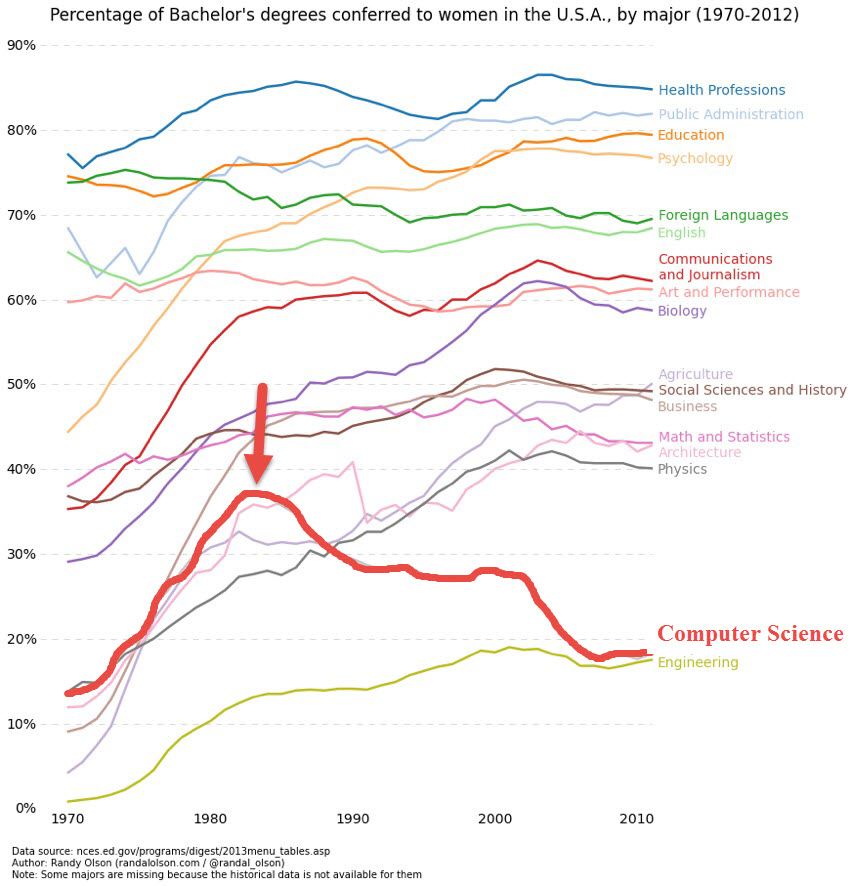
If the author's positions sound mild or plausible to you, I don't believe you've actually read the science on this issue. What the original author said simply isn't supported in the way they claim. That we can measure slight differences in aggregate between women and men in no way explains what's going on as a sole factor.
And again, I'm pointing out that the author advanced biological and evolutionary psychology as mechanisms for explaining away this, despite them operating on time scales that make this impossible.
Not as much as men. See a study [1] and Steven Pinker's slide [2], and many more studies. It's a well established scientific consensus.
> despite them operating on time scales that make this impossible.
The author isn't claiming that men evolved within 100 years, but simply that men have in thousands of years evolved to have skills more suitable for programming by a small margin. When considering the 99%tile, this small difference becomes quite big. According to [3], you find 4-10 times more men in the top 1% bracket than women in certain skills.
[1]: https://is.muni.cz/el/1423/jaro2011/SPP457/um/23632422/Hakim...
[2]: https://www.edge.org/3rd_culture/debate05/images/pinker.slid...
[3]: https://www.psychologytoday.com/files/attachments/56143/sex-...
not to say that chart couldn't be related to what's going on now, but it's not helpful to simply point there and say "look science!".
> "Sex researchers recognize that these differences are not inherently supportive of sexism or stratifying opportunities based on sex. It is only because a group of individuals have chosen to interpret them that way, and to subsequently deny the science around them, that we have to have this conversation at a public level." -- Dr. Debra W Soh
The problem is the author is repeating a pattern common in these discussions, where some kernels of empirically supported science are used to justify opinions unsupported by them. That we can measure some differences in MRI in no way establishes that under-representation of women in tech is a result of biological inevitability. We know for certain this isn't the case due to history itself, as well as variation in representation by location and culture.