Don't have all the answers, but less emphasis on loans, competition from better-supported state and other non-profit schools, and having multiple forms of post-high-school education and credentialing available could all potentially help to bring some competition and sanity back to all this.
https://fivethirtyeight.com/features/fancy-dorms-arent-the-m...
The benefits are actually much larger than I've just described. There's a snowball effect as the industries of the state move up the ladder. America is currently benefiting from past state investment in education. (There's intangible benefits too, but for these purposes let's just talk about the benefits the state accrues.)
That's if you accept the higher-education-as-training model. Under the higher-education-as-signaling model, the primary effect of education is to choose how to allocate a fixed set of high paying jobs. If there's 100 slots for new lawyers this year, then the difference between sending 150 and 151 students through law school is an additional unemployed lawyer.
Basically state governments off-loaded the burden of funding on the students while reaping the benefits of said investments.
Further, financial aid makes nameplate number less meaningful. If someone has rich parents or wins a full ride then schools want to milk that for as much as possible. Otherwise they can always add discounts down to whatever someone can pay.
http://slatestarcodex.com/2017/02/09/considerations-on-cost-...
My observations from attending and then later working at a large southern public university is that a bunch of things happened:
1) The financiers got in bed with the financial aid office, figuratively and possibly literally.
2) The campus went on an inexplicable building boom the likes of which no one had ever seen before. The state funded those projects, but they were clearly handouts to construction companies and pork spending. Sickening, really.
3) The quality of the average student plummeted. I blame the financiers for this, too--asses in seats is a thing.
So while it may be generally good that more people had access to higher education, at the same time the quality dropped, and I seriously doubt the outcomes for many of those people actually improved over attending community college or perhaps no college. Their debt loads had to be tremendous, after all.
It's also possible that states where education was valued have pulled back funding. There is actual hard data to indicate this is the case, but I'm also trying to avoid dismissing your claims out of hand.
The rise in college tuition is the most baffling, as this industry refuses the amortize costs. The buildings have been built, the books have been written, the intro courses have been handed down to graduate students, the handouts are sometimes the same handouts that were used a decade ago.
Yet the costs keep on rising.
Asking young humans with incomplete information to make a decision with long term financial impacts is a good gig, especially when "all their friends" are doing it.
"We find a pass-through effect on tuition of changes in subsidized loan maximums of about 60 cents on the dollar, and smaller but positive effects for unsubsidized federal loans."
Then you have to realize that tuition increases at private schools are misleading. You have to look at what people are actually paying not what the sticker prices.
At Harvard, for instance, 70% of students receive financial aid, so they are paying $12k a year on average (not the $60k sticker price). That's tuition, fees, and room and board. Harvard has generous financial aid, but it's not unusual among elite schools. Most private schools worth going to are going to have very good financial aid packages.
And even at lower tier private schools most people aren't paying sticker price unless you're talking about for profit institutions.
How long does it take to build and staff a private school? How long to get it into US News top 500?
Even something like increasing the number of students admitted to existing private schools is tricky because they are tracked on their admission percentage.
All that has to happen is for EXISTING colleges to realize that they can make a ton more money by expanding in size.
Obviously, this doesn't happen overnight. You have to hire new employees, buy more land, and build more buildings.
But I'd argue that this process would happen a lot, lot quicker than "create new college". Colleges are already expanding all the time.
If a single college doubles in size, the effect on total college supply is minimal.
You double the amount of quantity sold, for You, while only slightly decreasing price, because Total college supply has only barely increased.
It is simple supply and demand in a competitive market.
Harvard and Yale are ranked so highly that they could get away with it. But they won't do it for other reasons. Mainly that they don't need the money coming in from tuition. If you take a private school a bit further down the list though, their rankings would tank if they accepted twice the students.
Also there are other limiting factors. Many colleges don't have the physical space to just double in size. Their isn't land for sale within walking distance of their current campuses. Adding satellite campuses is one way around that, but that adds logistical problems that will reduce desirability. In addition to satellite campuses not always inheriting the reputation of the main campus.
Additionally you can't simply double the student to faculty ratio b/c that would tank rankings, and hiring double the faculty takes time.
You also don't know which departments you need to scale beforehand. If you decide to double your enrollment in the next 5 years, which majors will the new students choose? It's unlikely the ratios would stay the same. Good programs don't always scale well either. If a department worked hard over the last 20 years to build a good reputation, they can't just hire 20 new faculty members and teach twice the number of students without impacting quality.
Schools do expand all the time, but it is a very slow process that by its nature can't keep up with a constant growth in demand.
For decades the private sector has been feeding off the gravitas created by Stanford, Harvard, Yale and other superb private institutions. Maybe time has helped, maybe the Internet made comparisons easier, but it's pretty clear that private schools can be separated into three tiers, with tier one (Stanford, Yale) still being top notch, tier two being a questionable proposition for most people, and tier three (U of Phoenix, Trump U) being borderline fraud.
70% of Harvard students receive financial aid from the institution, and they pay an average of $12k a year total. Harvard clearly isn't charging a market rate for tuition.
Also government backed loans aren't nearly enough to cover tuition plus housing at these schools, so if your argument is that the prices are similar because they are both near the max loan amount, they aren't.
Does this mean that education budgets for the states has had cuts in the last 16 years? Where is that state money saved going?
This is not limited to education pension funds, public sector or prison guard pension funds typically negotiate the same deal, very frequently with people they themselves have helped get elected, so you know those negotiations are extremely tough.
https://satyagraha.files.wordpress.com/2011/11/uc-tuition-an...
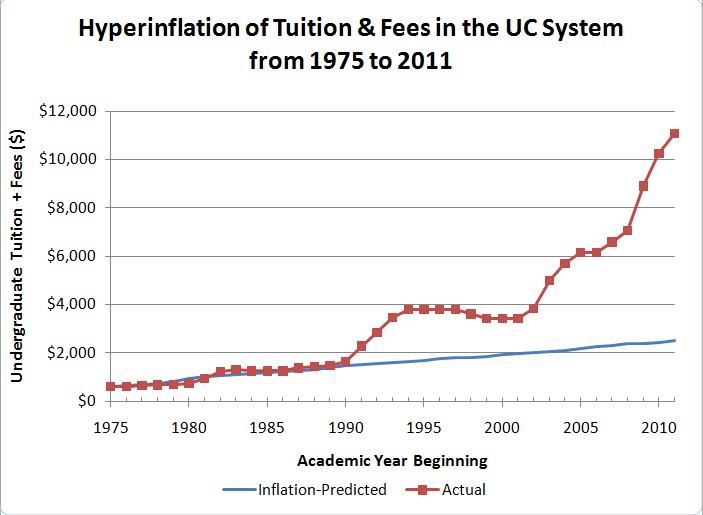
As a California resident, I can tell you there are plenty of taxes and tax hikes, and the money doesn't make it to the Universities anyway.
Everyone got paid, except the sheep who got sheared.
So if you want to put yourself on the path to the C-Suite in a Fortune 500 company or to a partnership in a major law firm, you have to get into one of the very top colleges in the country. That, in turn, means top colleges can charge pretty much whatever they want and it's still worth the money. Not because of the instruction students receive, but because getting admitted is highly competitive and those students managed to do it. In other words, it's a positive feedback loop driving up prices for a scarce resource.
Even when you get out of the nosebleed tier, colleges are easy to rank by their accept/reject ratio. So if you're a big employer and you have a candidate from Brown (acceptance 9.5%) and one from Cornell (acceptance 15.1%), you'd probably prefer the one from Brown, everything else being equal.
The sad part is adding more money just makes the problem worse for the same reason adding money to real estate markets just makes everything more expensive.
The most prestigious colleges actually don't charge much money, except for families that can easily pay. Financial aid, including stipends for living expenses, is extremely generous at elite schools. The sticker price might be high, but few people actually pay it.
The problem is more with second tier schools that aspire to greater prestige but have more limited financial resources. While many of these schools offer perfectly good educations, they don't really open the same kind of doors that going to a more elite school can. A big tuition price can make parents think they're sending their kid to a really elite school - just like people often will assume a more expensive diamond ring is better than a less expensive one. But it's probably not really worth the money.
So instead I only applied to in-state colleges, thinking I was being sensible and pragmatic by doing so. But there's a chance I would have paid less at the top tier schools than I ended up paying for local schools.
It's an example of how inequality along financial or racial lines can be real despite there being no theoretical reason for it: if you don't know that you could attend a top tier university and leave with very little debt, you'll consider applying as a student. If you don't, then you've preemptively rejected a very good opportunity for upward mobility. Too many people just don't know because their families or communities don't play the college admissions "game."
If the minimum barrier to employment is having a college degree, then people will continue doing whatever they have to in order to get a college degree.
The only way you're going to change demand is if decent jobs start being created that don't require a bachelor's degree. And I don't see that happening...
Everything about our country is one big lie.
College is oversold but the American Dream is alive if you go to a cheap school and buy a house in a smaller city or burbs. There are plenty of great cities and emerging ones with jobs and reasonable cost of living.
However, if you choose to buy crap you don't need and succomb to debt, that's not America's fault. That's yours.
But yes it's dead in LA, NYC and SF. You have to be a top performer there. But that's just supply and demand. Nobody owes you the American Dream in those cities. You aren't entitled to it.
Which cities? How long will it be until they too turn into LA, NYC, and SF (While being surrounded by oceans of hopelessness and poverty)?
You're so hung up on the CEO thing which is irrelevant. We don't need more CEOs just like we don't need more lawyers and doctors. And you mention doctors - those are needed in any town of size anyway. My own grandfather was a doctor in a rather small town outside of Little Rock and he did very well for himself and sent 4 kids to college, one to med school. His son is doing the same thing now as a doctor in Memphis.
The American Dream is alive and well: it's just changed. It's no longer "graduate college, get a good job, buy a home and be set for retirement"
Too many people just aren't adapting and are frustrated because they are sinking themselves with poor decisions like crippling debt.
I know people w 200k school debt that graduated with degrees targeting jobs that tap out at around 80k that are way more competitive than any tech or marketing occupation. Makes no sense.
My uncle makes 100+k selling tools out of a town of 6k people. My father in law makes 150k+ in HVAC out of a suburb of about 50k people. They both own their homes outright. One didn't go to college.
People don't want to learn general crafts like sales and they don't want to learn crafts that get their hands dirty. Their parents keep pushing them into college which provides less and less value and tons of debt.
The American Dream doesn't go away just because less people are realizing it. It goes away because people are being stubborn and we have a nation of financially ignorant and wreckless citizens.
I've just driven out to Whidbey Island this past weekend - a 70 minute drive from Seattle. Beautiful place. Economically, it's also dying, and not because the people who live there are lazy bastards. If it didn't have a US Navy base, it would be dead. As a young person, you'd be insane to stay there.
In order to feed your uncle and father-in-law, small towns must have something to export.
It could be lumber. It could be coal. It could be applications for social security. It could be people, who work in the city, and live in their community, 40 miles away. But it has to be something.
Small towns that have an export - one big enough to feed all the doctors, cops, plumbers, politicians, realtors, teachers, babysitters, bricklayers, HVAC installers, and other people who bring no money into their economy can do reasonably well for themselves.
Those that don't are in a death spiral, and it won't matter if you replaced every person in them with a skilled contractor overnight.
1) the American Dream has included a college education as a general requirement for quite some time now. People that live in small towns, esp. mid-sized ones that rely on Naval bases or other similar economic drivers as the example you provided generally aren't part of this group
2) it ignores that the Dream is alive and well elsewhere
Nobody should expect to get a college education and go live in any given town and be set for life. That's not practical. Economies change, but the opportunities are still out there.
If you believe people should be entitled to make a living wherever they grow up (or choose) forever, then yes the American Dream doesn't exist because your expectations are out of line with capitalism.
That's not fair; it's alive if you aren't stubborn with occupational choices and where you live. It sucks to move but people need to get over that fear.
I do. At the lower end, if employers can't afford to pay people enough to make their loan payments, they'll start hiring people without debt.
The worry I have is that if the automation worries are born out, then you're going to have an inflexible debt loan (student loans) meeting a market that offers fewer jobs (due to automation).
I think you've misunderstood what you're hearing: low cost college by definition can't be the cause of high cost college.
The claim is that high availability of funds/liquidity for college is what pushes up prices,since there are more dollars available to chase a supply that hasn't kept pace[1].
> college is free in many countries where they are doing quite well. So I question the facile opinions I keep hearing.
This doesn't really make any sense. Colleges that are provided for free are a lot less dependent on markets to determine prices: they treat them like a more or less generic public good (where college choice is determined by quality of student more than ability to pay).
[1] strictly speaking, the supply hasn't been that constrained, but since college is largely perceived as a positional good, this affects all but the bottom rung for-profit colleges.
Exactly. It's no different to what causes a real estate bubble: Extremely low interest rates and lax lending policies make borrowed cash very cheap, which pushes up the amount that the average buyer can 'afford' to borrow.
It's gotten to the point that you might consider the alternative of starting a higher education co-op to hire associate professors and frustrated, underemployed phds while minimizing tuition by meeting in un-fancy locations or online.
That said, I would definitely join such a co-op as I feel the knowledge is more important than the paperwork anyways.
For those seeking ROI, boot camps are already providing a compelling vocational alternative.
At the same time, getting rid of tenured positions is a decent means of cutting costs to try to address the same shortfall.
Though I should note that PhD students in history aren't major drivers of demand for professors of history - undergraduates are.
In the sciences, there's a bit more of an incentive to have lots of graduate students.
So now we get to see other effects at work and some of those effects expose this rise in price as unrealistic.
Although I do want to mention that in my eyes these so-called top schools are overvalued. With both their professors and students gaming the system in order to 'stay the best'.
Well, yes; software is on average more reliable today than 15 years ago.
This has the same structure as your argument and is incorrect, so you have to add something specific to government to repair the argument structure.
I do think they should make student loans bankrupt-able. It's time.
Oh yea, and put a hiring freeze/salary cap on all administrative personnel for any school that accepts federal loans.
The best teachers I had were at community colleges, and usually had summer jobs.
I never figured out what most of the administration did besides irritate the better teachers.
The real answer is to cut what's funded by the government, make the rest of the financing come from the universities themselves, AND make it bankrupt-able. Then as demand declines and universities share the hit for each bankruptcy, universities will lower prices to something more reasonable to increase supply.
I thought the whole business of government helping with student loans is to enable poor people to get a degree when that was vital to getting rich. But that's not really needed anymore. You can often make more money with a trade certificate than a degree.
Banking industry does not have a concept of a college loan. A loan is either secured (mortgage, auto, HELOC) or unsecured (personal, credit card). Without government participation all college loans are treated as unsecured, which means that everybody will get roughly the same offer as they do today on personal loans. High interest rate, payments must start immediately, bad credit requires a co-signer (time to talk to Mom and Dad).
Banking sector interest in unsecured private loans to people with bad credit (which describes most 18-year-olds) is so close to zero that LendingClub pretty much owns the sector.
Want a new degree, your credits won't transfer so you start over as a freshman. (if you can get in - school is competitive and the bankruptcy is sitting there on your record)
https://nces.ed.gov/fastfacts/display.asp?id=40
"The 6-year graduation rate was 58 percent at public institutions, 65 percent at private nonprofit institutions, and 27 percent at private for-profit institutions."
Why not make the coding bootcamp start at kindergarten. And why not let parents pay for such schools so they can choose the best ROI for their kid.
If those "thinkers" were really contributing something valuable, that will show up in ROI. If you don't agree with that measure, how do you propose to eliminate completely useless classes and make space for better alternatives? Do you just assume that any classes that are part of the status quo must be valuable?
There are so many examples of this I don't know where to begin. Ok I'll start: Fracking.
Another good example of chasing the mighty fractionally reserved greenback:
Generally it is about playing to the strengths. Customized education.
Guaranteed downvotes
I think he/she is right-ish about the supply-demand calculus on this; looking at history, overextended credit/margins often lead to nasty bubbles because of the distortion effects.
As a teacher who has experienced that irritation, I hear you. But I also know that multitudes of administrators are a necessity in the modern world. There are a number of reasons for this; one of the biggest is regulatory burden.
Pick your favorite downtrodden group. Some politician makes a speech about how Group X has gotten the shaft for too long; he says he wants to pass a law that says no federal money is going to go to a university that hires people from Group X at a lower rate than other groups. Everyone says, "Yay, politician." And the law is passed.
Now, I am not (repeat: NOT) arguing against such policies. If thoughtfully enacted they can be beneficial. But they also come at a cost. And much of that cost is administrative.
Basically, this politician has just invented a new form to fill out. Before receiving federal $$$, we have to fill out this form that describes our good-faith efforts to hire qualified people from Group X.
Now, someone has to fill out that form. They have to keep the necessary records. They have to tell their coworkers what they need to do to be in compliance. They have to get periodic training, because government requirements change. That person needs office space and equipment. They need a parking space, and their trash needs to be emptied, and their restroom needs to be cleaned and stocked, and their paycheck needs to be deposited, and someone needs to supervise them. And none of this is free.
The modern world comes with a huge number of policies like this. "Let's prevent hard-working Americans' money from being misspent. I'm going to require that any scientist who receives a government grant has to account for his time, so we know where the money is going." Fine. And every university hires someone for a new administrative position.
"Every new construction project must conform to stricter safety requirements." Great idea. Another hire.
And again, none of this is free.
> Oh yea, and put a hiring freeze/salary cap on all administrative personnel for any school that accepts federal loans.
Ah, but the reason the administrative personnel are necessary in the first place is to ensure that the organization meets the qualifications to accept federal money. So the idea is, I'm afraid, completely impractical.
T.I.N.S.T.A.F.R
There is no such thing as free regulation. Some people tend to forget that when they say "We should make a law that says..."
Unless they are going out of their way to spend a lot of money, the cost of those graphics is actually pretty cheap in comparison to the entire device. It's probably things like marble floors where the cost between one material choice can be 3x-10x the cost of another that would increase costs.
I figure there's two factors behind this:
1) People want a "college lifestyle". It wouldn't really matter much to me, but I know this is something kids leaving home care about, so it's surely a massive factor.
2) People NEED to have a piece of paper with a fancy stamp. This to me is the biggest problem, and I don't know of an easy solution.
To share my own anecdotal story:
I was working on freelance projects prior to going to university (this is some time ago now). I won't say I didn't learn anything there, but certainly I went to many lessons covering material I was already familiar with, in much greater depth, from my own learning. As there was no way for me to get a job interview without the degree, I stayed put and ran up years of student debt.
The first issue lies with the student. The second lies with the industry at large.
Maybe this is how that happens - the dawning realization that higher education doesn't begin and end with college - and folks start to really look at the other options seriously.
This is manufactured demand. Many other countries have a norm of commuter schools (Where most students live with their parents).
Those that don't tend to have cheap, barracks-like housing, instead of 'lavish' dorms.
No, this is real.
One of my kid's friends is going for Mechanical Engineering at a school that will cost her $60K per year. And she is committed to go past and Bachelor's and obtain a Masters.
I have begged and pleaded with her to reconsider. I have done all the research for her showing salary potential, payments and a comparison showing what would happen if the delta in payments were to be invested in a Roth IRA for, say 30 years. She won't budge.
This girl is going to graduate with an M.E. degree and $300K in debt. This is insane beyond belief. That degree is not worth that kind of money, not by a long shot. Average salaries are in the $60K to $80K range depending on location and industry. Getting significantly north of $100K is very difficult and getting to $200K seems down-right impossible. And so this girl is going to have MD level debt with an earning potential nowhere near that of an MD.
In other words, she is signing up for financial slavery.
And worst than that, she is making a bad decision today that will cause severe damage to her future family. She will realize this when she marries and has kids. And, if her husband comes in with another $200K in debt. Well, that's a formula for a really shitty life for 30+ years. Great education, shit life.
I have to admit I don't understand how these decisions are made.
BTW, I forget the exact number but investing $500 a month on a Roth IRA from, say, 20 to 50 years of age has you waking up one day with something like $1.6 million in the bank. Keep at it until age 65 and it is somewhere around $3 million. Which means that paying an extra $500 a month for a high dollar student loan has a huge opportunity cost. A $300K loan probably means payments that are $1000 a month above those for a loan to go to a mid-tier university.
And so she said: "My parents are going to take out a second mortgage and pay $200K out of the $300K. It'll be OK."
To which I replied: You are smart, you took a lot of advanced math in High School. Go figure out how much you would have in 30 years if your parents gave you $200K and paid for you to go to an investment adviser to invest that money wisely. Then do the research and find out how much more you might earn if you pay $300K for your degree rather than $100K.
Half the people that I went to school with in physics, math, econ, bio, did exactly that. They're doing just fine now because TBH, those fields are vastly more intellectually challenging to learn at a research level than being a well qualified working programmer is (doing proper CS at a grad level is a different story, on par with those other fields, but you don't need to be a research-class CS PhD to be an above average programmer), and most of them already had to learn to program to get through their courses anyways, so it's an easy transition.
It's the people in completely non-technical majors that have the most trouble, because they don't know math, they don't understand proofs or algorithms, or even basic problem solving, let alone how to design systems, and worse, they've never really had to learn to effectively use software except in extremely limited ways.
I went to a local college while living at home with my parents. That saved tons of money. I also worked 20-30 hours/week while in college and paid for most of while I was going. I get that not everyone lives close to a decent college, but many do and still go away.
Then do the research and find out how much more you might earn if you pay $300K for your degree rather than $100K.
So the suggested alternative to a 300K college is a 100K college.
Here's a good article:
https://www.wsj.com/articles/do-elite-colleges-lead-to-highe...
Quote:
"What we found startled us. For STEM-related majors, average earnings don’t vary much among the college categories. For example, we find no statistically significant differences in average earnings for science majors between selective schools and either mid-tier or less-selective schools. Likewise, there’s no significant earnings difference between engineering graduates from selective and less-selective colleges, and only a marginally significant difference between selective and mid-tier colleges."
Another reality check quote from the same article:
"Our findings are crucial for families to understand because chasing a prestigious STEM degree can leave students burdened with huge amounts of unnecessary debt. Financial aid can certainly help, but for many families, the cost of education can still differ dramatically across schools. For example, if an engineering student chose to attend the University of Pennsylvania instead of Texas A&M, the average starting salary would differ by less than $1,000, but the tuition difference would be over $167,000. At that slightly higher salary, you’d have to work for more than 150 years before you make up for that vast tuition difference."
This is startling and should be considered by every single student and family engaged in choosing a school.
Something else not mentioned is that the education can be better better than the not top-tier schools because they are typically focused on teaching instead of research. In another thread I talked about my smallish college where the dept. chair on down rotated through teaching the into CS classes in addition to their higher level duties.
Medical care is part of survival. Going to a university for job training is part of survival (and as an aside, I think it's an inappropriate use of academia in the long view). But going to a university for life betterment, intellectual pursuit, or even just ego is a luxury. So there's no real price pressure on the latter, only the former.
I would say that just having the magic paper is what low market demand degree pursuers want, regardless of the major. But that means the paper itself has high market demand, even if the actual field of study doesn't, so it still comes down to cost-benefit calculations. The reason they chose that specific degree is to lower the exertion cost of the beneficial degree.
* Other comments in this thread rightly point out that US higher education loan policy is largely the cause of unsustainable growth of college tuition. However, instead of bloated bureaucracies and buildings that are unmaintainable at lower budgets, why didn't at least some colleges invest the proceeds into index funds to directly defray the costs to students, like at Yale? Or allocate to competitively recruit and retain proven professors with observable education outcomes (or invest in establishing metrics to identify such outcomes)? Is there a herd effect at work in how colleges decide to spend the largesse, and if so, where did it roughly originate from?
* I find it interesting that the standard investment is effectively an S&P 500 index fund. If your slow collective consciousness meme is on point, then pointing more working and middle class towards indexing with big life goals like children's higher education could have big ramifications for the financial industry, as one of the large institutions supporting the industry---pensions---starts eroding away in the future, and now another source of funding in 529 plans might open up more to indexing. How likely is indexing going to replace pensions, and when will most 529 plans shift to indexing?
* It is common for US employers to note that colleges are producing graduates that do not hit the road running at the workplace. There are quantified lists of skills that are observed missing in the graduates [1] [2]. Why aren't there "finishing schools" set up to teach these skills?
[1] https://www.fastcompany.com/3059940/these-are-the-biggest-sk...
[2] https://www.forbes.com/sites/karstenstrauss/2016/05/17/these...
It lists Scala and Go as "MOST SOUGHT AFTER" skills.
First, IMO it's weird to consider particular languages as "skills" when talking at a sort of macro level about educational preparedness. "Go schools" and "Scala schools" won't fare much better than "Java schools", and we'll be having this same conversation but replacing Scala with Haskell and Go with Rust (etc. -- you get the idea). (And if you need to go to a finishing school to learn Scala or Go after college, the college has fundamentally failed at its primary task.)
Second, Ctrl-F for Scala in the latest Who's Hiring thread -- some Javascript frameworks are more in demand. And I'd imagine Who's Hiring threads are more representative of the sort of companies hiring FP programmers than a generic jobs board.
The Forbes article is more interesting -- communication, interpersonal skills, teamwork, data analysis (which, if we step outside the zeitgeist and generalize across several generations of in-demand technical skills, we should really just read as "mathematical maturity" and "ability to self-learn").
Those are all the sorts of things you don't simply teach in a single course. They require prolonged situational exposure, of the sort that colleges readily provide. The problem is that students don't avail themselves of challenging course work and extra-curricular activities, and universities don't demand it.
Investing implies that the tuition increases are not to make up for current budget shortfalls. This is often not the case. Many states, for example, cut the budget for higher education in 2008-2009 by the high double digits, with no real way for the universities in question to make that up.
"Or allocate to competitively recruit and retain proven professors with observable education outcomes (or invest in establishing metrics to identify such outcomes)?"
Honestly, because if they were doing it strategically to make up for the shortfall, they'd be competitively recruiting and retaining proven professors with a track record of funded research projects. Which is what they're doing, but that too is becoming more difficult as federal research budgets stagnate.
First of all, are you investing the same money in both cases? Even with a smaller annualized ROI you can earn more by investing more at the start.
This brings us to the second point: if you skipped college to just invest in the market, where are you taking the money? I would be very surprised if you managed to obtain a loan of some tens of thousands of dollars by stating that you will invest then. And even if you did, the blog post calculations didn't account for the interest rate that would necessarily have to be included in this case. Let's say you invest your savings then. The majority of teens out of high school has little to no savings, and it's a fact that jobs you can apply to out of high school pay much less than those requiring a degree or more (at least in the first few years).
The trouble is that these outliers, who are able to realize artificially high incomes due to the artificial labour supply constraints, make it appear that everyone with a degree can do better than without when observed on average. But closer inspection of the data does not continue to back it up. Despite substantial increases in college attainment over the last several decades, incomes have remained stagnant.
We should also learn this lesson for land. This is how prices are set.
In my opinion, college as a publicly subsidized institution of educational breadth needs to end. I think that we could move towards reducing the current burden by doing the following:
1. Privatize student loans entirely, and give them eligibility for bankruptcy.
2. Eliminate all degrees that do not demonstrate a true specialized skill in the manner of a vocation, or a level of academic rigor that cannot be achieved outside an academic setting.
3. End the cultural stigma against those without a college degree.
4. Regulate the use of college as a requirement in job listings, and disallow it as a filter unless it can be specifically demonstrated to be required for a specialized skill (through legislation, if necessary).
5. Reduce the number of courses in an undergraduate degree. Get rid of courses that are not "in the major", and supplement what's left with practical subjects that are critical for personal success (taxes, personal finance, etc).
I don't think this is ever going to happen. But I do earnestly believe it would be the best possible outcome. It's also imperfect and a message board comment obviously cannot flesh out the implementation details. But it's a start!
Privatizing student loans and allowing the debt to be relinquished through bankruptcy would provide a free market incentive for eliminating degrees that are generally unproductive. There are many courses of study aside from the stereotypical "basket weaving" which are taken because kids simply don't have the maturity or direction to understand what they want to do or accomplish with a degree. These harm more than they help, in my opinion, because they forget most of what they learn anyway.
Ending the stigma against the choice to go without a degree could help drive people who would otherwise get poor degrees to go into practically useful vocations, at least until they decide they'd like to do something else. It might also lessen the stigma of adults who return to college later than "college age."
Regulating the use of college as a professional filter would be tricky, because historically this seems to bounce it some other form of signaling (it used to be an IQ test, then it was college, etc). But it might tighten the loop between a choice in major and a choice in career, which is acceptable if it becomes culturally okay to make that decision closer to when the brain is fully developed and if the time required for the degree is shortened (e.g. you could simply go back, if you want).
Finally, you'd help accomplish that last point by reducing the number of courses required for a full degree, potentially bringing the time to complete an undergraduate down to two years.
In my opinion, the ideal of undergraduate education is somewhere between the current Master's degree and vocational training.
Considering most college graduates have nothing but tons of debt behind them on their graduation day (and that's if they graduate, a fairly big maybe in the US), the incentive to declare bankruptcy the day after graduation is extremely strong.
No private investor is going to rush to profit from this questionable opportunity, and aspiring college student will be left with advice to "work a few years, save up, and then see what happens" or "talk to your parents about home equity loans".
Lenders will just requires parents to co-sign so anyone who is not from a well off family can no longer go to college. It will also stop the ability for the student to go into bankruptcy and discharge the student loan debt.
The way this manifests in reality isn't millions of people all doing a cost/benefit calculus like this and coming to the rational conclusion they can skip college. What happens is that slowly, the meme that "Jim went to college and he doesn't seem better off" seeps into the collective consciousness. More and more people start running into this evidence, and reconsider mortgaging the house (figuratively) to send their kids to college, and the upward pressure on college tuition starts to lessen.
After a while this meme that college is a tradeoff becomes well established, and it becomes common knowledge that you think hard about it before you send your kid to college. The underlying reason is something like "You can make a better return in principle investing in the S&P" but the way it becomes a force in the real world is by a collective bayesian reasoning process we all engage in as a society.