Actually, there are two more permanently red lights in Dresden alone. They are mentioned at the end of this Video: https://www.ndr.de/fernsehen/sendungen/extra_3/Realer-Irrsin...
If it's anything like the picture, the reason right turns are allowed is the green arrow (it roughly translates to "when red, right turns are allowed if you don't interfere with other traffic"). I strongly doubt random towns in Germany can bypass the StVO (the laws which govern public roads).
EDIT: To clarify, I was born in Cologne, which is on the opposite of Germany, and green right arrows exist here as well and they are part of the material you learn for taking a driving exam.
But the Rechtsabbieger "Grünpfeil" is also in the StVO § 37 Abs. 2 Nr. 1 Satz 8 bis 10 https://de.wikipedia.org/wiki/Gr%C3%BCnpfeil
History: The old DDR came up with this Grünpfeil (turn on red) law. During the Wiedervereinigung it was "agreed on", that this law can persist for max. one more year, 1991. But based on huge civil protests on silly law reforms (same for abortion and women rights which where more advances in the east), Germany kept this exception, and even some old ex-BRD towns introduced it since.
I believe Dresden had most of the existing 2.500 Grünpfeil signs in Germany, but in the meantime the west has caught up, and there are now 5.000 such signs.
Sorry for nitpicking but your first post read like Dresden had special traffic laws and green arrows were rare outside a handful of cities (plus AIUI the green arrow has slightly stronger implications in the US).
NYC should secede from NYS.
http://s3.freefoto.com/images/41/03/41_03_88_web.jpg

(English: "Give way")
"4 Way" or "All Way" -- Indicates that every entrance to the intersection has a stop sign. I understand all way stops are either uncommon or unheard of in Europe.
"Cross Traffic Does Not Stop" - often used with "Two Way" stop
"Traffic from the left/right does not stop" -- often used when one direction is coming off a signaled light or crossing railroad tracks, or other cases when traffic from one direction needs to continue to flow to prevent a backup that could be dangerous.


Also worth of note: when traffic lights are active they always take precedence over static signs which in turn take precedence over road markings (which themselves take precedence over road layout). The green arrow sign is special in this regard because the rules for traffic lights explicitly take it into account -- otherwise the red light would always trump the sign because of precedence rules.
https://ais.badische-zeitung.de/piece/00/bb/82/9b/12288667.j...

I understand that from this road, you can only ever turn right, and can do so at all times, so there's no need for a traffic light, except that it legally needs to have one because other roads at the junction need traffic lights for other reasons.
So what are the other roads here? Clearly it has to be more than just the Ziegelstraße and the Güntzstraße.
what does it matter if the green and yellow bulbs are broken? They'll never be turned on.
As a driver approaching this particular crossing while seeing I'm only allowed to turn right I'm not sure I'd ever notice the light staying red indefinitely.
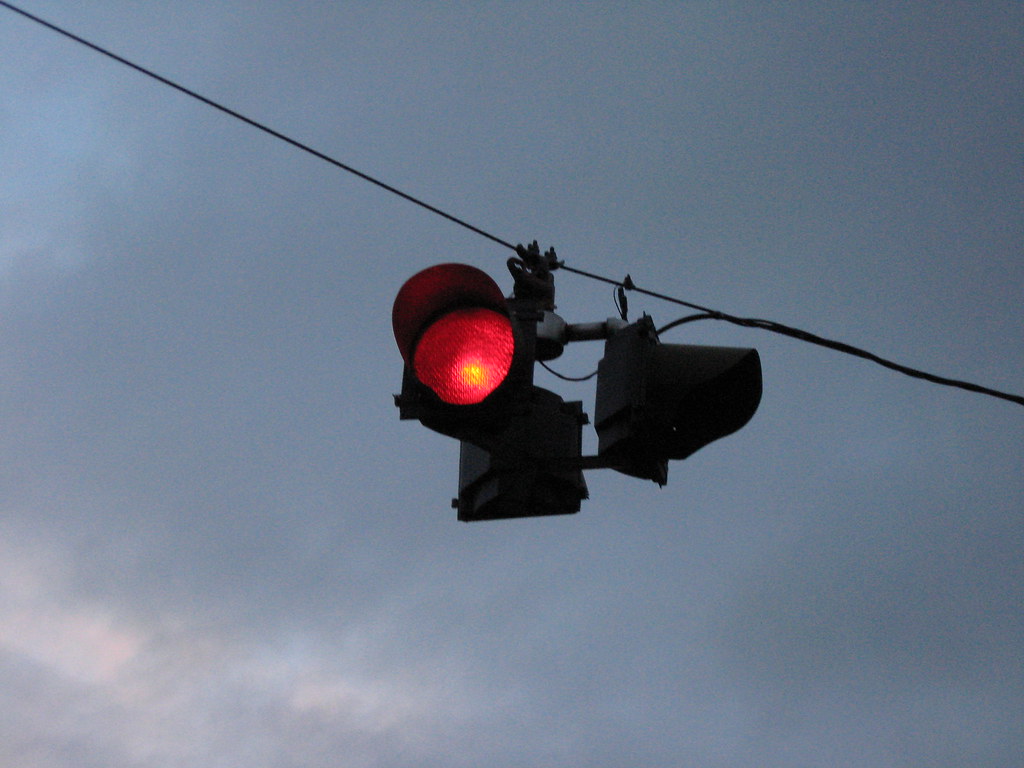
What I don't understand is why the 3 light red/yellow/green signal unit has never been changed to a 1 light red-only unit.
Like this one....
https://c1.staticflickr.com/3/2041/2234314943_bdcd95d800_b.j...
If you have a strong requirement to avoid failure, proactive replacement let's you optimize the unit cost of replacement because you can fully utilize the crews and have no wastage.
If you dispatch reactively, you either have people sitting around waiting for light bulbs to burn out or lightbulb replacement pulls crews off of other work, impacting schedules.
The key assumption is you want low/no downtime. The problem you have is negotiating SLA penalties are difficult to get right for organizations like cities and getting good metrics are tough.
The other thing, especially with government contracting where RFPs are extremely difficult to change after the fact without getting contracts disputed by the losers is that the contractor will add risk premiums for penalties.
As things move to LEDs it hardly matters anyway, a correctly engineered LED lamp doesn't suddenly fail like filament lamps, it just gets sort of dim gradually, so a regular schedule (e.g. replace all the LED lamps every 5 years) is the correct way to deal with it. Cheap consumer-grade LED modules sometimes fail suddenly due to over-heating or badly made electricals but the road maintenance people probably aren't buying unlabelled stuff off eBay so they're unlikely to have that problem.
So if one fails, a bulb burns out, one gets destroyed in a storm, or anything else happens, there will be at least one full backup.
But the best is the last sentence: They do change all the green and yellow light bulbs also in their regular maintenance schedule. The justification goes like this: Bulbs mostly wear due to hours in usage, yes. Red and Yellow are not used, so should not wear, and thus should not be replaced. But hours can not be the only cause for problems, and while we are there and there's a budget for replacement, we'll do it all together. Not really a just technical justification, just a practical one.
We do the same in software also all the time. There are two principles: 1. Make minimal changes to cause only minimal effect. 2. Harmonize your changes to avoid unnecessary asymmetries. They went with 2. You can fight the system, or you can live with it. In this case there is no reason to rock the boat.
[Update:] The lawful alternative would have been to close this crossing for the Ziegelstraße into the Güntzstraße. People would have protested over this sillyness. And Dresden has enough budget surplus to do such things. In fact Dresden was very lucky in its real-estate deals, where they sold all of their old residential apartment complexes to a US company Fortress for billions: http://www.spiegel.de/wirtschaft/milliardendeal-dresden-verk... Normally such deals turn out bad and unprofitable, but in this case not. Both parties are happy.