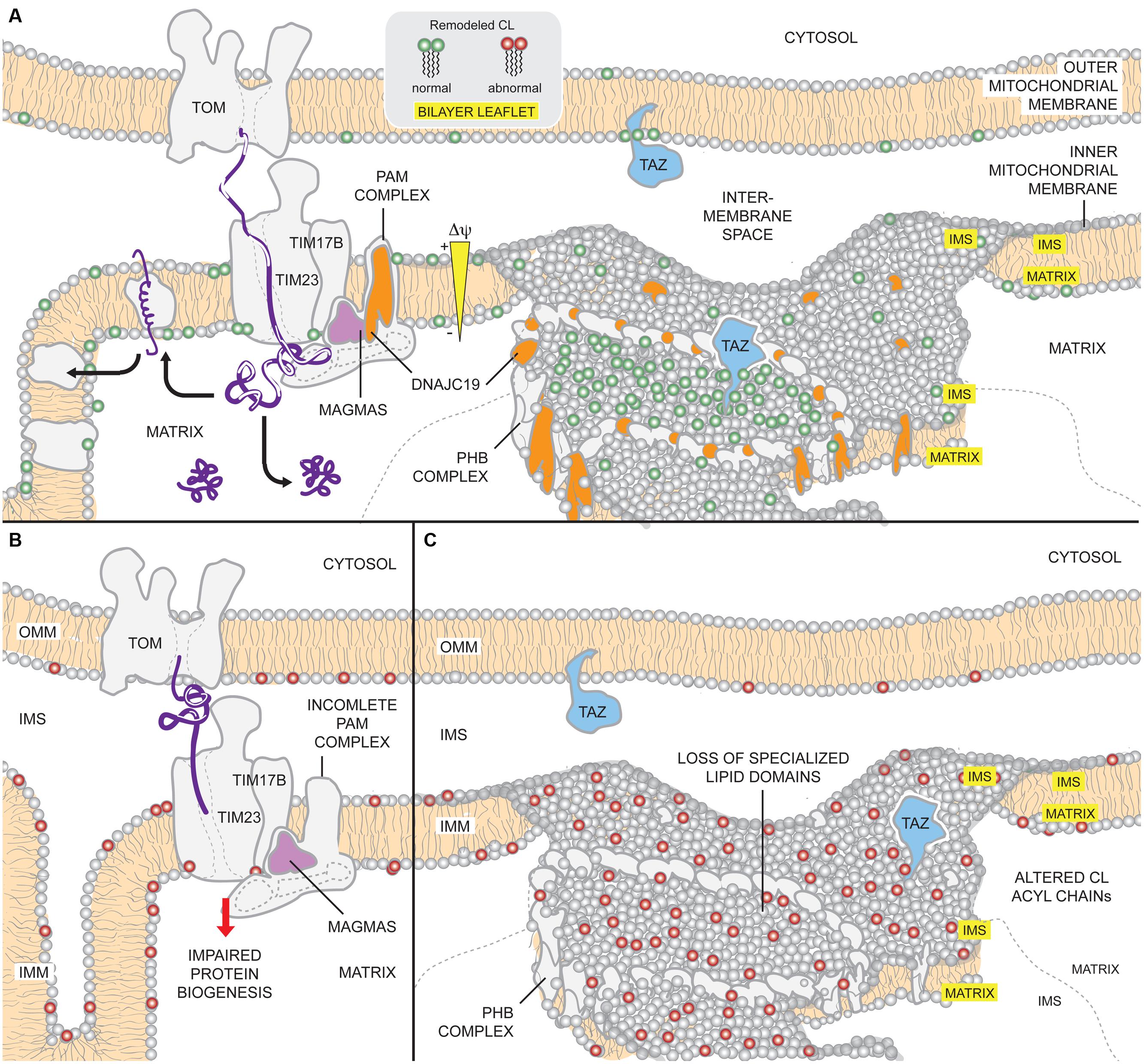
Guys, the bio side of things is incredibly complicated and trying to set controls that are achievable in your time and budget is the heart of these fields. The thing you are trying to study in the bio side of science is actually alive and trying to study you right on back. If you are going to kill the thingys, they really do want to kill you too. Look at this diagram of mitochondrial phospholipid gene/protein interactions (https://www.frontiersin.org/files/Articles/128067/fgene-06-0...). That is very complicated and that is for one of the best studied organelles in the Animalia family. There are an uncountable and evolving set of other proteins that then interact with that diagram in different ways depending on the cell-type, species, and developmental history of the organelle (to start with). All of which are totally unknown to you and will likely forever remain unknown to you up until your death. Hell, we are still figuring out the shapes of organs in our own bodies. People that have studied areas for decades spending untold millions of dollars on some of the most central questions of life have essentially nothing to say for themselves and the money spent('We dream because we get sleepy'). Trying to tease out a system that has been evolving for 4.5 billion years and makes a new generation (on average) every 20 minutes is going to be just insanely difficult.
This stuff is hard, the fields know it, and we don't believe anything that someone else says, let alone what our 'facts' and experiments tell us. But we solider on because we love it and because we want to help the world.
Outsiders think of journals as pre-packaged nuggets of science fact, with conclusions that you can read and trust.
Scientists who publish in the journals view them as a way to communicate a body of work of "I did this, here is the result I saw. I think it might mean this."
The difference between these two views can not be understated. Each group wants the literature to be useful to them, so that they can use it, and that's understandable.
For most areas of science, especially in the early days of that science, it's absolutely essential that scientist's view be allowed to persist. Is it better to share early, or to wait to publish until you've tried all possible things that could potentially go wrong? I think the answer is obviously that you share the early data, and what you think it means, even if you may be wrong about it.
If the goal is to advance knowledge as quickly as possible, I think that the scientist's view is probably a better idea of what a journal needs to be than what the outsiders' view is. In some fields, like fMRI studies, the field is realizing that they may need to go about things differently. And that means that a lot of the interpretations that were published earlier are incorrect. But that process of incorrect interpretation to corrected interpretation is an essential part of science.
The old system of "gentleman science" (where only independently-wealthy heirs did science, as a hobby) had a lot of problems and wouldn't really be workable today, but one thing it had going for it was that the scientist could count on the funding being there tomorrow, and so had much less of an incentive to overstate their work.
The scientific literature is an ongoing conversation anchored by rigorous experimental facts and data. But rigorous doesn't mean it's clean like a mathematical proof. In fact, most science approaches its "proofs" in quite a different way than math. For example, as far as science would be concerned P!=NP in complexity theory. We've done the experiment many times, tried different things, it's pretty much true. But it's still not mathematically proven because there isn't a formal proof.
That's not to say it's invalid to expect more rigor, or that we wouldn't all love to have "chains of proof" and databases and signatures for data etc. It's that it's simply not practical given how noisy and complex biological systems are. In contrast to math, you pretty much never know the full complement of objects/chemicals/parameters in your experimental space. You try to do the right controls to eliminate the confounding variables, but you're still never fully in control of all the nobs and switches in your system. That's why usually you need multiple different experiments tackling a problem from multiple different approaches for a result to be convincing.
Formalized systems would be great, but I don't think we're even close to understanding how to properly formalize all of those difficulties and variables in a useful way. And it may not even be possible.
Such scripting is a step on the path to formalising methods. They'd help those who just want to see the same results; those who want to perform the same analysis using some different data; those who want to investigate the methods used, looking for errors or maybe doing a survey of the use of statistics in the field; those who want a baseline from which to more thoroughly reproduce the experiment/effect; etc.
The parent's list of mouse-frighteners reminds me of the push for checklists in surgery, to prevent things like equipment being left inside patients. Whilst such lists are too verbose for a methods section (it would suffice to say e.g. "Care was taken to ensure the animals were relaxed."), there's no reason the analysis scripts can't prompt the user for such ad hoc conditions, e.g. "Measurements should be taken from relaxed animals. Did any alarms sound in the previous 24 hours? y/N/?", "Were the enclosures relatively clean? Y/n/?", "Were the enclosures cleaned out in the previous 24 hours? y/N/?", etc. with output messages like "Warning: Your answers indicate that the animals may not have been relaxed during measurements. If the following results aren't satisfactory, consider ..." or "Based on your answers, the animals appear to be in a relaxed state. If you discover this was not the case, we would appreciate if you update the file 'checklist.json' and send your changes to '[email protected]'. More detailed instructions can be found in the file 'CONTRIBUTING.txt'"
It's not particularly onerous, considering the sorts of things many scientists already go through, e.g. regarding contamination, safety, reducing error, etc.
> Yes, you made some checklist, great. But no other lab is going to go through all of that. And in your field, if you are very lucky, you may have just 1 other lab doing anything like what you are doing. It would be a checklist just for yourself/lab, so why bother recording any of it?
Why bother writing any methods section? Why bother writing in lab books? I wasn't suggesting "do all of these things"; rather "these are factors which could influence the result; try controlling them if possible".
> Yes, do it, fine, but how long should you store those records that will never be seen, even by yourself?
They would be part of the published scientific record, with a DOI cited by the subsequent papers; presumably stored in the same archive as the data, and hence subject to the same storage practices. That's assuming your data is already being published to repositories for long-term archive; if not, that's a more glaring problem to fix first, not least because some funding agencies are starting to require it.
> Why in god's name would you waste those hours/days just going over recordings of you watching a mouse/cell/thingy to make sure of some uncountable number of little things did/did not happen?
I don't know what you mean by this. A checklist is something to follow as you're performing the steps. If it's being filled in afterwards, there should be a "don't know" option (which I indicated with "?") for when the answers aren't to hand.
> a specification for describing analysis workflows and tools in a way that makes them portable and scalable across a variety of software and hardware environments, from workstations to cluster, cloud, and high performance computing (HPC) environments. CWL is designed to meet the needs of data-intensive science, such as Bioinformatics, Medical Imaging, Astronomy, Physics, and Chemistry.
Even in machine learning, how difficult would it be to get that field to adopt a unified experiment running system? It sounds like a huge engineering project that would have to adapt to all sorts of computational systems. All sorts of batch systems, all sorts of hadoop or hadoop like systems. And that's going to be far easier than handling wet lab stuff.
I think that the lack of something like this in ML shows that there's enough overhead that it would impede day-to-day working conditions. Or maybe it just hasn't been invented yet in the right form. There are loads and loads of workflow systems for batch computation, but I've never encountered one that I like.
In genomics, one of the more popular tools for that is called Galaxy. But even here, I would argue that the ML community is much better situated to develop and enforce use of such a system than genomics.
Maybe a field that's less dependent on resources would be a better fit. An example I'm familiar with is work on programming languages: typechecking a new logic on some tricky examples is something that should work on basically any machine; bechmarking a compiler optimisation may be trickier to reproduce in a portable way, but as long as it's spitting out comparison charts it doesn't really matter if the speedups differ across different hardware architectures.
When the use of computers is purely an administrative thing, e.g. filling out spreadsheets, drawing figures and rendering LaTeX (e.g. for some medical study), there's no compelling reason to avoid scripting the whole thing and keeping it in git.
However it's not a simple thing that automatically combines different studies. It takes skilled application to understand how data connects, what's comparable, what's not, etc. Traditionally, "meta-analysis" is the sub-field of statistics that combines studies. But that only combines extremely simple studies, such as high-controlled clinical trials. It's inappropriate for the complex type of data that appears in a typical molecular biology paper is a chain of lots of different types of experimental setups.
Those who don't know the body of stats, trying to reason about application, is a lot like an MBA trying to reason about software architecture. The devil is in the details, and the details are absolutely 100% important with application of statistics to data.
I knew of a student that graduated with only 8 cells of data out of his 7 years in grad school. That may sound like a small amount, but to his committee, it was a very impressive number. He (very very) basically sliced up adult rodent brains and then used super tiny glass pipettes to poke the insides of certain cells. He chemically altered these cells' insides in a hopefully intact network of neurons, shocked the cells, and then recorded the activity of other cells in the network using the same techniques. Then he preserved and stained the little brain slice so he could confirm his results anatomically. From start to finish, it took him 13 hours total, no lunch or restroom breaks, every day, for 7 years. He got 8 confirmable cells worth of recordings total.
That is a hard experiment. But due to his efforts in adding evidence we now suspect that most adult hearing loss is not due to loss of cells in the ear, but in the coordination of signals to the brain and their timing mis-match. It is not much, bu it adds to the evidence and will for sure help out people someday.
To add, he is now a beer brewer in Bavaria and quit science. This shit takes sacrifice man.
In medicine, case studies are often used for low n issues. There are too many variables for meaningful statistics to be pulled out, but a "this patient had X, we did Y, Z happened" is still a way to pass on observational information. It's recognised that case studies aren't ideal, but it's still better than not passing on information at all.
I always find it amusing when physicists talk about how mind-blowing it is that at the quantum level, things aren't entirely predictable. Over in biology, that's the starting point for everything rather than the final frontier - you don't need ridiculously expensive tools to get to the point where you're finding unpredictable stuff.
laser pointer plus a sharp enough carbide wheel
(trained as a chemist, grad school in biostats & genetics, now mostly design experiments & clinical trials... I have physics envy, except I don't envy their funding models!)
I don't think it's entirely accurate to say that conditional editing of DNA is a new thing. The ready accessibility and combinatorial possibilities, yes, but for targeted conditional knockouts, floxing mice has been a thing for about 20 years now.
I spent 7 years doing experimental biology (from bacteria to monkeys) and trying to replicate someone else's techniques from their papers was always a complete nightmare. Every experimentalist I talk to about this relates the same experience -- sometimes unprompted. Senior faculty tell a slightly different story, that they can't interpret data of someone who has left the lab, but it is the same issue. We must address this, we have no choice, we cannot continue has we have for the past 70+ years, the apprenticeship system does not scale for producing communicable/replicable results (though it is still the best way to train someone to actually do something).
EDIT: An addendum. This stuff is hard even when you assume that all science is done in good faith. That said, malicious or fraudulent behaviour is much harder to hide when you have symbolic documentation/specification of what you claim you are doing, especially if they are integrated with data acquisition systems that sign their outputs. Still many ways around this, but post hoc tampering is hard if you publish a stream of git commit hashes publicly.
Wouldn't it be better to use something like a cloud biology model - where you define experiments via code, CRO's compete on consistency(and efficiency and automation) and since they probably do a much larger volume of experiments than the regular lab, they would have stronger incentives to develop better processes and technologies ?
Between automating labor, economies of scale in purchasing, and access to more efficient technology(like acoustic liquid handling) ,etc - isn't it just a matter of time before cloud biology becomes quite cost effective and combined with other benefits - it would be the only way that makes sense to do research, so funding will naturally go there?
Also - do you see a way to add the extreme versatility of the biology lab into a cloud service ?
> do you see a way to add the extreme versatility of the biology lab into a cloud service We let you run any assay that can be executed on the set of the devices that we have in our automated lab. So in that sense, yes its very flexible. Also, there's no need to run your entire workflow in the cloud. You can do some at home, some in the cloud. Some people even string together multiple cloud services into a workflow. See https://www.youtube.com/watch?v=bIQ-fi3KoDg&t=1682s
That being said, biology labs can be crazy places. Part of what we do is put constraints on what can be encoded in each protocol to reduce the number of hidden variables. Every parameter that counts must be encoded in the protocol, because once you hit "go" on the protocol, it could run possibly on any number of different devices each time it runs. The only constant is that the exact instructions specified in the protocol will be run on the correct device set.
2. Maybe not better, but certainly more result oriented. Core facilities do exist right now for things like viral vectors and microscopy (often because you do need levels of technical expertise that are simply not affordable in single labs). If there were a way to communicate how to do experiments more formally then the core facilities could expand to cover a much wider array of experiment types. You still have to worry about robustness, but if you have multiple 'core' facilities that can execute any experiment then that issue goes away as well. The hope of course is that individual labs as they exist today (perhaps with an additional computational tint) would be able to actually replicate each other's result, because we will probably end up needing nearly as many 'core' facilities as we have labs right now, simply because the diversity of phenomena that we need to study in biology is so high.
Just a little metadata would help: Experiment A, Phase N, Day X
Thanks for sharing your knowledge and experience in this discussion, by the way. It's what makes HN great.
That's what I meant. Just stick some cameras in the ceiling (or wherever is best) and capture what you can. It seems cheap and better than nothing, but I know nothing about biological research.
I would love to hear more about your work, and the strategies you propose to improve the reproducibility of scientific experiments. My email can be found in my user description.
Cheers!
Friend of mine has been experimenting with wrapping it all up in Docker containers! :-)
> a specification for describing analysis workflows and tools in a way that makes them portable and scalable across a variety of software and hardware environments, from workstations to cluster, cloud, and high performance computing (HPC) environments. CWL is designed to meet the needs of data-intensive science, such as Bioinformatics, Medical Imaging, Astronomy, Physics, and Chemistry.
Maybe the format needs to change. Perhaps journals should require video, audio commentary or automated note taking for publication.
While at the time I was pretty upset with him, perhaps it's the competitive nature of science and funding that also gives people a mild incentive to be secretive.
In this case, simply publishing code would have resolved the questions.
That's not science, that's bullshit. Can you please expose that? Scientists shouldn't simply get away with such malicious behavior.
People could also publish plain text data as supplementary material, but why do that when you can get away with a raster image of a plot...
I felt my results were solid enough (and that my skill at producing more results was good enough) that this wouldn't hurt me. This was just how things worked in my field (physics).
Interestingly, my experimental colleagues rarely felt that they couldn't reproduce results they saw in a paper.
Any real scientists ought to recognize that secrecy as a strategy is terrible for science as a whole even if it is very temporarily good for them.
Especially for final masters degree projects this is very common as the students don't get paid by the university at all, so many try to find a company to sponsor. But the students still need the uni to publish the report for them to get their final degree so you get this conflict of interest again. Most of these reports are just written with the end goal of getting a degree, not of creating solid research, this really needs the stricter universities not letting through all that crap, for now they shouldn't really be trusted the same way as proper research papers.
Edit: This is additional context for the commenters below.
I'm actually surprised to hear of high school teaching good scientific practice. I don't remember ever being taught that. Widely may it spread.
As you say - it's not a comforting lie, it's a command.
I'm not saying you're wrong about the incentives - scientists are often incentivized toward secrecy - but I deny that we have to follow such incentives.
Am I worried about getting scooped on the results of a major, multi-year cohort study that would take thousands of dollars to replicate? Nope.
Am I worried about being scooped on the math modeling study that is perfectly reproducible based on two slides from a presentation? Hell yes.
There has been some work for archiving code with some journals and some allow video uploads as well for segments from the actual experiments.
A 'world view' column in Nature suggested the same things last week [1]; the author described a paper of theirs [2]:
> Yes, visual evidence can be faked, but a few simple safeguards should be enough to prevent that. Take a typical experiment in my field: using a tank of flowing water to expose fish to environmental perturbations and looking for shifts in behaviour. It is trivial to set up a camera, and equally simple to begin each recorded exposure with a note that details, for example, the trial number and treatment history of the organism. (Think of how film directors use clapper boards to keep records of the sequence of numerous takes.) This simple measure would make it much more difficult to fabricate data and ‘assign’ animals to desired treatment groups after the results are known.
[1]: http://www.nature.com/news/science-lies-and-video-taped-expe... [2]: http://onlinelibrary.wiley.com/doi/10.1111/2041-210X.12668/f...
Most experiments run for years (literally) and no one is going to record or archive, let alone watch, years of footage to confirm that one paper is legit.
A brief experiment showing the apparatus and the collection of a few data points might be helpful for understanding the paper, but I can't see using it to verify a non-trivial experiment.
Recording and storing years of footage shouldn't be a significant problem with modern tech.
Nobody has to watch years of it; they can watch the parts they are interested in. They also can watch at 4x and search, as needed.
Sure, but a lot of information does appear. Not everything appears in papers; should we stop publishing them?
Why not? Just setup a permanent camera and go. Storage is cheap. Organizations with security cameras often have multiple streams to record.
That would help prevent such "hidden specs" from entering the experiment.
[1] Note: this implies that authors cannot be part of the experiment or conduct it themselves, because they can't "pass on their identity" in a research paper, as would be necessary to put readers on par with the technicians.
Based on your description, it actually sounds like it's making you do things exactly the way science is supposed to work! You quickly identify issues of "real effect or experimenter error or undocumented protocol?" -- and you prevent any ambiguous case from "infecting" the literature.
Those are the same objectives modern science is currently failing at with it's "publish but never replicate" incentives.
> Lastly, you can tell a lot by being hands-on with a study; there's a lot you can miss if you aren't in the room with the study.
I wasn't saying that you can't be there in the lab and do that kind of experimentation, just that scientists shouldn't represent this kind of ad hoc work as the repeatable part that merits a scientific conclusion. The process should be: if you find something interesting that way, see if you can identify a repeatable, articulable procedure by which others can see the same thing, and publish that.
E.g., looking from the perspective of a scientist-reader, if someone has spent a few months doing the ad hoc hands on experiments and achieved interesting observations, then I would want them to publish that research now, instead of spending another half a year to make the repeatable procedure or possibly not publishing it ever because they'd rather do something else than make it up to these standards. There is a benefit from getting all the tricks to make the experiment cleaner, but the clean experiment is just means for acquiring knowledge and ideas for further research, not an end goal by itself for a researcher in that area. Outsiders may have different interests though (https://news.ycombinator.com/item?id=13716233 goes into detail) preferring "finalized and finished research" but to the actual community (who in the end is doing everything and evaluating/judging their peers) generally would prefer the work in progress to be published as-is instead of having more thorough results, but later and less of them.
Outsiders can get the repeatable procedures when it's literally textbook knowledge, packaged in assignments that can be given to students for lab exercises (since that's the level what truly repeatable procedures would require). Insiders want the bleeding edge results now, so they design their journals and conferences to exchange that.
OTOH, it's a problem if people are basing real-world decisions on stuff that hasn't reached textbook level certainty. That's pretty much what happened with dietary advice and sugars. "Two scratchpads say a high-carb low-fat diet is good? Okay, then plaster it all over the public schools."
For a recent personal example, a company published a paper saying that if you give a pre-treat with 2 doses of a particular drug, you can avoid some genetic markers of inflammation that are in the bloodstream and kidneys. Well, I looked at the stimulus and ordered some of my own from a different manufacturer that was easier to obtain and gave it to some mice with and without pretreatment by their compound. Instead of looking at the genes they looked at, I looked at an uptick in a protein expected to be one step removed from the genes they showed a change in. Well I haven't exactly replicated their study, but I've replicated the core points: stimulus with a the same cytokine gives a response in a particular pathway and it either is or isn't mitigated by the drug or class of drugs they showed. Now, my study took 2 days less than theirs, but it worked well enough that I don't need to fret the particular details I did differently from them. If my study didn't work, I could either decide that the study isn't important to me if it didn't work my way or go back a step and try to match their exact reagents and methods.
So yes, I do think the news industry picks up stuff too quickly sometimes, but depending on the outlet, they tend to couch things in appropriate wiggle words (may show, might prove, could lead to, add evidence, etc).
It's like the stages of clinical research - there we have general standards on when it is considered acceptable to use findings for actually treating people (e.g. phase 3 studies), but it's obviously clear that we need to publish and discuss the initial findings since that's required to actually get to the phase 3 studies. However, the effects seen in phase 1 studies often won't generalize to something that actually works in clinical practice, so if general public reads them then often they'll assume predictions that won't come true.
Though I should say that I really like JOVE. You can learn a lot.
You really have to try it yourself before you can understand the degree of troubleshooting that's required of a good experimentalist. You could have scientists live-streaming all their work, and you'd still have the same issues you do now. Even a simple experiment, something most wouldn't blink an eye at, has dozens and dozens of variables that could influence the result. The combinatoric complexity is staggering. The reality is that you try things, find some that work, and then convince yourself that it's a real result with some further work.
The methods that endure are the ones that replicate well and work robustly. Molecular biology is still built on Sanger sequencing, electrophoresis, and blotting, all in the context of good crossing and genetics, because that's what works. Some of the genomic tools are starting to get there, I'd venture to say that RNAseq is reasonably standardized and robust at this point. Interpreting genomic data is another story...
What you're talking about is the authors not reporting variables they considered, and then didn't control for. These not being reported is not universal - for example, I very frequently report every variable considered, and make my code available, with comments about variable selection within.
What the parent post is talking about is "unmeasured confounding", or a Rumsfeldian "Unknown Unknown". If there is something that matters for your estimate, but you're unaware it exists, by definition you can neither report it nor control for it.
Another group was doing a metabolism experiment with caffeine and rats. The only meaningful result they got was the half-life of caffeine. The rats were incredibly animated regardless of whether they had been dosed with caffeine or not, and they basically got garbage for results as well.
I'm an analyst now, and I've noticed biology is a second-class science in the eyes of a lot of hiring managers when it comes to analytics. Not everyone knows how to use data in bio, but if you are a data-type person, you get so much experience working with the worst data imaginable. The pure math types aren't that great at experimental design, and the physics and chem people tend to be able to control most of their variables pretty easily.
I'll admit that bio people tend to be a bit weaker in math, but almost every real-world analysis situation I've been in has been pretty straightforward mathematically. Most of the time is spent getting the data to the point where it can be used.
We tried using a machine vision program written by a grad student at another college to count trees from old survey photos at one point, and it did not work well at all in anything with more trees than a park-like setting. We ended up just having a human circle all the trees they saw and I wrote a program to detect the circles. It worked much better. The program I created was based on something similar used to count bacteria colonies on petri dishes.
Mate I think that's the point of this whole thread that you're commenting in. And the tangential point to the article posted.
Science isn't some binary thing. You can do poor science, and you can do great science. Some variables are hard or impossible to control for. Some fields make this simpler than others. I'd say that as we've continually endeavored with the sciences we're probably better at it now than we've ever been before.
Synthetic conditions are absolutely critical to science. Typically, the more conditions you can specify in the experiment, the more reproducible it should be. Some of these are very difficult, and others in the thread have pointed out that some don't get labeled in the journals.
If we ran such experiments in the wild, completely outside of control, then we can never know what we're really observing. By controlling the environmental variables your observations gain meaning.
I mean by that measure, medicine is not a science either because we don't know most of the possible confounding variables. That doesn't mean that attempting to use the scientific method still isn't the correct choice.
That's not what I'm trying to say here at all. The point isn't about how amenable you are to experimental control. The point is that even when experimental control is easy to isolate out, like in the physics example above (which I don't think is true in all of physics, by the way), it's not free. You're trying to compensate for the lack of available statistical power to measure an effect in noisy data by cutting down on the noise in the data. But you're doing it by generating the data in an environment that doesn't exist outside of laboratory conditions. Writing off replication failure as not being a problem because lab conditions are difficult to reproduce misses this; if the findings are difficult to replicate in other conditions, that could indicate that the findings are more narrow in scope than the study suggests. As I pointed out downthread, for example, if all the rodents in an experiment on a drug are on the same diet, all the experiment proves (assuming it's otherwise well run) is that the drug works in combination with this diet. If the drug works independently of diet, then the findings on the drug are generalizable. If it doesn't, though, they aren't. And if you have 60 years of medical research based in part on studies with rodents who eat diets very differently than what rodents eat in the wild, or what people eat, then it raises all sorts of questions about the state of medical research. That doesn't mean that medicine isn't a real science, it just raises questions about how well it tells us what we think it's telling us.
In the wild, there are plenty of mice that aren't in the vicinity of rats.
One week, they're moving your growth cambers out into the hallway to work in the ceiling. The next, they had to cut power for 8 hours for maintenance, and by the way, it wasn't plugged into an outlet with emergency power. Oops.
Hell, they can't even keep the lab temperature steady. Solutions sitting on your bench will start to precipitate out.
So yeah, the issue is money. It's also planning; you never know what the needs of researchers are going to be in a few years.
In the end, nice facilities can certainly help with a lot, but they don't address the core issues of experimental variables and combinatoric complexity. The way you deal with this is skeptical peers that understand the methods, reliance on robust methods wherever possible, and independent methods to confirm results. Even with all this replication difficulty, it is quite possible to make compelling conclusions.
If you can't do science in that environment, then it's not scientific because you can't control all the variables.
Let's say you want to know where a protein localizes in a cell, of a given tissue, in both mutant and wild-type organisms.
* Immunolocalization. You develop antibodies to the protein of interest, fix and mount tissue, perfuse it with the antibody, and use a secondary antibody to make it detectable.
* Fluorescent tagging. You make a construct with your protein fused to a fluorescent protein. Usually this involves trying a few different tagging strategies until you find one that expresses well. Then you can make a stable transgenic, or try a transient assay. If it works, then you see some nice glowy confocal images. Be careful, though, as the tagging can affect protein localization.
* Fractionation. In some cases, you can get a rough idea by e.g. extracting nuclei and doing a simple Western blot to see where the protein shows up.
In the real world, you might start with the FP-tag and see that your protein is absent from the nucleus in your mutant. Which would be cool, and interesting in terms of figuring out it's function. If that was presented as the only result, I'd reject the paper and think the authors are terrible investigators. I'd want to see, at least, some nuclei preps that detect the protein in the WT, and don't in the mutant. I'd love to see immunos, too, as FP often does mess up the localization.
You can take it even further and start doing deletions. You take the protein and crop bits out to see what happens. You should see stuff like removing the NLS makes it stop going to the nucleus. That's a good sanity check and a sign your methods are working. You can also try to mess with active sites, protein-protein interaction domains, etc. etc. All within a theoretical model of what you think is going on in the cell.
Ultimately, the difficulty of replication isn't that troublesome. An inability to do so is, but science has never been easy. That's what you sign up for, and that's why you need to read papers critically. You get a sense of distrust for data unless there's really solid evidence of something. And when you find that solid evidence, you get a big smile and warm feeling in nerd heart.
Pre-experiment mouse handling procedures as outlined in section M.1.2 and M.2.4 of the Mouse Handling Procedure Standards Body Publication of 2014
Which document could have any number of sections detailing the finer points variable control for the relevant experiment.
Nevertheless, these kinds of standardization documents are important. But only as long as deviations from these standards are not discounted when justified theoretically.
Think about the epistemological ramifications of this.
This is why trust is so important in social contexts, even in science.
This this this this this a million times this. If your experiment with lab rats needs to be done this finely to be replicated, is it really telling you anything about the real world? Because of course, we don't really care about the behavior of laboratory rats, right? Not in proportion to how often we do studies with laboratory rats versus other species of animals. We care because of what it can tell us about biology in general. And if the finding can't even generalize to "laboratory rats whose cages have been cleaned recently," does the study really say what it seems to?
Worse, you could get a false result the other way. What if your control group had all been spooked before they were measured a few times? That could make the control group seem worse than they are!
And this works fine if the drug you're studying works identically given all rodent diets. But you don't know that it does! You're not controlling for the variable of diet in the sense that you know the effect of the variable of interest across all possible diets. You know how the drug works conditional on one specific rodent diet. And if you're not putting what brand of rodent food you use, and that causes replication failures, that suggests that you don't understand the effect of the drug as well as you thought you did. And if you have an entire field of research that undergoes such replication failures often, it's fair to start wondering how much of what gets called "science" isn't the study of the natural world but the study of the very specific sets of conditions that happen in labs in American and European universities.
Would you expect the tests to be done, then again but with both rats hearing the person upstairs installing a new microscope, then with a regular fire alarm, etc?
Describing the food given is quite a step away from describing how frequently the fire alarm goes off.
On the other hand, figuring out what variables to control is huge part of science. Say the development of next generation DNA sequencing technologies. People tried a ton of different variables, conditions, reagents, flow cells, etc. And failed and failed. But eventually they controlled the right conditions, optimized the right things, and now the process is done in thousands of labs every day as a routine tool. This is a technology development example, but the same could be said of the conditions needed to make stem cells.
You use independent methods and good controls to deal with this. This is nothing new, it's been the basis of experimental science for decades. If you're allowed to publish without doing this, the field has failed. Molecular biology, in particular, has flourished because of the effectiveness of genetic controls. Mutants are highly reproducible (you just send out seed, cultures, or live specimens), verifiable (sequencing), and combinatoric (crossing).
If adding a variable changes the actually effect being estimated, then it may indeed have been worth adding.
If it doesn't, they'll just eat away at their precision.
Disclaimer: I did bench and animal work 21yrs ago during undergrad, but havent used this company. So I know the field and how difficult replication is, but i'm not sure what has happened in wet science since 1997.
"Cargo Cult Science"
> I looked into the subsequent history of this research. The subsequent experiment, and the one after that, never referred to Mr. Young. They never used any of his criteria of putting the corridor on sand, or being very careful. They just went right on running rats in the same old way, and paid no attention to the great discoveries of Mr. Young, and his papers are not referred to, because he didn’t discover anything about the rats. In fact, he discovered all the things you have to do to discover something about rats. But not paying attention to experiments like that is a characteristic of Cargo Cult Science.
Then I contact the author and they send me a protocol that is a 'distant cousin' to what I read in the published article.
This caused me to assiduously report methods when I wrote papers.
If you are protecting, not reporting information (e.g., about a new technology), why would you be incentivized to share it?
"Experiments are supposed to be replicable. The authors should have done it themselves before publication"
That seems to imply the experiments aren't even replicated by the people who are supposed to know how to get it right.
- sound proof/resistant, record audio levels. - be hermetically sealed, temperature controlled and opaque to outside.
Given something as complex as a living animal, why aren't they treated as controlled as a chemical might be?
What a nauseatingly unnecessary comment. Boo
I would guess that the practical benefits are a big reason that they are the 'rules'.
I wish science was that simple. The methods section only contains variables the authors think worth controlling, and in reality you never know, and the authors never know.
Secondly, I wish people say: "I replicated the methods and got a solid negative result" instead of "I can't replicate this experiment". Because most of the time, when you are doing an experiment you never done, you just fuck it up.
Here is an example: we are studying memory using mice. Mice don't remember that well if they are anxious. Here are variables we have to take care of to keep the mice happy, but they are never going to go to the methods section:
Make sure the animal facility haven't cleaned their cages.
But make sure the cage is otherwise relative clean.
Make sure they don't fight each other.
Make sure the (usually false) fire alarm hasn't sound for 24 hours.
Make sure the guy who was installing microscope upstairs has finished producing noise.
Make sure there is no irrelevant people talking/laughing loudly outside the behaviour space.
Make sure the finicky equipment works.
Make sure the animals love you.
The list can go on.
Because if one of this happens, the animals are anxious, then they don't remember, and you got a negative result which have nothing to do with your experiment (although you may not notice this). That's why if your lab just start to do something you haven't done for years, you fail. And replicating other people's experiment is hard.
A positive control would help to make sure your negative result is real, but for some experiments a good positive control can be a luxury.