A few of the symbols are still printed on Apple's keyboards in a few locales, but it looks like the confusing ones (option, escape) are gone in all locales on their most recent keyboards.
[1] Apple follows the popular convention from *nix here, rather than the ISO standard, which is a sort of a dharma wheel thing that I can't find in Unicode.
[2] https://commons.wikimedia.org/wiki/Category:ISO_9995-7_symbo...
"The "⌘" symbol (the "looped square") was chosen by Susan Kare after Steve Jobs decided that the use of the Apple logo in the menu system (where the keyboard shortcuts are displayed) would be an over-use of the logo. Apple's adaptation of the symbol — encoded in Unicode (and HTML) at U+2318 ⌘ (HTML ⌘) — was derived in part from its use in Scandinavian countries to denote places of interest. The symbol is known by various other names, including "Saint John's Arms" and "Bowen knot"."
Thinking back, I can only remember once instance of the sign and it happens to be just around the corner from where I grew up.
And just for kicks, if someone wants to see it in action: https://www.google.co.th/maps/place/Guml%C3%B6sa+Kyrka,+288+...
It's for "⌥".
Yes, that's not ideal, and it's a striking UX failure on Apple's part that the keycap says "option" while the menu says ⌥ - all the more striking given Apple's generally well deserved reputation for getting that kind of thing right.
Same goes for control and ^ - granted, Unices have represented Control as ^ since forever, but part of the appeal of a Mac is supposed to be that you don't have to be a grizzled hacker to understand it.
That said, how does it take (more than) a decade to learn these correspondences? Not that I don't understand your complaint here, and I agree it should be fixed, but...I mean, this stuff doesn't seem all that hard.
https://qph.is.quoracdn.net/main-qimg-6f64cb39bfdaae2f7e097f...
Only on American keyboards, apparently.
Because it only comes up maybe once every two months and by the time I need the knowledge it has fallen back out of my brain.
As for the characters ⌘, ⌥, etc. they are printed on the key themselves...
Edit: Also, ⌘ historically denotes a place of interest. ⌥ is visually taking an alternative path... it's a straight line which goes parallel. It's the key for alternative functions... alt on pc.
I've always wondered why they don't put the symbols on the US keyboards yet use them in the UI anyway.
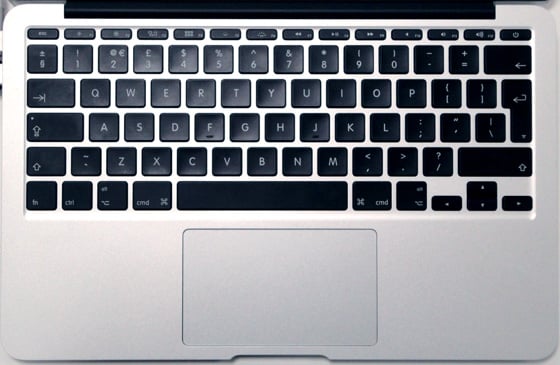
Sure enough: https://www.amazon.com/WhatKeys-Keyboard-Shortcut-Stickers-W...
$8 would have been instant click. I program for a living on a Mac and still can't remember the damn 'option' symbol in shortcuts.
$20...? Hmmm. Not so much. Where's that silver sharpie...
The only one that's really strange is ⌥, which by elimination is Option.
That is way easier to remember than "Swedish Campground", which we only got because there otherwise would be too many apples on the screen (http://www.folklore.org/StoryView.py?story=Swedish_Campgroun... the Apple 2 had 'closed Apple' and 'open Apple'. See http://www.macworld.com/article/2867994/think-retro-open-app...)
You don't want to be looking "where's the key with the Alt sign" or whatever key you want to find every time you need to hit it.
Ideally a keyboard could even be totally black -- and fancy touch-typing key-switching keyboards are.
I am still not sure why PC keyboards have a context menu key. I've only ever pressed it by accident.
Linux has control, alt, and meta (aka "super" or "the Windows key").
There's Control, Option/Alt, Command, and Shift. Four modifier keys. This is the same set you have on other OSes, except there, Command is called Windows Key or Super.
Yes, Apple has symbols as abbreviations for Control, Command, Option, and Shift. Yes, Option is also called Alt. But it's not really all that complicated.
I don't understand why we tolerative having shift, fn, control, alt, option, and command, not to mention ⌘ whatever that is. Is it really necessary? Do I need to be an Apple historian to be able to understand the primary input device on a Mac?
Command makes sense. And we need shift for capital letters. Let's just leave it at that.