To pop the bubble you must not exercise any demand at all. And to short, you have to construct a financial scheme that benefits when the price goes down.
For example, you could 'borrow' a home, sell it at market price, then 10 years later when prices are much lower, buy it back, then give back the home to the person you lent it from. Or in fact, housing prices could rise, as long as they do not rise more than another guaranteed investment, it makes sense to short this stock and reinvest it into the other investment, and you'd still make money, interestingly, without having to need money in the first place. Of course in practice all of the above is tricky and risky, and so I appreciate that within the opportunity set of a normal citizen, renting is preferable to buying, but let's not call it the equivalent of shorting.
Now, it doesn't matter which you do, either buy or rent. They are both wrong, because both are sky-high.
That's only true if your rent covers their payment, which tends to not be true in a bubble. Where I am, in the years leading up to 2008 there were more rentals available than the market could really support. People were buying houses and getting rents that only covered part of the payment because they were counting on capital appreciation to make them money. If you were a renter it was a great deal. For $1600 you could rent a house that would sell for $700k, which isn't even close to covering the payment.
After the bubble popped the price of housing went down dramatically, and the price of rentals went up dramatically as people stopped buying houses assuming they would appreciate forever.
Also, people who've never owned a house drastically underestimate the costs associated with owning one. I bought my house after the crash, for cash. My housing outlay (with no mortgage) is about 75% of what I paid in rent. And that's not counting maintenance, like painting and appliance repair, or major stuff like a new roof. If the bubble had never popped I would have come out far ahead just staying in the apartment and investing the savings.
You're not financing the bubble.. The bubble is based on valuations that assume much higher income than what you provide by renting at going market rates.
True. In relative terms, and in this context, you could say it 'contributes' to the bubble.
I still maintain that the concept of normal (organic, non-speculative) demand contributing to a bubble is generally wrong. I don't think it's accurate to say that any and all sources of support for the price are contributing to the bubble. This conceptual framework will mislead people about the cause of a bubble.
But in the context you're using it, it could be considered accurate.
PS. you don't need to get hostile. I was explaining how I interpreted your statement, not 'putting words in your mouth'.
Did Vancouver or Canada recently experience a huge economic boom and increase it's residents income band to more than the Reno, NV levels than it currently is? Actually, the opposite is happening with alberta's oil industry currently imploding and every imported good going up %30 in price due to the property increase.
I moved away, like a lot of younger people, to somewhere somewhat more affordable, and I suggest anyone who is a software dev to do the same. The compensation delta is %100+.
But for software devs, I definitely suggest the USA, either Seattle or even the SF Bay Area / NYC because the pay is so much more.
The last time a property bubble in a developed economy fueled by Chinese speculators crashed, it crashed by 70%. [1]
People never see a property price crash coming.
Credit Suisse First Boston – 15 July 1997: [2]
We believe the supply demand imbalance will continue to drive residential prices during 4Q 1997 and into 1Q 1998. The two extremes will perform best; luxury residential prices should fare particularly well as we see flows of capital into the top end of this sector. Luxury property is also much less sensitive to affordability levels and much more geared to supply and price expectations. The smallest units (below 40 square metres) will also fare well as there is very limited supply at this level, yet they are the most affordable private sector flats.
[1] http://www.macrobusiness.com.au/wp-content/uploads/2013/04/H...
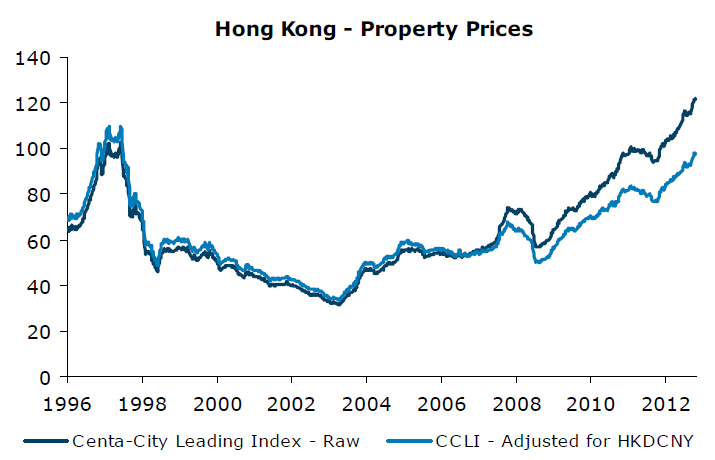
[2] http://www.businessinsider.com/hong-kong-property-did-you-se...
The overheated property markets Vancouver & Sydney are fuelled by Chinese speculators. Why are they buying overseas when there's a perfectly sound economy right on their border, Hong Kong?
There's a property bubble in Hong Kong too, and it was getting expensive there, the Chinese went overseas to other well-off cities that are full of Chinese, Vancouver and Sydney. If Hong Kong was leading the price rise amongst the three cities, it might lead the price fall too.
At this very moment, Hong Kong's property prices are slumping:
http://www.bloomberg.com/news/articles/2016-02-01/hong-kong-...
One could argue, for all the many rich people buying in Vancouver who could shrug off market fluctuation, there are even more millionaires and billionaires in Hong Kong, which has the 4th highest billionaires per capita, who could shrug off even bigger market fluctuations. Yet it's property price is falling anyway.
One third of property buyers in Vancouver are Chinese. How many percent Chinese do you think are buying the property in Hong Kong?
FUN facts - IF the Vancouver housing market crashed by 70%
1] - A Vancouver detached house would still be valued at OVER the current Canadian national average selling price(2016-02) for detached homes of 503K
2] If you exclude Vancouver and Toronto sales out of the national housing sale, the average price of a home drops from 503K to 355k
Nearly all of these millionaire immigrants to Quebec move to BC.
http://www.scmp.com/comment/blogs/article/1929324/study-reve...
People always see the property price crash coming. People know, intuitively, housing can't go up 20% or 50% or whatever every year. It's just that they think they can make money and get out before the crash happens. Let me put on my Carnac the Magnificent turban and tell you there's definitely a property price crash coming in Toronto and Vancouver. Guaranteed.
The problem is you have to know when it's coming to cash in, and I can't help you there. If I could I'd be buying up million dollar houses. These things last way, way longer than I expect.
Isn't this a bit like any statement. 'People who get hit by a car never saw it coming'. Or 'people diagnosed with cancer weeks before they died, never saw it coming'. Well sure, ignoring the people who did saw it coming, which are events we then ignore. i.e. there may have been various formations of bubbles, people saw it coming, adjusted their investments, and the bubble diminished.
Further, it's not like today, people don't realise there's a bubble in Vancouver. It's pretty much the opposite.
Property price crash != property bubble.
Everyone knows there's a bubble in Vancouver. No one thinks the bubble is crashing next month or even this year.
You've got people on this very thread thinking Vancouver's people are selling their souls and never getting it back.
I think for a general statement, it's carries a lot more weight than the two examples you've given.
It's a general description of sentiment during a bubble, not a precise description of each person's state of mind. As a statement, I think it's fine as it is.
1) Alice owns a property.
2) Bob borrows the property and gives Alice an 'IOU one house'.
3) Bob sells the property.
4) Market falls
5) Bob buys the property back, hands it back to Alice, and destroys the IOU.
As a result, I think there would have to be something more like this:
1. Alice owns a property that she would like to keep, but will not be using for X months.
2. Alice's default course of action would be to lease it out for those X months and get rental income.
3. Bob offers an alternative: Alice sells to Bob, who promises to sell it back after X months at the same price, while also paying the expected rental income for X months, plus an additional cash incentive.
4. Bob signs a note promising to give back that exact house after paying Alice the rent-equivalent every month for X months, and an escrow agent secures the note by putting a lien on the property equal to its current value plus Y%.
5. Bob can now attempt to short, by selling to someone else for the current value, and putting up Y% in cash as margin, to clear the lien. Bob also has to insert a panic clause giving him the option to rescind the sale by paying the buyers that Y% before the X months elapse.
6a. If the market value drops, Bob re-buys the property and transfers it back to Alice as promised. The escrow agent returns Bob's margin and the difference in sale prices.
6b. If the market value rises less than Y%, Bob buys the property back and transfers it back to Alice. The escrow agent returns the remainder of Bob's margin.
6c. If the market value rises more than Y%, Bob is unable to repurchase the property with pre-secured funds, and Alice might be pissed. The escrow agent could hand over all the cash to Alice, but the property itself would be worth more than that. To avoid this, the escrow agent will activate the panic clause immediately, using the escrowed cash, whenever increase in value approaches a fixed fraction of Y%.
Note that if Bob does not sell the property, the terms of the note and security instrument make the deal indistinguishable from a lease. Note also that there is so much friction in the real property markets that it is just a hell of a lot easier to short shares in any public company that owns a lot of developed land.
Part of the problem is much of the central property has been redeveloped, also increasing prices. Its tough to find place at <$800/bedroom or <$1000 for a studio in central Vancouver.
I would expect to pay $2200 for a central Sydney studio.
My apartment, 2 bedroom with study, half hour from the city, costs $2200 too.
I rent out the bedroom at $1050 and the study (size of 3 single beds tucked together) at $800 as a side venture.
Let me know the address of this secret cabal that meets every evening plotting misery and pain for the young and the middle class.
On a more serious note, this is just capitalism and free market economy playing out against you.
Also remember those days when people screamed real estate being a bad investment from the roof tops, while people belittled real estate investments and glorified stocks, a section of people have quietly invested in this area.
The fact of the matter is these opportunities were available for every one, but just like other things like in life like age, education, marriage, kids- time is a critical factor in these things. If you don't make the right moves at the right time blaming others hardly makes sense. People can't buy expensive homes for the same reasons, people with no education can't go back in age and do their schooling.
Investments are all about time, in fact I'm sure there are good house deals at the outskirts which many people are investing in. The young and middle class isn't buying them because they are too far/<regular excuses>. And yet when the prices go up after a few years and that too becomes expensive, same people will come up with the same complaints.
CBC did a great piece on it: http://www.cbc.ca/doczone/episodes/the-condo-game
This ain't going to end well.
Why indeed?
If there is a shortage of housing, why not build more houses?
Otherwise, if a person wants to exclusively use a piece of land, why shouldn't he have to outbid everybody else?
Unless of course an 'ordinary middle class' and 'the young' are somehow more valued than 'rich chinese people' and so should be given special privileges?
>In fact put one giant price on the whole of Vancouver and sell it ALL in one big job lot.
Well not everybody wants to sell obviously but if everybody does want to sell, why shouldn't they sell to 'rich chinese people'? Why should they not be paid the most for what is rightfully their property?
Because the new houses built are intended to be bought buy people who have money at incredibly high prices.
This argument is the one the property developers put whenever citizens object to selling real estate overseas.
In effect "don't complain, just build us more houses to sell overseas! that will solve the problem"
The demand is not infinite. If these new luxury houses actually do sell to the people who have the money to pay the incredibly high prices, what happens to the existing houses that were not purpose-built to sell to the rich? If the new houses satisfy even a part of the demand, prices on the existing houses have to drop.
This is like saying "all the rich chinese are buying up all the expensive top end iphones and now all the poor people of the earth and the seas can not have smartphones for their enjoyment".
Again and again I see the same 'fixed size pie' argument when somebody argues for special privileges for the 'special class' that they conveniently belong to.
What about all the canadians who bought their house 4 years ago and now have their property price increased 200%? Nobody talks about those guys. You only hear the 'evil rich foreigner chinese taking up out houses' narrative. If you are a rich foreigner you are taking our houses and if you are poor then you are taking our jobs.
At the end of the day these narratives are just appeal to group-identity and nationalism. They are very thinly veiled attempt at enraging people to get more 'engagement' 'views' 'clicks' or whatever. And they are clearly working because people who are sensible otherwise start losing their minds.
If the chinese people are of Chinese nationality then that is exactly true, from the perspective of the government of Canada.
> Well not everybody wants to sell obviously but if everybody does want to sell, why shouldn't they sell to 'rich chinese people'?
Because nurturing a foreign rentier class is not the best plan for retaining your sovereignty and keeping local people happy and wealthy?
I'm an Eastern European living in a relatively big Eastern European city, and I'm now writing this from an apartment that I'm a renting from a very cool French guy, the owner, who is in his late 50s or so. At the height of the local real estate bubble (in 2007) the Norwegian sovereign wealth fund invested in buying 500 apartments in a local project, the investment flopped (I don't petty the Norwegians, though, that fund is huge). And I could go on and on with other examples of foreign-owned properties in the city where I'm living in.
Point is, this is capitalism. I'm paying rent to the French owner of my apartment with the money I'm gaining from my current American oversees employer, and there's nothing wrong with that. You guys cannot choose which aspects of capitalism you want to like and which not, i.e. you cannot be allowed to invest freely in other parts of the globe (like Canada is now allowed to do) and in turn not allow other nations to invest in Canada (like not allowing Chinese real estate investors to buy property in Canada). Because if you do that you're economic colonialists.
Every country chooses which aspects of capitalism they want, via regulation, taxes, social programs. Even the most laissez-faire county does. There is no pure capitalism, it doesn't exist.
Yes they can, all countries do this. Minimum wage laws, environmental protection laws, progressive taxation etc... All designed to restrict elements of capitalism we don't like.
>You cannot be allowed to invest freely in other parts of the globe
Their are all kinds of property restrictions on foreigners in many many countries. Until 6 months ago foreigners couldn't buy property in China without first living there for a year.
If a country wants to restrict foreign property purchases that's their business. They don't owe anything to other countries who let their citizens buy property. The reason those other countries allow foreigners to buy properties is not altruistic, it's to attract investment. They would continue to allow Canadians to buy homes even if Canada completely shut their citizens out. But if Canadians started driving up local home prices to the point that they are causing problems, they would add restrictions.
So Canada doesn't want FDI, got it. Well, good for them, it means they're self sufficient.
It's interesting because when the going was good, meaning when Canada was making tons of money out of selling their mineral riches to China, I didn't use to hear so many bad stuff about the Chinese. Now, when some of those Chinese people want to invest their money back into Canada somehow it's bad for the middle class Canadians. I'm missing something, because I can't make sense of all this, but I'm just a programmer.
You're using the word "investment" to make it sound like they are starting local businesses that create well-paying long term jobs, grow the economy, and contribute to the community. The truth is that these houses sit empty 11 months of the year (or more).
Lastly, guess where that profit is going to end up when they sell? Not in the Canadian economy like it would have if a purchased by a Canadian. So again, is this a net gain? It's hard to say, but don't over simplify it.
Their perspective might as well be that canadian citizens are tax-cows to be milked until dry.
We should care about the people not the government.
It's not as solid of a distinction outside the U.S. where there is so much anti-government "them vs. us" mentality (rightly or wrongly).
If I say "the Government of Canada wants to legalize marijuana", it's generally safe to assume that is the will of the people unless evidence is presented to the contrary.
Of course, the government can and does occasionally go against the will of the people but that's more the exception than the rule.
Citizens should be granted privileges over non-citizens.
Who gives a toss for community or society or cohesion. Sell everything.
As long as property sellers can take all that lovely cash and buy more and bigger homes then what else matters?
Ordinary middle class people and the young - make em rent! Why the sense of entitlement that people should be able to afford to buy a home, what are you a communist? Whose country do you think this is?
In fact put one giant price on the whole of Vancouver and sell it ALL in one big job lot.