News for hackers. Stuff that matters.
Re:Chinese Buy One-Third of Vancouver Homes: National Bank E... by meric on Thursday March 24, 2016 @01:36AM (#11350793)
Not a bad idea...When the bubble pops buy it all back. Meanwhile, rent. That's equivalent to shorting the bubble.
Re:Chinese Buy One-Third of Vancouver Homes: National Bank E... by IkmoIkmo on Thursday March 24, 2016 @06:25AM (#11351723)
That's not shorting, in fact by renting you're financing the bubble. After all, valuation is done on the present value of future cash flows. Firms that earn a lot of money are thus valuable, as are firms that will grow into firms that make a lot of money. By renting, you're constructing that cash flow.

To pop the bubble you must not exercise any demand at all. And to short, you have to construct a financial scheme that benefits when the price goes down.

For example, you could 'borrow' a home, sell it at market price, then 10 years later when prices are much lower, buy it back, then give back the home to the person you lent it from. Or in fact, housing prices could rise, as long as they do not rise more than another guaranteed investment, it makes sense to short this stock and reinvest it into the other investment, and you'd still make money, interestingly, without having to need money in the first place. Of course in practice all of the above is tricky and risky, and so I appreciate that within the opportunity set of a normal citizen, renting is preferable to buying, but let's not call it the equivalent of shorting.

Re:Chinese Buy One-Third of Vancouver Homes: National Bank E... by pfarnsworth on Thursday March 24, 2016 @07:34AM (#11351972)
It depends on the rent price vs price to own. If renting is much cheaper, which it is in Vancouver unlike SF, then you are wrong. If the rent prices are equivalent to buying, like they are in the Bay Area, then you would be correct.
Re:Chinese Buy One-Third of Vancouver Homes: National Bank E... by gmarx on Thursday March 24, 2016 @11:08AM (#11353357)
Renting and buying prices are equivalent in the Bay area? Not in Palo Alto or the few surrounding cities.
Re:Chinese Buy One-Third of Vancouver Homes: National Bank E... by pfarnsworth on Thursday March 24, 2016 @12:18PM (#11354047)
10 years ago or more, the rent prices were much lower than the price to buy a place so it made sense.

Now, it doesn't matter which you do, either buy or rent. They are both wrong, because both are sky-high.

Re:Chinese Buy One-Third of Vancouver Homes: National Bank E... by illicium on Thursday March 24, 2016 @02:38PM (#11355211)
When the Bay Area housing bubble collapses in the future, renting will get cheaper, and your mortgage will stay the same.
Re:Chinese Buy One-Third of Vancouver Homes: National Bank E... by rconti on Thursday March 24, 2016 @12:28PM (#11354145)
No it doesn't. If you're renting, you're financing someone else's ownership of the property. It doesn't matter if they own it outright, or if you're only paying 1/10th of their mortgage. It only matters in degrees.
Re:Chinese Buy One-Third of Vancouver Homes: National Bank E... by gozur88 on Thursday March 24, 2016 @06:10PM (#11356893)
>No it doesn't. If you're renting, you're financing someone else's ownership of the property.

That's only true if your rent covers their payment, which tends to not be true in a bubble. Where I am, in the years leading up to 2008 there were more rentals available than the market could really support. People were buying houses and getting rents that only covered part of the payment because they were counting on capital appreciation to make them money. If you were a renter it was a great deal. For $1600 you could rent a house that would sell for $700k, which isn't even close to covering the payment.

After the bubble popped the price of housing went down dramatically, and the price of rentals went up dramatically as people stopped buying houses assuming they would appreciate forever.

Also, people who've never owned a house drastically underestimate the costs associated with owning one. I bought my house after the crash, for cash. My housing outlay (with no mortgage) is about 75% of what I paid in rent. And that's not counting maintenance, like painting and appliance repair, or major stuff like a new roof. If the bubble had never popped I would have come out far ahead just staying in the apartment and investing the savings.

Re:Chinese Buy One-Third of Vancouver Homes: National Bank E... by aminok on Thursday March 24, 2016 @08:13AM (#11352152)
"That's not shorting, in fact by renting you're financing the bubble."

You're not financing the bubble.. The bubble is based on valuations that assume much higher income than what you provide by renting at going market rates.

Re:Chinese Buy One-Third of Vancouver Homes: National Bank E... by IkmoIkmo on Thursday March 24, 2016 @11:28AM (#11353563)
I agree on the latter part of your statement, but that bubble valuation is based on an incorrect multiple and momentum of housing income, both of which are partially created and sustained by demand, which renting is, which is why I disagree on the former part of your statement. Bubbles usually start with actual high returns that are valued fairly, which attracts investors and turns it into a disproportionately large self-fulfilling prophecy. To keep renting in Vancouver now thereby definitely does contribute to the bubble, even though of course it doesn't create the bubble all by itself. If you want to short it, or do something with similar intentions, like the person I was replying to suggested, then I wouldn't recommend renting like that person suggested.
Re:Chinese Buy One-Third of Vancouver Homes: National Bank E... by aminok on Thursday March 24, 2016 @07:11PM (#11357257)
To the extent that the valuation is inaccurate, it's not based on the housing income created and sustained by demand. It's a based on a projection of the growth in that housing income. I believe you're mis-blaming real demand for rental units the for the mistakes being made by real estate investors in projecting growth in housing income.
Re:Chinese Buy One-Third of Vancouver Homes: National Bank E... by IkmoIkmo on Friday March 25, 2016 @02:53AM (#11358809)
No. Someone suggested that, to pop a bubble, you must 'short' by renting. I explained that no, that's technically not shorting, and no, if shorting the market is not an opportunity to you, then renting will indeed contribute to sustaining a bubble more relative to getting out of exercising demand on the market completely (i.e., not buying or renting but relocating). Both of those statements of mine are completely correct, and none of them imply that renting in and of itself creates a bubble, which are the words you seem to be putting in my mouth.
Re:Chinese Buy One-Third of Vancouver Homes: National Bank E... by aminok on Friday March 25, 2016 @06:16AM (#11359300)
>then renting will indeed contribute to sustaining a bubble more relative to getting out of exercising demand on the market completely

True. In relative terms, and in this context, you could say it 'contributes' to the bubble.

I still maintain that the concept of normal (organic, non-speculative) demand contributing to a bubble is generally wrong. I don't think it's accurate to say that any and all sources of support for the price are contributing to the bubble. This conceptual framework will mislead people about the cause of a bubble.

But in the context you're using it, it could be considered accurate.

PS. you don't need to get hostile. I was explaining how I interpreted your statement, not 'putting words in your mouth'.

Re:Chinese Buy One-Third of Vancouver Homes: National Bank E... by mahyarm on Thursday March 24, 2016 @04:30AM (#11351329)
I thought the bubble would of popped 9 years ago in 2007. It hasn't. Should I wait another decade for "bubble^2: faster, stronger" to not pop this time? Is the property value going up by about the canadian currency drop or more in the past 18 months a coincidence?

Did Vancouver or Canada recently experience a huge economic boom and increase it's residents income band to more than the Reno, NV levels than it currently is? Actually, the opposite is happening with alberta's oil industry currently imploding and every imported good going up %30 in price due to the property increase.

I moved away, like a lot of younger people, to somewhere somewhat more affordable, and I suggest anyone who is a software dev to do the same. The compensation delta is %100+.

Re:Chinese Buy One-Third of Vancouver Homes: National Bank E... by stuxnet79 on Thursday March 24, 2016 @09:26AM (#11352509)
What's that other somewhere? It can't be in Canada surely, because the only other tech hot spot I can think of is Toronto and it's not that much better here sadly. I don't know too much about Montreal.
Re:Chinese Buy One-Third of Vancouver Homes: National Bank E... by mahyarm on Thursday March 24, 2016 @01:59PM (#11354905)
Well ironically, even when alberta was in economic boom mode, it was more affordable to buy a house there than it was in vancouver. And it's still more affordable. Also montreal. The big RE bubble areas of canada are Toronto and Vancouver.

But for software devs, I definitely suggest the USA, either Seattle or even the SF Bay Area / NYC because the pay is so much more.

Re:Chinese Buy One-Third of Vancouver Homes: National Bank E... by narrator on Thursday March 24, 2016 @04:26AM (#11351320)
Why rent to the riff-raff if you are so rich? It's such a hassle. The property values going up is enough of a return. Soon we will have an empty Vancouver that serves as a city sized trophy case for rich people.
Re:Chinese Buy One-Third of Vancouver Homes: National Bank E... by hoodoof on Thursday March 24, 2016 @01:37AM (#11350796)
Do you think the people buying these houses are so poorly off that they will sell when times get tough or do you think they incredibly rich and will laugh off market fluctuations?
Re:Chinese Buy One-Third of Vancouver Homes: National Bank E... by seanmcdirmid on Thursday March 24, 2016 @03:07AM (#11351100)
They will sell, just like they sold when the Japanese bubble popped. This has happened before, playing out in almost the exact same way (except the bubble is bigger this time, and more cities are involved).
Re:Chinese Buy One-Third of Vancouver Homes: National Bank E... by meric on Thursday March 24, 2016 @01:47AM (#11350826)
Yes, they will sell. These people don't care about the price when they buy. They won't care about the price when they sell either.

The last time a property bubble in a developed economy fueled by Chinese speculators crashed, it crashed by 70%. [1]

People never see a property price crash coming.

Credit Suisse First Boston – 15 July 1997: [2]

We believe the supply demand imbalance will continue to drive residential prices during 4Q 1997 and into 1Q 1998. The two extremes will perform best; luxury residential prices should fare particularly well as we see flows of capital into the top end of this sector. Luxury property is also much less sensitive to affordability levels and much more geared to supply and price expectations. The smallest units (below 40 square metres) will also fare well as there is very limited supply at this level, yet they are the most affordable private sector flats.

[1] http://www.macrobusiness.com.au/wp-content/uploads/2013/04/H...
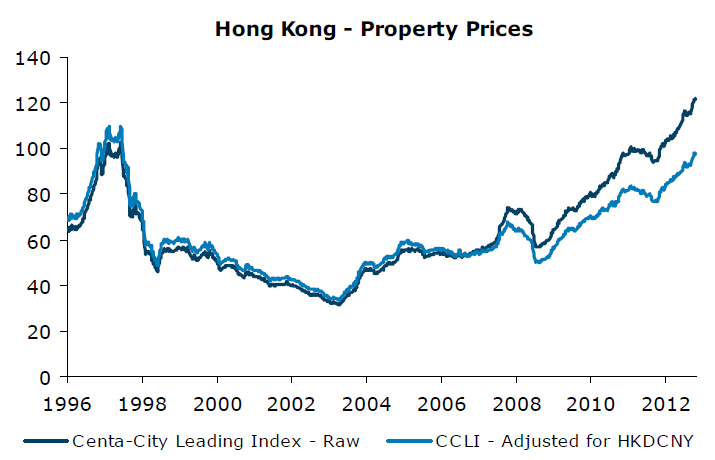
[2] http://www.businessinsider.com/hong-kong-property-did-you-se...

The overheated property markets Vancouver & Sydney are fuelled by Chinese speculators. Why are they buying overseas when there's a perfectly sound economy right on their border, Hong Kong?

There's a property bubble in Hong Kong too, and it was getting expensive there, the Chinese went overseas to other well-off cities that are full of Chinese, Vancouver and Sydney. If Hong Kong was leading the price rise amongst the three cities, it might lead the price fall too.

At this very moment, Hong Kong's property prices are slumping:

http://www.bloomberg.com/news/articles/2016-02-01/hong-kong-...

One could argue, for all the many rich people buying in Vancouver who could shrug off market fluctuation, there are even more millionaires and billionaires in Hong Kong, which has the 4th highest billionaires per capita, who could shrug off even bigger market fluctuations. Yet it's property price is falling anyway.

One third of property buyers in Vancouver are Chinese. How many percent Chinese do you think are buying the property in Hong Kong?

Re:Chinese Buy One-Third of Vancouver Homes: National Bank E... by sospep on Thursday March 24, 2016 @11:17AM (#11353447)
> the last time a property bubble in a developed economy fueled by Chinese speculators crashed, it crashed by 70%

FUN facts - IF the Vancouver housing market crashed by 70%

1] - A Vancouver detached house would still be valued at OVER the current Canadian national average selling price(2016-02) for detached homes of 503K

2] If you exclude Vancouver and Toronto sales out of the national housing sale, the average price of a home drops from 503K to 355k

SRC http://creastats.crea.ca/natl/index.htm

Re:Chinese Buy One-Third of Vancouver Homes: National Bank E... by hkmurakami on Thursday March 24, 2016 @02:14AM (#11350921)
Wasn't the Vancouver property also fueled by some kind of citizenship granting process from purchasing property in excess of some price?
Re:Chinese Buy One-Third of Vancouver Homes: National Bank E... by tostitos1979 on Thursday March 24, 2016 @09:36AM (#11352583)
Not anymore as far as I know. And not for a few years.
Re:Chinese Buy One-Third of Vancouver Homes: National Bank E... by Tiktaalik on Thursday March 24, 2016 @10:42AM (#11353159)
The Fed investor immigration program was canned, but there's still a backdoor in Quebec letting in millionaire immigrants, as Quebec manages their own investor immigrant scheme.

Nearly all of these millionaire immigrants to Quebec move to BC.

http://www.scmp.com/comment/blogs/article/1929324/study-reve...

Re:Chinese Buy One-Third of Vancouver Homes: National Bank E... by throwaway6969 on Thursday March 24, 2016 @02:09PM (#11354999)
That is unfortunate. There's been a long history of provinces just screwing each other (Sask just recently put two homeless men on a bus to vancouver).I wonder why the federal govt doesnt have full jurisdiction on immigrant visas.
Re:Chinese Buy One-Third of Vancouver Homes: National Bank E... by gozur88 on Thursday March 24, 2016 @06:30PM (#11357021)
>People never see a property price crash coming.

People always see the property price crash coming. People know, intuitively, housing can't go up 20% or 50% or whatever every year. It's just that they think they can make money and get out before the crash happens. Let me put on my Carnac the Magnificent turban and tell you there's definitely a property price crash coming in Toronto and Vancouver. Guaranteed.

The problem is you have to know when it's coming to cash in, and I can't help you there. If I could I'd be buying up million dollar houses. These things last way, way longer than I expect.

Re:Chinese Buy One-Third of Vancouver Homes: National Bank E... by IkmoIkmo on Thursday March 24, 2016 @06:29AM (#11351740)
> People never see a property price crash coming.

Isn't this a bit like any statement. 'People who get hit by a car never saw it coming'. Or 'people diagnosed with cancer weeks before they died, never saw it coming'. Well sure, ignoring the people who did saw it coming, which are events we then ignore. i.e. there may have been various formations of bubbles, people saw it coming, adjusted their investments, and the bubble diminished.

Further, it's not like today, people don't realise there's a bubble in Vancouver. It's pretty much the opposite.

Re:Chinese Buy One-Third of Vancouver Homes: National Bank E... by meric on Thursday March 24, 2016 @07:57AM (#11352088)
>> people don't realise there's a bubble in Vancouver.

Property price crash != property bubble.

Everyone knows there's a bubble in Vancouver. No one thinks the bubble is crashing next month or even this year.

You've got people on this very thread thinking Vancouver's people are selling their souls and never getting it back.

I think for a general statement, it's carries a lot more weight than the two examples you've given.

It's a general description of sentiment during a bubble, not a precise description of each person's state of mind. As a statement, I think it's fine as it is.

Re:Chinese Buy One-Third of Vancouver Homes: National Bank E... by moistgorilla on Thursday March 24, 2016 @04:12AM (#11351292)
if the bubble pops it means people are selling.
Re:Chinese Buy One-Third of Vancouver Homes: National Bank E... by redcalx on Thursday March 24, 2016 @08:36AM (#11352250)
Shorting the bubble would be more like:

1) Alice owns a property.

2) Bob borrows the property and gives Alice an 'IOU one house'.

3) Bob sells the property.

4) Market falls

5) Bob buys the property back, hands it back to Alice, and destroys the IOU.

Re:Chinese Buy One-Third of Vancouver Homes: National Bank E... by logfromblammo on Thursday March 24, 2016 @12:32PM (#11354195)
In #2, as residential properties are not usually completely fungible, it would have to be an "IOU this exact house".

As a result, I think there would have to be something more like this:

1. Alice owns a property that she would like to keep, but will not be using for X months.

2. Alice's default course of action would be to lease it out for those X months and get rental income.

3. Bob offers an alternative: Alice sells to Bob, who promises to sell it back after X months at the same price, while also paying the expected rental income for X months, plus an additional cash incentive.

4. Bob signs a note promising to give back that exact house after paying Alice the rent-equivalent every month for X months, and an escrow agent secures the note by putting a lien on the property equal to its current value plus Y%.

5. Bob can now attempt to short, by selling to someone else for the current value, and putting up Y% in cash as margin, to clear the lien. Bob also has to insert a panic clause giving him the option to rescind the sale by paying the buyers that Y% before the X months elapse.

6a. If the market value drops, Bob re-buys the property and transfers it back to Alice as promised. The escrow agent returns Bob's margin and the difference in sale prices.

6b. If the market value rises less than Y%, Bob buys the property back and transfers it back to Alice. The escrow agent returns the remainder of Bob's margin.

6c. If the market value rises more than Y%, Bob is unable to repurchase the property with pre-secured funds, and Alice might be pissed. The escrow agent could hand over all the cash to Alice, but the property itself would be worth more than that. To avoid this, the escrow agent will activate the panic clause immediately, using the escrowed cash, whenever increase in value approaches a fixed fraction of Y%.

Note that if Bob does not sell the property, the terms of the note and security instrument make the deal indistinguishable from a lease. Note also that there is so much friction in the real property markets that it is just a hell of a lot easier to short shares in any public company that owns a lot of developed land.

Re:Chinese Buy One-Third of Vancouver Homes: National Bank E... by serge2k on Thursday March 24, 2016 @04:53AM (#11351398)
The problem is the bubble is being propped up by foreign investment. So much money is able to flow, and the buyers have no incentive to keep the prices down.
Re:Chinese Buy One-Third of Vancouver Homes: National Bank E... by maxxxxx on Thursday March 24, 2016 @01:08PM (#11354501)
They will keep the bubble going with the help of your tax payer money.
Re:Chinese Buy One-Third of Vancouver Homes: National Bank E... by trevelyan on Thursday March 24, 2016 @06:03AM (#11351647)
Renting isn't a short because you don't profit when the market goes down. And you are still out rent.
Re:Chinese Buy One-Third of Vancouver Homes: National Bank E... by mahyarm on Thursday March 24, 2016 @02:50PM (#11355320)
It isn't but it is a hedge. You put that down payment in some other asset class (stocks?), pay about half of what a mortgage would be currently and then profit when the RE asset bubble pops and buy when it's cheaper. And while your waiting the stocks themselves will probably have a gain of some sort.
Re:Chinese Buy One-Third of Vancouver Homes: National Bank E... by kazinator on Thursday March 24, 2016 @11:36AM (#11353631)
The correct stock/equity analogy of renting is that you don't own shares of XYZ; you do volunteer work for XYZ. You pay XYZ regular dividends instead of the other way around, you maintain the equipment of XYZ and so on.
Re:Chinese Buy One-Third of Vancouver Homes: National Bank E... by rfrey on Thursday March 24, 2016 @08:29AM (#11352227)
I think what was meant by the short was selling at current prices and holding the money, intending to buy back after a crash.
Re:Chinese Buy One-Third of Vancouver Homes: National Bank E... by badsock on Thursday March 24, 2016 @02:34AM (#11350996)
It can be very difficult to find a place to rent in Vancouver.
Re:Chinese Buy One-Third of Vancouver Homes: National Bank E... by meric on Thursday March 24, 2016 @02:45AM (#11351027)
Vancouver properties seem to be renting for around half the price of Sydney properties, where I live. [1] It seems relatively affordable to me. But then again, maybe I'm numb to it...

[1] https://vancouver.craigslist.ca/search/apa

Re:Chinese Buy One-Third of Vancouver Homes: National Bank E... by graeham on Thursday March 24, 2016 @05:26AM (#11351507)
Depends a fair bit on location. Many of the 'cheap' places there aren't actually in Vancouver, but a 45 min drive away in a neighbooring city/ suburb.

Part of the problem is much of the central property has been redeveloped, also increasing prices. Its tough to find place at <$800/bedroom or <$1000 for a studio in central Vancouver.

Re:Chinese Buy One-Third of Vancouver Homes: National Bank E... by meric on Thursday March 24, 2016 @08:03AM (#11352114)
Since everyone thinks it's expensive, it is.

I would expect to pay $2200 for a central Sydney studio.

My apartment, 2 bedroom with study, half hour from the city, costs $2200 too.

I rent out the bedroom at $1050 and the study (size of 3 single beds tucked together) at $800 as a side venture.