I turned down a nearby alley in order to head back home, and was half way down it when a creepy-looking car with no lights on squeaked to a stop and blocked off the end of the alley. I froze and looked at it, and that's when the spotlight came on, and I realized it was a cop.
Unfortunately, my thought process went "oh, I must look suspicious. But wait, I don't have any ID. Maybe they didn't see me yet...", so I hopped into a driveway, out of sight of the cop. Oops, bad move. They went full lights-and-siren, and burned rubber down the alley towards me.
I took off running towards my house, zigzagging between houses to break line of sight. When I got back home, I hopped my fence and went in the back door, just because it was the closest entrance.
Double-unfortunately, apparently the cops decided I was a serious threat, and several minutes later I looked out the window to a police car in my own alley, following a cop with a german shepherd. The dog circled my property, and then barked at the fence, so the cops kicked my gate down and searched my back yard. They jiggled the doors and windows, found them locked, and decided to call it a night.
I got up early the next morning to fix my gate, and my parents never found out about it.
Two obviously bored deputies stopped me, talked to me for about 60 minutes, checked my backpack and generally couldn't believe a kid would be out on his own free will at that early a time.
No probable cause, I wasn't trespassing (walked the entire way on the sidewalk), but stopped because I was out of the ordinary. This was in a sleepy coastal California town in the late '70s, no real crime to speak of, but no, these guys had to be dicks.
If they had been cool, they would have called my parents to see if I was a runaway, or at least given me a ride to the lagoon, but no, they just wanted to be dicks.
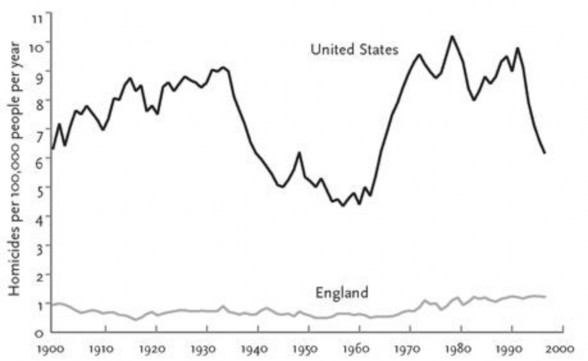
After crime fell dramatically in the US, we should have laid off a few. Instead we just hired more and more and more. Now we're seeing the effects of over-policing.

Jerry: I tell you what they should do, they should combine the two jobs, make it one job, 'cop\garbage man'. I always see cops walking around with nothing to do. Grab a broom! Start sweeping. You sweep sweep sweep... catch a criminal, get right back to sweeping.
Police have too much free time. Basically, their career path requires that they bring in money or arrests and if crime is down, they'll find ways to meet the unofficial quotas that are held over them.
Crime is down. This is the predictable result of having more police officers to handle less crime. Add in other factors like increasing militarization of law enforcement and the disqualification of people with high IQs and we get the mess that we have today.
Search for Jordan V. New London.
It's interesting, for sure, but certainly difficult to understand or draw any conclusions from without further context.
Figure 1 -- This one I'm not too sure about. It says "Cumulative percent growth in number of full-time sworn personnel."
Figure 2 -- It says "Full-time state and local law enforcement employees, 1992-2008". Each bar has "Civilians" "Sworn Officers" and "Total". I'm guessing that this is the break-down of "Sworn Officers" vs "Civilians" from the pool of "Full-time state and local law enforcement employees." Not all of those employees are sworn officers.
Figure 3 -- Just like Figure 2, but the numbers are "per 100,000 residents."
Also:
"Two things get your ass kicked faster than anything: one is making a cop run. If he catches you, you're 18 years old, you've got fucking Nikes, he’s got cop shoes, he's wearing a utility belt, if you fucking run and he catches you, you're gonna take some lumps. That’s always been part of the code. Rodney King could’ve quoted that much of it to you."
https://www.themarshallproject.org/2015/04/29/david-simon-on...
So we're walking around downtown just enjoying a nice summer night, when a police car shows up in a corner. No big deal, it's actually nice to see them around. We walk a block and there's the police car again... and it was like that for basically every block we walked until we got home. Fortunately we were not stopped, but we were definitely being followed and watched.
We come from Latin America but we're both white (German ancestry). I can't help but think the experience would likely have been a little worse if we had more typical Latino looks.
Is it generally that people feel they won't be victims to crime if they're armed?
"When seconds count, the police are only minutes away."
This is a large and diverse country. There are significant areas of land where the median time until an emergency first-responder will appear is a multiple of the median duration of a typical criminal (or dangerous wildlife) encounter. With the right planning, I could probably walk coast to coast unarmed, without ever feeling unsafe. But if I took my hotel budget and bought a tent and sidearm instead, I wouldn't need to do nearly as much research ahead of time. Besides that, not all dangerous animals are human enough to know the law.
I don't typically go about armed, but several people that I know do. They consider it to not just be protection for themselves, but for their entire community, like vaccinations.
The weapon does not prevent the crime, but it does suggest a more favorable outcome.
In this particular instance, my opinion of the meaning of the 2nd Amendment to the U.S. Constitution is not clouded by any doubt.
The anecdotal facts I have at my disposal suggest that common gun ownership is neither necessary for public safety nor detrimental to it. The security of a people seems to be correlated more to the strength of their character than that of their arsenal.
I dislike authority and cops more than most, but I also like evidence and I don't feel like this supports the implied harassment.
2) The whole thing made us feel very uncomfortable. Sure, they could have been looking out for us... But if that was the case, why didn't they just pull over and tell us that? Our relaxing evening walk became tense with us wondering why the police was watching us.
It's tacitly understood that "smelled weed" is one of several simply accepted pretenses that give an officer the ability manufacture probable cause out of thin air.
http://www.bostonglobe.com/metro/2014/07/09/sjc-odor-unburnt...
The problem is that marijuana shouldn't be illegal in the first place. But it is illegal, and it's also common enough that if a cop smells weed, it's believable. Part of the problem here is that we make too many things illegal, and since cops have some choice in which laws they enforce when, it gives cops far too much power.
Like, require they take photos and they can just plant the evidence before they take the photo.
Compare and contrast a dank whiff with gun fire. I'd like police to be able to respond to the sound of gun fire. I don't see how it is less problematic than responding to the smell of marijuana.
Yeah, but, you know, we actually do have such a problem: http://en.wikipedia.org/wiki/Police_perjury
The checks on abuse of power should happen at a higher level in the system than making rules about what an officer can reliably testify about.
Why should there even be such rules? An officer, like any witness, can testify about anything they observe that is relevant to the matter under consideration by the court, and not barred by any generally-applicable prohibition (e.g., hearsay, etc., to the extent that is barred.)
Whether such testimony is reliable is a matter for the court/jury receiving the testimony to consider, based on the statement, any evidence of bias of the witness, and any conflicting or corroborating evidence.
Treating cops as privileged witnesses in any domain makes no sense, and seems to be contrary to the whole thrust of the Constitutional constraints on the criminal justice system, which are to protect the individual from arbitrary action by the government or its agents.
I think I probably agree that police shouldn't base searches on smelling weed (I'd have to think about whether they should be able to stop a car and tell them to tone it down).
What I don't agree with is making that determination based on concerns about fabricated statements about smelling weed.
The concern about fabrication by the government underlies much of the Constitutional restriction on government power in the criminal domain. I'd say that restricting government based on that concern is generally legitimate, and has a strong tradition in the US.
The line shifts a bit in the case of imminent danger, because we prefer to take more of a risk with the cops than the criminals in that case. A smell of marijuana doesn't indicate a life-threatening situation so we're back to the whole abuse-of-power bit for why the police can't just search people entirely at will.
I see what you are saying about limits on power and trust being mixed together, if someone is literally 100% trustworthy there is no need to limit their power. I still think it is reasonable to consider whether police can reliably testify that they smelled something (this should at least be a goal for a just system) separately from the question of whether they should be allowed to act upon smelling something.
Hell look at parallel construction.
Long story short, was there for two months, walked home maybe five times, got stopped and id'd twice. Both occasions they were really confused as to not only why someone would walk "so far" to get home, but how.
They were totally fine taking my student id as a drivers license when I got pulled over speeding though. Ho hum.
I have had very few police interactions where it was not clear that the cops viewed their role as dominating and using overwhelming force. U.S cops seem to have a very militaristic mindset which is really bizarre, considering compared to other jobs, being a cop is not that dangerous.In fact, the one case that stood out to me was one where a cop acted the way he should have. I got rear-ended on New Years Eve (as luck would have it, right in front of the State Trooper Barracks). The State Trooper who responded was amazing. He checked on everyone, found that the passenger of the idiot who rear ended me had a broken nose (she had no seatbelt on), called an ambulance, squared everything. He had a truly calming presence. That is how cops should be.
The aggressiveness in the police along with the adversarial attitude needs to change, it's been unhealthy for a while, on the other hand crime is down, but no one can agree why. Is it police aggressiveness, tougher sentencing, removal of pollutants from environment, aging population.... There are several explanations, but none are completely convincing.
I think some day we'll have to reconsider the interpretation of the second amendment, short of that, change people's perception of firearms. Households with firearms suffer more injury due to accidents than they prevent via deterrence. So, we need to change the attitude so that owning firearms are frowned upon as much as being a tax dodger is frowned upon.
It's hard to avoid feeling that being preemptively aggressive when you know there are people either crazy enough or desperate or foolish enough to use a firearm against a cop and that having your guard down can result in premature departure. But if the likelihood of guns circulating was low, you could give the public the benefit of doubt.
"No police officer in England has died from a weapon attack during the past two years, according to the most recent published data, and none have been involved in fatal shootings during that period."
http://www.nytimes.com/2015/05/05/us/police-start-to-reconsi...
I think you're mistaking correlation for causation.
Consider: a household that's more likely to be in danger is also more likely to have a gun. For example, a drug dealer is frequently in dangerous situations, and so is likely to have a gun. He's also more likely to be injured or killed than your or I. Is that because he owns that gun? It seems unlikely. Many more legitimate professions and activities carry risks like that.
So simply showing that correlation isn't anywhere near sufficient to demonstrate that the gun owner would be safer without his gun.
One of the first, and most important things we can do is to change the language we are using. Above, you spoke of civilians as different from - separate from - police officers.
Please stop doing this. All police officers are civilians - just like you and I.[1]
If you are not in the process of being arrested you are the peer in every way of the police officer. Don't forget it.
[1] With the obvious exception of the reader of this comment who is an active duty soldier/sailor.
Police should be held to a higher standard to compensate for this, and the civilian legal system is poorly equipped to handle them.
Violent, aggressive EMTs trying to treat a patient?
And a huge portion of the people jailed in the US are jailed for non-violent crimes.
If you can't deal differently with violent, aggressive people than with people who are clearly non-violent and not aggressive, you have no fucking business being a cop.
Having lived and worked in some pretty nasty areas, I've dealt with some violent, aggressive individuals, yet every day I manage to restrain myself from wrongly accusing people of crimes and beating up innocent people. I'm not sure why you think this is hard.
> The cop-hate is really getting out of control.
I think I have a right to hate people who are violent and aggressive.
> Inner-city blacks kill a lot more black people than cops do, yet we bend over backwards to not be judgemental of them.
No, I hate inner-city blacks who kill people just as much as I hate cops who kill people. I just don't talk about it much, because we don't seem to have much problem giving inner-city blacks who kill people the jail time they deserve.
> But automatic hatred of cops is really driven by the same kind of thinking.
I don't automatically hate cops. It just so happens that cops frequently go out of their way to give me reason to hate them.
I haven't encountered many, if any, people who bend over backwards to not be judgmental of inner city blacks who kill other black people, least of all the people who like to point to the number of inner city blacks who kill black people as a means of dismissing specific criticism aggressive behavior by cops.
Yes racism is bad. But...
Oh, yeah, there it is.
He died because he was placed on his stomach, with his arms handcuffed behind his back. This, combined with the fact that he was overweight made it impossible for him to breath effectively [1].
The 'interesting' (and depressing) thing is that the EMS crew that responded should have recognized this and had the cops reposition him. Instead, they just went with the flow, and didn't intervene... The one positive that has come out of his death is that his case is now the go-to example used to show EMS students how not to handle situations like that, and how to be an advocate for their patients.
[1] It's actually a bit more complicated than that... if he were just 'resting' in that position, he likely would be fine, but his inability to breathe deeply prevented his body from being able to compensate for various processes that kicked into overdrive when he was resisting the cops, but the tl; dr; is that if he had been placed on his back, or sitting up, he would almost certainly still be alive. Placing him on his stomach was against NYPD policy, and both the cops and EMTs/paramedics should have known better.
Well maybe this should change.
I am a night owl and sometimes take walks at night. I don't drink, I'm completely sober. Nevertheless I've been stopped and patted down a few times. Once I was illegally searched because the officer "smelled weed" (I favor legalization, but I haven't smoked since college--I don't like how it makes me feel). And I'm a white guy in my late 20s who dresses like a businessy nerd--if I weren't who knows whether I'd be in jail for some made-up charge by now.
Cops in the US have a combative relationship with the people they serve and that has to change. They work for us--we need to get them under control.
Stopping medical professionals from doing their jobs puts the lives of civilians in danger. Cops should be required to defer to medical professionals unequivocally.