Sure more pixels usually mean slightly more information, and there's obviously techniques: stability-enhancement, faster shots etc, that change this critical point. But for the average person carrying a camera: we crossed the critical point long ago and now just waste a lot of SSD space.
This results in an obvious merging of the blue/green strips. The more the diffraction the more they merge, the less sharp the images become.
Current APS-C sensors at 18 megapixels have pixels small enough that an aperture of around f/11 is the minimum size before this effect begins. As sensors get more and more dense, the required aperture size gets larger and larger. F/8 is considered a 'normal' aperture and once sensors hit that density then the payoff from increased resolution is significantly less and can impact image quality adversely.
This is why science missions use 2mp CCDs that they know the characteristics of, rather than some 40 megapixel phone sensor.
edit: I've just realised I've typed all this out with the wrong idea. You wanted a simple explanation of diffraction. Imagine a water tank with waves being generated from a source at one end. Put a wall with a narrow hole in the middle of the tank. If the wavelength of the waves is significantly less than the width of the hole, they will for the most part pass through unaltered. As the hole gets smaller, more significant changes to the waves occur. They begin to 'spread out' or 'diffract'. An intuitive explanation is difficult but this is a practical one that makes sense to people.
There's also technological barriers for creating large megapixel CCDs as opposed to CMOS. Large CCDs are usually created by "stitching" multiple sensors together, which increase their price as a square of the size.
You can shoot fullframe (35mm) camera at ISO 25600 and get decent results, but if you crank up signal amplification on iPhone to 25600 you'll get nothing but random color dots :-)
It would be foolish to suggest there was a single motivator for inclusion of a sensor. In reality it is a combination of our answers. Large sensors allows lower gain and better noise performance, enables smaller aperture use at acceptable sharpness, takes less resources to process, transmit etc.
You're not wrong in mentioning it though. Although FF at 25600 is going to be piss poor even if it's Nikon / Sony.
edit: corrected stupid misspelling
Nikon D600 at 25600: http://www.imaging-resource.com/PRODS/nikon-d600/nikon-d600G...
Not even close to "piss poor" in my book.
That being said, you don't go that high unless you're very desperate and the sensor itself can go up to 6400, the rest is software.

That was f/32. The rings around the street lamps are diffraction artifacts.
As a result, higher pixel densities will cause light from a single point to be spread across multiple pixels, with different wavelengths going to different pixels. Software can probably reconstruct the image somewhat, but I'm sure you'll hit a limit where there is too much interference to get the image any sharper no matter how many pixels you squeeze in.
What you've described is chromatic aberration.
Diffraction refers to the spreading of waves around an obstacle -- such as the aperture blades in your camera. No lens need be involved -- you can get diffraction with a pinhole camera.
The higher your resolution compared to your aperture, the less photons you get per pixel.
Sensor size doesn't matter at all.
Diffraction cannot be solved as easily.
If your sensor counts a mean of 100 photons per pixel, then you'll see shot noise with standard deviation of 10 photons in each of those, for a signal-to-noise ratio of 10. If you quadruple your pixel size and now measure 400 photons per pixel, then your SNR goes up to 20.
This is why bigger sensors (more captured photons for same light level and exposure time) are fundamentally better at image capture.
I realize that is a very flawed analogy but it's the quickest I could come up with.
Here's more: http://en.wikipedia.org/wiki/Shot_noise#Optics
He never said that Moore's Law explains everything. He simply said that Hendy's Law explains why phones will soon has 39-megapixel cameras. Since the Nokia Lumia 1020 is available today with a 41-megapixel sensor, I do not find this to be farfetched.
Facebook and Instagram will depend not on Moore's Law, but on availability of bandwidth and cost of storage. To argue against Moore's Law for Facebook is to argue against a strawman. The article did not make that connection -- you did.
In 2005, would you have predicted that Youtube would never carry 1080p videos? I mean, back then, Blu-ray and HD-DVD were still battling it out for dominance of the next-generation disc market.
I was referring to the fact this is on kurzweilai.net and Kurzweil tends to think it does explain everything: how we're going to beat the turing test in 16 years, how he's going to resurrect his dead father, etc.
From the subtitle to the last paragraph, the article clearly implies that this technique will soon be applied to social networking sites. And it seems to use Moore's law to handwave the details.
Famous last words when predicting non-advance of technology.
Please help me understand a future where social networking sites will maintain and display ~ 6200px X 6200px photos of your selfies. Outside of genetically engineering new eyeballs, I'm struggling here.
I think it's safe to assume that FB has tried to keep the original version of every photo ever uploaded. A few years ago, YouTube retroactively upgraded uploaded videos to HD. It's also safe to assume that they're going to continue upgrading/evolving/extending their most important feature, photos, and try to make it the #1 place to organize, store, and share all your photos.
Facebook then becomes an API upgrade away from exposing the original versions of uploaded photos. The photos will also come with all of your friend's faces conveniently tagged, allowing an app with the right permissions to extract high resolution faces/pupils/reflections. None of this needs to happen in the news stream.
So they may not have full resolution versions from the mobile, which is likely their primary source of pictures.
For a while, the Java upload tool was knocking down resolution before upload on desktop, too. That was a few years ago, I think. 2008-09?
I'm not saying you're wrong. But look at it this way: you are predicting that the resolution of stored photos won't increase by another power of ten. If you are right, this would be the first time in tech history that such a prediction would be correct.
Also, just a nitpick. I think relevant factor is ~100, the difference between the current resolution maintained by most websites and the proposed one for this technique to start becoming feasible.
[Ok, 20 may be right. I didn't know they allowed 2000x1000]
Personally, I will enjoy seeing high res pictures of other people on my 4k monitor when I get one.
Again, not saying I'm 100% that you're wrong, but you're making a bold and unprecedented prediction.
it would be cool to make group pictures, though.
10 years ago, I never would've guessed we'd be up to 120" TVs with 4k resolution. I was pretty happy with my 42", which was a big step up from what my parents had used before.
Right now, those examples I mentioned are new and expensive, but it won't be another 10 years before they come down in price and Sony and Samsung will be looking to sell us on another resolution.
Meanwhile, having computers hooked up to your TV is also becoming increasingly popular. My dad hates looking at a tiny computer screen, and would much rather look at photos on a TV.
So you've got high resolution TVs, and low resolution photos. That means the photos are too small or blown up to show their pixelation. That won't fly forever.
So, your limiting factor is glass, and manufacturing precision on that end is moving forward much slower than on the sensor.
[1] - http://www.luminous-landscape.com/tutorials/resolution.shtml
I wager we'll see 4k tablets under $1k within 2 years, and TVs will have to follow suit (drop in price, increase in quality).
Now imagine that lenses for single-shot panoramas are standard on all cameras and cellphones.
I used to think my 50GB disk was massive. Now I have more RAM than that, and use it all!
Photos will increase in size because of many factors, possibly including multiple focus points, or more color information, or 3d or a whole suite of yet to be thought up reasons.
I am very sure social networking sites will store larger files than 6.2k x 6.2k, with the 4K monitors and video and cameras producing larger and larger images (think medium format, even a piddly little smartphone now has 49MP!)
This saves a big resolution picture with spacial info. With your computer then you see a smaller part of the image. 6200x6200 images is not too much.
Add everything that has to do with 3D. Life is 3D, not 2D.
I can see the appeal of life-sized photos on social networking sites in the future. Group photos could benefit from being larger than that to include multiple people at life-size, but I'm unsure of how a resolution greater than 2400x3000 would be useful for a profile picture at this point.
[1] http://upload.wikimedia.org/wikipedia/commons/6/61/HeadAnthr...
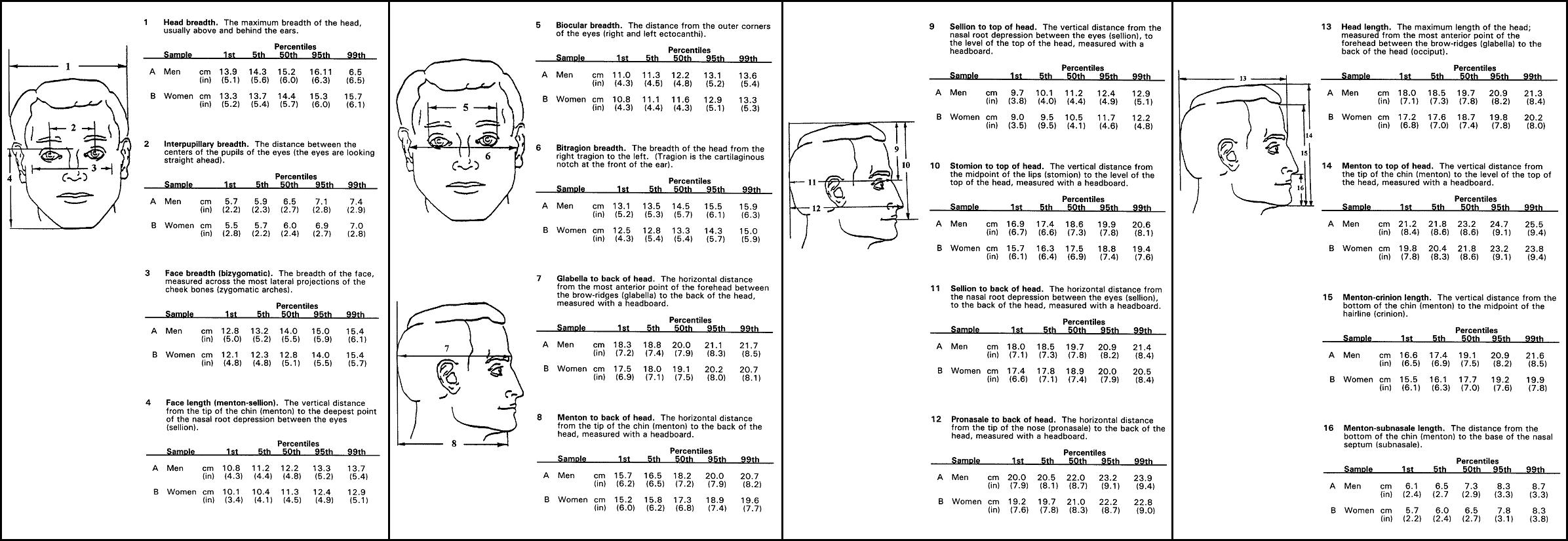
[2] http://prometheus.med.utah.edu/~bwjones/2010/06/apple-retina...
A few people are pointing out use cases where a 39MP photo might make sense down the line:
-Group photos
-Head to toe shots
-Panoramas
Let me just point out that this research is done on "high-resolution passport-style photographs." That is a close up head shot with a normal FOV. You fit your whole body, your friends, and everything else in the photo... you're going to need hundreds to thousands of mega pixels for this to work. At the end of the day, it looks like you still need > 39MP just for the face.
Ah Moore's Law. It explains everything. Double every twelve months, eh? Hmm, quick math. Facebook has been around for 9 years... oh yea, that explains why Facebook allows you to upload full resolution 60MP photos. /s
>What do your Instagram and Facebook photos reveal?
Nothing. They're about 100 times too small for this technique. And they probably always will be.