Most people just live with the stomach discomfort because it's difficult to try a gluten-free diet. And dismissive comments like yours also aren't helpful in motivating people to experiment.
I lived with stomach issues for 30+ years, and after trying a myriad of solutions, from eliminating dairy to exercise, I finally tried eliminating gluten from my diet. That did the trick.
A second problem is that there is a whole spectrum of how intolerant people can be to gluten. Some people will simply find they are a little more constipated or gassy the next day if they eat gluten and some will find that they need to urgently visit the restroom 30 minutes after consuming it. Neither of those groups of people would be considered celiacs. Many of the people in those groups go through live oblivious as to the cause.
Unfortunately, ignorance like that of lysol's grandparent comment dominates this debate. It's amazing and a bit scary the number of otherwise intelligent people who blindly assume that what is true for them is true for everyone. It's as if the mere fact that some people prefer to avoid gluten in their diets is a personal affront to them. It baffles me.
I thought I didn't have any issues with gluten until I stopped eating it for a month. Now if I eat gluten I get a headache almost immediately afterwards.
I'm married to a woman with a dietetics degree. We have discussed this subject. She has read papers on the topic, and knows the literature.
You, I am guessing, are a software developer, who, in all likelihood has not read the literature on this subject (if this assumption is incorrect i would be happy to stand corrected).
It mystifies me how people stand so sure of themselves and claims such as "gluten is an inflammatory agent", despite the fact that grains have been consumed by vast numbers of humans for millennia, the absence of evidence that it causes disease, and the fact that no causal links have been proposed between gluten and causing Celiac disease†.
†: my wife says that if you are strongly predisposed to Celiac (which has a genetic component), then yes, consuming gluten may exacerbate your condition. However the idea that you can take an otherwise healthy (or heck even unhealthy) person, force them to gorge on gluten to give them Celiac is definitely wrong.
It's not empirical, but if you have any evidence that suggests otherwise, I would gladly be corrected.
Here's a summary of the literature about Celiacs which my wife linked me to: https://www.clinicalkey.com/topics/pediatrics/celiac-disease...
You'll note in the epidemiology section that Celiacs to genetics. The disease is prevalent primarily in western european populations (or populations descended from western europe), and has actually shown a decrease in non-european descended populations.
(My wife also notes that in the Infant Diet section it does say that if you feed gluten to infants it can increase their chance of Celiac's. This is true if you have genes which predispose you to Celiac's. If you do not have the genes, you can't develop Celiac's. And even if you do have the genes, you can go throughout your life w/o developing Celiac's, although apparently being fed gluten early in life does increase your risks. Seems more like a thing about feeding infants than it does about gluten really.)
Edit: My wife also points out that Celiacs diagnoses prior to 1997 were done via biopsy (which is of course, invasive, when we're talking about intestines). After 1997, and the availability of a simple blood screening test, testing for Celiac's has become cheaper, easier, and more prevalent. That certainly must contribute to the increased number of diagnoses.
I hate the words "empty calories". It's an oxymoron. Calories cannot be "empty", they are fuel for the body, they always have been.
Only years of fad-diets and food industry advertising could have turned a staple of human evolution as bread as something "evil".
As it has only existed since the dawn of agriculture, your tying of it to evolution is incorrect.
I was speaking of evolution in broad terms (as in, social and technological evolution as a race) not strictly in terms of darwinian evolution.
I'm going to stop you right there and say that evidence is empirical.
I'll believe personal experience and observation over some conclusion from a published paper that used obscure statistical methods, possibly lied, got paid to publish a pre-determined finding and found a 2% significance of some occurrence of something with some caveats thrown in.
The ADA has no interest in preventing or curing diabetes as curing diabetes would end the institution. The AMA isn't interested in getting people healthy and proper treatment because that would eliminate the need of such an organization. The only reason Snickers isn't in the food pyramid is only because people aren't that stupid... yet.
http://www.underconsideration.com/speakup/archives/idiocracy...
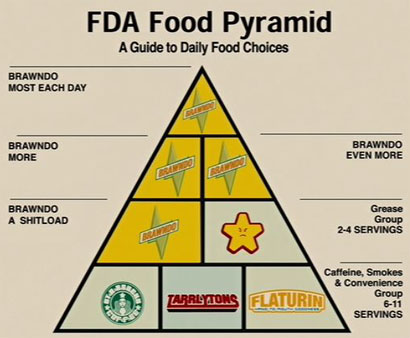
Sure, the Academy has its flaws, and there are bad actors who are out there just for fame and money who will lie to enrich themselves. But that's doubly true for the "health food" industry and people who claim to be nutritionists.
Humans are terrible at introspection regarding health matters. Absolutely horrible. This is one of the reasons why double-blind test protocols exist.
And so, even if you are so paranoid as to think that the American Medical Association is engaged in some mass conspiracy to keep people sick, unless you are also writing off all health care researchers, you've got to admit that there are people who are trying to help people, and help cure disease (which lets face it, we're actually pretty damn good at, all things considered).
Then you are in good company. There are many reports of villages complaining about wireless towers causing headaches and other health issues... even when it later turned out the towers were not even active. I read an interview today with Bill Gates, who noted that one of the biggest problems the Gates Foundation has encountered in its efforts to eradicate certain diseases is that 10-20% of the people hear rumors of vaccines being bad and refuse to take them.
The t-test isn't science in the strictest sense. It's a statistical method which informs us of probabilities and distributions.
If I find that eating fruit makes me fatter while a study concludes that it makes people skinnier, do I believe my own experience or the study?
Even with celiac disease: that just eliminates certain grains.
Comparative vitamin B-6 bioavailability from tuna, whole wheat bread and peanut butter.
http://www.ncbi.nlm.nih.gov/pubmed/6655507
the high phytate content of whole grains binds to minerals such as iron, calcium, magnesium, and zinc in the gastrointestinal tract, significantly reducing their absorption by the body
http://www.sciencedirect.com/science/article/pii/S0140673673...
EFFECTS OF PURIFIED PHYTATE AND PHYTATE-RICH BREAD UPON METABOLISM OF ZINC, CALCIUM, PHOSPHORUS, AND NITROGEN IN MAN
http://www.ncbi.nlm.nih.gov/pubmed/1657026
Effects of dietary fiber and phytic acid on mineral availability
It has long been recognized that high cereal grain consumption induces vitamin D deficiency in various animal species, including primates, our closest animal relatives. By studying the fate of radio-labelled vitamin D, researchers observed significantly increased excretion of vitamin D in healthy human volunteers fed sixty grams of wheat fiber daily.
http://www.ncbi.nlm.nih.gov/pubmed/6299329
Reduced plasma half-life of radio-labelled 25-hydroxyvitamin D3 in subjects receiving a high fiber diet.
Full analysis:
http://fox13now.com/2013/04/26/boy-11-dies-after-severe-alle...
https://www.ncbi.nlm.nih.gov/pubmed/10200001
This includes tree nut allergies as well. The short of it is that 0.6% of children under 18 in this study were found to have peanut or tree nut allergies. If this is true, that means many schools will probably have fewer than 5 students with the allergy.
In this case, outright bans seem to be more about reducing potential liability in the face of activist or litigious parents than they are actually addressing a student health issue.
My understanding of this type of reaction is that it doesn't require a large volume of the allergen to cause a very serious response. Trace amounts can be very dangerous. So it seems impossible to guarantee prevention by banning foods.
In my opinion, kids need to be aware of what they can and cannot eat, and the school must be prepared to actually deal with a reaction situation instead of just saying 'look, we banned peanut butter, what else do you expect?'
Anaphylaxis from food can take a while (up to an hour or two I believe) to set in. When it does, it can cut off an airway, and then you're basically racing against suffocation with an epipen. If the kid's outside at recess or in the bathroom alone or just slow to tell a teacher, you're in a bad situation.
I don't know how much gluten it takes to trigger some of the scarier symptoms of IBD or if any of them are lethal in children. My guess is they're not, just because I haven't heard of gluten bans in schools.
It was... bad. Another classmate also ended up hospitalized with a celiac diagnosis. Whether it was brought on by food, I don't know, but the prevalence of wheat in a standard American diet could lead one to believe so.
It definitely shouldn't.
The last time I saw my cousin she looked and acted anorexic, meanwhile raving about her new gluten free vegan lifestyle. She looked terrible. My other cousin who suffers from narcolepsy was on the same diet raving about all her new energy while falling asleep at the table. Meanwhile I went from being the fattest person in the family to the most in shape in less than 10 months. I usually jokingly order a side of gluten these days, just to piss the gluten freers off.
Tip for American grocery shoppers: Don't hit the isles. Stay within the vegetable and fruits section, shop there, only there, then leave. That is a healthy diet. Usually there are nuts and meat in that section. Don't be looking for the gluten free potato chips and cookies, that isn't healthy.
As someone who has tried to hack his way out of unhealthy eating (and succeeded somewhat), I've found that the biggest grocery shopping tip is to go to the store just after a meal.
I really couldn't say it any better than this. Vegetables people. Get more of them. Fresh ones. Learn to enjoy onions and mushrooms.
I think you just contradicted yourself entirely.
----
"The current international Codex Alimentarius standard allows for 20 parts per million of gluten in so-called "gluten-free" foods" - http://en.wikipedia.org/wiki/Gluten-free_diet
----
It's enough to prevent exacerbation of symptoms for those with gluten sensitivity, but it's not a complete removal.
Celiacs don't even eat food prepared in the same production environment as foods that contain gluten. The sentiment that these people are deluding themselves because their very careful planned and meticulously controlled gluten free diets still contain gluten is preposterous.
http://en.wikipedia.org/wiki/Gluten-free_diet#Popularity_and...
"One study examined the effect of ω-5 gliadin, the primary cause of wheat dependent exercise/aspirin induced anaphylaxis, and found increased permeability of intestinal cells caused by this gliadin and another wheat albumin."
http://en.wikipedia.org/wiki/Gluten_sensitivity#Gluten_toxic...
"Another line of research shows gliadin binds a chemoattractant receptor and causes increases of a factor that destroys tight junctions. These junctions prevent leakage around the cells that line the small intestine, resulting in the leaking of food proteins into the body."
http://en.wikipedia.org/wiki/Gluten_sensitivity#Gluten_toxic...
The second and third studies are a bit too specific. Can you break this down into a list of effects on every day people?
I think this quote sums it up best: "Gluten intolerance is one of the most popular self-diagnoses because of its over-expanded list of potential symptoms. The gluten scare is mostly an overblown hippy-fueled movement."
> A 2011 panel of celiac experts concluded that there is a condition related to gluten other than celiac disease and named it "non-celiac gluten sensitivity".[51] however, for those without celiac disease or gluten sensitivity, the diet is unnecessary.
Gluten causes gastrointestinal symptoms in subjects without celiac disease: a double-blind randomized placebo-controlled trial.
http://www.ncbi.nlm.nih.gov/pubmed/21224837
On a visual analog scale, patients were significantly worse with gluten within 1 week for overall symptoms (P=0.047), pain (P=0.016), bloating (P=0.031), satisfaction with stool consistency (P=0.024), and tiredness (P=0.001).
Lots of people aren't like me though, and for them I do not believe there is any particularly well documented issues when it comes to gluten.
^Where 'seems to have' is self-produced anecdata: I spend months working through food group diet permutations (starting with removing basically except lightly cooked vegetables, miso soup and congee :-/) in an attempt to zero in on what was causing near-permanent (~10am->sleeping) acid reflux I had developed. Conclusions point fairly strongly to gluten, which I now mostly stay away from (I still eat it occasionally, zomg burgers, I just make sure breads/pasta/etc isn't the base of my diet).
Yes, and anyone allergic to strawberries know they should be avoided as well.
I'd definitely be interested in a citation if you have one! I find this really interesting, especially since I've accidentally cut red meat out of my diet recently (despite enjoying it quite a lot, so I don't want to be ill next time I have it!), so I'm wondering on what sort of timescales these effects happen (both losing and gaining the ability to digest a certain food group).
But both problems happen all over the world.
They're not. Wheat contains gluten, a known gastrointestinal irritant, and celiac and IBD patients know that wheat is one thing you want to stay away from. It can also trigger inflammation and cause serious health problems for anyone with an inflammatory condition.
Perhaps proposing gluten-free foods is a better idea.
In addition, the guidelines for "advertising to children" are quite peculiar, and I don't know why children should be advertised to at all. What even constitutes advertising to children is not quite clear either.