Restaurant profit margins are not high, there is way too much competition. Until recently, and probably even now, the robotic technology needed to automate the kitchen would have been prohibitively expensive and likely unreliable. Restaurant kitchens are hot, greasy, steamy environments. Also anything that's used for food production has to be able to be regularly cleaned by immersion or high pressure hot water or chemical cleaning. Not great for electronics and precision mechanisms unless they are built to rugged specifications (not inexpensive). Even ordinary, manually operated restaurant equipment is very expensive compared to what we buy to use at home, and the reason is that reliability must be very high; you cannot afford to lose your production capability for even a short time, since restaurants are the ultimate just-in-time production operation.
Finally, unlike more traditional factory operations (e.g. automobile manufacturing) where robots replaced highly paid unionized workers, the average McDonald's worker probably makes less than $10/hr with minimal benefits. At maximum staffing, labor costs for the kitchen staff might be $50/hr, and at most times of the day, less than that. There's just not a huge savings to be had.
McDonalds are working with a certain flow of customers mostly based on location, time, etc, not on "ability to serve".
Now, if they start throwing people off because they are just too many to serve, that's another thing...
Burger assembly is only a small part of the labor cost. You have the cashier, the fries person, drinks, management, salad/deli assembly, cleaning (during opening hours as well as final cleanup afterwards), as well as carrying stock from the truck back to the store.
Whether those machines would be profitable would depend on whether it is worth saving 5% of the cost of a burger in exchange for the capital and maintenance cost of the machine.
McDonald's isn't a burger company. It is a real estate company.
http://seekingalpha.com/article/73533-mcdonalds-is-a-real-es...
As for the link - I don't buy his arguments: "First, it buys and sells properties, as one might suspect."
I've never seen a McDonald's close down. I'm sure they do sometimes, but they probably realize really quickly if the place will be profitable or if it needs to be sold asap. So effectively they never cash in on any long term real-estate investments. If the real-estate values goes up, more than likely you're gunna be selling more burgers too.
The second point he makes is kinda semantic. At the end of the day McDonalds needs to extract money from the franchise. They can charge more for using the brand, more for the ingredients or more for rent or whatever. It doesn't really have any significance. At the end they are trying to get as much money as possible out of the franchise without running the owners bankrupt.
His last point about them getting bought and all their real-estate sold.. I dunno maybe he was trying to just be cute - but net worth of assets is taken into account into the stock price. It's the kind of stuff that's on quarterly reports. Kinda scary that this guy is an investor.
“McDonald’s real moneymaking engine was its little-known real estate business, Franchise Realty Corporation; envisioned and created by Harry Sonneborn. The obscure McDonald’s alter ego company was based on Sonneborn’s unique even lesser known financial formula.” http://en.wikipedia.org/wiki/Harry_J._Sonneborn (First CEO)
Fewer people will see one close down than you might expect; the ones that close down are the ones that not enough people go to, so only small numbers of people see it close down - if lots of people were there to see it close, it wouldn't be closing.
I've seen plenty new ones open but never a closure.
This is in Glasgow, Scotland.
There are however plenty of better restaurants out there, Glasgow included, so don't be sad!
FWIW, I've seen two close down. This is in Brisbane, Australia (for those who are interested, one on Roma St, and another a bit further out, near the Albion Five-ways IIRC). They'd both been around for a while.
Not saying this changes anything about your point, just making an observation.
You might not want to, though. You might want to keep the redundant infrastructure around in case the automation breaks down and you need somebody to flip burgers in the interim, after all, the jobs you're replacing aren't terribly skilled.
Further the machines get cleaned constantly, and are deep cleaned every night. That takes people, and given how low the crew numbers are normally, you're not going to save anything by having robots make the food.
Thus I have said: in a few years time, we are going to face the choice - either we all retire, or we'll all be sacked. To take option 1, first discard money and capitalism.
In 10 years I think your comment will look just as silly.
Block Buster got squeezed out by automation - At the high end from iTunes and on the Low-End from Netflix/Redbox/Amazon.
People were tired of paying $5+ to rent from Blockbuster and get nailed with late fees all the time. Redbox simplified this model ($1/day until you return it). Of course the 24 hour kiosks are a boon too.
[1] https://lh3.ggpht.com/-0vJb6GbCYGs/Tn9dFJkPPUI/AAAAAAAAGtE/2...
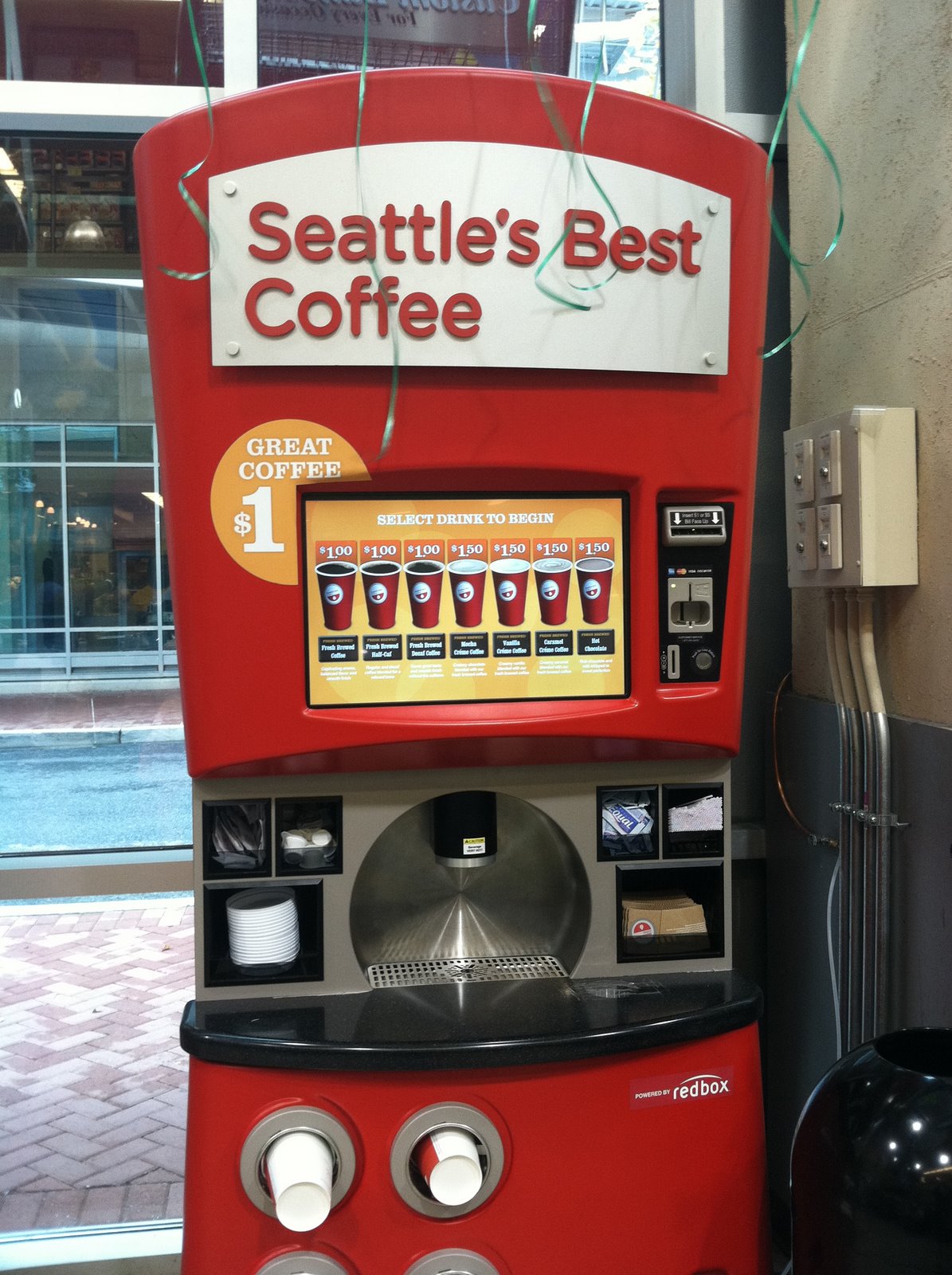
[2]https://blogs.msdn.com/cfs-filesystemfile.ashx/__key/communi...

You'd punch in your order (tall drip, decaf, etc.), and it would grind beans and brew your coffee all in about 20 seconds. They're quite spectacular.
Burger King, to take an example, probably doesn't give a crap about the restaurant sales at all.
Most of their profit is from franchise fees, not restaurant sales.
Company restaurant revenues in 2011 were 1638.7 million, and company restaurant expenses in 2011 were 1447.4 million. All told, profit from restaurant sales was 191 million.
Franchise fee revenue in 2011 was 697 million, franchise and property expenses 97.1 million. All told, profit from franchise fee revenue was 599.9 million.
Basically, I can't imagine they care if they are franchising restaurants with people, restaurants with robots, or heck, franchising robot boxes themselves.
They only care that someone is paying them to call it burger king, and giving them a cut of sales
I still think they'd be just as happy franchising robots. I could be wrong.
It was this judgment that I felt super-serial was responding to.
McDonald's is heavily invested in new technologies, but they are very conservative about deployment. If something like this did appeal to them, it would take a lot of field trials and monitoring before it went out. Remember that the corporation can specify certain equipment to produce their products, but in franchised stores those store owners need to do the actual purchase and maintenance of the equipment. They need buyin as well.
McDonald's also second-sources everything. If they say "this is the shake machine we recommend", there will be two competing companies making that type of machine. This is good business for a number of reasons. So something like this mega robot would never make it to the field without a duplicate style of machine being made by someone else.
As far as this robot goes, it's just too complex and too critical to base an entire restaurant upon. If it goes down, your entire operation is stalled for the duration of the repair. Doesn't matter if a technician is seated on a stool next to it 24 hours a day, you still can't guarantee when it will be running again. This type of technology just won't be able to compete with semi-skilled labor and simpler cooking devices for the mid to long-term.
Even if it costs less in the long run, increasing their startup costs might decrease growth enough to make it now worth it. And since they demand uniformity everywhere, they'd be in the position of imposing change on their existing franchisers who might not want it, which is never fun.
Not for all businesses, but for public ones, there is something pretty close: SEC EDGAR [1]. Search for the most recent 10-Q (concise quarterly filing) or 10-K (more detailed annual filing).
So you don't get an accurate look at how the average McDonalds franchise operates.
Other businesses have their earnings obscured by different sources of retail, or inexact expense breakdown.
With a complex machine like this, keeping it from breaking is the key. If it works well though...this really could change things.
That's a somewhat subjective statement.
I'd still rather eat a brick. Carl's Jr. continues to insist on using very un-marbled top sirloin and then they cook it to death, with it ending up extremely dry usually. At one point I think they must have experimented with using Gelatin to hold more of the moisture in the meat. It tasted like meat Jell-O.
Ugh...
The addition of providing a superior experience (custom meat combos? Slicing ingredients on the fly) might not have occurred to them. I think that emphasising the high output gourmet burger is the way forward. Especially since McDonald's has already proven that "Masstige" does have a spot in the food prep industry.
One of the top 3 hits for googling "restaurant industry publications" is an answer to someone asking this question.
I have the feeling that, if this sort of idea was as value as the article implies, McDonalds (or Burger King, or any other big chain) would have put serious money into developing this sort of thing and it would already be everywhere.
(I wish there was a website or publication that took businesses and profiled how they work, the challenges they face and the costs associated with parts of the business consumers might not understand, so these sort of questions were easy to answer. I would love to read how McDonalds works (as a business))