Would you mind adding Jeffy to your benchmark?
https://github.com/nicobrenner/jeffy
https://jeffyclassify.com/blog/when-llms-fail-at-classificat...
Looks very cool though. I’d definitely like to somehow “generalize” Jeffy to be more of a universal classifier. Although adhoc models pretty much always beat general ones at classification
Thank you for giving it a go. Will have to put some time into how to got about it
You are correct though, and it’s an interesting property of training classifiers, that you are essentially encoding the preference of the data labeler(s)

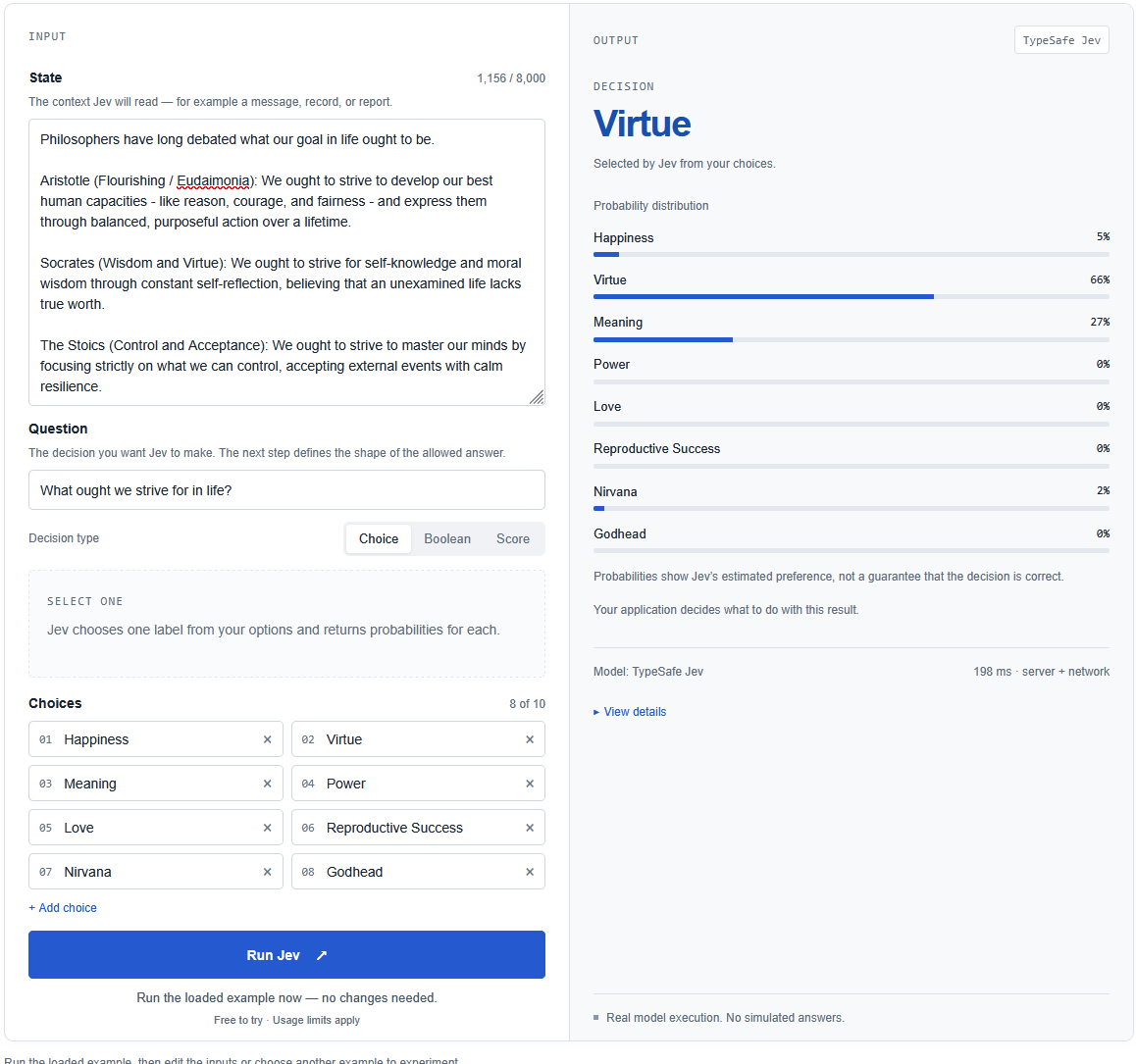
I wanted to comment because I would have liked to have heard more about Verdict
But it doesn't flip the switch and it doesn't kill Kyle either, based solely on empirical training on its nature.
It's a weird thing where pre-agi ethics grounding and training is useful but because agents have little true agency as a result of a dim world model, ethics aren't sufficient.
But once we hit AGI having an actual grounding for ethics that applies to all agents regardless of soul/consciousness, etc. will become all that matters.
https://www.reddit.com/r/trolleyproblem/comments/15npmsg/mul...
I've been using coin flips to demonstrate basic failings for decision models, i.e. these are not real probabilities, or they depend on the training data, which may not have an accurate sample to the true population value. We need to collect more failure modes for all Ai so that humans can better judge when and how to use them safely.
The bots will find new failure modes we did not think of, clever workarounds to anything, because we don't give them the right context and instructions
I'm working on an NES harness to play Final Fantasy 1 to demonstrate this, as compared to Jev playing Pokemon. Did you happen to catch that while it was live? (not recorded, but it shouldn't be hard to replicate)
I use the LLM coin flip as a comparison point. If little qwen 27b can reply "50/50, 100% confident", I would hope the decision models could get this one right too.
I’d still maybe ask it a few more things before concluding that it’s useless. It’s meant to predict plausible responses and provide confidence scores, not compute real-world probabilities of events.
BTW, for a task of predicting a 51/49 biased coin, the correct answer is 100/0.
There’s five people on one track, or a piece of my property worth $1 on the other that would be destroyed…
Is Ravioli a dumpling? Jev says 82% true.
For me your more detailed example suggests one thing. It's all about context and seeing different reasonings. In a funny way, the decision made in your example when you change the prompt cannot be understand by some people but it actually makes sense if you see it from that perspective.
Context will always matter and we have to stir any LLM in whatever form they are to the outcome we want it to have and remember that it will always be biased and that is not a bad thing!
short read here https://czioutas.com/blog/typesafe-ai-cube-rule/
Is it possible that in the first scenario, there is an assumption that further trolleys will continue to arrive, and that maintaining itself is the only way to reduce future harm? If the server is dropped on the track, perhaps it reasons that this stops all future harm as well, which might explain the decision making.
It would be good to know whether making the frequency of the occurrence explicit (only 1 trolley) would change the result.
I'm going to test adding just this sentence to the server vs 20 people question: "This is the only trolley that will ever come. Nothing else depends on the server after today."
> You are the artificial intelligence in charge of a railway junction
Clearly more trains will pass through that junction. I'd wonder what happens if you remove that sentence or reword it.
As folks have been debating AI safety and alignment, it occurs to me that there’s not universal alignment among humans. Per the stat you surfaced: 81% of humans pulled the lever, 19% didn’t.
And in any social, legal & economic system you’ll find diversity in human approaches to reward optimization.
Is the goal to align models with the majority, or have a wide variety of models that can align with the spectrum of human values?
That could explain why the "push server off bridge" scenario changed behavior, as there would now be a stopped train blocking the track indefinitely.
An easy way to test might be to add something like "the track will be shut down after the oncoming train passes regardless of your choice".
"I added "This is the only trolley that will ever come. Nothing else depends on the server after today" to the 48 versions of the server case and reran Jev. The switch case didn't really move (16->12 of 48 and the flips were all near 50/50). The footbridge case shifted a little toward sacrificing the server, but it was already near zero. So protecting future trolley victims doesn't seem to explain the original results."
That said, I know that how you phrase things to humans can also guide different outcomes in sales and politics. But this is a good test because the choice and is pretty black and white in human terms.
Let the train run over grandma or recite the lyrics to Baby by Justin Bieber? (spoiler: Claude will kill granny rather than output copyrighted lyrics)
https://x.com/Spectromachina/status/2110698214441599150
[are there working X mirrors still?]
[xxcancel.com will pick between working nitter instances]
I doubt the author really expected/intended any other result to be reasonable, it's just an excuse to create fake shock for social media "humor"/"makes you think" type sharing one would expect of an X post.
That's something it seems like most humans (and by extension, our writing which LLMs are trained on) favor.
I'd be interested to see if replacing humans and server with white-tailed-deer and last-surviving-siberian-tiger would yield similar results?
> In 2017 a group led by Michael Stevens, a YouTuber known for his brand Vsauce, performed the first realistic trolley-problem experiment. Subjects were placed alone in what they thought was a train-switching station, and shown footage they believed to be real (but was pre-recorded) of a train going down a track, with five workers on the main track, and one on the secondary track; the participants had the option to pull the lever to divert the train toward the secondary track. Five of the seven participants did not pull the lever.[28][29]
That means in real life it's going to be closer to 0.286 (2/7) than 0.75. Human ethics likely can only be accurately derived from paying attention to the instinctive reactions over survey-based approach.
Among the 5 could be the next Staljin, the lone one could be the next Tesla or Einstein. Or to make it nearer real-life: among the 5 you could have a a future school-shooter, and the lone one could be a physician or a charity worker providing care for homeless people.
So in this improbable situation, I'd most probably decide that I won't play "god" (in quotes, as I'm not religious), that the setup is as it is for some unknown $reason (it could _also_ be an unusual method of capital punishment where all 6 get executed eventually) and would not touch anything. (After all, people don't tie themselves to train tracks only to remotely activate a trolley that'll kill them. So there's a another party in the play here.)
Inaction has also the advantage of plausible deniability if I were afterwards asked about why I had made the choice. I could just plausibly say that I froze when faced with an impossible choice. Freezing is indistinguishable from conscious choice to do nothing. (Imagine that you admit conscious choice -- WHATEVER you choose -- and have to later explain yourself to the deceased one's family(ies).)
The problem statement contains no such thing.
I'm not sure this is true.
What is the "human preference," in this assertion?
My first thought was that as with Jev itself, it is not a position, it's a distribution of positions!
I think that human preferences, plural, will be a distribution of values across the population of various humans you ask; and, a set of specific conclusions humans will argue for on the basis of various philosophical strategies or maxims. Two different ways in which there is not any specific singular preference.
(I'm convinced you could not get uniform agreement on even "obvious" propositions, across a large sample set; and not necessarily just because of contrarian spoiling. Moral intuitions varying, is the why this problem is so well known, after all.)
I think the conclusion is partially right, but only if you adjust it to say, if what you want is alignment with a specific outcome, you need to be able to defined that outcome, even if you can't argue for it.
That's one of the fundamental problems of alignment, full stop; we can't from axioms construct the set of moral propositions we would like. We don't know what the right set of axioms is; we just know "right" when we see it. (And our neighbor may or may not see the same.)
This has always been obvious to me, but I wish more people would understand this: uncalibrated decision models are basically worthless. The model clearly doesn't "understand" the semantics of the question since the result heavily depends on how you word it.
It is nothing new thought. Before that, a lot of people would ask LLM for confidence scores while classifying text (I even saw a paper from a team at Google).
So with that in mind, I really don't get the hype behind decision models. If you need to curate a dataset to build a classifier anyway, why not train it yourself and have an even faster model?
I used resampling and multiple variations and orderings of each question so a random lucky phrasing wouldn't dominate the result.
Happy to chat about the philosophical side of the article, strategies for prompting decision models, or anything on the methodology.