How did they "neuter" Iran? Iran responded quickly and managed to heavily damage TelAviv and is now rushing to accelerate rebuilding their nuclear capabilities.
If anything, the previous operation was a disaster, it allowed to regime to entrench itself even further in IRAN and regime change that they were hoping for didn't happen.
I'm sure both Iran and Israel are gearing up for another round of heavy conflict later this year or early next year.
IRAN is still very much a threat to Israel.
https://nationalsecurityjournal.org/irans-air-force-is-start...
Israel gained air superiority over Iran and successfully conducted military decapitation strikes. Iran sort of launched some half-assed rockets in Israel's direction.
The only damage Israel has suffered is to its intelligence faculties in Iran.
> the previous operation was a disaster, it allowed to regime to entrench itself even further in IRAN and regime change that they were hoping for didn't happen
It was a tactical failure and strategic success. Iran's proxies have been shown they're completely fucking on their own--Tehran can't defend itself.
As for regime change, Israel didn't prosecute its war in a way that suggests that was the aim. Separatism? Yes. Destabilisation? Sure. Incapacitation? Surely. But regime change? I really don't think so. Knocking out the regime would likely mean elements of the IRGC consolidating power. That isn't a win for Israel.
> I'm sure both Iran and Israel are gearing up for another round of heavy conflict later this year or early next year
Iran doesn't have the ranged capability.
> IRAN is still very much a threat to Israel
I haven't seen any credible, impartial analysis that suggests this is remotely the case.
What happens when it turns into a contest of rocket production and absorption against a country with 10x the population and 20x the land area? Completely unwinnable for Israel. Iran doesn't need air superiority to fire rockets.
Iran was rapidly running out of launchers. Once Israel gained air supremacy, it severely reduced its launcher deployment to avoid losing them for nothing.
> What happens when it turns into a contest of rocket production and absorption against a country with 10x the population and 20x the land area? Completely unwinnable for Israel
Iranian rocket production rates aren't particularly amazing. Tehran's deterrence came from the size of their stockpile, and the fact that they could fire on Israel from four directions (Hezbollah, Hamas, Houthis and Iran proper).
> Iran doesn't need air superiority to fire rockets
Where did you get this?
Iran's MRBMs are mostly liquid fuelled [1] and stored in fortified bunkers (like V2s were). This leaves them highly vulnerable during fuelling (same as V2s). With air supremacy one can take out the missiles on the pad. (Which, due to the aforementioned fortification requirements, are predictably placed.) This is one reason Iran's missile firing rate collapsed during the war [2]--Israeli intelligence combined with targeted (land-origin, it seems) strikes took out their launchers.
Iran also has a fleet of solid-fuelled missiles which can be launched on short notice, but these are also less accurate, have to carry smaller payloads and more cheaply intercepted.
Moreover, in a war of attrition (which we did not reach, both sides were burning stockpiles) production reigns supreme. You need at least air parity to fire missiles. You need a favourable air situation to run fixed factories.
[1] https://www.iranwatch.org/our-publications/weapon-program-ba...
[2] https://jinsa.org/wp-content/uploads/2025/06/Iranian-Ballist...
Russia wasn't supposed to be economically capable of a war this long and yet here we are. And that's a war of choice. If Iran is being attacked, they have no choices. People will find a way to make missiles underground if they have to.
And that's all before we get into political and psychological factors. How long does Netanyahu stay in power if Tel Aviv is hit every day?
(I have to note, USA vs Iran and Israel vs Iran are very different economic comparisons. It would be impossible for Israel to sustain 24/7 suppression over a country Iran's size but maybe with enough American funding its more feasible.)
iran doesnt make israel's choices, so chances are israel is gonna attack either way for israel's own internal politics
You're referring to strategic depth. Iran has lots of it. Israel does not. Countering that, however, is power projection capability. Israel has a lot of this, through its air force and allies. Iran was thought to have a lot of it, through its proxies, but that failed.
Without its proxies, Iran's fire on Israel has to originate from its own territory. That means trading missile range against the protection offered by its strategic depth from Israeli counter-battery fire. Hence why Iran's launchers were somewhat distributed across its territory. But! If Israel has air supremacy, that strategic depth changes from a risk to a logistical cost. If Israeli jets can freely access Iranian air space, that extra distance Iran's central and eastern launchers have to fly don't trade against any defensive upside--they're still going to be blown up shortly after a pad is revealed. They just have to burn more fuel to get the same payload to the same place.
> Russia wasn't supposed to be economically capable of a war this long
There were a variety of estimates. Most of them assumed Russia's economy would crumble under sanctions and so Moscow would lose the will to fight. I don't believe any showed Russia would lose the ability.
> If Iran is being attacked, they have no choices. People will find a way to make missiles underground if they have to
Rockets, sure. Missiles? No. The Shahab-3 reaches altitudes of 400 km [1]. That's where the ISS orbits [2].
> How long does Netanyahu stay in power if Tel Aviv is hit every day?
How long does Putin stay in power if Ukraine keeps dismantling Russia's energy infrastructure? The sad truth is war-time leaders tend to be deposed after unpopular wars, not during them.
> It would be impossible for Israel to sustain 24/7 suppression over a country Iran's size
Again, they don't need to. They just need to destroy the launchers.
It's estimated Iran went from 350 to 100 launchers in the war. Once you've levelled the launchers, you're defending against unguided rockets (which everyone in between will try to pot) and drones (which are cheaper and easier to destroy and cause less damage).
> would be impossible for Israel to sustain 24/7 suppression over a country Iran's size but maybe with enough American funding its more feasible
Israel's economy is twice the size of Irans's [3][4]. Its smaller territory means it can concentrate air defences. And with 10x fewer mouths to feed, it can devote more of that economy to its war machine in a spurt.
Iran-Israel is super interesting because they don't share a border, and they sort of min-maxed their militaries and economies in very different ways. If Iran had maintained its proxies, I think your original analysis stands. Without them, when it can only fire from one direction and from far away, all while Israel can scoot up close and right on top of it, many of its advantages turn into liabilities.
[1] https://en.wikipedia.org/wiki/Shahab-3
[2] https://en.wikipedia.org/wiki/International_Space_Station
I think you're overindexing on a prepared sneak attack with maximum ops velocity from Israel. They threw the best punch they had and it.. disrupted Iran. Didn't knock them out.
Longer term, Israel has 260 fighter-bombers and Iran is huge. Allied analysts after WW2 generally concluded that strategic bombing didn't really move the needle on German war production, and that was with 10s of thousands of bombers, although admittedly a lot less precision. Any long, flat building in Iran's gigantic, mountainous country could be building missiles. And new launcher locations won't be plotted out ahead of time for a high-tempo 72 hour operation, they'll be coming up continuously over the long haul. They don't need to be hypersonic once interceptors are exhausted.
How's Israel going to sustain that long term, especially if they take any amount of ongoing civilian losses at all? It stops being an abstract conversation about collateral damage to civilians pretty quickly once it's happening to them. 10/1 ratio is nowhere near good enough for the polity there.
By the end of the war Iran was using domestic surveillance drones to direct artillery, and was even experimenting with the first attack drones by fitting RPGs on their larger surveillance UAVs, had reverse engineered and started domestically producing TOW missiles, had started producing the Shahab-1 ballistic missile (a Scud clone), Silkworm-clone radar-guided antiship cruise missiles, etc..., all the while their air force was down to less than 100 hundred aircraft in various degrees of disrepair and with very few advanced munitions remaining.
The war ultimately ended in a stalemate, even after the US intervened in Praying Mantis.
This is a terrible analogy. Iran and Iraq share a land border. That makes armies relevant in a way they are not to Israel-Iran.
Long term, no clue. The best strategy would be a system of regional alliances, but they've screwed that pooch with Gaza. Second best is setting red lines for Iranian missile production and stockpiles and intervening when those thresholds are breached.
What right does Israel have to govern Iran's self defense capabilities? Iran's been attacked unprovoked by USA/Israel several times in the last 6-7 years, they're not the ones starting shooting wars.
Iran's supply chain is already fully domestic thanks to sanctions. Repeated strikes on that supply chain will only serve to harden it.
> It's estimated Iran went from 350 to 100 launchers in the war. Once you've levelled the launchers, you're defending against unguided rockets (which everyone in between will try to pot) and drones (which are cheaper and easier to destroy and cause less damage).
That's possible, although no one actually knows how many TELs Iran has, and no one knows how many have been destroyed : Israeli evidence to that effect has been very very slim. Iran's TELs are essentially a pneumatic piston and a FCS (read: Beidou GNSS receiver) bolted onto a domestically-designed 8x8 or 10x10 platform. Iran has far, far more than 400 8x8/10x10 military trucks, so it's essentially impossible to know how many of those they can or have configured as a TEL at any given moment, especially since those conversions are easily done in undergound facilities.
So the "they just need to destroy the launchers" theory is very thin, on the edge of wishcasting. The launchers being domestically produced and similar/lesser in cost to the missiles they fire suggest that even if it does work once, it's not a viable long term strategy.
Iran has a very large automotive industry - they produce over 1 million cars per year. If the main strategic hit was to destroy 200 trucks made in a country that cranks out 1 000 000 cars, I'm going to very skeptical about claims of neutering them.
You may be confusing the guidance mechanisms of early ballistic missiles, which relied entirely on on-board inertial guidance. These missiles therefore needed quite precise initial guidance and an expensive TEL with a myriad of expensive sensors in order to calibrate themselves. Modern ballistic missiles don't work like that : they have non-inertial GNSS guidance (and for the most sophisticated, some kind of active or optical guidance system in the mid course and terminal phase) to complement inertial guidance. That means that the TEL just needs to communicate an initial position, so nothing much more complicated than a GNSS receiver is needed, and to the extent that this is incorrect, the missile can correct itself.
> Rockets, sure. Missiles? No. The Shahab-3 reaches altitudes of 400 km [1]. That's where the ISS orbits [2].
What does that have to do with anything? The Shahab-3 missile has a small fraction of the dV necessary to reach orbit, and is therefore much smaller than the kind of rocket you need for that. We already know that they are stored in large numbers underground, so what's the bottleneck that prevents underground production?
In fact, in Masyaf, Syria, Iran placed the planetary mixers which are the most sensitive and expensive component underground. There is no clear reason why they wouldn't have done so at home.
The rest of the production of solid-fueled missiles is bottlenecked by casting pits. Iran has placed mant of these above ground - obviously we can't know if or how many they have placed underground, but they seem to have largely resisted Israeli airstrikes - they are not a sensitive target. See : https://www.armscontrolwonk.com/archive/1220847/guest-post-a... for an independent account of Iranian MRBM-scale solid fueled rocket motor production. The only easy target are the planetary mixers - Israel has claimed to have targeted them, but in Masyaf, Syria, they failed to destroy them using airstrikes and had to resort to a commando attack on the underground facility, so that theory is thin as well.
> Its smaller territory means it can concentrate air defences.
That's right, which is why Israel uses weapons designed to evade air defenses and exploit gaps, while Iran uses weapons that simply exhaust interceptors. The former is easier to exploit from the get go, but the latter fails catastrophically once the breaking point arrives.
> And with 10x fewer mouths to feed, it can devote more of that economy to its war machine in a spurt.
Yes, but Iran doesn't feed it's citizens in US dollars (at least not anymore), it feeds them using a PPP-adjusted basket of goods. And similarly while Israel's interceptors are in large part manufactured in the USA and paid for in USD, Iran's missiles are almost entirely manufactured domestically, with workers paid in a much cheaper basket of goods. In terms of exchaning interceptors and ballistic missiles, Iran is ahead.
The main issue Iran has is that their missiles are mostly not accurate enough to degrade Israeli force projection, and that while missile production is very high, it hasn't been for a long time and thus stockpiles are not great. That's a problem that has an expiration date, and that's why Israel attacked Iran, because the window is closing. Iran only very recently demonstrated the kind of technology that is needed to execute precision strikes using MRBMs: the first missile design they claim is able to do so is the Qassem Basir, which only entered service this year. If that works and if they can scale production, the advantage Israel has in being very concentrated and densely protected turns into a liability - Iran then has the ability to directly attack Israeli BMD radars, and then directly attack airbases. It's a serious threat, and that's exactly why the Israelis decided that they needed to attack.
Granted. We're still talking about a 3x difference, advantage to Iran, in the face of a lot more territory to defend, population to manage and a technical deficit.
> if the main strategic hit was to destroy 200 trucks
MRBM launchers are not trucks.
> You may be confusing the guidance mechanisms of early ballistic missiles
Guided vs unguided refers to the ability to course correct en route. An unguided missile is a lobber rocket. A guided missile has reaction controls onboard.
> What does that have to do with anything?
That it's a complicated machine you can't whip up in a garagd.
> while Iran uses weapons that simply exhaust interceptors
A strategy undermined by collapsing launch rates.
> If that works and if they can scale production, the advantage Israel has in being very concentrated and densely protected turns into a liability
Absolutely. I'm not saying Israel is indefinitely invulnerable to Iran. Just that in the last war, it neutered Iran's capacity to hurt it.
It's a piston mounted on top of a utility truck. It's a truck! If a semi-truck with a refrigerated trailer is a truck, then an 8x8 utility truck with a hydraulic piston is also a truck.
> Guided vs unguided refers to the ability to course correct en route. An unguided missile is a lobber rocket. A guided missile has reaction controls onboard.
That's not what I'm referring to. Early ballistic missiles only had inertial guidance, and therefore needed an accurate positional and attitude fix provided by the launcher, which made it expensive and complex. Modern ballistic missiles have absolute guidance mechanisms, so the launcher is now much simpler.
> That it's a complicated machine you can't whip up in a garagd.
Iranian UGFs aren't garages. They are called missile cities for a reason.
> A strategy undermined by collapsing launch rates.
25-35% of ballistic missile impacts on Israel occured on June 22nd. The Iranian capacity to actually hit targets in Israel did not collapse through the 12 day war.
> Absolutely. I'm not saying Israel is indefinitely invulnerable to Iran. Just that in the last war, it neutered Iran's capacity to hurt it.
Iran's ballistic missile strikes were most successful on June 22nd. In the last week of the war, there is plenty of evidence pointing towards Israeli BMD degrading faster than Iran's ability to launch ballistic missiles.
The only way to conclude that Iran's ability to launch was neutered is if you believe that, were the war to continue, Iran's ability to launch missiles would have continued to degrade. The only argument to that effect is that they'd run out of launchers - I find that implausible on the basis of the launchers being simple modifications of extremely plentiful military truck platforms.
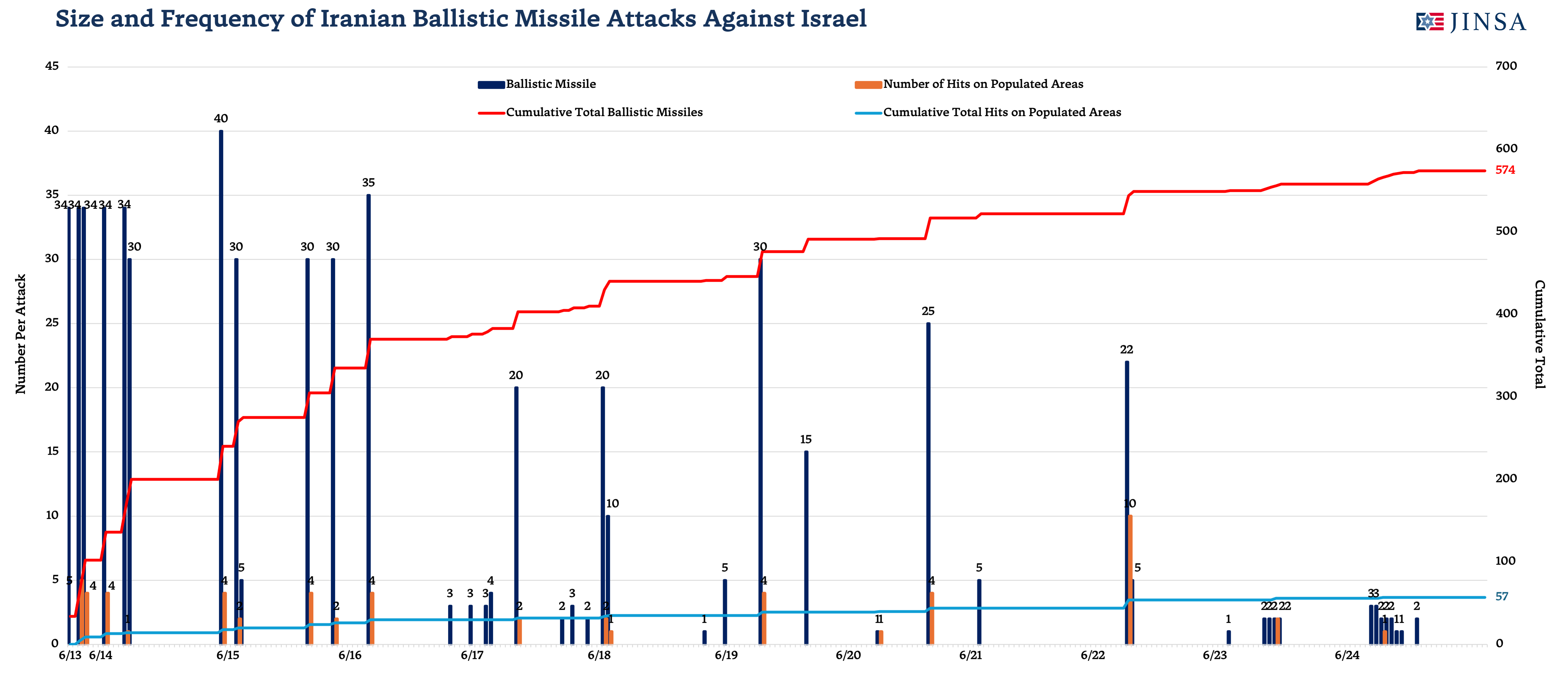
after first week or so iran could launch only from bases that were much further away from Israel (way east), because Israeli air control was weaker there
Iranian missiles launchers are pretty cheap, and reportedly quite plentiful - they are relatively simple modifications of domestically produced truck platforms.
The Iranian account for why the strikes slowed down, FWIW, is that it took a significant amount of time to dig out the exits of the missiles bases, not that they ran out of launchers. Given the recycling of footage from launcher destruction and the simplicity of the launchers I personally find that account significantly more plausible.
They didn't run out of launchers. The launchers just emerged from a predictable place with unfuelled rockets. That made them easy to pot from the air.
Since it took at least an hour for a cruise missile to make it's way and around 15 minutes for an ALBM to make it's way, that means that once Israeli drones started being shot down, they were able to dig out the entrances, exit and launch faster than it took for a munition to be delivered.
Of course if Israel had been able to fly manned aircraft deep into Iran and for prolonged periods of time, that would have been impossible, and they would actually have been unable to fire. But that wasn't the case and so they were able to fire, probably limited by the ability to dig out the entrances and synchronize launches between different sites.
Not independently. At this point, Israel is independently a de facto regional power. The strike in Doha drove that home. (As did the attacks on Iran, which delivered a geostrategic win to Riyadh that Washington was never able to.)
During the Rhodesian Bush War, their forces ran circles around the ZIPRA and ZANLA with multiple battles and encounters where they'd routinely record 500:1 KD ratios like Operation Dingo, etc. They had complete freedom of action to bomb any infrastructure obstructing them, reach deep into neighboring countries and slaughter guerillas copiously.
Hell, South Africa had a dozen nukes.
Once the sanctions came on, it unraveled everything they had.
Israel is in such a precarious situation right now. Their economy depends on technology exports to an extreme degree. Cutting off that source of FX would literally half the economy overnight because cash would stop sloshing around internally from its main sources.
If that happens, all the smart kids propping up the economy will move out while you're left with extremists who want war but won't fight in the army. In fact, it's ongoing right now with people leaving the country in the midst of a war they're 'winning.'
You might think sanctions are a far-off notion, but key Western powers are breaking with America on recognizing Palestine. That's a red line designed to signal to Israel that it's losing ground. People across the world are calling for sanctions and it won't be long before they materialize.
And America? Israel's main power base are American boomer evangelicals who're going the way of the dinosaur. Like I said in another comment, their kids are either not religious, don't like bombing kids, have been radicalized by the atrocities they've witnessed, or are aligned with people like Fuentes.
I hope they can smell the coffee; if anyone had told South Africa that a nuclear power could be disarmed without a gunshot, they'd never have believed it. But, look what eventually happened.
Thanks to the ongoing genocide, America's voting demographic for the next 40 years has begun to see Israel as a genocidal terrorist state. They will be voting for the next 50 years, while the boomer evangelicals die off.
While it’s bad what’s happening, it’s still nowhere near Syrian or Yemeni levels, although that may change.
The best analogy I can think of is the Allied conduct in Germany at the end of WWII. WWII was a just and defensive war. But the bombing of Dresden and atrocities by the Soviet Army were unnecessary and dishonorable.
Israel is now engaged in unnecessary and dishonorable conduct. They’ve been demoted from impressive to embarrassing.
But they’re still a legitimate country, just like, say, Saudi Arabia.
Okay. Opinions are on a spectrum. just like you, hundreds of millions of people who used to be pretty neutral on Israel now have strong opinions on the country. As a country, you generally want to blend in like Singapore/Switzerland and just not attract attention. Israel is attracting that attention, and for very bad reasons.
Western voters are childlike and emotional. They hate seeing blood on screen, children crying, starving, dying, being squeezed in queues for food. For any reason at all. Israel might seem like just another middle eastern country to you, but when you aggregate across 8 billion people, the average vibe has shifted negatively. By a lot.
>While it’s bad what’s happening, it’s still nowhere near Syrian or Yemeni levels
Tell that to Western voters who will be voting for 50 years. No one cares. just make it stop.
>But they’re still a legitimate country, just like, say, Saudi Arabia.
You're being nuanced. Cool. But the average human is not. Good luck beaming that moderate position into everyone's minds.
There are like half a dozen wars of extermination currently occuring with lots of disturbing footage. Nobody really cares. Israel is close to home because it's an ally and we styled it as a Western-style democracy (versus something closer to the Middle Eastern democracy it is.)
> Tell that to Western voters who will be voting for 50 years. No one cares. just make it stop
There are precisely zero foreign policy issues that have survived this long on the back of vibes alone.
Christian Zionist support for Israel is 100% based off vibes. Hitler's plan to invade Russia & exterminate its people for living space was based off Master Race vibes. America's Manifest destiny was based off vibes. Anti-communist domino theory was based off vibes and 58k young American kids died in Vietnam for it, not counting the 153k maimed and injured. Japan's imperial delusions that got them nuked was based off vibes.
Want me to go on?
>There are like half a dozen wars of extermination currently occurring with lots of disturbing footage. Nobody really cares. Israel is close to home because it's an ally and we styled it as a Western-style democracy (versus something closer to the Middle Eastern democracy it is.)
Would you kindly name them, good sir? Off the top of my head, I think Sudan. But, no Westerner really cares about Sudan. Israel they do care about because of the media onslaught and their countries' stance on the issue. It's one of those conflicts you just can't unsee.
This is totally serious analysis that is reflective of mainstream analysis and not just the projection of highly partisan political views. Foreign Policy Analysts certainly will be going to be making decisions based on views like this!
There's no need to debunk a gish-gallop. I'd simply make the claim that this poster's views are not reflected by the overwhelming majority of academic historians and foreign policy analysts in any country, certainly not in reductively reducing things to "deluded people". That's more of sign of unserious polemics.
Couldn't possibly be that in the post-colonial world there was a burst of new countries, the superpowers were constrained militarily by MAD, and thus both engaged on a worldwide game of attracting potential military allies and trading partners into their respective spheres of influence while denying the other the same wherever possible?
> Would you kindly name them, good sir? Off the top of my head, I think Sudan. But, no Westerner really cares about Sudan
Sudan. Burma. Tigray. (Ukraine. Uyghurs, technically, too, but we don't have footage because China's gotten good at this since Tibet.)
> Israel they do care about because of the media onslaught and their countries' stance on the issue. It's one of those conflicts you just can't unsee
One. Among many.
Uniquely capturing American attention. But so was Darfur once. And #StopKony before that. Barring Israel literally continuing this war for another twenty years, chances are, it too will be forgotten. There really is just that much horribleness constantly happening in the world. I cannot imagine the 2030s will be so blissfully peaceful as to allow us to continue to fixate on the crimes of decades past.
My point is this isn't a realistic threat for Israel. Its exports are highly desirable to too many parties. Technology. Weapons. Energy. There is too much money to be made, too much advantage to be had.
Yes, if the war in Gaza continues for another decade, Israel will run out of goodwill. But if it wraps up within a year or two? I don't see anything happening quickly enough that they can't adapt. Apartheid was a permanent state. The war need not be.
> America's voting demographic for the next 40 years has begun to see Israel as a genocidal terrorist state. They will be voting for the next 50 years
I'd say a strategic prerogative for Israel at this point is to diversify away from America. It's unfortunate. But they screwed a golden goose.
For the aforementioned reasons, however, that isn't existential. Particularly given India and China have what they consider to be problematic Muslim populations within and around themselves, too.
During the Cold War they played both sides: socialist but democratic.
Even now they can get the Chinese on the line in a minutes notice. I’m pretty sure the Chinese are running one of their ports.
China has actually been more arms length in this conflict, possibly due to its relations with Iran, possibly because it wants Israel to fully commit east. (Possibly because they have a moral position on occupation and genocide, though unlikely, it's not like they're handing back Tibet and Xinxiang.)
And they clearly don’t. China actively talks against it (because it builds global goodwill on the diplomatic stage) and India only plays lip service (they have more to gain from the Gulf than Israel).
They've both deepened trade ties with Israel throughout the war. India is literally selling Israel weapons [1].
[1] https://www.middleeasteye.net/news/war-on-gaza-indian-made-i...
Yes. That's trade. It's true for most international relationships.
You don’t get to have your cake and eat it too. China and India don’t have an ideological relationship with Israel. So Israel is never going to “diversify” (your words) their relationship to the point that China is shooting down cruise missiles flying over Tel Aviv on their behalf.
> India don’t have an ideological relationship with Israel
Right-wing Indians and Israelis actually have quite a bit in common. I don’t think it’s enough to sustain a long-term alliance. And New Delhi is no Washington. (It’s also a buyer of Iranian oil.)
But there are outright exterminationist wings in both countries, and their enemies share the same faith.
Everything Israel makes is fungible. The middle east is a river of gas. Israel's defense technology industry can't exist without Western partners. Hell, America denying them F35 repairs/upgrades effectively kills their airforce.
>Yes, if the war in Gaza continues for another half decade, Israel will run out of goodwill. But if it wraps up within a year or two? I don't see anything happening quickly enough that they can't adapt. Apartheid was a permanent state. The war need not be.
The damage has been done. Hundreds of millions globally now voice opinions about Israel openly that they wouldn't have allowed to just a few years back. These people vote in their countries, buy products, interact in the real world. We're seeing Israeli tourists get harassed openly. Would have been unthinkable in, say, 2020.
>Yeah, I'd say a strategic prerogative for Israel at this point is to diversify away from America. For the aforementioned reasons, however, I don't see that being a problem. Particularly given India and China have what they consider to be problematic Muslim populations within and around themselves, too.
India cannot even field 4.5 generation jets. Their airforce (French Rafales) got whooped in the recent confrontation with Pakistan. In fact, after China delivers Pakistan's J35s, India would have nothing to counter it. Israel's military core is air supremacy so much so that it is state doctrine to use nukes if the IAF is ever destroyed.
And China, trying to project an image of fairness to the third-world, as an alternative power, supports a two-state solution. Unlike Western politicians, they can't be lobbied and bribed to support endless wars.
I have my gripes with the West but they're still a superpower bloc. If they sanction you, you're fucked. There's a reason even China keeps its dealings with sanctioned Russian companies plausibly deniable. To avoid contagion.
You just don't understand how dependent Israel is on the West. 53% of their exports are technology goods. If you're cut off from Western markets, not only will China not buy much from Israel, they will copy their products and compete with them.
The only country you can build a shared resistance towards Muslims is India. For now, their economy is small and irrelevant. China has their Islamist problem under control and they won't want to offend the moneybag Arabs by supporting Israel (LMAO).
Israeli weapons are absolutely not fungible, particularly not for non-Western buyers. And something being fungible doesn't make it less valuable.
> America denying them F35 repairs/upgrades effectively kills their airforce
Correct. I am guessing we'll see diversification here.
> India cannot even field 4.5 generation jets. Their airforce (French Rafales) got whooped in the recent confrontation with Pakistan
...and guess who makes a state-of-the-art integrated air defences? And knows how to penetrate (and thus harden) state-of-the-art Russian air defence systems?
> China, trying to project an image of fairness to the third-world, as an alternative power, supports a two-state solution
Uh, China is doing whatever it can to keep America distracted. If Israel can give China technology, China will continue calling for a two-state solution while buying what it needs. (Chinese-Israeli trade has increased throughout the war.)
> have my gripes with the West but they're still a superpower bloc. If they sanction you, you're fucked
Israel is not at material risk of blanket sanctions from the West in the next decade. And being a democracy, there is a lot of good a change of face can do.
> 53% of their exports are technology goods
Why does this have to go to America and Western Europe?
> China has their Islamist problem under control and they won't want to offend the moneybag Arabs by supporting Israel
Which of the Arab monarchies is particularly distressed with Israel? Which has even walked back its previous support and recognition? The Gulf is more than happy for Israel to fight their wars against Iran. If the war dies down, they've got more important things to worry about. (Their populations have never liked Israel. Not super relevant.)
It seems that everyone in this conflict has doomsday fantasies for their opponents. The Gazans will all shrivel up and die. Israel will poof away because young Americans decide foreign policy--not jobs or housing or the rule of law--is their single issue. These extreme outcomes are incredibly unlikely.
My claim was specifically with China in mind. Pretty much everything the Americans will let Israel sell to non-Western partners can be gotten from China, Turkey, etc. cheaper and with less headache.
>Correct. I am guessing we'll see diversification here.
Yep. Introducing my magical new fighter jet that replaces the f35!
>...and guess who makes a state-of-the-art integrated air defences? And knows how to penetrate (and thus harden) state-of-the-art Russian air defence systems?
Well, it probably didn't work great given how India fared recently, did it? They're a committed partner of Israel and collaborate on military tech.
>Uh, China is doing whatever it can to keep America distracted. If Israel can give China technology, China will continue calling for a two-state solution while buying what it needs. (Chinese-Israeli trade has increased throughout the war.)
The only thing China reliably does is single-mindedly pursue their interests. Propping Israel up doesn't achieve that. In fact they're quite chummy with the Palestinians and lots of the weapons used for the Oct. 7 raid were Chinese-made.
>Israel is not at material risk of blanket sanctions from the West in the next decade.
If you say so. The chances of the Five Eyes breaking with America on recognizing Palestine were also exactly zero just a few months ago.
>Why does this have to go to America and Western Europe?
Because they're the only ones who have the money for it. No non-Western company/country has the amount of tech demand/cash to have completed the Wiz acquisition for $32b in cash. Their software markets have no viable customers outside the West.
>Which of the Arab monarchies is particularly distressed with Israel? Which has even walked back its previous support and recognition? The Gulf is more than happy for Israel to fight their wars against Iran.
Good point.
>It seems that everyone in this conflict has doomsday fantasies for their opponents.
I have no dog in the fight. Both countries could disappear overnight and it wouldn't affect my quality of life. I'm simply a student of history and I'm trained to see patterns.
Pakistan shot down Indian plane(s). India didn't return the favour. Worse, Pakistan's integrated air defence systems had situational awareness; it's clear Indian Rafale pilots didn't even see the shots coming.
It's not a victory for one side or the other, overall. But in the air battle, Pakistan gained tactical supremacy.
A lot of folks have looked at a lot of OSINT. There is no evidence of any Indian kills. The best we can say is we have zero confirmed kills by India on Pakistan. For what it's worth, New Delhi seems to have backed off repeating its claims of kills internationally.
> Pakistan claims to have shit down six jets and India says it's 3
India claims three jets crashed for unknown reasons [1]. French and US officials have indirectly confirmed those kills [2][3]. Internationally, it's being treated as three confirmed kills by Pakistan.
[1] https://www.reuters.com/world/asia-pacific/three-fighter-jet...
[2] https://www.reuters.com/world/pakistans-chinese-made-jet-bro...
[3] https://edition.cnn.com/world/live-news/india-pakistan-attac...
You really think the French, Swedes, Russians or Chinese won't sell them planes? They're seeking to be a regional power. They don't need F-35s. (Though they're certainly handy.)
> probably didn't work great given how India fared recently, did it?
India doesn't field Israeli air defences...
> only thing China reliably does is single-mindedly pursue their interests. Propping Israel up doesn't achieve that
I'll grant that China has been the most consistent on Israel and Palestine. Nevertheless, Israeli-Chinese trade keeps growing.
> If you say so. The chances of the Five Eyes breaking with America on recognizing Palestine were also exactly zero just a few months ago
Really? According to whom? I haven't been in the UN for a while, but everyone I knew was asking when, not if. It clearly works for domestic politics, doubly following the recent trade concessions.
Netherlands (not Five Eyes) was 1 in 3 [1]. Canada and France were making motions for a while; Japan and Italy were like 50% going back two months.
> they're the only ones who have the money for it
The U.S. funds about 15% of Israel's defence budget. We allow them to splurge in a way they can't alone. But that just means they can't defeat Hezbollah and Iran and Hamas at the same time without us.
[1] https://kalshi.com/markets/kxrecogpalestine/palestine-recogn...
The fact we're even having this conversation is the point. Top-end equipment was always guaranteed. The fact you're shopping around mentally for second-best points to that.
>I'll grant that China has been the most consistent on Israel and Palestine. Nevertheless, Israeli-Chinese trade keeps growing.
Well, there's a reason why they've been consistent on it so far. If Israel's trade comes to depend significantly on them, they can use it as leverage against them.
>Really? According to whom? I haven't been in the UN for a while, but everyone I knew was asking when, not if. It clearly works for domestic politics, doubly following the recent trade concessions.
I should have been more specific than a few months ago. Here's what I meant. Many of these countries have no issues against Palestine, but wouldn't break openly with the US position because of how dependent they are. That happening is a vibe shift.
>The U.S. funds about 15% of Israel's defence budget. We allow them to splurge in a way they can't alone. But that just means they can't defeat Hezbollah and Iran and Hamas at the same time without us.
You keep taking my statements out of context, attacking a point I didn't make and then claiming victory. I'm not even addressing US aid to Israel, which is extensive. I'm talking about their economy! Without that trade, the economy will shrink by a lot. The technologists bringing in that FX will move away in large numbers. Spending will have to reduce by half or more, especially given Israel already has a high tax-to-gdp-ratio. The country won't survive it. More high earners will leave and you'll go into a death spiral.
Dozens of UN resolutions have been issued against Israel and vetoed by the US. If it happens without American support, they'll be placed under an intl. embargo until they comply. Ask Iran what intl. embargoes have done to crush their economy before you wave it off. What America offers Israel is both a large export market they don't have internally, and protection from consequences.
Israel is too integrated with the West, going as far as competing in Eurovision, UEFA, etc. If they break with the West, they can't survive it. I cite Rhodesia as an example repeatedly because that's where they slowly but surely ended up.
If you end up with Western sanctions, no matter your country's size, you're fucked. USSR and Maoist China can give you any lectures you want.
The 'chosen people' delusion can make it seem economic realities don't apply, but the earlier Israel can get to a lasting peace while conditions are favorable, the better.
I've literally not thought about this until you brought it up. My point is there is an extensive list of eager jet sellers who would step up to the plate.
> If Israel's trade comes to depend significantly on them, they can use it as leverage against them
Sure? Same as America can now. This defeats the argument that Israel is being economically isolated, or faces devastation from losing America as a close ally in decades.
> Many of these countries have no issues against Palestine, but wouldn't break openly with the US position because of how dependent they are. That happening is a vibe shift
It's been months in the making. Not paying attention doesn't make something surprising. It would have been extremely surprising if Canada, the UK and France didn't recognise Palestine, and I'm saying this going back half a year.
> I'm talking about their economy! Without that trade, the economy will shrink by a lot
But going back to the top, there are plenty of other trading partners America's third of exports could be replaced with. Not entirely. Not on as great terms. But close enough to keep Israel reigning as a regional hegemony.
> technologists bringing in that FX will move away in large numbers
Where are you getting this notion that tech exports are a major source of FX for Israel? Or that Israel would stop being a tech centre if America turned its back on it? (And again, major emerging gas exporter.)
> you'll go into a death spiral
I'm not Israeli. I've never been to Israel.
> Dozens of UN resolutions have been issued against Israel and vetoed by the US. If it happens without American support, they'll be placed under an intl. embargo until they comply
Look at the list of UNSC sanctioned countries [1]. They're symbolic. The point is to cause members to enact follow-on sanctions [2]. When that doesn't happen, they're ineffective.
> Ask Iran what intl. embargoes have done to crush their economy
They're...still around. You also missed Angola, Yemen, North Korea...
> Israel is too integrated with the West, going as far as competing in Eurovision, UEFA, etc. If they break with the West, they can't survive it. I cite Rhodesia as an example repeatedly because that's where they slowly but surely ended up
I get this is your hypothesis. It simply isn't sustained. This is before we get to the point that if a couple Western countries sanction Israel for shits and giggles, there is a lot of money to be made by someone defecting and acting 'neutrally'.
(Also, in any world where Israel is sanctioned, Palestine gets devastated. That's simply the nature of having an economic basket case as a neighbour.)
Again, there seem to be folks who like to see patterns that sustain extreme outcomes that support a moral view of the world. You're having to go so deep into hypotheticals while being able to surface zero sources because the precedented outcome for this war--like most others that caused moral outrage in the West--is that we forget about it and move on and then everyone goes back to making money again.
(The only note I'd add is that if this rhetoric becomes commonplace, that America is destined to abondon Israel, it incentivises one outcome and one outcome only: destroying Palestine today, quickly and decisively. Nobody talks about that because nobody really buys the pitch you're making outside pro-Palestinian activist circles. I'm also not criticising you personally. Ukraine was my pet war. I absolutely bought into all sorts of conspiracies about Russia getting sidelined and partitioned up. We all want to see patterns that sustain the illusion of a just world.)
[1] https://main.un.org/securitycouncil/en/sanctions/information
From their own economic publications. Tech exports are 53% of their export output. Gas is a laughable non-issue. Like I said earlier, the middle east is full of it. It's not a significant source of leverage since every third country has it.
>UN sanctions are way less biting than American secondary sanctions alone.
You can always tunnel around sanctions, but it kills a lot of your open-market economy. You have to sell for a lower, discounted price. Acquisitions and mergers are effectively over. Sales shrink by a lot. Your largest companies move away to avoid contagion. I mean, have you ever read about the sanctions on Rhodesia & south Africa?
>They're...still around. And they never had a weapons sector like Israel's.
They're severely, terribly weakened. Even China won't sell them any modern airframes. That should tell you something.
>I get this is your hypothesis. It simply isn't sustained. This is before we get to the point that if a couple Western countries sanction Israel for shits and giggles, there is a lot of money to be made by someone defecting and acting 'neutrally'.
I have evidence of Western & non-western countries banding together to sanction consistent bad actors, despite being even more Western than Israel will ever be. Do you have any evidence of any country surviving sanctions without severe economic damage? Please share; my viewpoint has abundant proof. I'm just supposed to believe yours.
>Again, there seem to be folks who like to see patterns that sustain extreme outcomes that support a moral view of the world. You're having to go three levels deep for every turn because the most precedented outcome here is everyone forgets and moves on.
I don't have a dog in the fight. Both countries could die to the last man and I'd still go on my merry way, whistling. I'm simply projecting based on history, which is why I cite precedent that you refuse to admit.
Sure. Where are you getting that these are a critical source of FX?
> Gas is a laughable non-issue
To FX? Seriously?
> have you ever read about the sanctions on Rhodesia & south Africa?
Yes. Zimbabwe is still sanctioned. South Africa had preëxisting power-sharing negotiations.
> Even China won't sell them any modern airframes. That should tell you something
...that Beijing isn't drunk? Why do you think Washington got pissed off when Turkey bought Russian air defences and let them paint our fighter fleet?
> have evidence of Western & non-western countries banding together to sanction consistent bad actors
One, during a unipolar world. Someone else commented on this, but in a multipolar world, that is a luxury that simply doesn't emerge. (Even the bilateral world of the Cold War very rarely saw international sanctions regimes effected. That was just a nudge for someone to switch from one system of alliances to another.)
> Do you have any evidence of any country surviving sanctions without severe economic damage?
Yes [2]. In the short term, they cause damage. ("Severe" needs to be quantified, however--when regime change is targeted, it's only successful about a third of the time.) In the long term, they're less effective. Economies go into cockroach mode.
If you want a list, Russia, Iran, North Korea, Belarus, Burma and Venezuela are each heavily sanctioned and pretty much setting themselves up to permanently be so. (Pyongyang and Minsk having practically turned it into an art.)
> I'm simply projecting based on history, which is why I cite precedent
You haven't cited anything! Based on history, Israel is highly unlikely to get sanctioned by anyone, let alone America, and if it were, it's likely to be fine.
[2] https://www.sciencedirect.com/science/article/abs/pii/S01475...
The pro-palestine progressives are rapidly loosing political power, if not being targeted right now by the Trumpian administration. The National Conservatives may be isolationist regarding free funding, but they certainly aren't going to sanctioning Israel or ending arms sales, while Pro-Palestine is pretty much a useful proxy as is for them to signify "un-americans".
Furthermore, the sanctions on South Africa occurred within the context of the Liberal International Era where one could afford to alienate a state in a region with little importance. But it's posters like you that have been calling for the so-called multipolar world, which is where NGOs and Human Rights will be sidelined in favour of a Westphalian-Type Sovereignity whereby hard interests decide foreign policy, not human rights concerns. In that Realist context, it is virtually within complete interests for the Gulf States and other actors to align with Israel over Iran, the former which has proven itself militairly and acts accordingly to economic interest, whereas the latter is bordering on a failed state still motivated by irrational hegemonic concerns. In the same context, a Palestinian states that takes over Israel basically will likely be detrimental to the other actors.
Westphalian sovereignty refers to "a principle in international law that each state has exclusive sovereignty over its territory" [1]. It doesn't support realpolitik nor negate human rights. The only degree to which it intersects with the latter is in arguing against foreign intervention. (Which realpolitik encourages.) It's a concept that was promulgated to integrate previously-independent city states into the larger nation-states and empires of the time.
It's also quite idiotically named, given the actual Peace of Westphalia dealt with foreign powers deciding what to do with the Holy Roman Empire at the end of the Thirty Years' War, with France and Sweden being "recognised as guarantors of the imperial constitution with a right to intercede" [2], sort of the opposite of inviolable sovereignty.
Today, it tends to be something Putin brings up, again, quite idiotically, given he's constantly fucking around in other countries' affairs.
(You're broadly correct that in a Realist international framework the morality of Israel's actions are irrelevant. And that everyone advocating for a multipolar world shifts us in the Realist direction. Practically, however, these are models, not theories, and they coëxist with each other.)
Iran maintains the ability to build ballistic missiles in large numbers, greatly depleted Israel-US BMD reserves, continues to build even more reinforced nuclear sites. Neutering those capabilities was the main goal of the 12 day war and by most accounts, that didn't work.
Israel did not manage air superiority over the large majority of Iran, instead the majority of strikes over Iran were done using standoff weapons and drones, many flown from within Iran as an act of sabotage.
If Israel truly managed to get air superiority over Iran, the Iranian regime would have suffered the same fate as Nasrallah. But that didn't happen, because while Israel was able to execute a number of deep strikes, the capability to do so was much closer to Russia's ability over Ukraine than, say, the way the US operated over Iraq. And Iran at the same time was able to execute dozens of deep strikes within Israel, but with much less precision - without a much deeper cut to the Iranian MIC it's only a matter of time before the newer, much more precise missiles are built in sufficient numbers to become a similar threat to the Israeli airforce.
There is no reason why China would ever want to partner with Israel on defense anymore. They tried do in the 2000s, and they found that Israel was so deeply and inextricably dependent on US technology and manufacturing for it's military technology that there was almost nothing worthwhile they could get that wasn't so dependent on the US that the US would veto it. Israel's military sophistication is not endogenous to the extent it would be competitive without the US - it's entirely dependent on an extremely privileged relationship with the MIC that allows Israel to stand on the shoulder of giants and produce weapons that are far more sophisticated than would be possible for any economy of its' size otherwise.
An article came out only today on Haaretz detailing how much of the footage and imagery from Israeli strikes were deepfakes or recycled footage. That's not something you do when you've managed to neuter your opponent.
Iran hasn't been neutralised. It was just reduced to a non-threat during the war. Of course it maintains future capabilities that could be threatening.
> That's not something you do when you've managed to neuter your opponent
Why not? It's an information war.
I wouldn't call 10 ballistic missiles hits in a day a non-threat. If they were accurate that's a significant threat: enough to disable all BMD radars in a day, and over a week to disable airbases.
The most important factor that made them less threatening is the lack of pinpoint accuracy, and that is not something that changed over the course of the war.
> Why not? It's an information war.
Getting caught using fabricated imagery is inevitable within a couple days, so that's not something you'd want to do in an information war if you are looking for long term effect, unless you have to.
Israel probably came out ahead if all they lost is prestige.
They've neutered Iran and become the de facto regional security power. Their weapons and military have been validated, which makes than a desirable trading partner in an increasingly-militarising world. And they're turning into a gas exporter.
Worst case, a generational shift occurs and Israel loses its military support from America. (I don't see us sanctioning Israel any time soon, so its economic primacy will remain intact. And we only pay for like 15% of their military budget, so not a disaster.) Do you really think China and India would even hesitate to partner with Tel Aviv on defense?