News for hackers. Stuff that matters.
Re:A 94x speed improvement demonstrated using handwritten as... by jsheard on Monday November 04, 2024 @08:38AM (#42041414)
This is a slightly misleading comparison, because they're comparing naive scalar C code to hand-vectorized assembly, skipping over hand-vectorized C with vendor intrinsics. Assembly of course always wins if enough effort is put into tuning it, but intrinsics can usually get extremely close with much less effort.

For reasons unknown to me the FFmpeg team has a weird vendetta against intrinsics, they require all platform-specific code to be written in assembly even if C with intrinsics would perform exactly the same. It goes without saying that assembly will be faster if you arbitrarily forbid using the fastest C constructs.

Re:A 94x speed improvement demonstrated using handwritten as... by unlord on Monday November 04, 2024 @10:57AM (#42042706)
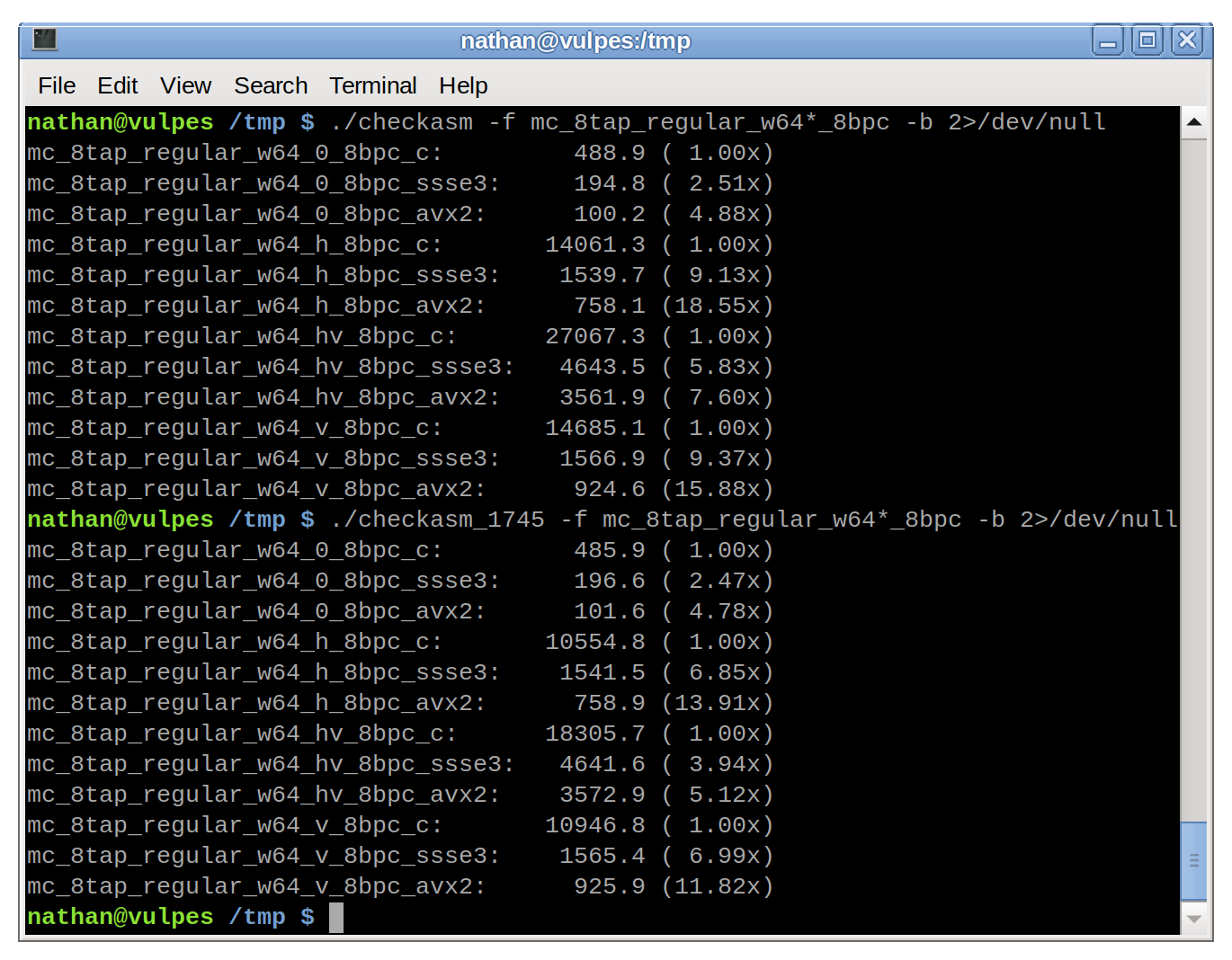
It is actually quite a bit more misleading. I was not able to reproduce these numbers on Zen2 hardware, see https://people.videolan.org/~unlord/dav1d_6tap.png. I spoke with the slide author and he confirmed he was using an -O0 debug build of the checkasm binary.

What's more, the C code is running an 8-tap filter where the SIMD for that function (in all of SSSE3, AVX2 and AVX512) is implemented as 6-tap. Last week I posted MR !1745 (https://code.videolan.org/videolan/dav1d/-/merge_requests/17...) which adds 6-tap to the C code and brings improved performance to all platforms dav1d supports.

This, of course, also closes the gap in these numbers but is a more accurate representation of the speed-up from hand-written assembly.

Re:A 94x speed improvement demonstrated using handwritten as... by zbobet2012 on Monday November 04, 2024 @04:01PM (#42045936)
The thing I found interesting in the AVX512 gains over AVX2. That's a pretty nice gain from the wider instruction set which has often been ignored in the video community.
Re:A 94x speed improvement demonstrated using handwritten as... by Dylan16807 on Monday November 04, 2024 @04:16PM (#42046053)
For most operations, on most CPUs, you can get the same results with twice as many AVX2 instructions. And that's excluding the CPUs with no AVX512 at all.

But the number of situations where AVX512 has a significant advantage is growing, so interest will grow alongside it.

Re:A 94x speed improvement demonstrated using handwritten as... by jsheard on Monday November 04, 2024 @04:14PM (#42046038)
Sadly AVX512 is still very easy to ignore given how badly Intel has botched its rollout across consumer processors.

Ironically AMD has stronger AVX512 support at this point despite the spec originating at Intel.

Re:A 94x speed improvement demonstrated using handwritten as... by wscott on Monday November 11, 2024 @05:50AM (#42106140)
The important thing to understand about why AVX512 is a big deal is not the width. AVX512 adds new instructions and new instruction encodings. They doubled the number of registers (16->32), and added mask registers that allow you to remove special cases at the end of loops when the array is not a multiple of the vector width. And there is piles for new permutation operations and integer operations that allow it to be useful in more cases.

The part Intel struggles with is that in many places if they had the 256-bit max width but all the new operations then they could build a machine that is faster than the 512-bit version. (assuming the same code was written for both vector widths) The reason is the ALUs could be faster and you could have more of them.

Re:A 94x speed improvement demonstrated using handwritten as... by Const-me on Monday November 04, 2024 @08:57AM (#42041552)
> FFmpeg team has a weird vendetta against intrinsics

To be fair, ffmpeg is really old software. Wikipedia says they released their initial version in the end of 2000. The software landscape was very different.

Back then, there were multiple competing CPU architectures. In modern world we only have two mainstream ones, AMD64 and ARM64, two legacy ones in the process of being phased out, x86 and 32-bit ARM, and very few people care about any other CPUs.

Another thing, C compilers of 2000 weren’t good in terms of performance of the generated code. Clang only arrived in 2007. In 2000, neither GCC nor VC++ had particularly good optimizers or code generators.

Back in 2000, it was reasonable to use assembly for performance-critical code like that. It just they never questioned that decision later, despite they should have done that many years ago.

Re:A 94x speed improvement demonstrated using handwritten as... by astrange on Monday November 04, 2024 @03:42PM (#42045791)
FFmpeg developers aren't stupid and aren't doing things because of historical accident. If you don't mind writing platform specific code, it simply works better this way.

Here's clang messing up x86 intrinsics code.

https://x.com/ffmpeg/status/1852913590258618852

The other reason to do it is that, since x86 intrinsics are named in Hungarian notation, they're so hard to read that the asm is actually more maintainable.

Re:A 94x speed improvement demonstrated using handwritten as... by Const-me on Monday November 04, 2024 @06:51PM (#42047321)
> it simply works better this way

That is simply not true.

> clang messing up x86 intrinsics code

The code is correct, and on some processors runs slightly faster than the original. Clang is the only compiler which does anything like that. And the example is irrelevant to ffmpeg because it operates on FP64 numbers, video codecs mostly do integer math.

> they're so hard to read that the asm is actually more maintainable

That’s subjective, I’m using SIMD intrinsics for years and I find them way better than assembly.

Another thing, you can treat C as a high-level language as opposed to portable assembler. If you define structures, functions and classes in C++ which use these SIMD vectors, readability of intrinsics becomes way better than assembly. Here’s a good example of a library designed that way: https://github.com/microsoft/DirectXMath

Re:A 94x speed improvement demonstrated using handwritten as... by lsllc on Monday November 04, 2024 @09:04AM (#42041612)
The intrinsics aren't portable across architectures, so using them vs inline asm (or linking with a .s/.asm file) is more about convenience/ease of use than portability (although they might be slightly more portable across different OSes for the _same_ architecture, e.g. macOS/linux for aarch64).

In some ways, I prefer the "go big or go home" of asm either inline, or in a .s/.asm file, although both inline and .s/.asm have portability issues (e.g. inline asm syntax across C/C++ compilers or the flavor of the .s/.asm files depending on your assembler).

Re:A 94x speed improvement demonstrated using handwritten as... by jsheard on Monday November 04, 2024 @09:10AM (#42041659)
Intrinsics do have certain advantages besides convenience, since the compiler can reason about them in ways that it can't with an opaque blob of asssembly. For example if you set the compiler to tune for a specific CPU architecture then it can re-order intrinsics according to the instruction costs of that specific hardware, whereas with assembly you would have to manually write a separate implementation for each architecture (and AFAICT FFmpeg doesn't go that far).
Re:A 94x speed improvement demonstrated using handwritten as... by astrange on Monday November 04, 2024 @03:44PM (#42045809)
Those kind of optimizations aren't needed on big desktop CPUs these days, they don't need special scheduling or anything.

And yes, when it's important it does do that. They aren't stupid. (An example is that unaligned SSE loads are very slow on some CPUs but faster on others.)

Re:A 94x speed improvement demonstrated using handwritten as... by flohofwoe on Monday November 04, 2024 @09:10AM (#42041656)
> but intrinsics can usually get extremely close with much less effort

Why 'much less effort' though? Intrinsics are on the same abstraction level as an equivalent sequence of assembly instructions aren't they? And they only target one specific ISA anyway and are not portable between CPU architectures, so the difference between coding in intrinsics and assembly doesn't seem all that big. Also I wonder if MSVC and GCC/Clang intrinsics are fully compatible to each other, compiler compatibility might be another reason to use assembly.

Re:A 94x speed improvement demonstrated using handwritten as... by jsheard on Monday November 04, 2024 @09:15AM (#42041697)
Instrinsics more or less map to specific assembly instructions, but the instruction scheduling and register allocation is still handled by the compiler, which you have to do by hand in raw assembly. Possibly multiple times, since the optimal instruction scheduling is hardware specific. Intrinsics can also be automatically inlined, constant folded, etc, which you don't get with assembly.

Also Intel and ARM themselves specify the C intrinsics for their architectures so they're the same across MSVC, GCC and Clang, it's not like the wild west of other compiler extensions.

Re:A 94x speed improvement demonstrated using handwritten as... by flohofwoe on Monday November 04, 2024 @09:20AM (#42041734)
Hmm right, makes sense. I do wonder though if actually making use of the high level convenience then can harm performance again, e.g. let's say I'm building intrinsic parameters with regular C scalar expressions, or use if-else control flow between intrinsics. Convenient to do, but can't be great for performance versus fully simdified code.
Re:A 94x speed improvement demonstrated using handwritten as... by janwas on Monday November 04, 2024 @09:57AM (#42042080)
Sure, we generally don't want branches in the code.

What makes intrinsics really interesting is that you can use wrapper libraries such as our Highway, then the code actually is portable and efficient.

Re:A 94x speed improvement demonstrated using handwritten as... by astrange on Monday November 04, 2024 @03:46PM (#42045819)
Clang doesn't guarantee that; it runs everything through its optimizer, which means you can use an intrinsic and not get the instruction it's named after.

The other big general issue is memory aliasing. If you're working on 8-bit data then C says that means it aliases everything and it's going to deoptimize your other memory accesses. Conversely if you're freely switching types like SIMD tends to do, that's against the aliasing rules.

Re:A 94x speed improvement demonstrated using handwritten as... by brigade on Monday November 04, 2024 @04:31PM (#42046191)
Intrinsics are compatible across compilers and OSs within the same architecture, and are also mostly compatible between 32 and 64 bit variants of the same architecture. With asm, you have to handle the 3 different calling conventions between x86, x86-64, and win64, and also write two completely separate implementations for arm32 and arm64, instead of just one x86 intrinsic and one NEON intrinsic version. Sure ffmpeg tries to automatically handle the different x86 calling conventions with standard macros, but there's still some %if WIN64 scattered around, and 32-bit x86's register constraints means larger functions are littered with %if ARCH_X86_64.

Which brings us to the most "more effort" of assembly - no variables or inline functions, only registers and macros. Which is okay for self-contained functions a hundred lines or so, but less so with heavily templated multi-thousand line files of deeply intertwined macros nested 4 levels deep. Being able to write an inlined function that has no side effects felt a thousand lines away reduces mental effort by a lot, as does not having to redo register allocation across a thousand lines because you now need another temporary register for a short section of code, or even think about it much in the first place to still get near-optimal performance on modern CPUs.

Re:A 94x speed improvement demonstrated using handwritten as... by account42 on Monday November 04, 2024 @08:56AM (#42041546)
> This is a slightly misleading comparison, because they're comparing naive scalar C code to hand-vectorized assembly, skipping over hand-vectorized C with vendor intrinsics. Assembly of course always wins if enough effort is put into tuning it, but intrinsics can usually get extremely close with much less effort.

It's a perfectly valid comparision between straightforward C and the best hand optimization you can get.

> For reasons unknown to me the FFmpeg team has a weird vendetta against intrinsics, they require all platform-specific code to be written in assembly even if C with intrinsics would perform exactly the same.

Wanting to standardize on a single language for low level code is absolutely reasonable. This way contributors only need to know standard C as well as assembly instead of standar C, assembly and also intel intrisics which are a fusion of the two but also not the same as either and have their own gotchas.

Re:A 94x speed improvement demonstrated using handwritten as... by mort96 on Monday November 04, 2024 @09:00AM (#42041580)
I mean currently, contributors who want to work on vectorized algorithms need to know C, amd64 assembly with SSE/AVX instructions, aarch64 assembly with NEON instructions and aarch64 assembly with SVE instructions (and presumably soon, or maybe already, risc-v assembly with the vector extension). I wouldn't say it's simpler than needing to know C, C with SSE/AVX instricsics, C with NEON intrinsics, C with SVE intrinsics and C with risc-v vector intrinsics.
Re:A 94x speed improvement demonstrated using handwritten as... by astrange on Monday November 04, 2024 @03:48PM (#42045835)
You don't need to submit all of those, but generally these vectorized DSP functions are parts of decoding straight out of the spec, so there isn't a new way to do it.

Sometimes there is of course. In that case you can get someone else to help, or one platform just runs ahead of the others.

Re:A 94x speed improvement demonstrated using handwritten as... by mort96 on Monday November 04, 2024 @04:07PM (#42045985)
Right, but you see my point, don't you? For every set of intrinsics you'd need to know as a contributor if the vectorized code was in C, there is an assembly language and a set of intrinsics you need to know as a contributor today. Moving to C wouldn't increase the set of things a contributor needs to know.
Re:A 94x speed improvement demonstrated using handwritten as... by snvzz on Monday November 04, 2024 @10:39AM (#42042538)
Relevant: https://xcancel.com/FFmpeg/status/1852847683666641124

And my take on intrinsics, they add, not remove, complexity. For no gain.

Awful, relative to writing (or reading) asm.