Sadly, also for a fraction of the time.
Until storage is solved in a satisfactory way, solar and wind will remain auxiliary. And the capacity should be in gigawatt-days.
And storage is being solved as we have more batteries being deployed and grid supply capable EVs becoming more popular.
The market is deciding where money should be allocated and it's simply not going towards nuclear.
Because you'd get paid for it, and you like free money.
And it should be pretty trivial to set an option to ensure you always have the necessary range for your daily commute by a little bit before you leave your home.
And why wouldn't it be? The whole point here is for power companies to avoid buying as many batteries themselves, and their own batteries depreciate too.
This isn't hard -- the power company adjusts the price it pays minute per minute, and you set the threshold at which it is profitable for you, taking battery cycles into account. And it becomes a classic supply and demand curve -- it's Econ 101.
Do you think most Uber drivers drive for the $0.7-$0.12 = $0.58/mile or the actual cost of $0.70-$0.50=$0.20/mile? Sustainable Supply/Demand doesn't work until all costs are measured.
A Rivian battery is roughly $17k. Estimating 1500 charge cycles [2], that's roughly $11/charge. If you "give back" half a cycle, there's only $1.50 worth of electricity sold back, but its $5.50 worth of battery. Are you expecting to get paid $1.50+profit or $7+profit?
[1] https://www.stilt.com/careers/how-much-does-uber-pay/ [2] https://www.reddit.com/r/Rivian/comments/10onhud/ev_battery_...
But trying to hit some purity target of 100% is irrelevant. There are lower hanging fruit for decarbonisation than the last few percent of power generation.
We need a battery that is safe and mandate every home to have one. Or provide incentive for it to be installed. We shouldn't wait for super battery to be install in a central place, instead every home could afford one an provide high quality electrical power.
Surely instead of a giant Water boiler in a lot of homes we could have a giant battery instead.
https://www.sciencedirect.com/science/article/pii/S030626192...
https://assets.solar.com/wp-content/uploads/2023/01/Carbon-f...
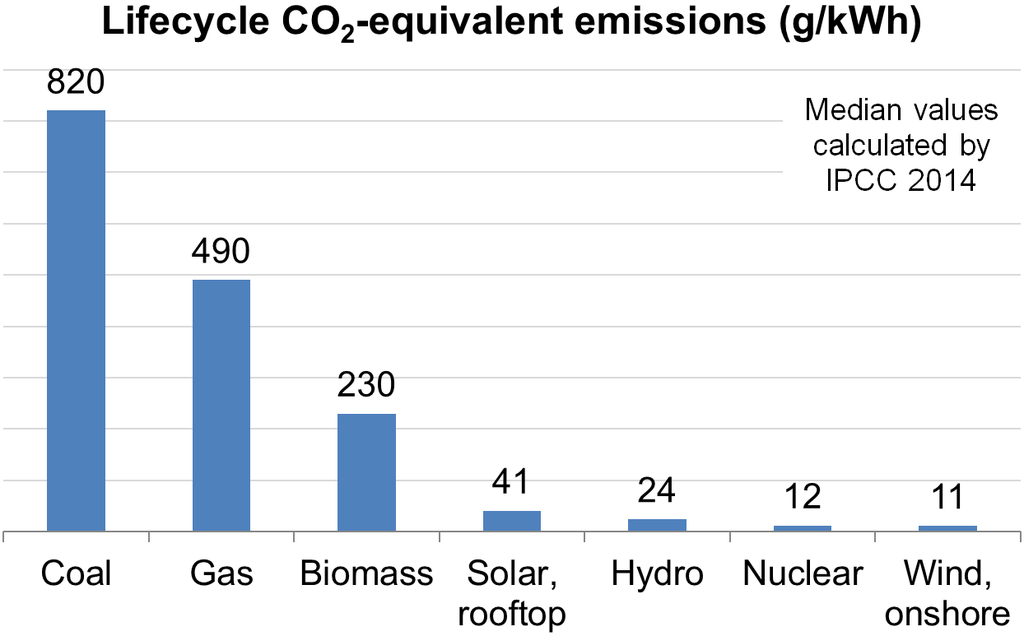
I'd say 1-5% of coal is pretty good.
Also as we make the power grid cleaner and switch to electric vehicles, the CO2 used in manufacturing goes down.
Energy return in investment is <10x for solar, but more like 100x for nuclear. We have an energy budget to solver climate change. This is nothing to do with how much things cost.
Rooftop solar is worse, but 4x worse than wind/nuclear is still quite good (and non-rooftop solar is almost certainly better than that). Solar's energy return on investment is higher than 10x by my searching, and we should be mass producing all three technologies at this point.
I suppose that instead of eliminating the processes that produce large amounts of CO2, we should embrace them, learn to capture the CO2 where it's produced in high concentrations (like steel plants or cement furnaces), and either bind the carbon in non-volatile ways, like in plastics, or produce fuel from it again and close the loop.
Energy return in investment is <10x for solar, but more like 100x for nuclear. We have an energy budget to solver climate change. This is nothing to do with how much things cost.
And if we could build nuclear properly in a reasonable fast way around the globe, i would be for investing it heavily anyway i'm just not controling it in anyway and the only thing actually working is solar, wind and battery.
Low risk, broad spectrum investment (private, small companies, big, basically everyone can)
And those dumb turbines and solar panels produce power at a fraction of the cost of nuclear. And every year they get cheaper and more efficient. Which is why the market has continually decided over and over again to go in this direction.