Example word: vaa'an — genetive of "vaaka" = "scale"
You say it with a bit of a slur - suhMON or fuhLAX - where the first syllable is not only unemphasized but uttered as quickly as possible then slurred into the next. F’lar really is just “fuhLAR”
It's tricky to write an opening sentence though. We all recognise "Call me Ishmael" and probably "Last night I dreamt I went to Manderley again" is obvious to lots of people but for example, "I am always drawn back to places where I have lived, the houses and their neighbourhoods" doesn't exactly promise Breakfast at Tiffany's does it?
By the second chapter I think you've earned a lot of leeway, either the reader is engaged and will soldier on despite your six new nouns and what might be a new word or possibly a new meaning for a word they know already - or they have probably set the book down some time ago and will never see this sentence anyway.
I'm reminded of the Illuminatus Trilogy, which at times is barely more than proper nouns arranged into sentences at random. like Finnegan's Wake but with more flower power
> There was Eru, the One, who in Arda is called Iluvatar; and he made first the Ainur, the Holy Ones, that were the offspring of his thought, and they were with him before aught else was made.
I'm a huge LOTR fan and a moderate Silmarillion fan, and I can see how maybe Tolkien is guilty of this 'new words for familiar things' problem.. I guess when Tolkien does it, I'm enchanted, e.g. the first non-introduction line in _Fellowship_:
> When Mr Bilbo Baggins of Bag End announced that he would shortly be celebrating his eleventy-first birthday with a party of special magnificence, there was much talk and excitement in Hobbiton.
To me this immediately evokes: we're in a foreign land, but it's going to be vaguely small-town England in its manners and interests.
Even so. If the sentence was something like "Kowalski's Mosquito soared high above the Führerbunker, Hitler's final redoubt in Berlin," no one would find that problematic. McCaffrey's sentence is only troubling if you've already assumed that made-up names are inherently bad writing.
There is nothing inherently wrong with made-up names, and some genres will require more than others, but I suspect that sentences in the style of McCaffrey's are partly intended to draw in the reader who feels, vaguely and probably subconsciously, as someone who has the inside scoop on esoteric knowledge from having deduced what sort of entities these names denote. To be clear, I am not immune to the effect, and it can be pleasant in small doses if the rest of the story is engaging.
Also note that it's the start of the second chapter, so some of those nouns may have been introduced already.
I am also entirely in agreement with the position that no significant criticism of the author can be made from a single sentence, especially when presented without context.
Put more bluntly: having a reading disability does not obligate all authors to write to your reading level.
This, although it's not even always a disability related issue. Sometimes things in life aren't made for you, and you'll be happier understanding that. It's similar to complaining that an advanced mathematics textbook wasn't understandable given your baseline understanding of maths. It's not being written for you.
Not everybody agrees: https://www.jesusandmo.net/wp-content/uploads/2011-05-31.png
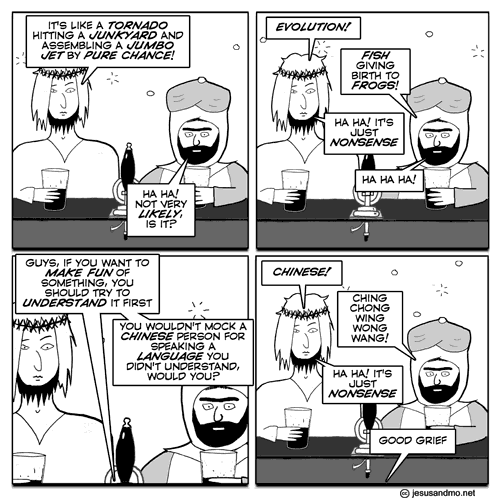
On a more serious note, I watched a Chinese drama with my parents, and the fact that the characters' names were in Chinese caused enormous problems for them.† This is hard for me to empathize with, but clearly it's something that some people can't handle.
† Another thing that caused them problems is that Chinese characters are addressed differently by different people, sometimes by name, sometimes by title, sometimes by a kinship term that will vary with the relationship between speaker and addressee....
That's easier for me to empathize with; it causes difficulties for me too, but those difficulties are mostly in the nature of nailing down a bunch of different pieces of information about each character, not in the nature of "why are you speaking a language that isn't English?!?"
English names already have an allocated space in my brain. Fake names that follow the pattern of English names are usually easy to slot into the existing system. Names in my second language can be slightly more difficult but I seem to have developed a similar system of breaking them down and storing them. But names that don't fit into patterns I'm familiar with can be like trying to memorize completely arbitrary strings of information.
For example (grabbing some Aztec mythology names) "Tlaltecuhtli" won't be accurately stored beyond the first syllable or two until I've seen it many, many times, and if there's another character called "Tlazolteotl" I'm likely to mix them up.
But I will never ever remember how to spell the name. It’s like the perfect combination of letters that are just alien to me. I usually find it by searching “hiccup github duplicate finder”
I often 'round' them to the nearest English name or just see a long string of letters and mentally think 'the guy with the S name'. It gets confusing when there are additional weird names all starting with S though. Even relatively short names, if they are weird, I'll notice halfway through the book that I've been mentally pronouncing them as if 2 of the letters were swapped in a way to feels more natural.
I have that problem with watching anime, especially slice-of-life types where you have 20 people all in school uniforms and with realistic hair colors and such. They'll all be called 3-4 different names and have no real distinguishing characteristics.
Aren't all names made-up?
This is honestly the core component of most criticisms of genre fiction as far as I've seen.
[1] https://tvtropes.org/pmwiki/pmwiki.php/Literature/Illuminatu...
F'lar is unexplained within that sentence. Mnementh is also unexplained, but sounds like a constellation.
Fax and the High Reaches are explicitly marked as the names of a person and a place. Those are going to appear as proper nouns no matter what genre you're reading. It's the only possible way to do things. This is like complaining that Robin Hood's primary antagonist is the Sheriff of Nottingham. What's the complaint?
So novels that start like that make me read uphill. Way better to plunge into the book.
The first few lines of books I recently liked...
"DEATH CAME FOR him through the trees."
"Gallegher played by ear, which would have been all right had he been a musician - but he was a scientist. A drunken and erratic one, but good."
“Like any good story, it began with a girl. It was supposed to end with a bullet."
"The level was at his top lip now. Even with his head pressed hard back against the stones of the cell wall his nose was only just above the surface. He wasn’t going to get his hands free in time; he was going to drown."
a little conflicted on this one:
"ON TUESDAY, OCTOBER 11, 1988, the Jason Taverner Show ran thirty seconds short. A technician, watching through the plastic bubble of the control dome, froze the final credit on the video section, then pointed to Jason Taverner, who had started to leave the stage. The technician tapped his wrist, pointed to his mouth."
The books that made me read uphill in sentence 1 loosely correlate with the rest of the book.
Makes me think of the MrBeast pdf from yesterday wrt the first crucial seconds of a youtube video.
provided they fulfill the implicit promise, that on a second reading all such things will be clear.
It's an intentional device. Andre Norton is particularly adept at this: when accounting for my deep love of her many thin "pulp" novels, many of which exist in the same universe, something I regularly praise is the way she almost as a signature drops you without exposition into drama.
The conceit of a chatty expositional conversational narrator who can in effect be imaged to be turning to their friend-from-out-of-town to helpfully explain what this thing is or what the significance of that is—often with a presumed familiarity with the frame of reference their audience might hanve—is by contrast a crutch and now most characteristic of what we call Young Adult fiction.
Trust in the reader, and trust in their sufficient interest to file such things away, is, I think, characteristic of a different era—one that demanded more of readers. I don't think it's a coincidence that our own era finds this off-putting.
We're lazy now, and we have small token windows.
EDIT: and I could probably have reproduced, or at least completed, that line of McCaffery's, from memory—though that particular book shows its age and its history in being the first short story she wrote about her world Pern. She got a lot softer and more sentimental as she went along, and less prone to patriarchal stereotypes she brought along from her work as a romance writer.
"My breath froze into pink pretzels."
But pretzels? Why is your breath freezing in pretzels? Even pretzel "rods", let alone twists?
Picture a world whose surface is covered in an ocean of hyper-oxygenated dense fluid (like the kind used in liquid-breathing experiments.)
(The fluid isn't cold! The "freezing" isn't a description of the temperature, but of motion ceasing.)
Now imagine this fluid with the appearance of a gel ant farm, with eaten-through trails in it — but rather than these trails being hollow, they're full of a cotton-candy-like pink "fluff".
Why? Through some kind of chemical reaction, exhalation of the now-CO2-saturated-and-warmed fluid into the medium, causes the formation and rapid expansion of a (pink!) aerogel, where the "gel" is "something from the fluid, plus water from your breath" and the "aero" is "nitrogen and CO2".
This aerogel is neutrally or even positively buoyant relative to the dense medium — so it doesn't fall or pour out of your mouth, but rather worms its way out, curving around your face in a random, pretzel-like extrusion pattern, fighting its way out, pushing against the working fluid.
I would imagine that, to continue to breathe safely in this strange medium, you would have to 1. always breathe in through your nose and out through your mouth; and 2. ensure that the reaction product of your exhalation doesn't linger to stick to your face as it forms.
So the optimal way to survive, would be to constantly, briskly walk backward, with this exhalation product extruding away from you like a rocket engine's exhaust (or perhaps more like spaetzle) as you walk.
I imagine you would frequently walk through trails of (your own or others') exhalation product. Which might feel somewhat like walking through gathered up hunks of spiderweb.
I also imagine that this reaction would probably be happening to some degree in your throat and lungs as well, rapidly giving you something like silicosis. Depending on how much tension you want in the plot, you could either just embrace this as "putting a timer on" getting off this planet; or you could posit that the character would be able to pry just the filter from their rebreather, using it to ensure that the reaction never occurs inside of them (but further increasing the strain of breathing in this medium.)
Micheal Crichton's Sphere mentions this (actual) fact in regards to certain gases, such as Helium, being needed in high pressure environments to counter act oxygen poisoning and nitrogen narcosis, but due to differing thermal properties, can lead to hot/cold spots, thermal turbulence, etc.
It was the underwater habitat that had the possibility of extreme temperature gradient fluctuations.
I assume the spacecraft detected and matched the artificial habitats - that's what I had meant, not surface atmosphere.
The characters need to use "talkers" because their voices would be too high pitched to be understandable otherwise.
I think the author either forgot about the talkers when the characters were in the plane, or left them out. How he describes a voice "echoing" in the 96+ percent helium of the plane does not really make sense. Also, why does the plane have enough helium and oxygen gas to pressurize up to 33 atmospheres? Helium leaks like hell, right? It lasted that long? And it can't really have switched from something else, based on how the "wacky events" are claimed to happen in the book. If the ship has an AI, it's probably just standard control loops attached to an expert system (based on Crichton's other books, is that a fair assumption?), I doubt it would detect people outside and then adapt.
Wouldn't it get crushed before it had the opportunity to be pressurized in the first place? I doubt the mission planners knew it would jump into water, but I guess it was in shallower water and then sunk/the seabed collapsed or something?
If that's the explanation, it must have been pressurized according to an algorithm the entire time, not based on the habitat. The habitat was never connected to the plane before the characters went in, they walked over in suits.
I can't really see how something like that would last that long. Current soft plastics don't, and I don't really think that's solvable with incremental improvement, but incremental improvement is what's shown in the book.
Sure, you can add antioxidants to polymers, but that competes with dyes/carbon black for UV resistance, and flame retardants, for the filler percentage. Too high a filler percentage and the mechanical properties go in the trash, you can quite commonly see this with plastic parts that attach to circuit boards, they're really brittle. With soft plastics, you usually need plasticizers too, and those leach out/degrade over time, and I have no idea how to to fix that.
I'm thinking a fluoroelastomer with antioxidant/carbon black/some flame retardant as fillers, but fluoroelastomers don't have very good mechanical properties in the first place. I think that's really pushing it.
https://www.musixmatch.com/lyrics/Len/Steal-My-Sunshine
Confirmed by promo video footage
Enlightening article - this is the exact complaint I have with the world-building Bungie does, and now I have a word to describe it. Halo is somewhat grounded, with Humans feeling familiar but the Covenant are both literally and literally (!) purple. Destiny is (IMO) so full of pink pretzels that it's undecipherable to newcomers.
The winning results were pretty entertaining. I only remember the Heinlein entry having something like "Why, he's using plasteel for his helmet liner instead of ferrocrete!"
It's incredible how much screen time is dedicated to the opening/closing of car doors and the the driving of cars into/out of parking lots or driveways. Tho I guess this somewhat reflects life in America.
Even the mere act of walking out to one's "car", opening the door, getting in, and zooming away could be an act of adventure.
It would still be quite purple [1], though. A well-known trope of the time. For some reason TV Tropes hadn't covered it yet, though, so I guess we should cut the authors some slack on that front.
I would consider "My breath froze into pink pretzels." effectively unredeemable, though. Malzberg's rehabilitation attempt on that fails, in my opinion, and by the time someone wrote around it I think the surrounding prose would already have passed the Purple Event Horizon itself.
[1]: https://en.wikipedia.org/wiki/Purple_prose