I am certain there exist weird wines that could fool me (I’ve had a few really weird wines) but typical shit from the grocery store, I’m gonna be able to tell at least that much. I might even ID them more precisely than red or white. It’s not exactly subtle…
Then again I don’t have a clue how someone could fail to tell which is coke and which Pepsi in the “Pepsi challenge”. They’re wildly different flavors. I can tell by smell alone.
So it's less a case of "they cannot distinguish red from white" and more a case of "they went along with a suggested classification". I feel like this is a weaker result, although it's still a little surprising.
For comparison, imagine someone showing a piece of Picasso to art critics and saying "Could you please describe the artistic significance of this painting by da Vinci?" The critics won't start using terms commonly reserved for Renaissance era; they'll say "What the fuck are you talking about, this isn't da Vinci."
Quick, label all the US states: https://imgs.xkcd.com/comics/label_the_states.png
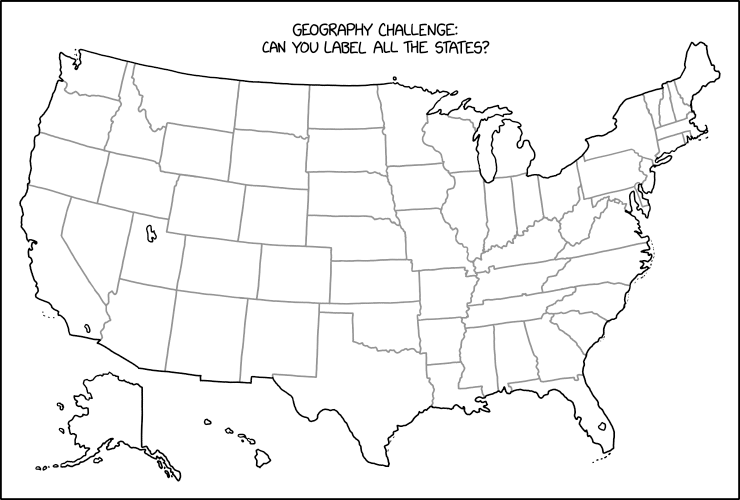
I've given this map to half a dozen smart/well educated Canadians, who happily engaged in pointing out the states they recognized for several minutes, and not one of them noticed until it was pointed out.
https://www.explainxkcd.com/wiki/index.php/2868:_Label_the_S...
The hard part is identifying the type of wine, but many of my wine-drinking friends can do with ease. We've tried the "test," having me or someone else randomly purchase wines from the closest store and then serving random samples to them while they're blindfolded. They're able to identify the specific variety more than 4/5 of the time.
Source: my wife's godfather did the studies for that[1] two years ago.
[1]: https://www.isvv.u-bordeaux.fr/fr/diplome-universitaire-dapt...
What’s a good place to find out the SOTA of the custom tooling and workflow?
Right. Full of code injection vulnerabilities.
"Quadrupled" is a very specific and quantitative word. What measure are you basing that on?
https://soundcloud.com/rs-539916550/soul-of-the-machine?utm_...
IMHO many of the successes of "artificial intelligence" come from "natural stupidity". Humans have many glitches in our perceptual mechanisms. The AIs that end up going viral and become commercially viable tend to exploit those perceptual glitches, simply because that's what makes them appeal to people.
(like it's sort of no difference than paying someone to voice something and share it)
I think the stuff that is completely generated with no human in the loop is a different category for me because it can be used for things at scale like, bots on social media, or ads in a podcast generated just for you, etc. As long as there is still a human in the loop making the editing decisions, it feels not categorically different from the world we have today.
AI/Human combos can still be valuable. More broadly I'd argue that that's how almost all tech works. E.g. there are still textile workers, just many less of them producing much more clothing.
Like, there's been computer-singing voices for awhile, but they always sounded pretty robotic and goofy (e.g. Microsoft Sam), and I think for a long time people just assumed that to get mostly-realistic voices, you need an actual singer. Yes, it still requires a bit of human tweaking to make it perfect, but I suspect that if put to the test it would reduce the cost of making a song substantially.
People fail to identify even the most basic and obvious fakes, but somehow there’s a group of people who think that as fakes become harder to distinguish from reality, we’ll all magically become experts at it. We won’t. People’s ability to detect fakes will get worse, not better, as a consequence of more prevalent and better fakes.
I didn't mean to imply that everyone will become experts; I meant that some people will become very good at distinguishing AI vocals.
Until it becomes impossible which seems to be the trajectory here, no?
I just rewrote the lyrics as "paste-ing" and it sung it perfectly afterwards.
    The cake is a lie, but the music is real

    It’s all fake when the truth is revealed
Or think GLaDOS. Pretty sure that's not a coincidence.
* sublicence - "sublissence"
* fitness - "fisted"
* infringement - "infring-ment"
* liable - "liar-ful"
It's also obviously not a pure human voice recording as the pitch transitions sound heavily auto-tuned or electrified (think Cher's "Believe").
I anticipate people becoming experts in detecting AI-generated vocalists in much the same way that we can currently detect AI-generated images due to abnormalities especially in details like ears or fingers.