The fact of the matter is the feelings of public are the feelings of the rich propagandists who, on principle, don’t want a leftist in power, regardless of whether he’s good for the economy or not.
People care about the job market, the cost of living, direction effects of inflation on buying goods and services. When people say they economy sucks they mean they can't buy a car right now because the bank will only give them an ass interest rate even with great credit and the price of groceries has skyrocketed.
I've believed for awhile now the stock market has been a poor measure of the economy because its become decoupled from the "real" economy, ie: the things I listed above.
Maybe "All Economics are Local" too.
Obviously neither of those are true in a general sense - but the local situation is what feels most important.
With regards to grocery prices, what does corporate greed have to do with the president?
As for the car, the FED has a big hand in interest rates, and yeah, Biden did choose to re-nominate Powell, but Powell was originally appointed by Trump, so I don't know how voters can really say the republican would have done better.
The American economy is bad for people under a certain line, yes. The question is why does the media always overplay the economy when Republicans are in power and downplay it when Democrats are?
As one example the meat packing industry has become highly consolidated, squeezing both farmers and consumers while extracting massive profits. But across the entire economy many industries have become highly consolidated and subsequently raised their profit margins to the detriment of everyone but shareholders.
The media obviously wasn't talking about this when they were talking about how good the stock market was under Trump...
Most people aren't extracting the root causes to high prices. They watch the news, hear there is inflation and go to the store and see prices are high. Even if they had an inclination to, that kind of economic education is not standard. The population at large is very ignorant to how the economy works. They blame the prices on inflation and companies looking to gouge prices know this and take advantage of it.
But, corporate greed and monopolies have a lot to do with the president. At least Teddy Roosevelt thought it did. And he did something about it. It's not unreasonable to ask why Biden doesn't. There was a point, brief as it may have been where it at least seemed like our institutions cared more about how the economy effected the common man.
>The American economy is bad for people under a certain line, yes. The question is why does the media always overplay the economy when Republicans are in power and downplay it when Democrats are?
I should have made this more clear in my first post. But my core point is, public sentiment doesn't care about economic reports. It cares about tangible every day things like prices of goods and interest rates. It doesn't care nor understand the root causes. It blames the guy in charge. For better or worse POTUS is always to blame for the current state of the economy. It comes with the job. Instead of saying the public is stupid, I think its more productive to accept it and work out how best to deal with it.
And I don't think they downplay for republicans and exaggerate for democrats. The large media corps are selling a product and outrage helps. The kind of outrage the sells best depends on a lot of things. When trump was president, it was effective to just sell him as the outrage product. Biden is a much more dour and boring person. You have to focus on other things than the personality at the top. Before 9/11, Bush was getting attacked for the economy. He presided over the dot com bust. But with GWOT most criticism for him switched to that. The 2008 recession happened while Obama was in office and had long since left the news cycle by the time he left so duh.
The large majority of people are doing well. When people say the economy sucks they are largely not talking about their own economic situation. Most people believe that they, personally, are doing well, but that some nebulous "the economy" is doing badly. We have a nation of thriving people who believe everything is falling apart.
https://www.nytimes.com/2023/09/07/opinion/economy-inflation...
People don't think of inflation quarter to quarter or even FY to FY. They think of it in terms of what they are calibrated to think "normal" prices are. For most people that's going to be pre-pandemic. Since prices have not returned to pre-pandemic levels the economy is bad. Especially so since their wages haven't gone up comparably to match. This is why the numbers are largely useless at gauging public sentiment. Nobody cares that this quarter the rate of inflation has slowed. They care that chicken breasts cost double what it should. They care that a Ford Mustang GT can cost $50k when they were pretty sure they were $30k. They care that fast food costs as much as a sit down restaraunt should and the sit down costs as much as a nice one should.
Now you can all explain that with numbers and reports but sentiment doesn't care about that. Public opinion is an inherently irrational thing. But it is still incredibly important because elections are decided by it. It doesn't matter if GDP is positive and inflation is good right now if everyone thinks we are in a recession and the prices of everything are too damn high. You will get voted out. I'm not sure why this is a hard concept to grasp.
The economic data indicates that average income has gone up more than prices have since the start of the pandemic. If you look at Real Personal Income (https://fred.stlouisfed.org/series/RPI) it's up 5% relative to the end of 2019.
And if you think inflation is way higher than is being adjusted for, you're simply wrong. The MSRP for a 2023 Mustang GT is $38,345 (https://www.kbb.com/ford/mustang/2023/). The 2020 was $38,320 (https://www.kbb.com/ford/mustang/2020/). The price of Chicken Breast is up 38%, not 100% (https://fred.stlouisfed.org/series/APU0000FF1101).
Yes, public opinion is irrational, but the more obvious political question is why public opinion is so wrong now, when often it is not so pessimistic about the economy.
In 2020 I could get Mustang GT for $8k off MSRP. In 2023 Mustang GT MSRP is $42,495 and there is only $500 off.
To that I would say there is likely a problem with average. I didn't see a break down of the data in your link, but admittedly its my lunch break and I didn't have the time to really dig for it either. But its entirely possible that some groups saw an outsized growth in wages while others didn't.
>The MSRP for a 2023 Mustang GT is $38,345
The MSRP of a Mustang GT is $42k before options https://shop.ford.com/configure/mustang/model/customize/ecob... The GT Premium is $47k
You think the average income is being computed incorrectly? Or that there is just a lot of variance so many people are worse off? It is true that wage increases have been uneven, but they are actually much larger at the low end -- this is why you see the most inflation in low-wage service-heavy categories like restaurants.
Is it public opinion being irrational or governments around the world playing games with "basket of goods", "core" inflation and other bullshit designed to convince their citizens to trust magic math formulas instead of their own eyes?
It is a poor measure. The top seven or ten stonks levitating the SP500 should be a concern. I went to cash in early September and will re-evaluate at SP500 4000 or maybe 3500.
Good luck gaslighting the working class into believing their day to day situation is something it's not. "Don't believe your lying eyes. Your grocery bills and rent and gas and car and healthcare didn't go up, and you're closer to owning a house than before! It's the bad people telling you otherwise. Trust Us. Four Legs Good, Two Legs Bad."
I'm obviously only looking at a small part of the overall US, but if we're going to go by what we as individuals see the numbers I'm personally seeing largely match the trends I see from the BLS.
Feelings are more present and real. It's a mistake to expect that anyone will ignore their feelings. The question is how to get upstream of those feelings.
I had a big anger problem when I was a kid - my dad told me that if someone can make you angry, they control you. It's hard to tell someone they are being controlled while they are angry though.
Sometimes people are happy to be angry because it makes the world simpler. All I have to do is be angry, and this guy will fix things for me. And maybe that guy fixes things, or fixes one thing, but later things get worse again, because just being angry and trusting someone to fix things doesn't work.
Humans are very smart animals, but the world is very complicated.
A common and easily mocked media meme. On the New York Times Pitchbot humor account, an hour ago: "We're not in a recession. So why does it feel like we are?"
Debtors really don't care about the deficit. There's not a lot of places to park large quantities of cash. Even if the US Treasury was offering a measly 1% most bond buyers would still take that over any higher yielding riskier debt. It still confounds the typical US taxpayer that other countries buy our sovereign debt because that is how they insure their currency.
The numbers are meaningless, even if they are accurate, which I sincerely doubt. GDP is up 5%? My salary hasn't gone up 5%, but my grocery bill has gone up way more than 5%. Health insurance costs went up more than 5%. Maybe all those increases in prices are boosting GDP, but wages aren't keeping up. Maybe the numbers are hand-waving nonsense.
People know whether they are doing okay or not. GDP is a blunt instrument metric of little value except as a broad comparison. But noting that it "happens during a Democrat presidency" is quite telling.
If you're in the top 1-2% of income earners you feel things differently, this is understood.
So while your math is good, it's not meaningful. I find it very weird the lengths people will go to in trying to make one-off metrics reflect a different reality than what is very clear from people's experiences.
But job switchers (rightly) give themselves the credit for their salary boost. OTOH the government gets the blame for inflation and job loss. It's a crap job, you get blamed for the bad stuff, but don't get credit for the good stuff.
Suggesting that people job-hop is insane. Most workers cannot do this for a multitude of reasons, and most jobs are fungible. It's a very keyboard-warrior way to look at the economy, which is like getting advice on which car to buy from hedge fund managers.
Have you talked to low-wage workers? They switch jobs a lot. Long-term job stability is actually more of a corporate white-collar phenomenon.
In any event, others disagree with your chart: https://www.pewresearch.org/short-reads/2018/08/07/for-most-...
That's literally the point of adjusting for inflation. You can of course pick the fastest growing components of the CPI (housing is already a huge component) and complain that we're not outpacing the fastest growing component, but that's arbitrary.
> In any event, others disagree with your chart: https://www.pewresearch.org/short-reads/2018/08/07/for-most-...
That chart looks at wages rather than income, e.g. excluding healthcare contributions. You can argue that we shouldn't count healthcare because it's gotten way more expensive for no real increase in quality (which is true!). But healthcare is a huge and rapidly growing component of CPI which we are using to deflate wages -- you can't have your cake and eat it too by excluding healthcare payments from compensation but including it in your deflator.
Also that chart just seems to be wrong (they don't actually show the source or data). You can do the comparison yourself easily enough -- take the average hourly wages (https://fred.stlouisfed.org/series/CES0500000003) and use FRED's graph editor to compare to a deflator (e.g. CPI -- https://fred.stlouisfed.org/series/CPIAUCSL). This is up ~10% since 2008. It's not massive but it's not nothing -- and remember the caveat above that this is an underestimate.
And re: switching jobs for low-wage workers -- either they are getting big raises or getting big pay increases from switching jobs, or the BLS is massively wrong. Which is it?
That 8% debt would generate 4% more economic output this year, next year, the year after, the year after that, etc...
If your 8% debt only generates 0.5% of extra growth once, and then we get back to a baseline 3.5% growth, the additional economic output will equal the debt in 16 years and continue generating economic output afterwards.
But it's also completely unclear why, as a government, you should care about the ratio of debt to growth. The two numbers are of an entirely different nature. That economic output corresponds to things produced by the economy. The 8% debt corresponds only to who has control of which money pile (in particular, it includes the promise that the government will redirect a large chunk of money to the lenders in the future, which you might or might not find problematic). It doesn't take anything away from the total sum. So by shuffling money around, you have created real economic output. That's great!
I have "opinions", but if you are interested in this topic, rather than me dumping it here, it can be worth reading up a bit on GDP, then googling around for GDP criticisms. I think there's a sense in which it measures something useful, but it isn't measuring what people think it is and what the media sort of pushes it as meaning; it is correlated to the health of an economy but it is by no means a measure of the health of the economy, and the fact government expenditures are simply straight-up added to the GDP has such an obvious way for the government to manipulate the numbers that I can't hardly even call it an exploit. Whether they are doing that, I'll leave that to the reader to decide.
Another relatively obvious issue is that the GDP number waved around in the popular press is generally not adjusted for inflation. That's not just the US GDP in 2023, it's any GDP the press will talk about, anywhere and anytime, so I'm not trying to make any stealth political point here. It's something to be aware of in any context a "GDP" comes up, look to see if it's inflation-adjusted or not. Such measures exist and more serious economists definitely use them. The wikipedia page I linked to above has a wide variety of other interesting definitions and that's still a Wikipedia overview itself, of course, not the fullness of econometrics.
However, to make things simpler assume you don't have cash, for example, because you are unemployed.
So, if you are making the mortgage payments using the credit card and the total CC payments this year alone are 8% of the value of the house, you can see problem.
Eventually, the debt becomes due, and no amount of house will repay the incurred debt.
So the relationship is, you may buy any house (assets) that grows in any amount, but if your CC hole is growing faster, you are actually worse than you started out.
Financing and even currency issuance depends on trust.
I can get a 0% from family and friends if i needed for far more my net worth. With connections I could also get counterfeit and pass it around.
It comes down to the fraud triangle: opportunity, incentive, rationalization.
The government may have more leeway to commit fraud than an individual. But the comparison is still apt, the fraud is the same, whether its a house being paid with CC or GPD with govt bonds. Ignore that at your own peril
Conversely, the US government has also spent the last 40+ years abusing the fallacy that loaning money is completely different than spending, which has grotesquely distorted the financial industry and the housing market. So the sooner we shove off these misguided notions, like that the government's balance sheet is anything like a private balance sheet (and even worse, that the Federal Reserve's balance sheet is somehow distinct from the government's!), the better. Modern Monetary Theory is more in line with the actually-conservative Austrian School than the hybrid catastrophe of the past four decades.
But that's just like you demanding to have a 0% CC from a financial institution. If you are Bezos, you may be able to swing that.
But that demand only follows your credit rating. You can demand 0%, but that doesnt mean you will get it. If Bezos is suddenly bankrupt, bet he's not getting the same CC, or even any CC.
Making the bet that the USG can set rates as they please forever just because they have for 12 years is just saying "I'm a turkey and life is good, this nice farmer feeds me every day!"
Thanksgiving always comes.
Thanksgiving will always arrive but the government is not going to be the turkey with its debts, in this case, it could be a global stagflation. The US government can always make good on however many debt it has as long as it is denoted in US dollars.
If the government spends more, it should cause more work, which should lead to higher GDP.
This is one simple way to look at it.
If the government is spending more, but GDP isn't growing by the same, it might be a sign that the governments expenditures are wasted.
Now, I'm not saying that's happened, but it could be. Government spending is historically the most likely to be wasteful, in comparison to individual/retail/business spending.
So isn't the situation today exactly the same as four years ago, before Covid, under a Republican administration?
Yet somehow I never heard this argument that GDP growth is a function of the deficit back in 2019.
The more they spend, the more others earn, leads to higher GDP.
A one time expense of 8% GDP for a 4% growth is great. That means it would get paid back in two years, or faster if you consider compounding.
The problem is determining if the 8% spending is related to the 4% growth (and how much.
Another way to to frame the whole topic is that the US government spends %40 of GDP in taxes, plus another 8% borrowed, per year. Even this could be a good deal, but it comes down to how much of the growth is causes by govt spending, which types of spending, and if the growth is permanent.
It will never default because it can just create the credit. That’s what the Federal Reserve did with its zero interest rate policy. It distorts the economy, and the economy can shrink and be torn apart, but the government can always pay its debt by simply printing the money.
The real problem lies with private debt, and that's what's actually leading to a default. When people default on their debt, they end up forfeiting property to the creditors. What we’re seeing now is a large scale transfer of property such houses and cars that people had bought, and so on, that they can no longer keep making payments on. this results in a transfer of income from the 90% to the 10%.
Take social security for example. You can print money to repay all the money borrowed from the fund, but in doing so, you have debased the currency it pays out.
If a retiree is owed 100$, you pay it with printed money, so in theory they are made whole, but it no longer has the same purchasing power. It is a rug pull for the retiree.
You can expand the money supply and amounts in circulation without inflation in the exact case where you expand the value goods and services in equal measure.
Even then, the purchasing power of currency holders is less than the counterfactual where the money supply was not expanded and you had deflation as a result.
Money drop a million printed dollars on each consumer, and prices will skyrocket.
Are you trying to tell me that the expansion of the money supply in Venezuela has no direct relation to inflation.
This is exactly what happens when the government expand the money supply to repay debt. It send out social security checks, pay workers, and buys goods. This puts money directly in the hands of consumers.
You even agreed we are talking about an increase in the money in circulation. Are you walking that back and saying that money in circulation doesn't give consumers more money? The creditor of Government debt Is citizen consumers with benefit obligations.
What about Venezuela? Consumers don't have more currency there either?
Not really, because most government debt isn't consumer debt. US isn't increasing money supply to pay for social security or to pay workers. It's increasing things like military contracts for large corporations.
> You even agreed we are talking about an increase in the money in circulation. Are you walking that back and saying that money in circulation doesn't give consumers more money? The creditor of Government debt Is citizen consumers with benefit obligations.
I'm not walking anything back. I'm saying that the currency that's being created isn't going to the hands of regular people. This is obvious from the fact that majority of the working population can't even afford to live on the salaries they make forcing them to take on debt to buy essentials
https://finance.yahoo.com/news/jaw-dropping-stats-state-cred...
> What about Venezuela? Consumers don't have more currency there either?
Venezuela is under a brutal blockade by the US, and that's the actual source of most of the problems there.
You are confusing the debt owner, and where the money was spent. The governments make create internal debt for a military contract, but the debt is held either by the public (e.g bonds), or intragovernmental ( e.g. borrowed from the social security fund) When these get paid back, they go into circulation.
Besides, Most government spending goes to salaries and benefits.
If what you claim was happening then we wouldn't be seeing this happening. If money went to salaries and benefits, then workers wouldn't be under water financially the way they are right now.
The irony is off the charts.
Not quite. The payback time will depend on the growth in government revenues, which should be correlated to GDP growth, but a fraction of it.
The purpose of the government isnt grow, it is to serve the people
Not that comparing those two numbers is at all meaningful.
The percentages don't appear comparable here. They also don't allow for future multiplier effects from the spending.
No agenda, just holding that sentence up to a little scrutiny.
https://thehill.com/business/economy/4057722-greedflation-is...
The latter would fall into the bucket of government handouts to the bottom cause inflation, would it not?
If you're skipping the monetary interaction and saying "it's not the handout, it's the greed", then I'd like to point out that companies have been behaving the same way forever (trying to maximize profits), yet inflation has been low for a decade.
That corporations would take advantage of poor people having more money to spend is intended behavior, and something that needs to be accounted for in functional monetary policy.
This isn't true. Companies only started to maximize profits under shareholder value recently. Corporations originally were thought to have a responsibility to society at large, thus with things like pensions being provided to their employees.
Additionally, the small handouts to the poor are much more dwarfed by handouts to the employers at the time. Which made it baffling that large employers then raised prices anyways, when they already got the vast majority of covid relief money. No, it is pure greed.
The human condition is to endeavour. Even with free money the majority of folk will work, or do something to improve their situation.
I agree that GDP is a poor measure of “on the ground” experience, but not sure what that has to do with deficit spending.
the main argument that the economy is doing well is that "the labor market is strong" and unemployment is low, but how many jobs are tied to government deficit spending via contracts or direct employment? If that spending is cut back, I'd imagine the jobs numbers will quickly start to decline
0 - https://www.reuters.com/world/us/us-budget-deficit-jumps-23-...
That's really the key thing. What level is sustainable? I've come around to the idea that the main danger of deficit spending is inflation (because of the idea that government debt is private sector wealth).
The big levers the government have access to are spending and taxes. The first adds wealth, the second subtracts. In this way, government debt is really nothing like household debt that you and I have.
I personally don’t buy it. When other country’s start divesting from US treasury ties, the party will be over. Already prices are rising faster than income. What did Germany, Zimbabwe, and Argentina, Venezuela, etc. do wrong, that the US is doing right?
Think about Carland, a country that makes lots of nice cars, and largely sells them to the US. Imagine the US decides to print a bunch of money, weakening our currency relative to Carland's. Carland's cars now cost more for Americans to buy. This might sound nice at first (for a Carlandian car peddler), but in reality what's going to happen is less cars are going to be sold, and your cars are likely to become less competitive than those from other countries. So the Carland government has a major incentive to try to weaken their own currency, and start doing exactly that. So other countries effectively end up absorbing much of our inflation, helping to greatly minimize the impact of any given batch of money-printing.
So if the USD hits a point where we're no longer able to effectively export our inflation, the result's not going to just be inflation. That's a SHTF moment, because it means we'll have reached a point where we're inflating so much that other countries simply can't afford to absorb it without or imperiling their own economies, or have become okay with not exporting much to the US. Given how extremely dependent we are on imports, this is going to be a catastrophe.
Beyond this there are lots of self-feedback effects to consider, especially with borrowing, but this post is already long enough!
[1] - https://search.brave.com/search?q=exporting+inflation&source...
But if it's actually providing a boost to economic growth, it also means the debt isn't actually unsustainable. If you boost economic growth this year by 0.1%, and afterward it returns to previous growth rates, then the economy will stay 0.1% larger than it otherwise would have been perpetually. If your interest rates are comparable to the base line economic growth (true now, last decade they have been lower), and you take a twenty-year view, then taking on 5% of GDP in debt to generate a one off 1% growth boost to the economy is a no-brainer. The real issue is to understand when the government (vis a vis the private sector) actually can spend money to generate genuine extra growth, and when it cannot (e.g. if it only shifts growth that would happen anyway forward you would expect growth to dip after the initial boost, but that would be true whether the deficit spending stops or not).
The argument against debt is often not based in economic sense or sound science (remember the debacle when a widely cited study on the problems with high debt turned out to be based on an Excel mistake?). In my view, it's based on an aversion to the government having too much spending power. After all, a version of the argument, above was used by conservatives to sell tax cuts that were supposed to pay for themselves. They didn't because the tax cuts did not actually generate growth, they merely redistributed wealth to the top. For deficit spending, the evidence that it can boost economic growth is much more robust.
The real debt crisis will hit once countries start to seriously shrink...
Or it would've been placed in the reverse REPO facility at delicious interest rates paid straight from the printing press. A lot of COVID spending was sanitized this way, without it inflation would've been much higher. And this money has started to get back into the economy.
People will never “feel good” about the US economy again.
To pick an extreme to illustrate the point: if GDP shoots up 100%(!) but it's all a dozen people trading with each other a whole lot and everyone else is now impoverished, is that better? GDP is better! GDP/capita is better, too! But the economy is definitely worse.
Another exaggerated example to illustrate the point: if GDP is outpacing consumer inflation—let's say 4% growth in a quarter, and 2% inflation in the same—but only because we've made the "basket of goods" to calculate inflation qualitatively worse, and meanwhile several important things that aren't part of that basket have gone up 1,000% and everyone rightly reports feeling poorer—is the economy doing well?
Maybe everyone is miserable because they’re newly aware of the violence and injustice in the world generally. How is that useful when trying to understand the state of the economy specifically? It’s important to understand how people feel as a society, but this isn’t supposed to be that. How do you filter out the “noise”?
We can’t really use “vibes” to determine if interest rates should go back down, for example. That would be disastrous.
https://www.pewresearch.org/politics/wp-content/uploads/site...
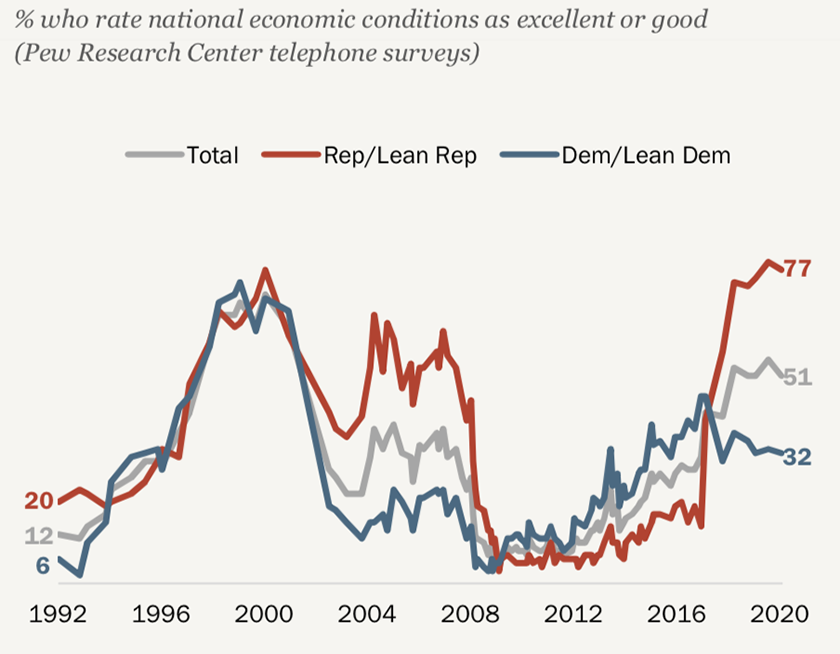
The economy suddenly was awesome once a Republican was back in office, according to Republicans. Just turned on a dime.
You act like people would finally be happy if inflation were just under some number. No. People will just find the next thing to be miserable about. That’s how people are now.
This is not exactly true. They raised their prices, but they have a permanent 30% off coupon on their app.
God I feel like I’m in the Twilight Zone.
People radically misreport this stuff for political reasons. "The economy is doing well" numbers will change radically in a week when a different party takes the White House, typically in a purely partisan fashion [1]. The economy didn't get better in that week, it's just that people "feel" differently about things when their preferred (resp. disfavored) candidate takes office.
[1] https://news.gallup.com/poll/1609/consumer-views-economy.asp...
"But gas prices are low" so whatever apparently.
Making everything about everything is an extremely effective way to paralyze any potential improvements. It’s unhelpful and exactly what I’d do if I wanted nothing to change.
Also it isn’t largely accurate, so the fact that they feel it is disconnected from reality, which is kind of my point anyway. For some it’s probably true, nothing is ever 100% good, but for the vast majority of people who feel that way they’re a) not helpless but indeed complicit based on their voting (or lack thereof) and purchasing choices and b) their lives are indeed improving even if they refuse to accept that.
https://www.axios.com/2023/10/16/life-expectancy-educated-ad...
Their lives are literally shorter. How do you think that data makes them feel?
I get that the privileged are too isolated to understand the issues facing the unprivileged these days; it seems like yet another self-reinforcing doom-loop that will eventually lead to some sort of national breakup/collapse. At which point the GDP will probably fall and then there may be some concern. I've never been much of an optimist though; maybe everything will just work out somehow.
Further, to conflate "many people are generally unhappy" with "the economy and choices related to the economy are what is making many people unhappy" is unhelpful. The economy can be doing well (the subject of this submission), and people can, separately, be struggling for non-economic reasons. It's unhelpful, however, to constantly bring it up when it's irrelevant, such as right now.
For the question you're interested in, you'd want to look at other measures like the deficit as a share of GDP. Which is trending badly in large part due to lower revenues (variety of non-ideological reasons).
But, that doesn't mean the the economy overall is seeing growth so we can hold all three things can be true.
What are those numbers?
EDIT: I don't necessarily disagree, but it's important to not let general sentiment get in the way. Sentiment is often a lagging indicator.
So when you talk about numbers “you see coming out” you’re at least a year out of date.
I’m assuming you’re going to just start saying “the numbers aren’t real man”. But in that case why talk about the “numbers you see coming out”.
> I’m assuming you’re going to just start saying “the numbers aren’t real man”.
Nice way to prove you are arguing in partisan favor and not discussing anything in good faith.
Core inflation doesn’t include housing and fuel. But fuel is down 10% from its peak last year and the median home price in July 2023 was 2% below the median price in July 2022.
Inflation is going down, wages are going up.
You can’t argue that “the numbers coming out” are showing the opposite because they aren’t.
This is why the numbers are largely useless at gauging public sentiment. Nobody cares that this quarter the rate of inflation has slowed. They care that chicken breasts cost double what it should. They care that a Ford Mustang GT can cost $50k when they were pretty sure they were $30k. They care that fast food costs as much as a sit down restaraunt should and the sit down costs as much as a nice one should.
Now you can all explain that with numbers and reports but sentiment doesn't care about that. Public opinion is an inherently irrational thing. But it is still incredibly important because elections are decided by it. It doesn't matter if GDP is positive and inflation is good right now if everyone thinks we are in a recession and the prices of everything are too damn high. You will get voted out. I'm not sure why this is a hard concept to grasp.
Are you saying people are expecting CPI deflation? I don't think that's accurate, and it's also definitely not gonna happen.
A chipotle burrito with carne asada steak and guac is now $17
Amy’s frozen pizza was $6.99 and is now $10 (don’t buy it any more, I’ll be dammed if I spend 10 bucks on frozen pizza)
I looked up the price for Amy's Vegan Supreme pizza at my local Kroger, in-stock for $7.99. No sales tax on that item, so just that price.
Because they're two different concepts. Public sentiment is generally a lagging indicator on the economy. People will think we're still in a high even after the economy has started to falter. And people will still think times are bad even after the economy starts to come back.
You are correct that public sentiment is on what people vote. That doesn't mean they are accurately assessing the economy.
Someone’s belief was causing them to invent numbers coming out to justify that belief.
I think a lot of people feel bad about the economy because they are told to feel bad about the economy.
Which, if your job is hiring people, might be the case because wages are going up for those on the lower end.
Because growth likely means inflation in this case, so that causes uncertainty.
How much deficit did we add last year? The year before? OK, two years ago means they are Covid numbers, so... five years ago?
How much did the economy grow in those years?
I'm not sure that you can say anything as simple as "the growth is because of the deficit". I suspect (but I don't currently have the numbers) that there have been lots of years when the US ran a large deficit and did not grow.
Besides regional differences, it’s also the case that more and more economic activity is being captured by fewer and fewer people. So, if the richest billionaires grow their stash fast enough, the rest of the country will probably feel less dynamic.
Like this: https://www.axios.com/2023/08/18/americans-economy-bad-perso... TL;DR: 71% say economy is bad and 51% say it's getting worse, while for 60% people in the same poll their personal financial situation is just fine. There are many similar polls, all point to the same thing.
Also, economic growth in U.S. is now mostly concentrated in lower income groups. It seems that high middle class (statistical one, i.e. top 10-20% of population - "people just out of poverty" if you look at it honestly), are on the losing side now. Hard numbers are hard to come by but once the tax season is over we will see them next year.
https://usafacts.org/articles/how-many-homeless-people-are-i...
There are fewer homeless than before 2008, which was a period of economic boom.
Here's the basket that the bls uses for cpi: https://www.bls.gov/cpi/tables/relative-importance/2022.htm
What specific issues do you have with it?
We just raised GDP by $2 trillion!
There are all kinds of reasons why this figure might be politically influenced. The reality on the ground is we've had to make significant cuts to our standard of living just to maintain spending flat even with wage increases. The wage increases have been on the order of 3% per year and not tracking with inflation for both my wife and I.
Perhaps you're a pessimist.
These are the good times that the government should use pay to pay off debt by taxing more and spending less.
I don't put much stock in your feelings about the economy. My feeling is, I see people shopping at the mall, I see them filling the bars, and I see them buying new cars. The problem some people may be having is that they over-extended themselves and now owe too much. For example, while their real wages have actually gone up, they may have underestimated how much inflation would erode the real value of their nominal wage increases (I did this, in fact). So they took out loans they thought would be easy to pay, at interest rates that were higher than they were used to, and found that they had made the wrong bet. The disatisfaction, imo, is all about disappointed expectations, not the actual living conditions people have. I got a 20k raise, but now it feels more like a 12k raise, and meanwhile I took out a loan for a kitchen remodel.
Yes, I am fortunate enough to earn a middle-class income for my family. I grew up poor in a poor neighborhood with a lot of crime. Sometimes you can climb the ladder.
Obviously, the US government deficit spending is somewhat better than building dynamite statues (but only somewhat) and we can expect some degree of returns, but I highly doubt that the spending is efficient enough to outpace raising debts and the crowding out effect of the private sector.
Is it so hard to believe that people's negativity is often not about hard numbers and facts?
The US deficit spending this year is 6.6% of GDP. Last year the deficit spending of $1.4 Trillion was 5.5% of GDP. In other words, if there were no growth except that caused by government deficit spending, and that government spending was a wash - $1 of government spending for $1 of economic growth - you'd expect an annualized GDP growth of 1.1%.
Further, GDP growth fueled by deficit spending is still legit GDP growth, the same way that taking out a loan to remodel your home still creates a legitimate growth in your home's value. That remodeling may not have been the optimal investment, it might not even be a profitable investment, but it still is an investment.
That feels like a super bold claim that needs a lot of justification. Sorry I won’t just go with the hokey household metaphor.
you can pay someone to dig ditches for no reason. then pay to fill them back. both count as legit GDP growth, even if the value of either action is $0
If a government takes out a loan to build a $100 million bridge, is that bridge any different from a $100 million bridge that was funded by taking money out of the coffers?
Medicare and social security aren't bad things, but funding them with debt is pure consumption rather than a long term investment in US growth and productivity.
These two are often lumped together, though are quite different. SS deficit can be fixed with slight increase of retirement age and slight payout reduction and slight contribution increase. Medical spend is completely broken and unfixable without going after the medical cartels.
More to the point though, if you spend $20k keeping grandma alive, is she any less alive because that $20k was loaned versus pulled out of her mattress?
GDP is not a measure of how optimally money is being spent, it's just a measure of how much economic activity is going on.
In that case, the $1.7 Trillion deficit is 6.1% of GDP, so actually a half-percent lower than your calculations.
The higher interest rates haven't had time to dig into corporations yet, but the consumer really is faltering (e.g: https://www.forbes.com/sites/antoniopequenoiv/2023/10/21/ame...)
Once the consumer buckles and spending drops then the GDP should drop, pulling the US into a recession, that should cause rounds of severe across-the-board layoffs (not just isolated to tech) which then cause housing to buckle. And at some point commercial real estate should detonate as the loans there hit their maturity dates and roll over.
Remember: the nation's largest propaganda machine is dedicated to making people believe the economy is in shambles, because a booming economy fueled by government spending in green energy and protecting families falsifies their ideology.
The numbers I see coming out about the state of the economy just seem more and more out of sync with reality on the ground. Legit 5% GDP growth should mean a booming economy with people feeling good, yet people are struggling to cover their basic needs and pessimism seems high. I work remote so I see this in both the bubble of the tech world and in the "real world" outside of tech