To pick an extreme to illustrate the point: if GDP shoots up 100%(!) but it's all a dozen people trading with each other a whole lot and everyone else is now impoverished, is that better? GDP is better! GDP/capita is better, too! But the economy is definitely worse.
Another exaggerated example to illustrate the point: if GDP is outpacing consumer inflation—let's say 4% growth in a quarter, and 2% inflation in the same—but only because we've made the "basket of goods" to calculate inflation qualitatively worse, and meanwhile several important things that aren't part of that basket have gone up 1,000% and everyone rightly reports feeling poorer—is the economy doing well?
Maybe everyone is miserable because they’re newly aware of the violence and injustice in the world generally. How is that useful when trying to understand the state of the economy specifically? It’s important to understand how people feel as a society, but this isn’t supposed to be that. How do you filter out the “noise”?
We can’t really use “vibes” to determine if interest rates should go back down, for example. That would be disastrous.
https://www.pewresearch.org/politics/wp-content/uploads/site...
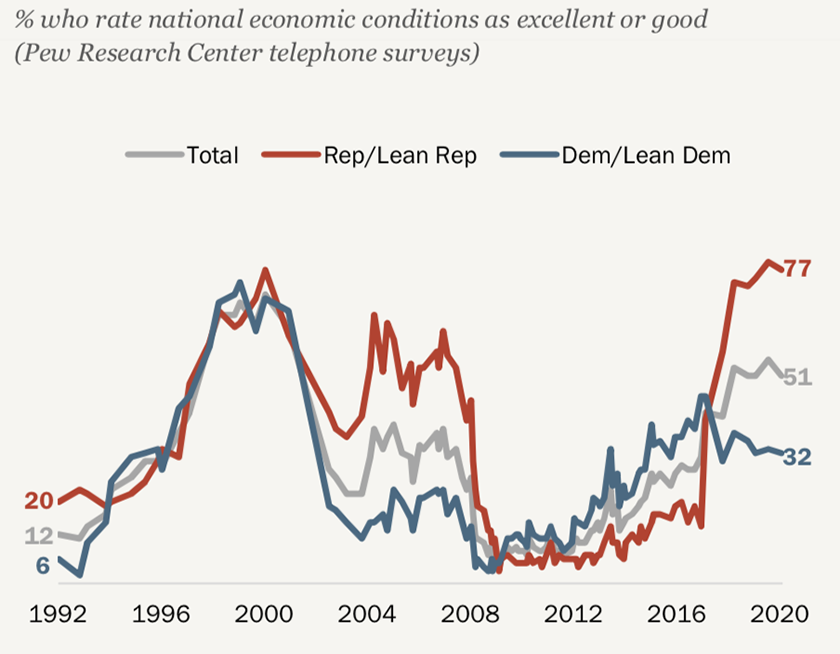
The economy suddenly was awesome once a Republican was back in office, according to Republicans. Just turned on a dime.
You act like people would finally be happy if inflation were just under some number. No. People will just find the next thing to be miserable about. That’s how people are now.
This is not exactly true. They raised their prices, but they have a permanent 30% off coupon on their app.
God I feel like I’m in the Twilight Zone.
People radically misreport this stuff for political reasons. "The economy is doing well" numbers will change radically in a week when a different party takes the White House, typically in a purely partisan fashion [1]. The economy didn't get better in that week, it's just that people "feel" differently about things when their preferred (resp. disfavored) candidate takes office.
[1] https://news.gallup.com/poll/1609/consumer-views-economy.asp...
"But gas prices are low" so whatever apparently.
Making everything about everything is an extremely effective way to paralyze any potential improvements. It’s unhelpful and exactly what I’d do if I wanted nothing to change.
Also it isn’t largely accurate, so the fact that they feel it is disconnected from reality, which is kind of my point anyway. For some it’s probably true, nothing is ever 100% good, but for the vast majority of people who feel that way they’re a) not helpless but indeed complicit based on their voting (or lack thereof) and purchasing choices and b) their lives are indeed improving even if they refuse to accept that.
https://www.axios.com/2023/10/16/life-expectancy-educated-ad...
Their lives are literally shorter. How do you think that data makes them feel?
I get that the privileged are too isolated to understand the issues facing the unprivileged these days; it seems like yet another self-reinforcing doom-loop that will eventually lead to some sort of national breakup/collapse. At which point the GDP will probably fall and then there may be some concern. I've never been much of an optimist though; maybe everything will just work out somehow.
Further, to conflate "many people are generally unhappy" with "the economy and choices related to the economy are what is making many people unhappy" is unhelpful. The economy can be doing well (the subject of this submission), and people can, separately, be struggling for non-economic reasons. It's unhelpful, however, to constantly bring it up when it's irrelevant, such as right now.
People will never “feel good” about the US economy again.