This seems highly debatable. Sure cheap calories and cheap corn based sugars make it easy to develop so called lifestyle diseases, but on the other hand we've essentially eliminated famine and in most parts of the world malnutrition.
In terms of ecosystem loss, it seems to me that concentrating most calorie production onto the smallest amount of land makes sense.
> And the labor issue is also complex
You're right of course, but I don't see how the manually intense process of regenerative and/or organic ag makes this better. Every small farm like this that I'm aware of makes heavy use of children, unpaid interns, and extremely low wage workers. It's not exactly comparable to migrant workers picking strawberries en-masse, but that's more of an issue of sacle and where these boutique farms find their labor IMO. I say this as someone whose parents and grandparents were all farmers, and my sister-in-law worked for a few years on a regenerative/organic farm.
> But a lot of the ideas from more fringe communities like permaculturists are becoming more and more integrated into the mainstream
This is the part that's actually really interesting to me. Finding ways to scale up and integrate ideas about soil health, water use, etc into mechanized, large scale agriculture is really great. People seem to be doing cool things with no-till and drip irrigation right now.
> alternative methods like agroforestry
My concern with this is that it definitely require LOADS of labor, and isn't likely to produce that much food. It also may put pressure on forest land may not be sustainable long term. On a small scale on you your own farm, it's probably great. But I have trouble imagining how it could ever make up a significant portion of overall fruit and nut consumption.
I think this is letting the good be the enemy of the perfect (a rare construction, to be sure). Yes, we've solved a very bad 1st order problem. That frees us up to work on 2nd order problems that we've never had to deal with before. This is a thalidomide-style problem in that the side-effects of the "cure" are a disease in their own right.
I'd rather have diabetes than be dead, certainly, but wouldn't it better to not risk diabetes just to stay alive?
I'm substantially in agreement with you though. The less land we use on food production, the better. The less labor we can expend growing and harvesting that food, the better.
All of that said, the parameter space of agriculture has a complicated shape, so optimizing for any one parameter will be at the expense of other parameters.
I actually agree with you.
> I'd rather have diabetes than be dead, certainly, but wouldn't it better to not risk diabetes just to stay alive?
Again I agree, but I also think there's a huge cultural component to food/eating that is often missed in these discussions.
This is a mischaracterisation. If you have any choice in what you eat, you risk diabetes just to stay alive.
There is so much food that far fewer people are dying of malnutrition than in the past. As part of there being lots of food available, it's also possible to eat yourself into heart disease and type 2 diabetes. Great availability requires some responsibility.
Since I reached the "can afford to shop at whole foods if I wanted to" stage of my life, the combination of lifestyle, genetics, and diet means I'm pretty far from diabetes at the moment.
But when I was a lot worse off, I bought the food I could afford, which tended to be the low-cost, high-calorie stuff that leads to health problems. Maybe (and I'm just spitballing here) we should find a way to lower the cost of higher-quality food. The decision for huge swaths of the world should not be "afford enough food to not starve, but the food is of such low quality that it leads to long-term health problems" vs "starve while eating food that, if eaten in sufficient quantity, would not lead to long-term health problems". Optimizing for dollars per calorie means you end up picking high carb options.
Telling people in Somalia or wherever "have you just tried keto?" is a pretty problematic stance.
Incorrect. Agroforestry is the practice of integrating livestock and orchards. The orchard is designed to serve as the basis for an extended ecosystem. Trees provide shade for fowl, sheep and small cows and help limit swale evaporation. Fallen fruits attract a wide variety of animals and birds, providing prey for cats, hawks and owls. Systems like this sustainably produce a high quantity and quality of food per acre while encouraging diversity and natural beauty, at the cost of being less accessible to automated farm machinery. The best case scenario for sustainability and diversity would be if everyone lived in small communities with shared food forests, eating mostly locally grown food.
A world with shared food forests and locally grown food is probably a world with far fewer people.
I think high population and natural farming are mutually exclusive.
And the state of industrial AG isn't static, robotic micro pesticides are interesting for example. Not that I'm a fan of them, but it would be great to see us move away from showering everything in loads of agent orange and have more targeted application.
It's ironic to note that high population and sustainable farming are mutually exclusive. When we can no longer sustain our current system of agriculture due to resource exhaustion, environmental destruction and climate change, a lot of people are going to die. Even worse, if we wait until the 11th hour to adopt sustainable agriculture there will be a lot of avoidable suffering and death that will occur during the transition.
There is an alternative - gradually adopt sustainable farming now and let food prices rise. That will signal to people to have fewer children, and also encourage people to grow some of their own food or otherwise get involved in agriculture. That way, our population will move towards a level that can be sustainable fed as our agriculture system moves towards sustainability, and we won't have an "oh shit" moment where human civilization collapses because the rich are hoarding food in the face of mass starvation.
I can't express enough how morally reprehensible I find your position of "let food prices rise. That will signal to people to have fewer children".
We are in a car rocketing towards a brick wall at 100 miles an hour. We can slow down gradually (controlled population decline) or we can slam into the wall (unsustainable agriculture practices turn the earth into a toilet, sudden mass starvation, civil unrest leading to the collapse of civilization).
You seem to be under the enchanted fairy tail notion that there's an exponential curve of infinite resources just awaiting the power of human cleverness to save us from this grim fate, but I'm sorry to inform you that's delusional. You can see clearly that most areas of human technology are already in the logarithmic portion of the (sigmoidal, not exponential) progress curve, and those areas that are still in the exponential phase like AI aren't going to magically transform agriculture.
If you're concerned about overpopulation being a drain on food resources, then you should be agitating for overall better living conditions, better access to healthcare, better access to education in the global south. We have seen repeatedly that a healthier, happier, better educated society has a lower birth rate.
> You seem to be under the enchanted fairy tail notion that there's an exponential curve of infinite resources
Resources are definitionally raw materials coupled with human ingenuity.
> You can see clearly that most areas of human technology are already in the logarithmic portion of the (sigmoidal, not exponential) progress curve
I don't see this at all. This is just your opinion.
You're essentially talking about starving people on purpose, "controlled population decline" is eugenics and you should take that nonsense somewhere else. Seriously your ideas are disgusting.
Agriculture production as a major driver of the Earth system exceeding planetary boundaries
https://www.researchgate.net/publication/320356605_Agricultu...
Our global food system is the primary driver of biodiversity loss
https://www.unep.org/news-and-stories/press-release/our-glob...
Biodiversity conservation: The key is reducing meat consumption
https://pubmed.ncbi.nlm.nih.gov/26231772/
Humans are driving one million species to extinction - United Nations-backed report finds that agriculture is one of the biggest threats to Earth’s ecosystems
We should reforest most of that land. It was previously mostly forested anyway, and doing so, together with a rapid phase-out of fossil fuels, would enable us to store enough carbon to halt global warming, restore biodiversity, and repair the water cycle to prevent droughts.
https://ourworldindata.org/deforestation#the-world-has-lost-...
> grazing animals are beneficial for the land
Not really.
https://www.oxfordmartin.ox.ac.uk/publications/grazed-and-co...
https://newrepublic.com/article/163735/myth-regenerative-ran...
https://grist.org/climate-energy/cattle-grazing-is-a-climate...
Your premise is flawed... outside of Antarctica, there's not really much empty land on earth.
We don't need to feed more, we just need to bring the education and standard of living if the world up. And maybe figure out how to make the people in developed countries to have sustainable birth rate...
https://www.eurekalert.org/news-releases/917471
A global shift towards healthy and more plant-based diets, halving food loss and waste, and improving farming practices and technologies are required to feed 10 billion people sustainably by 2050, a new study finds.
This is orthogonal to the way you produce food.
I'm responding primarily to the overall land use picture here. Agriculture even as efficiently as we're doing it now takes a lot of space, even removing most meat from the equation.
Feeding 10 billion people by 2050 within planetary limits may be achievable
https://www.eurekalert.org/news-releases/917471
A global shift towards healthy and more plant-based diets, halving food loss and waste, and improving farming practices and technologies are required to feed 10 billion people sustainably by 2050, a new study finds.
> If your proposal is to revert back to high land and labor input methods, then maybe it would make a difference insofar as a few billion people would probably starve.
Not necessarily. The crop lands we already have would be sufficient to feed the whole population.
https://ourworldindata.org/land-use-diets
Sustainable and regenerative agriculture is entirely possible. You may want to explore practices such as natural, syntropic, permaculture, and agroforestry farming, to name just a few. While it may require more knowledge and labor, advancements in technology and automation could potentially mean only a slight increase in the workforce, from around 2% to maybe upto 4%.
The benefits would be enormous. And with 40-70% of jobs being bullshit jobs I'm not even afraid we would fill those positions. It's just a matter of regulation and preferences.
> For my part, I'd prefer we try innovating our way through it.
Plant-based diets are an innovation. Restorative agriculture would require new machinery, agroforestry, smaller fields instead of vast monocultures, the incorporation of companion/nitrogen-fixing plants and compost instead of artificial fertilizers, among other changes. Many things would need to change.
> I'm responding primarily to the overall land use picture here. Agriculture even as efficiently as we're doing it now takes a lot of space, even removing most meat from the equation.
This is a very illustrative picture.
https://ourworldindata.org/uploads/2013/10/World-Map-by-Land...
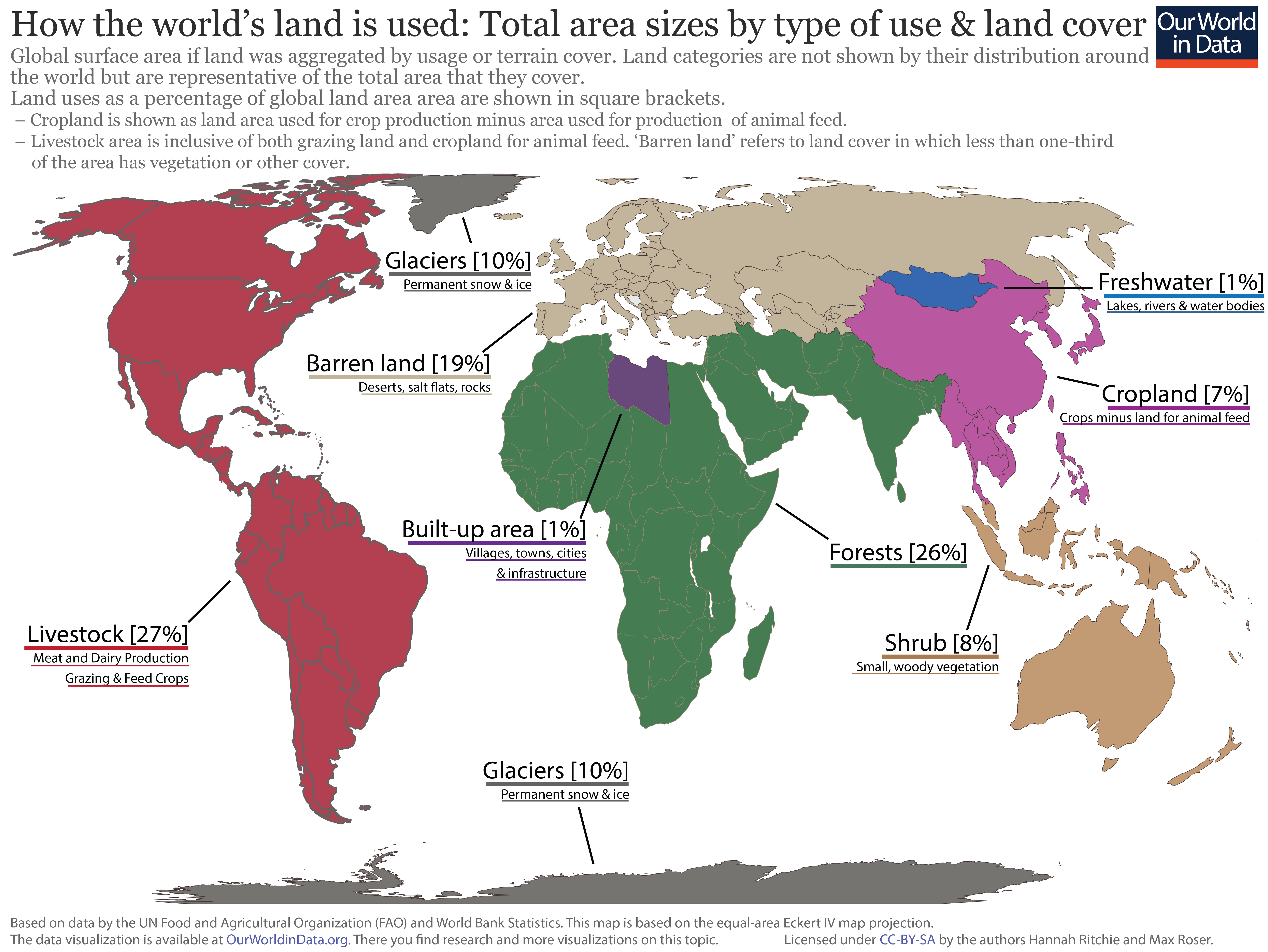
Animal ag. brings just 18% of calories and 36% of proteins, while destroying and polluting so much. We should dedicate the land to forests (carbon sequestration) and to the restoration of biodiversity.
> The benefits would be enormous. And with 40-70% of jobs being bullshit jobs I'm not even afraid we would fill those positions. It's just a matter of regulation and preferences.
This is total nonsense. When most people worked on farms, food comprised more than 30% of peoples' budgets. The idea that we could have a modern society with 40-70% of people shifting to agricultural labor is on its face ridiculous. You're making a utopian argument here and hand waving away the real problems involved in sending so many people back to agriculture.
> Plant-based diets are an innovation
Nowhere am I arguing against plant-based diets. You're arguing against a straw man. I'm also not anywhere here or at any point saying that the status quo of human calorie composition is ideal. I said that as it stands, our best effort to date to feed 8+ billion people has AT PRESENT negative externalities. I agree that problems are worth addressing, and you seem to be dead set on having an argument with me about something I'm not saying.
I never said we'd need 40-70% of people in the agriculture. I've talked about the possibility of the increase upto aproximately 4% , with a pool of 40-70% people to choose from. Is it clearer now?
> you seem to be dead set on having an argument with me about something I'm not saying
Ditto :)
> If your proposal is to revert back to high land and labor input methods, then maybe it would make a difference insofar as a few billion people would probably starve. For my part, I'd prefer we try innovating our way through it.
This has triggered my response. I can't agree with that at all.
There's no need to revert to high land and labor input methods. I'll simplify a lot. We could grow more veggies and fruit, plant more nut orchards to replace milk, grow more legumes to replace meat, on smaller fields separated with rows of productive trees (agroforesty) and reforest more lands to let biodiversity rebound and work with it, not against it ... nothing that is particulary hard and nothing of that means that billions would have to die. It would need new (smaller) electric machines and more workers, but maybe 1-2 times more, not 20 times more.
> I never said we'd need 40-70% of people in the agriculture.
> with a pool of 40-70% people to choose from
> There's no need to revert to high land and labor input methods.
> We could
> It would need new (smaller) electric machines and more workers, but maybe 1-2 times more,
This is all very squishy and utopian. I just don't see a practical proposal here. You're talking about completely reworking agriculture with no viable path to providing sufficient calories at a cost that developing nations can bare. We can see the recent debacle in Sri Lanka as a cautionary tale of what can happen if you try to force such a change. On a more personal note I've seen a lot of people try to spin up hobby farms using "restorative" practices and they're producing relatively little food, using unpaid interns, still having to charge 4x grocery store price for worse food, and havign to rely on government handouts to even do that.
> I just don't see a practical proposal here
My previous comment @ https://news.ycombinator.com/item?id=37589124 :
Sustainable and regenerative agriculture is entirely possible. You may want to explore practices such as natural, syntropic, permaculture, and agroforestry farming, to name just a few. While it may require more knowledge and labor, advancements in technology and automation could potentially mean only a slight increase in the workforce, from around 2% to maybe upto 4%.
> We can see the recent debacle in Sri Lanka as a cautionary tale of what can happen if you try to force such a change
Without a transition period, education, or support, it was poised to end up badly.
> hobby farms using "restorative" practices and they're producing relatively little food
Again, take a look into syntropic agriculture (Ernst Gotsch) and natural (or 'do-nothing') farming (Masanobu Fukuoka). Their yields are comparable to or better than those of their traditional counterparts, all while repairing the soil and without using any external inputs (thus saving significant costs).
The idea behind a lot of the regenerative methods is to work with nature to reduce the need for inputs. I am a pragmatist and will tell you that, it's really hard! On this I agree. But a lot of the ideas from more fringe communities like permaculturists are becoming more and more integrated into the mainstream. I just think we need to accelerate that, and put a lot more research into alternative methods like agroforestry – because I think we all rely on a food system that's way more brittle and tenuous than people realize. One with a lot of negative externalities that we can't paper over forever.