News for hackers. Stuff that matters.
Re:Glossary of Japanese words of Portuguese origin by DoingIsLearning on Thursday July 20, 2023 @01:46AM (#36797240)
Fun story, Tempura was allegedly inspired by Portuguese "Peixinhos da horta" which was a poorman meal of fried green beans, that was popular during Lent. [0]

Of course as with many things in japanese culture they carried Tempura to a next level.

[0] https://www.bbc.com/travel/article/20170808-the-truth-about-...

Re:Glossary of Japanese words of Portuguese origin by user070223 on Thursday July 20, 2023 @02:52AM (#36797554)
Related "Why Portuguese Food is Hiding Everywhere"[0]

[0] https://www.youtube.com/watch?v=eiXtAPfMj6o

Re:Glossary of Japanese words of Portuguese origin by georgeplusplus on Thursday July 20, 2023 @09:35PM (#36809049)
I went to Portugal and thought the food was just awful. It seems they exported all the good stuff lol
Re:Glossary of Japanese words of Portuguese origin by DoingIsLearning on Friday July 21, 2023 @11:33AM (#36814998)
I can't speak for your experience but in the last 20 odd years specially in Lisbon, Porto, and much of Algarve the number of tourist trap restaurants exploded.
Re:Glossary of Japanese words of Portuguese origin by HeyLaughingBoy on Friday July 21, 2023 @12:12PM (#36815596)
Reminds me of a friend's comment after he went to Greece on his honeymoon: "I've had much better Greek food in NYC."
Re:Glossary of Japanese words of Portuguese origin by NoZebra120vClip on Thursday July 20, 2023 @04:40AM (#36798159)
There used to be more fasting than Lent: "The word tempura comes from the Ember Days (quatuor tempora in Latin), the quarterly periods of fasting in Western Christian churches, where believers go meatless." (Wikipedia)
Re:Glossary of Japanese words of Portuguese origin by DoingIsLearning on Thursday July 20, 2023 @08:00AM (#36799275)
I understood that actual fasting was pretty much a poor people thing for catholics at least. i.e. That rich lords/merchants would just pay some repentance fee to their local church and could eat whatever they wanted (except for Good Friday)?
Re:Glossary of Japanese words of Portuguese origin by NoZebra120vClip on Thursday July 20, 2023 @08:42AM (#36799642)
Is that what the Calvinists have been telling you?
Re:Glossary of Japanese words of Portuguese origin by groovy2shoes on Thursday July 20, 2023 @08:48AM (#36799698)
It depends on time period. Indulgences weren't things that were for sale before the High Middle Ages, and then their sale was controversial. It was part of the motivation of the Protestant movement, and much curtailed during the Catholic Counter-reformation.

And then there absolutely were some (many, maybe) nobles and merchants who were genuinely devout. Even emperors, like Louis the Pious. I'd imagine they tried a little harder.

Re:Glossary of Japanese words of Portuguese origin by anon291 on Thursday July 20, 2023 @10:03AM (#36800596)
I mean... there is no 'one thing' any Catholic has done. There have been faithful Catholic Lords/Monarchs, and there have been not-so-faithful ones. Making blanket statements like 'actual fasting was pretty much a poor people thing' is not really a good description. Fasting is really something only the rich can do anyway, since if you're already poor... you're not missing much. There have been very faithful Catholic noble families (the Habsburgs come to mind -- many are still quite faithful today!) and they certainly did the normal fasting.

That being said, I've never heard of replacing the fasting days with a 'repentance fee'. I'm not going to say it's never happened because there have been billions of Catholics, and probably millions of priests so maybe someone did that somewhere. However, under normal Catholic doctrine it's impossible to pay to repent. God's mercy is freely given without money.

Re:Glossary of Japanese words of Portuguese origin by jschveibinz on Thursday July 20, 2023 @10:16AM (#36800779)
From Poe Assistant:

In the Catholic Church, both indulgences and penance are related to the forgiveness of sins, but they have different functions and purposes.

Penance is a sacrament in which a Catholic confesses their sins to a priest and receives absolution for them. The penitent is then required to perform some act of penance, such as prayer, fasting, or almsgiving, as a way of expressing sorrow for their sins and making amends for them. The purpose of penance is to reconcile the penitent with God and the Church and to help them grow in holiness.

An indulgence, on the other hand, is a remission of the temporal punishment due to sin, which is a consequence of sin even after it has been forgiven. The Catholic Church teaches that sin not only offends God but also disrupts the order of the universe, and therefore, it requires satisfaction or reparation. Indulgences can be granted for specific acts of piety, such as visiting a holy site or performing a particular prayer, or for performing certain charitable works. The purpose of indulgences is to reduce or eliminate the temporal punishment due to sin and to facilitate the process of sanctification.

It is worth noting that indulgences have been a controversial topic in Church history, and their use and abuse have been the subject of much debate. In the 16th century, the sale of indulgences by some Church officials became one of the factors that led to the Protestant Reformation. However, the Catholic Church has since reformed its teachings on indulgences, and they are now granted under specific conditions and with a clear understanding of their purpose.

Re:Glossary of Japanese words of Portuguese origin by NoZebra120vClip on Thursday July 20, 2023 @08:32PM (#36808635)
Anyway, that's not how indulgences work. They aren't a matter of "gain this indulgence and I get to indulge in something that's normally a sin."

Since fasting and abstinence are a matter of Church Law and not Divine Law, the practices can be the subject of a dispensation or commutation by an authority such as the pastor. For example, on St. Patrick's Day in these United States, when it falls on a Friday (as it did this year) it's customary for bishops to grant dispensations for the faithful to enjoy corned beef, or a commutation, to pray the Rosary and then enjoy corned beef (or pork tempura).

Whether any given pastor could be influenced by the money from a "rich lord/merchant" is left as an exercise for the reader, but if practically all his parishioners are tithing and paying his salary anyway, then what can you do?

Re:Glossary of Japanese words of Portuguese origin by lazyant on Thursday July 20, 2023 @10:18AM (#36800819)
Also Catholics are supposed to fast all Fridays of the year https://en.wikipedia.org/wiki/Friday_fast
Re:Glossary of Japanese words of Portuguese origin by s0fa37 on Thursday July 20, 2023 @04:41AM (#36798165)
Wow - I was recently in Lisbon for the second time in two years, and I insisted my other half and I ordered these at a restaurant, as I had tried them on my first visit and they were delicious!

I described them to her as 'tempura fried green beans', assuming naively that the influence came in the other direction!

Re:Glossary of Japanese words of Portuguese origin by jeltz on Thursday July 20, 2023 @07:27AM (#36799048)
I had actually wondered if tempura was a loan word a long time before I learned that it was due to how Romance language it sounds.
Re:Glossary of Japanese words of Portuguese origin by traceroute66 on Thursday July 20, 2023 @07:46AM (#36799180)
> Of course as with many things in japanese culture they carried Tempura to a next level

That is true. Although to experience the real thing you really have to be in Japan.

Sadly the Westernised versions of Tempura are more often than not massacred imitations.

The most common errors in the West are that the batter is wrong or, the most common of all faults ... the oil is old.

With true Tempura in Japan, the oil is frequently refreshed during the course of service and in addition is not shared with other deep fried foods. Both of which actions serve to maintain the delicate taste and texture of true Tempura.

Sadly in the West (if you're lucky !) the chef will simply dump the Tempura in the same deep-fat fryer that he's been using all day to fry god knows what else.

Re:Glossary of Japanese words of Portuguese origin by franciscop on Thursday July 20, 2023 @08:02AM (#36799291)
At least in Spain we have multiple ways of batter-fry our food, which are simply different and not "wrong" per se. For example with calamari you can have them "calamares rebozados"[1] vs "calamares a la romana"[2], which are two very different styles of doing it. And then even within those there are variations ofc. While Japanese Tempura is very homogeneous on its style all across, like most of Japanese food (quality might vary a lot, but cooking styles usually don't).

Then there is the point of oil, while we'd normally use olive oil in Spain, it's crazy expensive in Japan so surely they use other oils, which also change the taste and very likely make it feel lighter.

[1] https://content-cocina.lecturas.com/medio/2021/06/09/calamar...
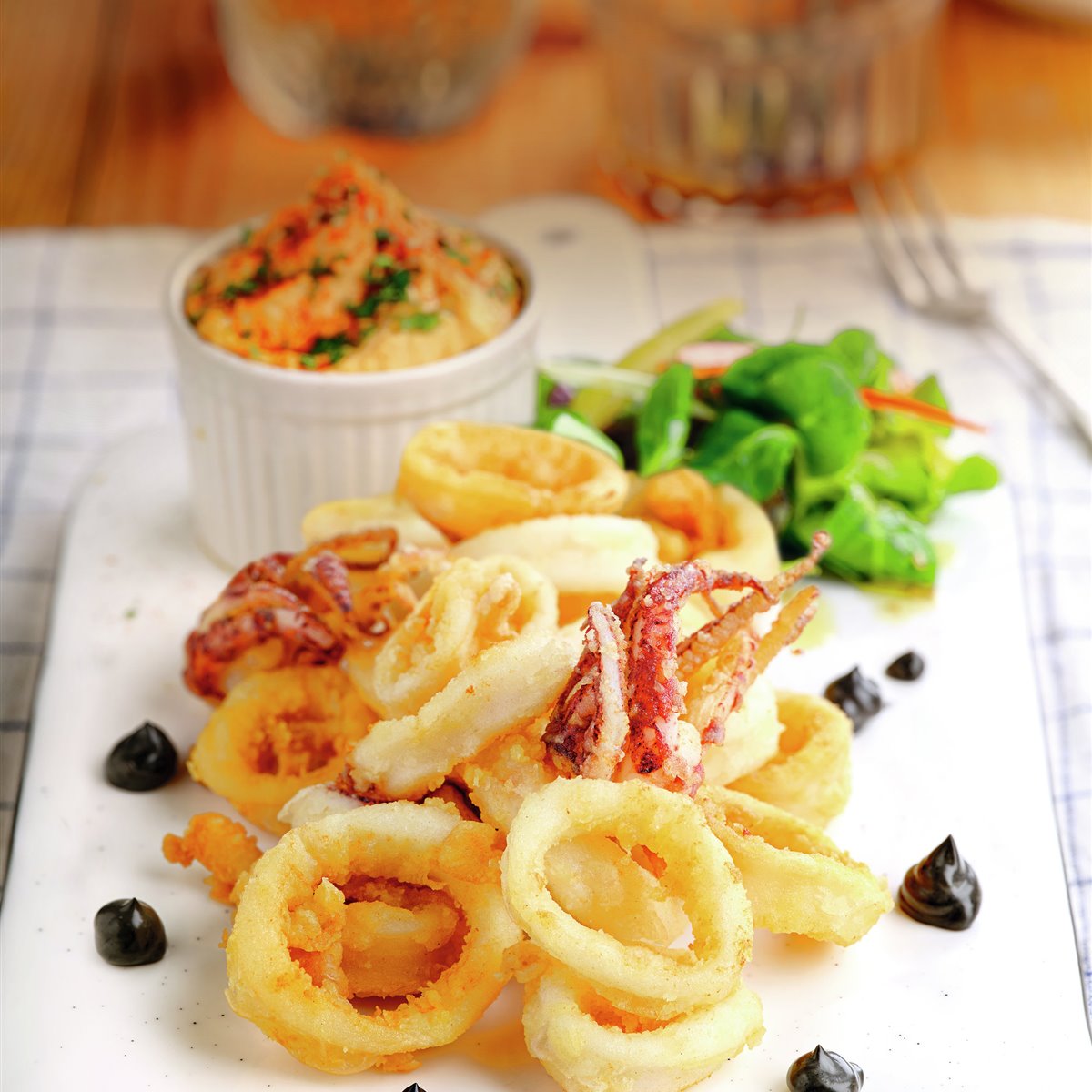
[2] https://cdn3.misrecetascaseras.com/sites/default/files/style...

Re:Glossary of Japanese words of Portuguese origin by unwind on Thursday July 20, 2023 @09:13AM (#36799954)
Do you deep fry in olive oil?
Re:Glossary of Japanese words of Portuguese origin by franciscop on Thursday July 20, 2023 @09:43AM (#36800318)
Of course, that's how e.g. Spanish omelette is done and how it gets part of its taste.
Re:Glossary of Japanese words of Portuguese origin by scythe on Thursday July 20, 2023 @09:44AM (#36800335)
There is a grade of olive oil — "extra light" — which is very good for deep frying. The darker stuff popular on salads won't work so well.
Re:Glossary of Japanese words of Portuguese origin by VoodooJuJu on Thursday July 20, 2023 @10:22AM (#36800877)
I appreciate the Westernized version more for being delicious while eschewing the decadence, wastefulness, and snobbery of the Japanese version.
Re:Glossary of Japanese words of Portuguese origin by mc32 on Thursday July 20, 2023 @10:29AM (#36800992)
Fast food places in Japan are like fast food places in other places. They don’t make the snobby versions.
Re:Glossary of Japanese words of Portuguese origin by mixmastamyk on Thursday July 20, 2023 @10:25AM (#36800924)
There’s great Japanese food in Los Angeles (and presumably other pacific cities).
Re:Glossary of Japanese words of Portuguese origin by wahnfrieden on Thursday July 20, 2023 @12:34PM (#36803023)
Always old oil, wrong temp, wrong oils / bad oil blends, less regional variety as seen in Japan. Tempura in North America is dire. I’ve eaten at many Michelin tempura exclusive restaurants
Re:Glossary of Japanese words of Portuguese origin by morsch on Thursday July 20, 2023 @01:17PM (#36803614)
You're saying there's not just one but multiple fine dining restaurants that exclusively serve (bad) tempura and you've sought them out?
Re:Glossary of Japanese words of Portuguese origin by wahnfrieden on Thursday July 20, 2023 @01:39PM (#36803938)
no just a qualifier on personal experience eating around japan. there are almost no michelin starred tempura restaurants in north america, like 2 total in the US. the tempura places in toronto are all bad so i stopped going.
Re:Glossary of Japanese words of Portuguese origin by anon291 on Thursday July 20, 2023 @10:15AM (#36800775)
The Indian curry vindaloo is also a Portuguese dish although few Indian restaurants actually serve real Vindaloo which you'll only get at a Goan house or an East Indian house. Only Christians eat Vindaloo really because it has to be made with pork, as it's a pork dish, and only us Indian Christians eat pork as far as I know.

It comes from the Portuguese dish Vinha d'Alho (https://en.wikipedia.org/wiki/Carne_de_vinha_d%27alhos). It's a simple recipe and tastes excellent.

There's a whole set of Indian pork and beef curries with Portuguese influence that are amazing and unfortunately never sold in restaurants.

Re:Glossary of Japanese words of Portuguese origin by zeruch on Thursday July 20, 2023 @01:02PM (#36803429)
Vinho d'Alho is actually more broad than just that dish; it can refer to anything marinaded in wine and garlic (which is literally what the name refers to, as stated in the wikipedia article).

I grew up in an Azorean household, and a lot of stuff besides pork gets prepped that way (or a permutation thereof)

Re:Glossary of Japanese words of Portuguese origin by anon291 on Thursday July 20, 2023 @01:16PM (#36803611)
Sure, the original dish may be broader, but the Indian vindaloo curry is a particular dish made with garlic and wine vinegar and some other spices. It's categorically not what most restaurants serve as vindaloo
Re:Glossary of Japanese words of Portuguese origin by 77pt77 on Thursday July 20, 2023 @08:47PM (#36808738)
They got it from India and then took it Japan.