He missed the boat on browsers and smartphones, so he is aiming for total monopoly of what he believes is the next-big-thing™.
I wonder if Zuckerberg suspects it might not be as well but, hey, Hail Mary!
It's an incredible tool and way to engage with virtual worlds, but the question we should be asking isn't "Is VR technology good enough" which I think people get stuck on. Really the question is "Does everyone want to be in a virtual world regularly?" and my intuition having spent a good amount of time in VR is that the answer to that is actually no.
I love video games, so much so that I even try to make them. I spend many hours playing in virtual worlds, but I very, very rarely want to use VR. I'm the perfect candidate for the technology, and it's honestly mindblowing when I do use it, but it's just not a casual experience. Even if we had the perfect, unobtrusive and lightweight technology, you are still choosing to disconnect from your current environment and spend time fully engaged with a different world in a way that games and TV don't. That can be really exhausting.
It isn't really something that people want to do.
Exceptions of course would be to do it with someone remotely, like a friend or a family member -- it is a good way to potentially 'hang out' with people who aren't physically there. But the same caveats apply.
An increasing number of relationships are happening purely remotely. My company went fully remote due to the pandemic and I've started building working relationships, and yes a friendship even, with new employees completely remotely. And I'm a millenial who remembers a distinct separation between the online and offline (and the modem tones lol). (Though I was a very online kid and have made many internet friends over the years.)
Younger relatives of mine don't see as strong a separation and they have friends who they made in primary school that they stayed in touch with despite families moving a long ways away because of how easy remote communication is these days; when I was a kid moving locales meant a new set of friends. It's this demographic and this world that I think is poised to enter VR experiences en masse. Gen X and older Millenials probably still have too strong concepts of "offline" and "online" (and usually prioritize "offline" over "online") to break this barrier down (as you say, a quintessential part of the "offline" experience is snuggling with your dog or an SO) but I'm pretty confident that younger folks won't see this distinction as pronounced. I might be wrong of course.
But they will see it as pronounced because it is pronounced, for all the reasons mentioned.
People love real spaces, real objects, real venues, smells, and atmosphere. The physical characteristics of friends and strangers, from subtle facial cues to outrageous clowning around. In VR, all that is stifled or non-existent; substituted with digitally representation, crafted by unknown processes. Cold origins. Black boxes.
> enter VR experiences en masse
Really? I wouldn't bet on it. The warmth of remote communication you mentioned, is coming from that which we already have. Phones, screens, coffee next to the laptop, simple face to face chats on the screen of your choice. Show me your new house! Cool, walk around carrying phone. Not a VR headset!
Strapping on a headset and embracing rendered distractions while you communicate? I don't see that happening en masse. You'd need to literally get real before VR takes off. Each headset commanding a tiny 360 drone camera, flying wherever you like without incident. See you at Burning Man! From your couch. In this impossible "RR" (remote reality?) future, a typical music festival or live event would have both real people and a bunch of VR drones - somehow inter-mingling, silent without collision, without any issues. Until then, VR is a device strapped to your head, dishing out pre-renders. Your real cat limits the VR experience, and into the bottom drawer goes your headset, right next to the DJI drone you got for Xmas.
> People love real spaces, real objects, real venues, smells, and atmosphere. The physical characteristics of friends and strangers, from subtle facial cues to outrageous clowning around. In VR, all that is stifled or non-existent; substituted with digitally representation, crafted by unknown processes. Cold origins. Black boxes.
This same argument could have been used to argue against the Internet, against using the Web to replace real services (how can you replace the minutiae of human voice interaction with a screen??), against the mobile revolution even. Yet mobile phones are here to stay and even developing countries with bad public infrastructure rely heavily on mobile phones to stay connected. Overly broad philosophical arguments never have explanatory power. I think you can make the argument that the experience of VR would make it too cumbersome to use no matter the streamlining, but to attribute some mystical quality to physical connections neglects the sheer growth of the internet, web, and mobile that are extant.
> See you at Burning Man! From your couch. In this impossible "RR" (remote reality?) future, a typical music festival or live event would have both real people and a bunch of VR drones - somehow inter-mingling, silent without collision, without any issues. Until then, VR is a device strapped to your head, dishing out pre-renders. Your real cat limits the VR experience, and into the bottom drawer goes your headset, right next to the DJI drone you got for Xmas.
It's not like mobile phones took over every aspect of our society. My relatives that kept in touch with their young school friends throughout their lives over mobile phones also as adults meet up with their friends IRL. Friends that met partners while playing WoW live with their partners and have started families with them. This isn't an all-or-nothing proposition and suggesting so seems absurd given the prior art we have of digital technologies.
If VR becomes a default way to communicate and collaborate, that's all it will take to "win".
No because we didn't have anything else before the internet other than landline phones, one per household.
In my comment where I said "we already have it", that's the key point. VR is not an incredible shift like mobiles and internet were, and yet your last line flirts with the word "default". Of course it will be popular and clever, and will do well for the special times we want VR by placing a thing on our heads. But like drone cameras, VR will not elbow out the default cameras we already have that work better in most cases.
> but to attribute some mystical quality to physical connections neglects the sheer growth of the internet
Some mystical quality? You say that like "meh, real life"! The internet isn't trying to be "reality", it's just the internet. VR literally has the word reality in its name. Obviously comparisons will be made to actual reality for technologies that use the same word in the name.
> Obviously comparisons will be made to actual reality for technologies that use the same word in the name.
You are getting distracted by a naming convention. If we called VR something else, without the word "reality" those points don't even make any sense.
VR is not a reality replacement. Like all technology it augments reality.
(I hope my intentionally interesting word choice of "augments reality" doesn't distract you from what the sentence means. As with VR, the meanings of words interpreted as a phrase, vs. interpreted individually, often mean related but different things.)
Virtual reality will be judged based on its own use cases. Given the ergonomics of VR hardware and software are rapidly advancing, seemingly compelling new use cases are being identified with interesting beta's and preliminary-shipping demos, and we haven't even seen a platform that delivers seamless navigation or co-navigation across apps (as the web provides for sites), I would say the potential has hardly been tapped.
As it stands a "TV" can be a screen of many different sizes and configurations, it can even be a projected image. VR can't be anything but a headset strapped to our heads. That's the point I was making about it's uptake woes... It's obviously fun and will have plenty of users dipping their toe in, or should I say customers, but "en masse" was the point I was replying to and doubting.
Look at the cambria demos, they’re already doing mixed reality by blending the room with the experience. No reason that can’t be used to put your couch, coffee table and SO in the virtual theatre. You also have to consider that a lot of the younger people using these won’t have dogs or kids to worry about.
I can actually take a drink with the headset on but the bulk does make it odd. But these next gen headsets are much more compact. Check out the vive flow, and then the nvidia prototype holographic displays.
If I live in a small apartment or dorm or just don’t have a tv in my room and want to watch anything then that becomes a better choice than holding my extremely heavy iPhone or iPad very soon.
My issue is specifically that it has great use cases (which we have gone over, like gaming and immersion) and mediocre use cases (like socializing) and poor use cases (like replacing a computer for general and work use).
Big leaps in technology that shifted paradigms have been catalyzed by a killer app (ex. spreadsheets for desktop computing) or have been incredibly obvious (ex. long distance real-time communication for telegraph/phone).
Trying to force a technology onto the larger population without one of these things by only advancing the technology itself is not only a waste of money, but tends to backfire and set the public against it for a non-trivial period of time.
I have able to buy Quest 2s locally for a pittance in 'like new' condition because people get them based on the promise of some general utility and end up realizing they are only great at gaming and media consumption, and a lot of people just don't want to wear a headset for those activities.

Seems like he has no choice. Even if it doesn’t work or we’re all skeptical — he better play along and go for it.
Hearing them describe their own product as “Chromebook for the face” just reconfirms my suspicious that this is a doomed product.
But that's fine for Meta. Facebook, Instagram and Whatsapp might all be running out of growth, but they are all big enough that Meta can afford to invest in something that will only pay off in a decade or two, as long as the payoff is big enough. Gaming-VR headsets are just a good way to get the technology into people's hands right now, and iterate on it.
See this demo of Quest Pro pass-through AR: https://www.reddit.com/r/oculus/comments/xvzxj2/new_footage_...
(My guess is that Unity (& Blender) will have an on-stage demo when the headset comes out. Unity: “just tick this box and your game will run on Reality Pro”)
Meta is in trouble, and it needs to do something to retain relevance. This is something, and Meta is doing it.
Go watch any long-form interview with him, such as with Lex Fridman. It becomes rather clear that he wants to be more like how Steve Jobs is seen by the wider public: as an innovator and pioneer, not as a power-hungry moneymaker.
What I am trying to say is, with how Facebook is managed isn’t at all like Apple.
Consider that Atari tried to compete with office PCs in the early 80s with their 8-bit family, and failed: https://images.fastcompany.net/image/upload/w_596,c_limit,q_...
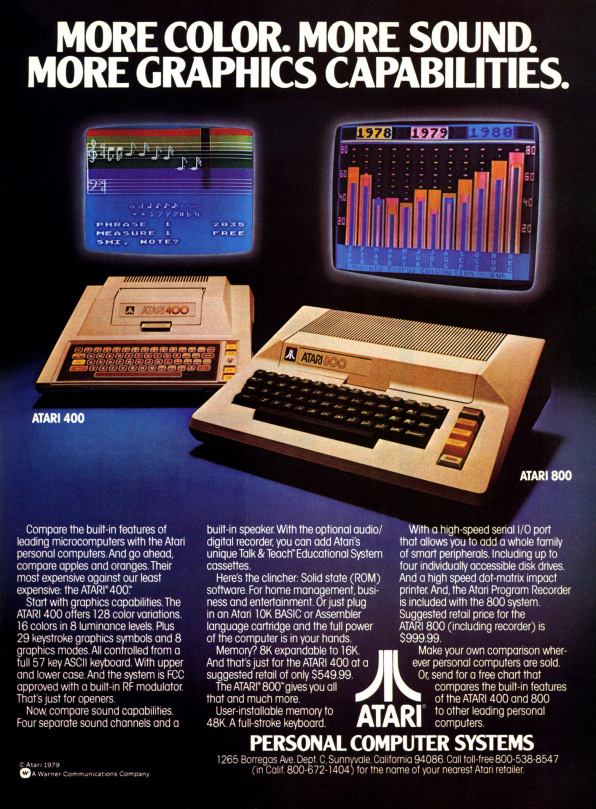
It's hard to focus on multiple things at once, and we're skeptical that the bureaucratic forces in play at a large company like Meta will allow them to do a good job at making their gaming platform also one that people actually want to work in.
I don't think that's very accurate. The Atari ST had a pretty good following compared to personal computers of the time much like the Amiga... The fact is that most computer companies from back then did not survive far beyond the decade but they had their time. So it's not really accurate to say they failed when Acorn, Amiga, Amstrad...etc, all "failed", in that they didn't produce more than a handful of unique and fairly incompatible computers with no clear future, but that had a market and sold with success in their time frame none the less.
> I don’t want to go too far given I’ve only tried Workrooms out once, but this feels like something real. And, just as importantly, there is, thanks to COVID, a real use case. Of course companies will need to be convinced, and hardware will need to be bought, but that’s another reason why the work angle is so compelling: companies are willing to pay for tools that increase productivity to a much greater extent than consumers are.
I bought the quest2 since it was cheap as a pandemic entertainment device and while I never play it, I regularly wish for a VR monitor (eg a high res nreal air)
The new Quest headsets are supposed to have some features for facial expression tracking for exactly this reason. But yeah, no doubt there's still a ways to go for the experience to be worthwhile.
The problem with your assertion is that you over count how many multiple things Meta has to do. What will make for a very good gaming VR Headset will also be a very good professional and productivity headset.
The key aspects which Mark Zuckerberg laid out personally in the recent VR Prototypes unveil pretty universally hit both targets. Comfortable light weight headsets with incredible fidelity is desirable for all VR applications. Not just gaming.
My bet is Mark is going to burn a LOT of money, fail to get mass adoption, cancel the project, and lay the design team off.
But who knows! Maybe we’ll all be taking work meetings in MetaLife this time next year! Just make sure you login to your meeting 5 minutes early to preview the new season of BigBrother and score an extra 60 seconds of microphone mute time!
From Meta or from SimulaVR?
Because Meta has been selling one of the best VR Headsets for the money thus far. I'd really recommend checking out their VR Headsets announcement [1]. Maybe VR will never actually go anywhere software-wise, but it's clear that the team at Meta has a good understand of the problems of current headsets and what would be necessary to make a generational leap in immersiveness.
I'm certain there will be markets for it.
>My bet is Mark is going to burn a LOT of money, fail to get mass adoption, cancel the project, and lay the design team off.
I don't think they're going to cancel it. It's very much a hail marry here. The Facebook phone was a massive flop and the cumulative result of failing to have their own hardware platform was Apple killing their mobile ads business. I think Meta will do everything in it's power to own it's own hardware so that whatever their business model is, no competitor could just kill it with a flip of a switch.
https://www.reddit.com/r/AR_MR_XR/comments/xwjzni/meta_quest...
What you're not seeing: a standalone VR headset running a VR Desktop OS natively with bleeding edge pixel density (i.e., like the Simula One).
We understand that Meta has some cool tools in its app store which can be used to get a feel for VR computing. But analogously, you could also purchase word processors for early gaming consoles too: https://en.wikipedia.org/wiki/AtariWriter
Our view is that dedicated VR computing devices are what the market actually needs.
My view is the market needs a product that does not require an internet connection, Facebook account, Microsoft account, windows PC, or equivalent restriction-ware.
In that case, "On September 18, 1998, believing that certain statements from Netscape employees reported in Lessons offered succor for its defense, Microsoft subpoenaed the professors' notes, tape recordings and transcripts of interviews, and correspondence with interview subjects. " https://caselaw.findlaw.com/us-1st-circuit/1179769.html
Here is Google subpoenaing Microsoft, https://www.business-standard.com/article/technology/microso...
AMD subpoenaing Microsoft, https://www.networkcomputing.com/data-centers/amd-subpoenas-...
Here is a judge standing up an squashing a Microsoft subpoena of Oracle and Sun , https://www.networkworld.com/article/2310247/microsoft-fails...
Oil Price Information Service, a Oil Industry trade publication was subponeaded in a price fixing case to hand over unpublished information, https://www.competitionpolicyinternational.com/oil-industry-...
> A lot of startups worry "what if Google builds something like us?" Actually big companies are not the ones you have to worry about-- not even Google. The people at Google are smart, but no smarter than you; they're not as motivated, because Google is not going to go out of business if this one product fails; and even at Google they have a lot of bureaucracy to slow them down.
I'm not saying it's going to definitely happen and the company is doomed or anything, it's certainly possible that SimulaVR will come out on top for productivity devices (or peacefully coexist as an alternative alongside Meta's offering). But it shouldn't ignore what Meta is doing either, especially when they're actively saying they're moving into their turf.
At the very least, it looks like Meta will put up a helluva fight.
Unless Meta decides to abandon that, I think we'll have a niche.
Isn’t their whole Metaverse thing a gamble to get away from that? Why does data collection prevent creating a good VR experience. If anything it should align goals well (spend as much time in VR as possible, so as much in VR as possible). Besides, most DataCollection companies offer CollectionFree enterprise contracts… which is where the money for this probably is.
(Btw I’m a huge fan of this sort of product and I hope a respectful company wins.. I’m just skeptical that meta can’t fund their way to success. )
Many of us think Meta is trying to gain as much market as they can early, so they can leverage eye tracking and mm wave tech for very invasive biometric collection and ad targeting in the future. Reasonable minds can disagree on that.
It could be a gambit to track your eyes but that seems even harder with worse reward than taking a 30% cut as the next App Store.
No these are the same thing. Tracking pupil response to stimuli tells advertisers how a human is reacting to what they see. It lets Meta sell a platform to advertisers where they can target humans in particular emotional states, or at certain times when that individual is more likely to make a purchase.
Wish you the best of luck either way, this is an exciting area and more competition is great. They definitely are competition though.
I think Meta's strategy was the right one. The only execs who would even consider adopting a virtual work model would be gamers who are already familiar with the tool. Gaming was their way to get in the minds of their potential next phase enterprise customers.
We've had many people tell us (often on Hacker News actually) that they're not super interested in VR gaming, but are very interested in VR computing.
(I myself am one of these people BTW; despite working in VR for half a decade now, I have almost no interest in VR gaming, and wouldn't be interested in the field were it not for its enormous potential as a new thinking tool).
My point is that interest in sci-fi technologies and having some interest (prior or current) in gaming are highly overlapping demographics. Many games explore interactions with future technologies.
Additionally, from a technical perspective of an executive who is looking into VR, "if a headset can provide the fidelity to play games then that would mean it can likely do X and Y complex things my business does"
I assume you've read?
I don't know if this is even remotely a possibility but it sure would beat dealing with constant CSS (can't see s*t)
VR there has never been exclusively about gaming nor has gaming been the overall goal of VR since their acquisition. The way they talked about it back in the day was, if I recall accurately, that they were focused on three pillars: "The metaverse", "The overlay", and "The future of work". Social presence, real-life AR metadata, and expanding the screens and capabilities of working professionals, respectively.
The direction of their research and implementation has, at least to my knowledge, been oriented literally towards creating a new category of general purpose productivity devices and admitting as much in a very public blog post is a pretty big own-goal if the idea is to try to avoid the subpoena by distinguishing yourselves (assuming you're speaking on behalf of SimulaVR).
> Hate to break it to you, but if you don't think that Mark Zuckerberg is actively trying to create VR devices that are general-purpose productivity devices aimed at replacing PCs and laptops, you haven't been watching some of their recent videos about the new headsets and prototype headsets they're working on. He very much is aiming for that market with future devices (not the Quest 2).
It sounds like they're saying that Meta doesn't currently sell anything that competes with what they're currently selling, and the info you give doesn't seem to contradict that. I'd question the premise that releasing a marketing video for a product that doesn't exist counts as being "in competition". They might be in competition in the future, but it doesn't seem like they are right now.
Or maybe I'm wrong and they are already selling a product? I didn't see it on the website.
>...Meta sells reasonably good gaming headsets to customers who want to be entertained in VR; we're selling general-purpose productivity devices which are aimed at replacing PCs and laptops.
Hate to break it to you, but if you don't think that Mark Zuckerberg is actively trying to create VR devices that are general-purpose productivity devices aimed at replacing PCs and laptops, you haven't been watching some of their recent videos about the new headsets and prototype headsets they're working on. He very much is aiming for that market with future devices (not the Quest 2).
Here's a couple:
https://www.youtube.com/watch?v=IMpWH6vDZ8E
https://www.youtube.com/watch?v=2zHDkdkqd1I
Also he's described their Project Cambria headset as intended for productivity, as in the following article:
"What’s different about Project Cambria?
The most important description we’ve received about Project Cambria comes from The Information; according to the publication, Meta employees have alternately described the headset as a “laptop for the face” or a “Chromebook for the face.” It’s a device Zuckerberg hopes people will use to get work done rather than being aimed primarily at gamers as with previous headsets."
https://thenextweb.com/news/meta-project-cambria-what-we-kno...