I’m sure your experience of your own hometown is accurate, but as a person who’s visited Valencia a few times I’ve found the transport to be excellent: my whole family used the metro to get around without any hitches, and we were always surprised by how clean, quiet and efficient it was.
The train between Valencia and Alicante was like boarding a luxurious airplane: an attendant ushered us on and came around with a food trolley. The ride was smooth and almost silent, and the ticket price included small extras like a free pair of headphones for listening to the onboard radio. This was all just regular economy.
I think it may be a national characteristic to rundown your own country, as my family background is also Spanish and all my relatives always say Spain is a ‘mierda’ (shit) and speak lyrically about how wonderful everything must be in my current country (Sweden), but in fact the last few weeks the train service here in Sweden has been sporadic and continuously interrupted by various problems, as it often is both summer and winter. A Swede will rarely admit this to outsiders though.
So I’m willing to give this initiative a very enthusiastic welcome, instead of instantly dismissing it as a gimmick, or gloomily bound to fail.
First, tourists frequent certain routes that aren't the same as routes for daily commuters. They tend to be much shorter.
Second, tourists rarely travel around in the rush hour and delays are not as crucial for them. You aren't under such a tight time budget when on holiday, unless you need to catch a plane or so. (And most people take a taxi to the airport, given that they travel with baggage.) On the other hand, even a 15 minute delay experienced four days out of five during an average work week gets old fast.
Third, tourists tend to visit cities in periods of good weather, when long waiting etc. isn't very arduous.
The real resiliency or fragility of any system tends to show under stress, and the most stress that a public transport system can be in is in the rush hour under inclement weather conditions (heavy snow, wind causing trees to fall on the track, freezing temperatures etc.), 30 km from the city centre.
So those are precisely the conditions that tourists tend not to encounter during their holidays, and form an inadequately rosy overall picture as a result.
The only thing swedes do right in trains is that they are very civil, make it easy for bikes, strollers and old people to use them, but that's about it.
Also I'm comparing it to Tokyo, which as others comment is a bit unfair since it's basically the best train network in the world.
i remember in tokyo that train headways during rush hour is as little as 90 seconds. and it's punctual as hell. in LA, we're lucky if we get down to 10 minutes, plus or minus 20 minutes. LA is not quite as big or rich as tokyo, but it's on a similar scale, yet we have an order of magnitude worse public transit. it's so frustrating.
The smell alone is sufficient, but the headways, good lord. Spotted several sets of foreign tourists just as astoundingly bewildered as we were.
So we rode buses. Good god. Never again. Sorry LA. You suck. No, I don't enjoy driving in LA gridlock (done it many times). What an apex cultural disaster.
I have to admit the transit was really cheap. I'd pay double for Paris's transit in a heartbeat.
yet, we can't have world-class transit because it's only for poor people. the only reason we're building any transit right now is because the olympics are coming here in 2028 and the rich folks sponsoring it can't deign to be embarrassed by the dearth of viable transit here.
By almost every measure, life in Spain is great. Public transport is great, but you compare it with Japan which is the best in the world. Security is great, but you compare it with Luxembourg. Unemployment and salaries are... OK, above average at least, but you compare it with Germany.
Spain has issues, but every other country does too. There's a reason "eramos felices y no lo sabiamos" is a Spanish expression... I really wish people here would appreciate how good they have it.
e.g. the job situation is ridiculously bad, and that's not a "compare" thing, it just is. I've seen people break down crying in class in my degree that hated it and studied it only because it's one of the few that you were kinda promised employment when you finished. Many friends all around Europe, or jobless for long stretchs of time, depending on their family.
I have similar anecdotes for how transportation or security can be troublesome in Spain.
Sure you can be happy with little, as Spaniards normally do, but that doesn't mean everything is great or we shouldn't try to do better. How do we improve if we don't see the problems within?
Another example of high speed train, they forced flight companies to make the Valencia <=> Madrid flights more expensive because people preferred going by plane than by train (faster, easier, way cheaper). Yup, instead of making the train better or cheaper, just force the private companies to be worse so the public infra can compete. Why was it so expensive? Because of it being many times overbudget? Why? Because everyone was taking money.
Anyways, I have to hard disagree on flying being faster and easier than going by train. Flying is a pretty horrendous experience in comparison, and if you account for the time spent in the airport and getting to it it's not faster either.
This particular flight I'm discussing it's more convenient. Getting to the high speed train station is tricky (there's no subway there!), you have to go to the closest one and then walk 10-15 min, which is just slightly faster but harder.
Let's see times:
• Train: 15 min to the station + 15 min early + 1.5h in the train + 15 min in destination = 2h15min
• Plane: 30 min to the station + 30 min early + 30 min flight + 30 min at destination = 2h
(this is domestic flying where you normally just walk in fairly straightforward)
I live in London and my closest train station is 10 minutes by foot, the closest airport is 1h by car or 2h by public transport. Also I tend to arrive 2h before departure, so flying burns at least 4h before even sitting in the plane and maybe as many hours when you land. It's a whole day affair. Domestic flights aren't any better. You save maybe 10 minutes not queueing for passport control.
Flight is terrible unless it's intercontinental. But most prefer the plane because it's vastly cheaper.
You live in London as you said. That's a totally different experience from a local domestic smaller airport in Spain. Budgeting 30min for a domestic flight (no traffic, no check in, no passport, 2-3 min walk to any gate, literally just the security check) is enough, if you want to be extra careful sure plan to arrive 1h early, but every time I've regretted it since then I had 50 min to wait.
Do you have any proof of that scheme you're mentioning? I say this because, believe it or not, one of the things that Spain does right is building infrastructure on a budget. There has been corruption cases and places when it has been horrid, but in general is well managed.
You'd be surprised how bad it is in many other countries deemed better by your average spaniard. In terms of cost overruns, time, and all kinds of nasty shit.
US is too big and too sparsely populated both on a large scale and small scale for trains like Europe, Japan and China.
There's a part where no one talk about, and that's the infrastructure within the city are not conducive to trains. People get to a train station and they need to get around and unless you're talking about New York they really just need another car.
This in comparison to European and Asian cities where your friend can just post you an address and you can use public transit all the way to the last block.
US land is amazingly well suited for HSR and cities are well suited for subways. We also have the money. The only problem is political.
I’m grateful to live in a country where having a vehicle is normal and not just for the wealthy class. I’m happy to not be packed onto public transit if I want to take the family to the beach or go hiking or something.
You don't need to. It's not like those countries with extensive train networks don't have cars and interstate highways. They do and people use them. The point is that in those countries, cheap options exist for all income brackets and all use cases.
In America, it's a car or bust.
And are you saying poor people in America wouldn't want a cheaper mode of transportation as an option?
The US has a massive setup cost problem, any significant infrastructure project takes years of regulatory hurdles and then legal challenges as competitors and NIMBYs try everything they can to slow things down.
Thus ending up being way more expensive than countries where they still have slums to ruthlessly tear down or land to seize from small-time farmers to make room for new infrastructure (not to imply that the way it works in the US is much better).
This is exactly what I meant by political problems.
> Thus ending up being way more expensive than countries where they still have slums to ruthlessly tear down or land to seize from small-time farmers to make room for new infrastructure (not to imply that the way it works in the US is much better).
India razed slums and farms for trains, the US razed forests and farms for interstates. It's the same thing. Slums in India have a land value to them. The government doesn't get that land for free. Just pay out property owners market value+20% for infrastructure and build the thing that is so direly needed.
Ship has sailed, it usually works in the reverse. People aren't coming back from suburbia because there's stations where they don't need cars.
The train in NYC runs 24 hours a day 7 days a week. The London Tube stops at midnight.
The train in NYC is much much cheaper, it's $2.75 to go anywhere on its almost 400km of track. London's Tube has zone-based pricing.
The NYC subway cars are all air-conditioned.
The NYC subway cars are far roomier than the Tube.
NYCs subway is "cut and cover" and so the stations aren't nearly as deep and quicker to get in and out of.
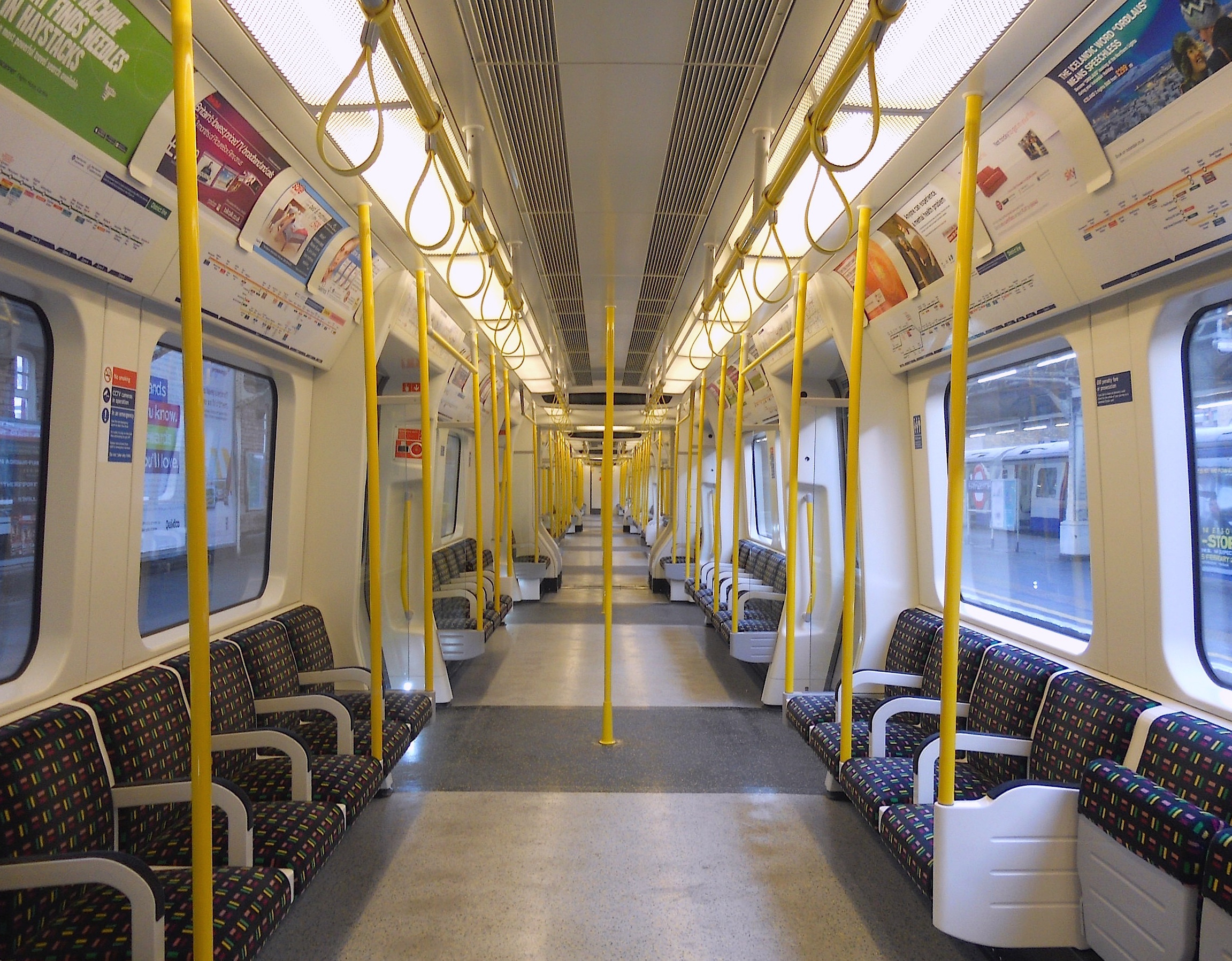
Public transport in London is notoriously expensive though it is true.
One major failing of the NYC subway in my mind is the near total lack of signage. There is like one map per carriage (which is often hidden behind people standing or sitting), and the platforms have almost no signage or maps or directions. You look out the window to see where you are when you pull into a station and there are no signs. Perhaps there is a single letter initial every 30 meters or so... WTF? At least in London the station name is repeated all the way along the platform (along with route maps and network maps and colour-coded signs to other lines etc), there are like 8 maps in every carriage at above-head-height so you can see it over people etc.
The express routes in NYC subway are awesome and I wish London had those
I don't want to overstate this too much, I dislike the JR privatisation (including a part where a lot of the public-era debt ended up in the gov't's hand), and all the train companies here do a combo of offering the train service and doing loads of real estate offerings at each station (making them very successful organizations overall). But I believe that we would see much less train coverage without continued gov't financing in these projects.
Here is an article (from '97, granted) talking about how the gov't sets up things like interest-free loans for developing new lines. https://www.ejrcf.or.jp/jrtr/jrtr11/pdf/f14_ono.pdf
If somebody is making money off of a transaction, that money is coming from somewhere. At the margins that is fine but when we're talking about 10s of billions of dollars it just looks like a handout from the general public to people who had enough money to invest in a transportation corporation during its privatisation.
Counterfactuals are not resolvable though, but I think we can look at how this stuff was built out and decide if there are structures to do it without having to just let go of democratic control of vital infrastructure.
[0]: yes I understand that there's a universe where the public-run version just falls apart and doesn't exist.
TIL this amusing combo, thanks! The Wikipedia entry is helpful [1]
Back in Valencia, the gvmt started building a new line, but then they abandoned it for over a decade. In some weekends with strong rains it floods. At least we got to see really beautiful pictures when someone entered and navigated with a boat! Multiple times across the years[2][3].
If you go a bit more local (smaller towns) and want to take a bus that is scheduled every 20 min, you go to the bus stop and hope that one will come within the next hour. We had to help a foreigner once that was gonna miss her flight since she was waiting for over an hour with no sight of a bus.
[1] https://www.youtube.com/watch?v=_BYW4YYqG5A
[2] https://web.archive.org/web/20130111154819/http://www.goodfe...
[3] https://www.youtube.com/watch?v=022pgffEy6A