News for hackers. Stuff that matters.
Re:Postmortem assessment of olfactory tissue degeneration in... by hammock on Tuesday April 12, 2022 @11:18AM (#31003847)
From the conclusion:

>The results of this postmortem cohort study demonstrated that COVID-19 infection could cause axon injuries and microvasculopathy in olfactory tissue. Overall, patients with smell alterations had more severe olfactory pathology than those with intact smell.

In layman's terms, people who reported loss of smell had damage to the nerves and blood vessels in their nose. That conclusion, and the paper's actual title, is quite a bit more mundane and less alarmist than the submitted title here ("Covid Smell Loss Linked to Damage in Brain").

Re:Postmortem assessment of olfactory tissue degeneration in... by PheonixPharts on Tuesday April 12, 2022 @12:14PM (#31004618)
The article states:

> In the region of *olfactory bulb and olfactory tract*, COVID-19 infection was associated with axon pathology and microvasculopathy, particularly in patients with smell alterations; the olfactory pathology did not result from direct viral injury and may be associated with local inflammation.

That is not the same as "nerves and blood vessels in their nose".

For those curious here's an image of where the olfactory bulb is [0]. It's pretty clear that any "layman" would define this as "in the brain". I don't think this is alarmist, rather that you are misunderstanding where the region effected is.

0. https://upload.wikimedia.org/wikipedia/commons/3/34/Head_Olf...
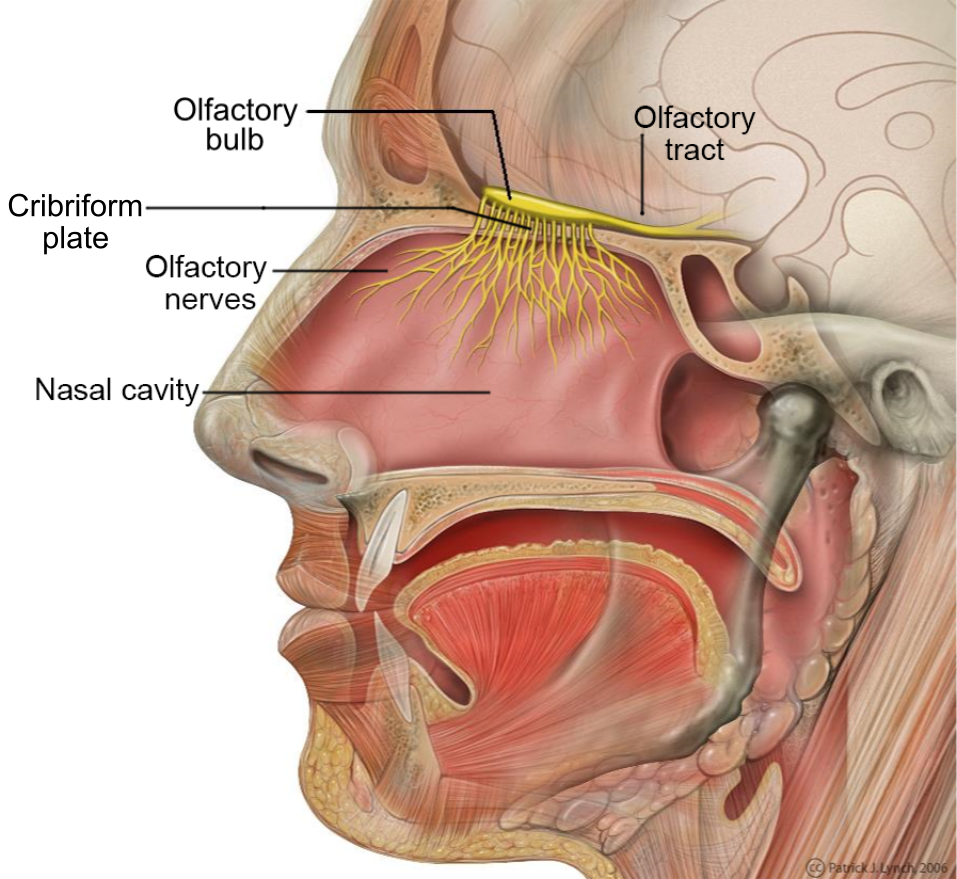
Re:Postmortem assessment of olfactory tissue degeneration in... by swasheck on Tuesday April 12, 2022 @12:43PM (#31005037)
yes and no. it is somewhat alarmist as the olfactory bulb is anatomically part of the brain and is responsible for initial transmission of the olfactory signals for further processing in the amygdala. it essentially completes the circuit between the olfactory neurons and the amygdala. if the research shows that the amygdala has been damaged, then i'd feel much more comfortable with alarmist "brain damage" headline.

even so, the damage itself is devastating. my daughter and wife both suffer from covid-related parosmia. my daughter has dealt with it for ~18 months now and has given up hope of ever getting to enjoy tastes she once loved.

Re:Postmortem assessment of olfactory tissue degeneration in... by ModernMech on Tuesday April 12, 2022 @01:36PM (#31005828)
I'm really sorry for your family. This is part of the reason I don't even want to catch Covid.

In 2020 my sister lost her sense of smell t Covid, and it seems to have permanently altered her sense of taste. What else but damage to the brain could do that?

To this day food she used to love have been corrupted. She can't describe it, but the closest she has articulated to me is that certain things things "taste the way cigarettes smell." As a result, she has had trouble eating and has lost a lot of weight (not in the way you want to lose weight).

I get really upset when people dismiss long covid as some sort of hysteria. Even if that were true, the impacts are real, and it's not a joke or something to be minimized and dismissed.

Re:Postmortem assessment of olfactory tissue degeneration in... by timr on Tuesday April 12, 2022 @01:42PM (#31005910)
> What else but damage to the brain could do that?

Damage to the olfactory epithelia. That is what this paper is describing.

Re:Postmortem assessment of olfactory tissue degeneration in... by shkkmo on Tuesday April 12, 2022 @02:31PM (#31006585)
This paper describes damage to the axons in the olfactory bulb and tract. While their olfactory neurons have their cell bodies in the epithelial, their axons extend through the tract into the bulb. Thus the damage appears to not be to receptors or support cells in the epithalia / nose but to axons in bulb / brain.
Re:Postmortem assessment of olfactory tissue degeneration in... by timr on Tuesday April 12, 2022 @04:24PM (#31007811)
> Thus the damage appears to not be to receptors or support cells in the epithalia / nose but to axons in bulb / brain.

No. From the paper:

> Consistent with findings reported by other groups,16,19 this study also did not find evidence of viral infection in olfactory bulb from most patients with COVID-19. Therefore, the axon and microvascular pathology in olfactory bulb and olfactory tract were most likely not caused by direct viral injury.

Moreover:

> this study did not find a strong association between olfactory endothelial injury and disease severity, suggesting that local inflammation in the upper respiratory tract may be sufficient to cause endothelial and axonal damage in the olfactory pathway.

I'm not an expert in the microanatomy of the olfactory pathway so I'm not going to debate the location of the samples, but the authors are explicit that your interpretation is incorrect. It's not the neurons themselves, it's some inflammatory process external to the neurons that is causing damage.

This has clear implications for the level of panic people are bringing to this conversation. A virus that can infect neurons (e.g. rabies, herpes) can cause damage by moving within the nerves themselves. This virus does not appear to do that, and instead causes local inflammation that indirectly influences the neurons.

Debating whether or not this is "brain damage" is academic; most people in this conversation are leaping to wild conclusions about the virus "infecting the brain". This is not supported.

Re:Postmortem assessment of olfactory tissue degeneration in... by shkkmo on Wednesday April 13, 2022 @02:01PM (#31017973)
> the authors are explicit that your interpretation is incorrect. It's not the neurons themselves, it's some inflammatory process external to the neurons that is causing damage.

I never claimed that infection of the neurons caused the damage. That is a strawman you created.

What I said is that there was damage to axons in the olfactory bulb, which is part of the brain.

If there are people leaping to wild conclusions, why not respond to them rather than trying to foist their views off on me?

Re:Postmortem assessment of olfactory tissue degeneration in... by somewhereoutth on Tuesday April 12, 2022 @07:24PM (#31009445)
I think the alarm was over brain damage - brain infection would be a deeper level of horror!
Re:Postmortem assessment of olfactory tissue degeneration in... by timr on Wednesday April 13, 2022 @10:48AM (#31015322)
You can rest assured that this paper shows neither.
Re:Postmortem assessment of olfactory tissue degeneration in... by djmips on Tuesday April 12, 2022 @02:03PM (#31006215)
I think that was their point. ^
Re:Postmortem assessment of olfactory tissue degeneration in... by nradov on Tuesday April 12, 2022 @02:56PM (#31006874)
Regardless of what you want, you will almost certainly catch a SARS-CoV-2 infection eventually (and perhaps multiple times). The virus is endemic and highly contagious so avoiding it is impractical. You might have already been infected without knowing it because many carriers never develop clinical COVID-19 symptoms. Fortunately the vaccines and other treatments are pretty effective at preventing deaths.

https://www.medpagetoday.com/opinion/vinay-prasad/94646

Most any serious viral infection can cause post-viral fatigue syndrome. We've known that for decades and this virus is no different.

https://pubmed.ncbi.nlm.nih.gov/3063394/

Re:Postmortem assessment of olfactory tissue degeneration in... by dv_dt on Tuesday April 12, 2022 @04:10PM (#31007687)
There are a populations of experts that promulgate that view. There is another population of experts which strongly disagree with the assessment of inevitability.

I gravitate towards those that say something can be done; that we have both the science and the ability to do it, though I'd say we do have a lot of people with a lot of power that want to tell us to give up on the precautionary principle.

Re:Postmortem assessment of olfactory tissue degeneration in... by nradov on Tuesday April 12, 2022 @05:10PM (#31008270)
Which specific experts claim that it will be feasible to avoid a highly contagious respiratory virus for decades? That seems implausible based on what we now about viral transmission. The virus will be around forever, and all it needs is one mistake or a bit of bad luck.
Re:Postmortem assessment of olfactory tissue degeneration in... by dv_dt on Wednesday April 13, 2022 @11:27AM (#31015815)
We have avoided widespread measles outbreaks for decades
Re:Postmortem assessment of olfactory tissue degeneration in... by nradov on Wednesday April 13, 2022 @02:50PM (#31018627)
So what? That's a total non sequitur. The measles vaccine is highly effective at preventing infection and transmission. That situation doesn't obtain with SARS-CoV-2. The vaccines are pretty good at preventing deaths but they have only a marginal and temporary effect on preventing infection and transmission. For the foreseeable future, every time you interact with another person (or certain other mammal species) there is a significant risk they will transmit the virus to you. That is our reality and wishful thinking won't change it.

Instead of trying to avoid infection and most likely failing, a more productive approach is to focus on reducing the risks of a bad outcome when you inevitably do get infected. For most people that means getting vaccinated plus resolving any major risk factor conditions such as obesity, type-2 diabetes, and hypovitaminosis D.

And you didn't answer the question. Which specific "experts" claim it will be possible to avoid infection?

Re:Postmortem assessment of olfactory tissue degeneration in... by dv_dt on Wednesday April 13, 2022 @04:24PM (#31019795)
All the ones signed up here for a start https://peoplescdc.org/ They recently had an opinion run in the Guardian.

https://www.theguardian.com/commentisfree/2022/apr/03/people...

Re:Postmortem assessment of olfactory tissue degeneration in... by nradov on Wednesday April 13, 2022 @05:45PM (#31020689)
Neither of those links support your claim. They don't state that it will be possible to avoid infection. Certain non-pharmaceutical interventions can potentially delay exposure for certain individuals, but unless you hide in a sterile bubble you will be exposed.

And the so-called "People's CDC" isn't even a serious scientific or medical group. Unlike the real CDC, they're not doing any original research or useful analysis. It's merely a political advocacy group. There's nothing wrong with political advocacy but don't confuse it with actual science.

Re:Postmortem assessment of olfactory tissue degeneration in... by somewhereoutth on Tuesday April 12, 2022 @07:28PM (#31009482)
It is a novel virus, new to us, so it is different.

How different, and what this means in terms of individual and public health, is what we are currently finding out.

Notably, Long Covid effects have a considerably higher prevalence than 'Long Flu'.

Re:Postmortem assessment of olfactory tissue degeneration in... by nradov on Tuesday April 12, 2022 @10:04PM (#31010462)
SARS-CoV-2 is only "novel" in the sense that no one had acquired immunity to it before 2019. But otherwise it's very similar to other betacoronaviruses such as HCoV-OC43.

https://dx.doi.org/10.1016%2FS0262-4079(20)30862-9

We don't actually know the prevalence of "long flu".

Re:Postmortem assessment of olfactory tissue degeneration in... by somewhereoutth on Friday April 15, 2022 @06:45PM (#31046861)
Closer relatives would be SARS-CoV-1 and MERS. Thankfully -2 is nowhere near as virulent as either.
[dead]
Re:Postmortem assessment of olfactory tissue degeneration in... by histriosum on Tuesday April 12, 2022 @02:20PM (#31006443)
You may want to try some empathy. Losing one of the primary senses is certainly a devastating loss, even though it is not mortal, as you point out. Death is not the only result that qualifies as devastating.
Re:Postmortem assessment of olfactory tissue degeneration in... by hypertele-Xii on Tuesday April 12, 2022 @03:23PM (#31007146)
Facts do not care about your emotions. Words have meaning. On a devastation scale of 1-10 losing your sense of smell is like barely a 2.
Re:Postmortem assessment of olfactory tissue degeneration in... by samatman on Tuesday April 12, 2022 @12:40PM (#31005006)
It's true that the olfactory bulb is a region of the brain, but this is a case where the loss of precision is misleading.

"damages the body" is just as accurate as "damages the brain", is just as accurate as "damages the olfactory bulb".

Re:Postmortem assessment of olfactory tissue degeneration in... by croes on Tuesday April 12, 2022 @01:38PM (#31005851)
There is a difference if something is in the brain or the rest of the body
Re:Postmortem assessment of olfactory tissue degeneration in... by samatman on Tuesday April 12, 2022 @02:12PM (#31006335)
There is a difference if something is in the olfactory bulb or the rest of the brain.
Re:Postmortem assessment of olfactory tissue degeneration in... by timr on Tuesday April 12, 2022 @01:36PM (#31005826)
> That is not the same as "nerves and blood vessels in their nose".

The words literally mean "nerves and blood vessels in the nose". The quoted text also tells you that the observed pathology is not from direct viral infection.

Saying that "covid leads to brain damage" because the olfactory nerves are connected to the brain is an unsupported leap, and it's why the title of the paper doesn't say this. The title of this article is purposely sensational, and really needs to be changed.

A better, more accurate title would be: "covid smell loss due to inflammation in the olfactory epithelia".

Or just the title of the paper itself.

Re:Postmortem assessment of olfactory tissue degeneration in... by slg on Tuesday April 12, 2022 @01:46PM (#31005977)
>A better, more accurate title would be: "covid smell loss do to inflammation in the olfactory bulb".

I'm a layperson. Like many laypeople, I would have no idea what the "olfactory bulb" was if I saw it in a headline, but the Wikipedia page for it starts with "The olfactory bulb (Latin: bulbus olfactorius) is a neural structure of the vertebrate forebrain...". It certainly sounds like "brain" is a fair and accurate summary.

Re:Postmortem assessment of olfactory tissue degeneration in... by timr on Tuesday April 12, 2022 @01:49PM (#31006020)
If you're a "layperson" and resorting to reading wikipedia, then you really have no basis to draw any conclusion. But you're extremely willing to jump to scary conclusions, and disregard people who understand the paper and terminology and tell you that your conclusion is wrong.
Re:Postmortem assessment of olfactory tissue degeneration in... by slg on Tuesday April 12, 2022 @01:56PM (#31006113)
I think there is an implicit assumption that HN titles shouldn't be written in jargon that most people reading it won't understand.
Re:Postmortem assessment of olfactory tissue degeneration in... by timr on Tuesday April 12, 2022 @04:00PM (#31007582)
It's a medical paper. It isn't written for non-practitioners, and if you don't understand it, the best thing to do is not to speculate, but to reserve judgment.
Re:Postmortem assessment of olfactory tissue degeneration in... by slg on Tuesday April 12, 2022 @04:43PM (#31008016)
I don't know what your point is considering I never speculated about anything in these comments. Ironically enough, you seem to be speculating about what people might speculate about when they see that headline.
Re:Postmortem assessment of olfactory tissue degeneration in... by timr on Tuesday April 12, 2022 @05:02PM (#31008198)
> I'm a layperson. Like many laypeople, I would have no idea what the "olfactory bulb" was if I saw it in a headline...It certainly sounds like "brain" is a fair and accurate summary.
Re:Postmortem assessment of olfactory tissue degeneration in... by slg on Tuesday April 12, 2022 @05:13PM (#31008293)
It is funny how something starts to seem more like speculation when you conveniently throw an ellipsis over the part in which I cite the source where the "speculation" came from.

I wasn't speculating. I was quoting Wikipedia.

Re:Postmortem assessment of olfactory tissue degeneration in... by nojito on Tuesday April 12, 2022 @12:36PM (#31004945)
Not sure why this is being upvoted. Your olfactory nerves are literally extensions of your brain. Any damage to these nerves equates to brain damage.
Re:Postmortem assessment of olfactory tissue degeneration in... by clankyclanker on Tuesday April 12, 2022 @12:43PM (#31005038)
It’s probably a problem of non-specificity: if you say “the brain” some folks will consider just the prefrontal cortex, where thought happens. Olfactory nerves, where the smell happens, is a different enough concept that it might not align with the reader’s preconceptions of “the brain.”
Re:Postmortem assessment of olfactory tissue degeneration in... by Zigurd on Tuesday April 12, 2022 @02:25PM (#31006502)
If vision were similarly affected, there would be less of this complacency about permanent damage to parts of the brain performing sensory processing.
Re:Postmortem assessment of olfactory tissue degeneration in... by bzxcvbn on Tuesday April 12, 2022 @03:20PM (#31007121)
I just cannot tell if you are serious. If someone cuts themselves a bit deep into the skin, it's probably that a nerve will be affected. Would you describe such an injury as "brain damage"? I am trying to understand your thought process.
Re:Postmortem assessment of olfactory tissue degeneration in... by nojito on Tuesday April 12, 2022 @04:51PM (#31008084)
Not comparable. The olfactory bulb is literally physically in your brain.
Re:Postmortem assessment of olfactory tissue degeneration in... by bzxcvbn on Wednesday April 13, 2022 @05:31PM (#31020555)
I thought we were talking about olfactory nerves? You're just shifting semantics.
Re:Postmortem assessment of olfactory tissue degeneration in... by nojito on Thursday April 14, 2022 @08:19AM (#31025889)
Yes...they are located in your brain.
Re:Postmortem assessment of olfactory tissue degeneration in... by bzxcvbn on Thursday April 14, 2022 @04:17PM (#31032704)
Nope. The bulb is in the brain. Not the nerves. A nerve in the brain is an oxymoron.
Re:Postmortem assessment of olfactory tissue degeneration in... by giraffe_lady on Tuesday April 12, 2022 @12:44PM (#31005058)
A common position on HN for many months now has been that the worst damages from covid are the economic and social ones caused by lockdowns.

There is going to be a lot of cognitive dissonance around, and resistance to, exploring long-term consequences of the virus itself for this reason.

Re:Postmortem assessment of olfactory tissue degeneration in... by wccrawford on Tuesday April 12, 2022 @01:37PM (#31005843)
That was a position before the lockdowns even happened. There's nothing new about that thought.

Some local governments even felt strongly enough about that to go against the majority and have the laxest restrictions they could, or even prevent cities and counties from enforcing stronger measures than the state.

It remains to be seen how that plays out in the end, though. History books in a few decades are going to be very interesting.

Re:Postmortem assessment of olfactory tissue degeneration in... by tick_tock_tick on Tuesday April 12, 2022 @01:35PM (#31005810)
I mean we pretty objectively know that they are at this point.
Re:Postmortem assessment of olfactory tissue degeneration in... by rootusrootus on Tuesday April 12, 2022 @01:52PM (#31006061)
Do we? It is arguable that much of what people are referring to as a 'lockdown' was voluntary and would have happened in any case. Especially early on, there was surprisingly little variation between jurisdictions that formalized it with regulation, and ones that did not.
Re:Postmortem assessment of olfactory tissue degeneration in... by tick_tock_tick on Tuesday April 12, 2022 @02:26PM (#31006526)
Schools are the biggest one especially since data seems to indicate it did nothing to improve covid outcomes.
Re:Postmortem assessment of olfactory tissue degeneration in... by NationalPark on Tuesday April 12, 2022 @02:49PM (#31006791)
This research on the neurological damaged caused by covid suggests that we objectively don't yet understand the long term impacts of covid infection. Given that something like 40% of the US has contracted covid at least once (per CDC), even a small effect on the age-incidence of heart attacks or strokes could cause major social and economic problems in 20+ years.
Re:Postmortem assessment of olfactory tissue degeneration in... by exabrial on Tuesday April 12, 2022 @11:34AM (#31004076)
Since covid, I've been a lot more conscious of when my sense of smell goes away.

1. Allergies

2. 'normal' Colds

3. Day after a stiff manhattan or two

Curious if the cause is all the same

Re:Postmortem assessment of olfactory tissue degeneration in... by Ensorceled on Tuesday April 12, 2022 @12:45PM (#31005082)
My sense of smell waxes and wanes ... it doesn't completely go away, does your sense of smell actually go away completely?
Re:Postmortem assessment of olfactory tissue degeneration in... by exabrial on Tuesday April 12, 2022 @12:50PM (#31005142)
Mine does too. Not in the way it did when I "had covid" though... that was like a blackout.

(My covid experience: all I did was lose my smell for 2-3 days. No cough, fever, brain fog, or other issues. Felt fine. Continued to be outdoors, walked/biked the entire week. Avoided anyone/everyone at any visual distance. Positive PCR test.)

Re:Postmortem assessment of olfactory tissue degeneration in... by jdminhbg on Tuesday April 12, 2022 @01:23PM (#31005636)
I had Covid-related anosmia for a few days, and it was very different from just being stuffed up and unable to smell/taste like with a regular cold. I could stand over e.g. a fire, and instead of smelling smoke, I had a sensation of smelling "nothingness."
Re:Postmortem assessment of olfactory tissue degeneration in... by doubled112 on Tuesday April 12, 2022 @07:43PM (#31009580)
This is probably the best way to describe it.

I was in the shower, squirted shampoo, lathered, and it hit me. Something was missing. I couldn't smell anything.

I went so far as to take the bottle and squeeze air from it into my nose. I could feel the puff, but that was it.

It was actually a little bit jarring. It was complete loss for a couple of days and got progressively better until back to normal a couple of weeks later.

Re:Postmortem assessment of olfactory tissue degeneration in... by rhacker on Tuesday April 12, 2022 @12:28PM (#31004831)
Since there is no money in the other 3 we'll continue forever to believe those are not the same as COVID's pathway. But great comment - you're probably right.
Re:Postmortem assessment of olfactory tissue degeneration in... by Overtonwindow on Tuesday April 12, 2022 @12:02PM (#31004451)
..and by extension those who gained their senses back experienced a ...repair to the nerves and blood vessels in their nose? Is that any different that nerve repair in the brain?
Re:Postmortem assessment of olfactory tissue degeneration in... by pvg on Tuesday April 12, 2022 @12:13PM (#31004607)
A postmortem study probably doesn't tell us much about those who regained their sense of smell back.
Re:Postmortem assessment of olfactory tissue degeneration in... by j_crick on Tuesday April 12, 2022 @03:35PM (#31007286)
“Mundane” as we’re getting the same effects from, say, any other everyday activities?

Yeah, right. So mundane and regular, just as a common cold.

Re:Postmortem assessment of olfactory tissue degeneration in... by vmception on Tuesday April 12, 2022 @11:49AM (#31004286)
so basically in this case, they (OP, maybe the authors too) are considering the olfactory tissue "in the nose" to be part of the brain?

thats..... extremely ambiguous and explains why my understanding of this COVID phenomena has gone full circle, like where's the limit then? nerves that aren't a part of the head? or would they consider losing a sense of touch in your knee from a dull nerve to be "damage in the brain" as well.

Re:Postmortem assessment of olfactory tissue degeneration in... by gaze on Tuesday April 12, 2022 @11:53AM (#31004328)
The neurons contributing to your sense of smell as well as your optic nerve are more or less considered part of your brain. Loss of smell is more or less a canary.
Re:Postmortem assessment of olfactory tissue degeneration in... by bredren on Tuesday April 12, 2022 @12:01PM (#31004425)
More detail on axons:

> Each neuron in your brain has one long cable that snakes away from the main part of the cell. This cable, several times thinner than a human hair, is called an axon, and it is where electrical impulses from the neuron travel away to be received by other neurons.

https://qbi.uq.edu.au/brain/brain-anatomy/axons-cable-transm...

Re:Postmortem assessment of olfactory tissue degeneration in... by Justin_K on Tuesday April 12, 2022 @12:13PM (#31004599)
When someone get's a nose job, do they also get brain damage as a side effect?
Re:Postmortem assessment of olfactory tissue degeneration in... by PheonixPharts on Tuesday April 12, 2022 @12:16PM (#31004651)
When they get a nose job the region of the body that contains the olfactory bulb is not touched at all since that is in the brain, not in the nose. I posted this image in another comment [0], but it seems there's a misunderstanding of anatomy here.

0. https://en.wikipedia.org/wiki/Olfactory_system#/media/File:H...

Re:Postmortem assessment of olfactory tissue degeneration in... by vmception on Tuesday April 12, 2022 @12:22PM (#31004736)
> but it seems there's a misunderstanding of anatomy here

yes, I agree and it also is worth mentioning that it is being communicated poorly in many forums where people also misunderstand this

olfactory = smell

people, myself included, think there are filaments in our nose (the parts we can see and stick our fingers into) that this is referring to. great opportunity for more anatomically minded people to explain this better.

Re:Postmortem assessment of olfactory tissue degeneration in... by shkkmo on Tuesday April 12, 2022 @02:46PM (#31006762)
> people, myself included, think there are filaments in our nose (the parts we can see and stick our fingers into) that this is referring to.

The confusion may be due to the fact that olfactory sensory nerves have their cell bodies (with the smell receptors on cillia) in the nose. Like many peripheral nerve cells, these cells also extend directly into the brian via their axons. In this case, those axons extend via the olfactory tract into the olfactory bulb in the brain. These areas (tract and bulb) are where the paper indicates axon damage was found.

Re:Postmortem assessment of olfactory tissue degeneration in... by bredren on Tuesday April 12, 2022 @01:00PM (#31005317)
Our science museum, OMSI, in Portland used to have this giant nose you could crawl in and learn about it.

I don’t remember stuff explaining nerves or how smell is connected to the brain but it was fun to go inside.

Re:Postmortem assessment of olfactory tissue degeneration in... by newestpersona on Tuesday April 12, 2022 @12:09PM (#31004546)
Cranial nerves are often considered part of the brain. That includes olfactory n. (CN I).

More precisely, this paper addresses damage to the olfactory bulb as well as the olfactory nerve. That's not in the nose - that's part of the brain proper, without any ambiguity at all.

Re:Postmortem assessment of olfactory tissue degeneration in... by vmception on Tuesday April 12, 2022 @12:51PM (#31005161)
okay, I understand, when people think brain damage, they aren't thinking about sensory inputs, they are thinking about thinking function. I can see how the line would be blurred to someone that cares. but maybe this is an indication of further damage to be investigated.