https://www.youtube.com/watch?v=CTV-wwszGw8
Video discusses this thoroughly. There ARE quiet cities amazingly enough. And suburbs are a HUGE source of the noise IN the cities they surround because it's the car traffic from suburbs into the cities that makes much of the noise.
Cities ARE loud, but they don't HAVE to be.
I can't think of an exception to this in any city I've been in, honestly. Which cities have lots of clubs and bars with loud speakers out the front? Is that common in the states?
In terms of decibels cars are indeed louder. But not all noise is created equal.
I have noise-cancelling headphones - they do a great job removing white noise(so traffic, among others), but aren't too effective against sounds with a more focused spectrum like people yelling in the middle of the night, bottles being broken or trash being collected in the middle of the night.
Paris is very densely populated - I'm surprised anyone attempts to drive there, because at these densities and distance between buildings it must be horrible.
My point is: it's not that clear cut. Removing cars is what makes places like Paris bearable, but the problem lies in the sheer population density that a truly walkable city over a certain scale requires.
I moved to a city that has 2/3 the population density of my previous location and even though it's just swamped with traffic, it's actually quieter on average.
I feel like population density is completely left out of the conversation. From my experience there's a middle ground between car-oriented suburbs and human pile-ups like Paris(or other cities approaching this density) which is rarely explored.
Half the problems with America seems to be lack of regulation and the assumption that it can't be changed :)
Like our party was able to carry a bazooka around openly in one state :)
A perfectly practical solution would be for the town to designate "outdoor power equipment times" such as "Saturday, 10-4" or "any day, 10-12, 3-4" or similar.
Electric is helping but even then there's noise created from just the action of the device, and you also reach a paradox where as things get quieter the remaining noise sources become more annoying.
There is no magic, just legal regulation and it just works. Switzerland and Japan are good examples.
The Dutch city of Delft in particular is just intentionally designed to care about noise. Both design and regulations. Turns out that when you simply prioritize reducing noise, it's actually doable. And it's still a city, albeit a modest-sized small city, not a major regional hub or a global-level metropolis. But the lessons can be applied anywhere.
Everytime I get passed by an e-bike my brain has a little pleasure seizure from not having to suffer the expected rawkus.
But subjectively I don't mind the tire noise nearly as much as the sound of an accelerating petrol engine.
It would sound like something out of a William Gibson novel.
[1] https://www.youtube.com/watch?v=6Qe1wuDsXVk
[2] https://www.youtube.com/watch?v=SvX7NnlhiOE
Bonus: Kia's sounds like an ambient synth track: https://www.youtube.com/watch?v=NdZwVJPN0Ow
https://m.youtube.com/watch?v=Hu_1JM_UiuA
This is because the manufacturer is based in Quebec.
Currently live in a dense city in Asia. Remove all the personal vehicles and it would still be noisy as hell. Just business vehicles delivering food, removing trash, etc. are a decent amount of noise. The high building density reflects and concentrates the noise.
Then add in construction, road work. Even the worker moving trash bins around by hand every evening is loud.
Pure fantasy to have dense city living an little noise.
On regular roads it's 50 km/h. There's one like 300 meters from my flat.
On a few big multilane roads it's 90 km/h or more but the closest such road is 700 meters from my flat, and it has these noise-cancelling panels around it.
The first time you shouted my eye was twitching. By the third time I could almost feel a stroke coming from the increase in noise pollution.
Humans are so susceptible... pfff
Mostly because of lawn stuff and garbage pickup. Also probably a factor that I’ve been in new city buildings with good insulation and not on the ground floor.
Garbage pickup is once a week, and the truck is close enough for me to hear it for maybe 15 minutes. Double that for recycling pickup.
I live a few miles from the city center, in just about the densest area where people still have lawns. There are maybe 5 houses close enough to me that I could hear a leaf blower from if I’m inside the house (loud enough to notice). Even if each one runs a lawnmower and leaf blower for half an hour each week, that’s 2.5 hours per week tops (only 2 of them actually use leaf blowers, and most only cut the grass 1x every 2 weeks). Also in most of the country mowing only happens a little more than half the year.
Compare that with road noise, and sirens, which I hear far more often.
Around me, there are three different recycling pickups (one for the each kind of recyclable). Combined with regular trash pickup, it means that the garbage truck is here on most work days.
Down in San Diego the noises are much MORE noticeable because many houses have poor or no insulation at all, and the windows are single pane (or open).
I eventually moved because they ruined my peace and quiet, and because I was getting sick of the 5' snow drifts starting in October.
# vehicle/person probably doubled since then.
I live in the densest neighborhood in Austin (West Campus). Sirens are rare, and car horns are moderately uncommon. Construction noise is near-constant during the day, as are big trucks related to the construction. Car noise is ever-present, but more of a problem on the larger roads. (I'm currently sitting outside a coffee shop on Lamar and the traffic noise is indeed constant and terrible.)
The two biggest sources of noise pollution in my neighborhood are 1. the construction and 2. leaf blowers. Leaf blowers might be third if you split the construction-related trucks into their own category.
Using car horns at cities is forbidden anyway, unless there's a crash or a dangerous situation you shouldn't hear them. I can't remember the last time I've heard a car horn in my city.
I've lived in countryside and in several places in 2 different big cities in Poland, and except for one time I lived near a big 4-lane road in the middle of the city (which is a disgrace of communist urban planning BTW) - cities were quieter than the countryside.
Cars are going faster in the countryside and dogs are constantly barking at night at anything that moves.
BTW another factor is windows quality. It significantly changes how quiet your home is.
Now we live in a not-so-popular area built during a great housing programme in the 60s ("miljonprogrammet" in Swedish) and we love it. Lots of green areas, all parking is in the outer perimeter so we have almost no traffic. The modern areas built in town are nowhere near as well planned from a life quality perspective.
I am not anonymous (nor even pseudonymous) here, so I might as well mention that the area is Vilbergen in the city of Norrköping.
Since all else isn’t equal, you could design cities that are quieter than the most suburbs. But you could also design suburbs that are quieter than most cities.
In the US at least I linked a study that showed cities are far louder on average.
Once you have density high enough you can't live in separate houses. People move to commieblocks or other kinds of multitenant buildings. This shifts everything closer together, makes public transport profitable and having a car becomes optional. These kinds of neighborhoods are quieter than the countryside usually. It looks like this: https://spoldzielnialsm.pl/wp-content/uploads/2018/05/Obecni... https://4.bp.blogspot.com/-ud9-Z0UHVHg/W7-qUjfNT9I/AAAAAAAAi...

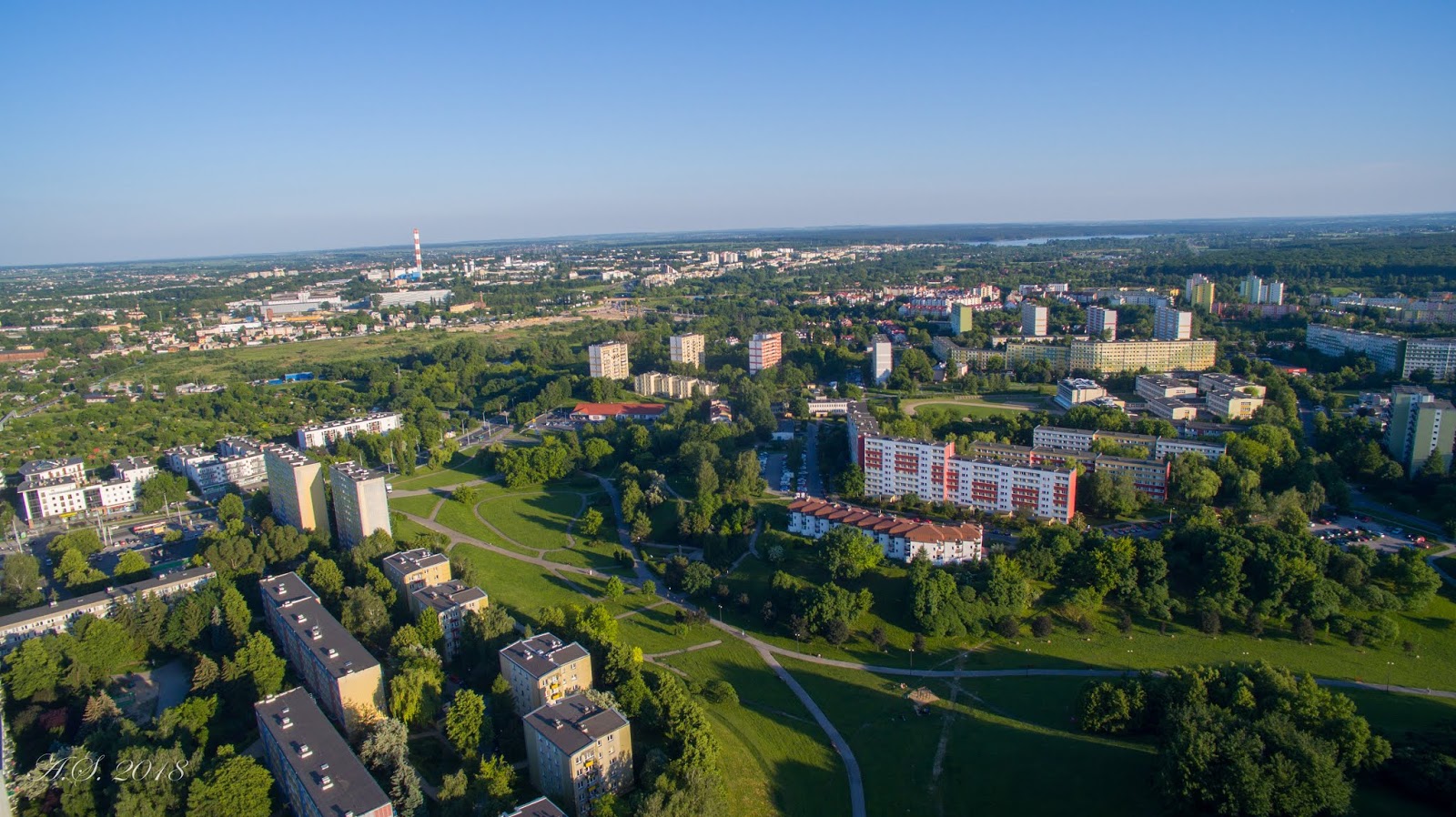
Or if you're insane you can mandate enough parking space that this doesn't happen and instead you have highrises in the sea of parking lots.
Its really annoying for WFH
Adding to that list: The poisoning of every downstream waterway for miles. The further south you go, the worse it is.
Driveways can, admittedly, be handy but you don't need a whole lawn for that. Just turn the driveway sideways and butt the whole thing up against the road. Boom, just as much parking and space for trailers or cleaning your boat or whatever, and you can cut out a few meters of lot depth with minimal loss of functionality. Of course, building codes mandate lawns, so that can't happen. Meanwhile I dream of a world where everything's ~10% closer just because we don't have suburban front lawns.
I also sometimes wonder how many amazing parks we could have if half the money everyone put into maintaining their front lawns went to that, instead. Put half the money and half the land into that and we could have an awesome park on every other suburban block, and still save money and space.
That's hugely hyperbolic.
But in the city there really are constant sirens, car horns, diesel trucks, construction noises, roadway noise etc...
The most comprehensive study done on this (admittedly a long time ago in 1970) shows a clear correlation between population density and noise pollution.
https://www.nrs.fs.fed.us/pubs/gtr/gtr_ne25/gtr_ne25_183.pdf
I think the most likely explanation is that you moved from a particularly noisy suburban neighborhood to a particularly quiet urban one.