While I agree with some of your critique, as Ted pointed out in https://citeseerx.ist.psu.edu/viewdoc/download?doi=10.1.1.45..., video is almost always edited with EDLs, edit decision lists, which are sequences of transclusions of the source footage. And transclusion is the way we've always done images on the WWW. So I think that at least that criticism is off-base.
Much of the elaborate optimization is simply a concession to the realities of 01984, when 1-MIPS workstations with 1 MB of RAM were fairly high-end workstations. (But some of it was just blunders.) You probably remember how in 01993, 4½ Moore's-Law doublings later, Mosaic struggled to deliver a usable networked hypertext browsing experience on the personal computers of the day, except those made by SGI or Sun. And that was without half of Xanadu's features: versioning, linkrot-proofness, and editability.
And if you are postulating unlimited storage, why not put videos there as well?
The primary concern of this architecture document from beginning to end is how to get adequate performance out of the computers of the day, given the features they considered to be fundamental.
BTW, as I understand it, the I-stream isn't the append-only data structure; the granfilade is. They contain mostly the same information, but in different orders, so that you can insert into the I-stream by appending to the granfilade.
I don't think it's true that forever storing all the text the system's users would write was infeasible in 01984; the revenues expected from readers would have paid orders of magnitude more than the cost of the space required, even in 01984. A book might be 1 megabyte; you might write another megabyte or two in the process of writing it. Someone writing a book in Xanadu — a level of success the system never in fact achieved — would have to pay to store those 2–3 megabytes forever, perhaps copying them onto a new computer every 6 years, at ⅛ the cost of the previous computer. How much might that cost?
I don't have good pricing data from 01984, but I do have here the Sun price list from December 01988; a Sun-3/100 at that time contained a 16.67-MHz 68020, 4–12 MiB of RAM, and if you got it with a disk, it would be a model 514D 141-MiB disk. The 3/140M-4-P5 configuration, with a 19" monitor, cost US$23700. 3 MB of text would have been about 2% of the machine's capacity, and so would have cost about US$237 in 01988. Four years earlier it probably would have cost about US$1000. Then it would have cost another US$125 for new storage in about 01990, US$16 in 01996, US$2 in 02002, etc., a total of a bit under US$1145. If you amortized the initial investment of the space for the book over the same 6 years, it would be about US$190 per year, so the system would be immediately profitable for any book that was expected to produce more than about US$190 of revenue per year across all its readers. A book with 100 readers per year, each paying US$10 to read the book, would earn five times the cost of its storage space.
Data transmission was plenty fast enough; people can only read at about 300 baud, or 150 baud with huffman coding. The Hayes Smartmodem 300 was introduced in 01981, and in 01984 1200-baud modems were common and 2400-baud modems were starting to appear.
Then the problem would merely be to build data centers fast enough, stuff them full of fileservers, and somehow keep the whole wild system from collapsing in chaos.
That wasn't the problem they had, though. The problem that they had was that their system design was so ambitious that they never shipped a working product.
As for video, well, even with modern codecs a two-hour-long movie can gobble up over a gigabyte of storage space (US$300 000 at the price I estimated above), and people were paying US$1 for a matinée movie ticket and US$0 to watch pan-scan-converted movies on late-night TV. There was actually a somewhat popular product a few years later to do data backup onto VCR tapes, called ArVid; it could get 4 gigabytes onto a 4-hour tape. (A few people were doing that starting in the early 01980s, but they were the people who had gigabytes of data, so there wasn't a mass-market product.) Although I was watching postage-stamp-sized MPEGs with mpeg_play_motif on SGI workstations in 01993, fullscreen digital video playback didn't become computationally feasible at all for mass-market hardware until the late 01990s; earlier systems like the Dragon's Lair arcade game overlaid the digital content on analog video backdrops.
So to deliver text to customers in 01984 and store it forever, you needed 300-baud modems, which were already a mass consumer product, a data center with fileservers, a packet-switching network like Tymnet, and textual data that averaged at least a few readers per month. Tymnet had been a commercial offering since 01972, and this whole package is something companies like The Source, CompuServe, and (as Animats pointed out) the vile Mead Data Central were already doing.
To deliver video without modern codecs, you would have needed four orders of magnitude more storage space in your data center, and you would have needed each video customer to either contract a T1 line to their premises or better, or also have the customers store the video data locally, perhaps on a VHS tape, so they could download it at slower than real time. With a 2400-baud modem you would be able to download a few seconds of video per day, though, so maybe you'd need to contract at least a 64-kbps frame relay link from the phone company, so you could download a minute of video per day. Then you could watch a single movie every other month.
There is a detailed description of it at: http://udanax.xanadu.com/green/febe/index.html
Edit: I’ve added this link in a footnote at the end of https://sentido-labs.com/en/library/201904240732/Xanadu%20Hy...
The conclusion I draw from this is that Xanadu is quite a different usage model than the web. The first webpage I remember reading (over dial-up connection to university server) was physics experiments for beginners. The first webpage I made (in the end of 1990's) was to publish plays from the drama club. Those would be be totally infeasible under "every published document must earn money" model.
I wonder if Xanadu could ever get completed, who would have used it? It will be probably be a Serious Place full of Professional Authors writing Real Books. Nothing like fun, random places of early internet [0] -- "a guide for backpackers and wilderness trekkers; [...]; a Grateful Dead fan page"....
[0] https://www.theatlantic.com/technology/archive/2017/04/a-sea...
I'm guessing there were more than two people in the drama club, so it's likely that even your first webpage had more than two readers a month, which was the breakeven point I calculated above for extrapolated 01984 storage pricing. By my extrapolated 01990 pricing it would have been economical at three readers per year, and by my extrapolated 01996 pricing at one reader every 3 years. Since you called it a "webpage" and not a "BBS" or "FTP site" I'm guessing that this was more like 01994 than 01984, so you would have been fine.
These numbers are no different for Xanadu and the WWW, it's just that on the WWW they are paid by the publisher (or their friend or university or something), and in Xanadu they would be paid by the users.
All this is assuming the value to the reader is about US$3 per megabyte, a number I based on the idea that a book is about a megabyte, people commonly pay about US$10 for a book, and the edit history for the book might be three times the size of the final book. (Maybe people paid US$2.50 for a paperback, while a hardcover might be US$40. Roughly 01984 dollars.) If you were reading 40 hours a week at 350 words per minute at this speed, that works out to US$15 a week, US$66 a month, or US$789 a year.
A more reasonable path is to figure that by 01994 people might pay US$20 a month for using the Xanadu service 40 hours a week, with half of that (US$10 a month) flowing to the author and hosting costs. That's only 46¢ per megabyte, but by 01994 storing a megabyte only cost about US$30 instead of US$1000, maybe US$5/year, so anything with more than one reader a month would pay for itself.
And if it didn't, well, a play might be 100kB, and maybe the drama club would spend US$3 up front to pay a Xanadu operator to store those 100K for eternity, money they'd get back if people read the play, but if nobody ever read the play on Xanadu then that would just be an expense. I feel like US$3 is not a prohibitive expense for vanity-publishing a play and having it never go out of print. I mean xeroxing it at the library probably cost almost that much. Per copy!
(In 01996, a single Moore's-Law doubling later, I bought my first computer. It had an 800MB hard disk and cost me about US$900, half of which was the monitor, and would have been a perfectly capable fileserver even though it was a cheap IBM PC clone instead of a Sun workstation. So my US$30/MB for 01994 might be too conservative. Maybe it would be more like US$3/MB. And by that time gzip and 14.4kbps modems were mainstream, dropping costs further.)
Now, it's possible that authors (or the Xanadu operating company) would have been too greedy, and charged much higher prices than that, which would have had the result you describe. (There's some evidence that people did shift from things like CompuServe and AOL over to the WWW because publishing on the WWW was cheaper.) Or it's possible that they would have subsidized the initial wide dissemination of their work, as we in fact did with the WWW, so as to build up a customer base.
interesting that you include the zero; is this a commitment to some kind of longtermism? Would you call 700bc 00700bc?
While I don't like that, I don't really see how some kind of pay-infrastructure is avoidable in the long run.
The way the Internet solved that by being owned in large part by a handful of mega cooperations, being full of ads and spam and turning the user into a product is not what I'd call a good solution either.
The fully open and free web is not sustainable, as we have seen by it dying out over the last 20 years. And the open web isn't even all that great to begin with, given that link rot is still an unsolved and extremely common problem.
It's not growing as fast as it was, sure, but for example the number of active blogs has grown by 12% in the last 7 years and 4.4 million blog posts are published every day, more than ever before.
This page claims "70 million posts from wordpress users", which comes out to 2.3 million per day. And there are many more other blogging platforms out there.
https://letter.ly/how-many-blog-posts-are-published-per-day/
If you are interested in non-Facebook/Twitter I recommend getting an RSS client first. Then as you read Hacker News, add the feeds of the interesting authors to your reader -- many front-page articles have RSS links somewhere. You'll have nice, non-FB reading list in no time.
We hope for vindication, the last laugh, and recognition as an additional standard-- electronic documents with visible connections." - https://xanadu.com/
Looks like they would fit right into the crypto world..
https://www.eff.org/cyberspace-independence
"[...] Cyberspace consists of transactions, relationships, and thought itself, arrayed like a standing wave in the web of our communications. Ours is a world that is both everywhere and nowhere, but it is not where bodies live.
We are creating a world that all may enter without privilege or prejudice accorded by race, economic power, military force, or station of birth.
We are creating a world where anyone, anywhere may express his or her beliefs, no matter how singular, without fear of being coerced into silence or conformity.
Your legal concepts of property, expression, identity, movement, and context do not apply to us. They are all based on matter, and there is no matter here. [...]"
RIP
That being said, while looking for court cases that supported "transclusion equals derivative work", it turns out this is actually more contentious among actual judges than I thought. If you ask the 9th Circuit, embedding by reference doesn't violate copyright because infringement is stored in the server[0]. If you ask other courts this is obviously wrong[1].
My gut feeling is still that the 9th is wrong on this, because embedding by reference not tripping copyright opens up a huge loophole in the law[2]. Think about how many low-effort articles are just "X is going viral" plus an embed of X - that's exactly the sort of behavior copyright is intended to prohibit. And given that we live with a legal regime that's obsessed in drowning the world in "innovation" and "intellectual property", I don't see how "evade licensing photos by just embedding them off the photographer's Instagram" is going to stay legal.
Putting that aside, if a reuse of a work by transclusion fell under Fair Use, then you wouldn't need the Xanadu payment system in order to license it anyway. You would be free to just reupload the portions of the work being fairly reused and not pay. So even if paid transclusion wiped away infringement, it would still be a tax on fair users (in the same way that YouTube Content ID is).
Compulsory licensing probably wouldn't matter much as copyright has very few situations in which you can purchase such a license. The ability to refuse to sell a license at any price is considered a key feature of the law by the copyright maximalists.
[0] https://www.reuters.com/legal/transactional/instagram-dodges...
[1] https://www.reuters.com/legal/transactional/manhattan-judge-...
https://www.reuters.com/article/legal-us-otc-panic/n-y-judge...
Hell, even our world's free digital encyclopedia was started by a guy who named his daughter after a fucking Ayn Rand character.
So the question should be: how did our world's burgeoning form of the web ever escape that persuasion in the first place?
More generally, the internet itself ended up being built in the US, even though adequate industrial capacity for it existed in many countries: the USSR, the UK, France, Japan, and so on. There are a number of possible reasons for that, and the UK and France did in fact build nationwide teletext systems with some degree of interactivity, and the UK also built JANET; but very plausibly the US was the one who built the internet because such a liberal network design was too threatening to the other countries, and it happened to work better than designs like Tymnet (which was also built in the US) and Minitel.
Of course the internet was famously non-market-oriented before the com-priv era, not at all like the Digital Silk Road proposed by the Agorics guys (unrelated to the darknet market, of course).
An interesting feature of capitalism that Marx liked to talk about a lot is that they can be unstable, like democracies: participants in a free market are free to pursue their own profits, but by far the most profitable situation for them is to become a monopoly or monopsony, which destroys the freedom of the market and ends capitalism. So we have this interesting situation where the internet, arising from government planning and with commercial use prohibited for decades, ended up being freer even for commercial use than the alternatives established by for-profit companies like CompuServe, Tymnet, and AT&T.
(In the same way, a politician in a democracy is free to pursue power by getting elected, but if they are sufficiently successful at pursuing power, they end democracy.)
actually it wasn't since the beginning
relevant quote from Wikipedia [1]
> WorldWideWeb is capable of displaying basic style sheets, downloading and opening any file type with a MIME type that is also supported by the NeXT system (PostScript, movies, and sounds), browsing newsgroups, and spellchecking. In earlier versions, images are displayed in separate windows, until NeXTSTEP's Text class gained support for Image objects. WorldWideWeb is able to use different protocols: FTP, HTTP, NNTP, and local files. Later versions are able to display inline images.
In 1990 the "Hypermedia Browser/Editor" by Sir Timothy John Berners-Lee already supported images [2]
[1] https://en.wikipedia.org/wiki/WorldWideWeb
[2] https://www.artribune.com/wp-content/uploads/2019/03/Il-Web-...
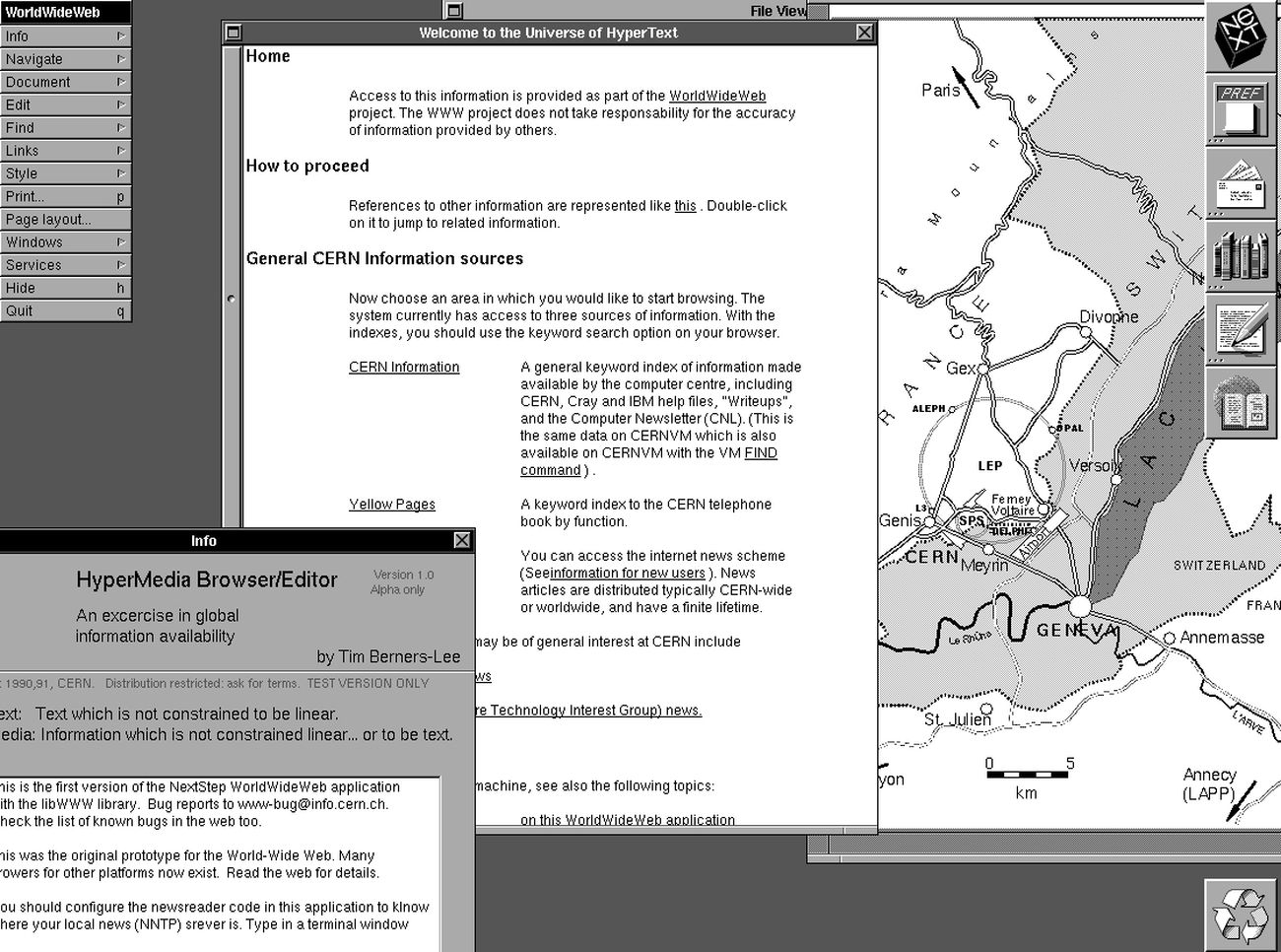
You seem to have responded that actually it wasn't because you could use it to download files of any type, including images (which you could display), and that years later it was able to display inline images (after pmarca added them to Mosaic in 01993). Well, that is true, but your implication that it contradicts what I said is false.
I'm not English native speaker, but I'm quite sure this sentence doesn't mean what you think it means.
I'll quote it again
> In earlier versions, images are displayed in separate windows, until NeXTSTEP's Text class gained support for Image objects
BTW, yes, everything you see in a browser's webview is "downloaded", even today
Inline or not, the web wasn't text only from inception (it was designed to support different media types according to the mime type mappings of the system, it's not a coincidence).
Lee called it hypermedia browser, not hypertext.
> years later it was able to display inline images
by years later I think you mean by 1990
This [1] is from the NEXTSTEP Reference Volume 2 (published in 1990)
read the last line
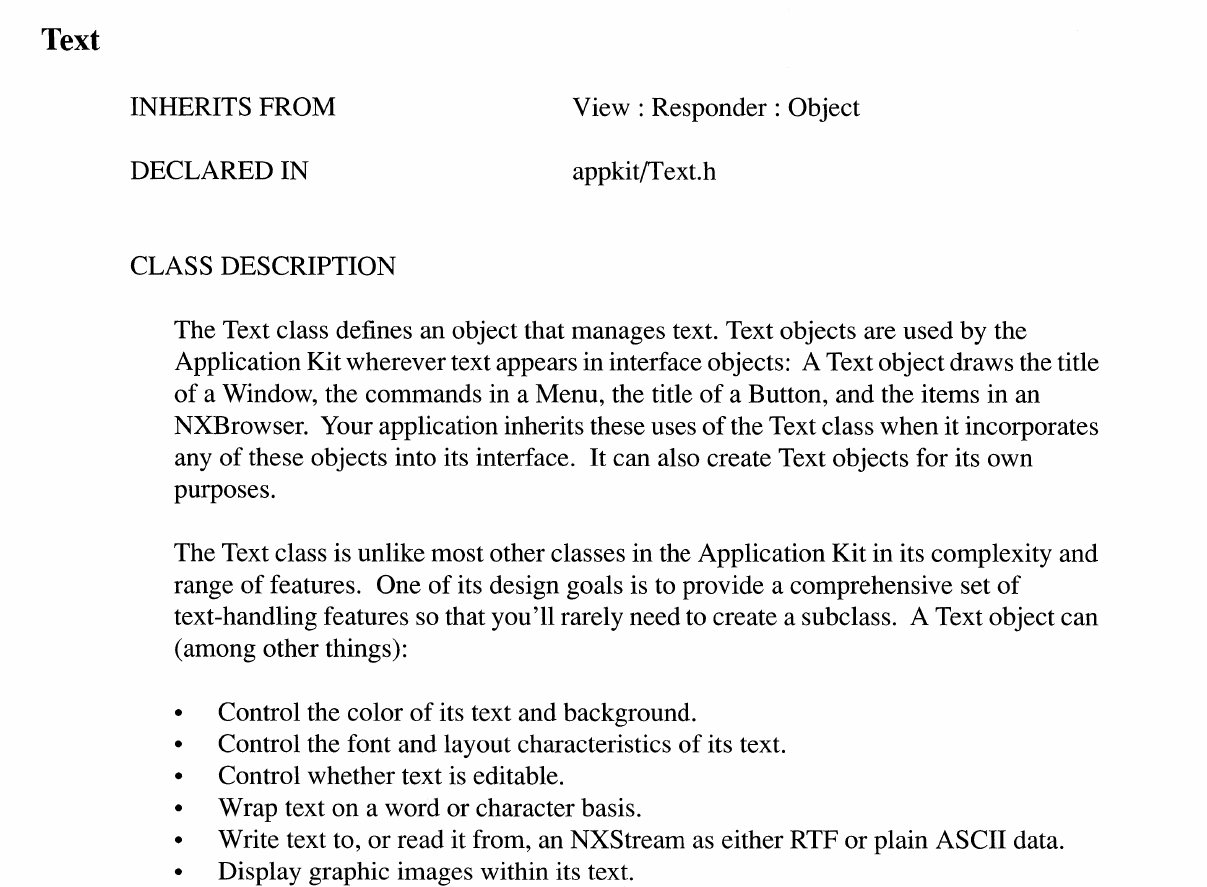
I didn't use the NeXT WorldWideWeb browser, so I don't have firsthand knowledge, but in http://web.archive.org/web/20110131164401/http://diveintomar... you can read TimBL commenting in 01993 about possible alternative ways of adding inline image support in ways that make it clear that he hadn't yet implemented any kind of inline image support. So I guess either the Wikipedia page is wrong or the page you posted is wrong about what NeXtStEp could support in 01990.
correct
but guessing the mime type is what many tools still do today
MIME types were one of the (many) emergent features added to HTTP out of necessity
like, for example, HEADERS
HTTP/0.9 had no headers, no status code it was basically nothing more than
- GET THAT
- HERE IT IS ITS RAW CONTENT
But Lee HyperMedia browser had support for different file types because he already envisioned it as a mean to browse a "web" of hosts in search of "resources of different kind"
WWW was text only the same way Excel was text only, meaning they could not show text and images side by side, not in the sense "VT100 text only"
Ask you this: was there another software that let you click on a link representing a file on another computer possibly on the other side of the planet, download it and show it to you in (almost) real time?
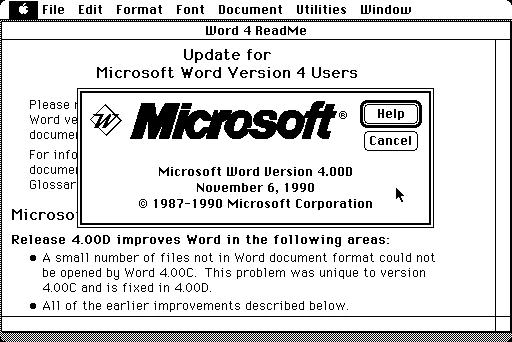
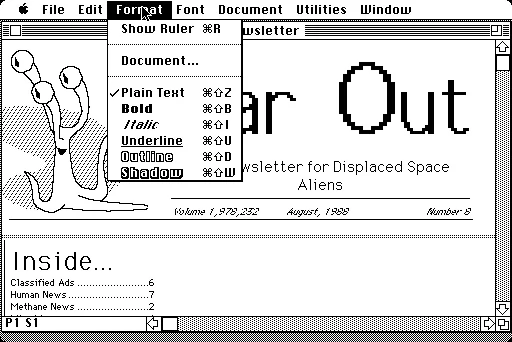
This [1][2] is the best Microsoft could do using all its resources in 1990, on a platform that was already very advanced for graphics (Word 1.1 for Windows looks like sh*t), T.B.Lee was basically himself writing the code for the server, the client on a platform that was still in its infancy while also having to learn the framework (NeXTSTEP)
[1] https://www.versionmuseum.com/images/applications/microsoft-...
[2] https://www.versionmuseum.com/images/applications/microsoft-...
> or the page you posted is wrong about what NeXtStEp could support in 01990.
you can check by yourself by buying (or downloading) a copy of the manual
https://findingaids.library.cmu.edu/repositories/2/archival_...
There was "another software that let you click on a link representing a file on another computer possibly on the other side of the planet, download it and show it to you in (almost) real time"; specifically, Gopher, which came out at the same time as WWW.
Can you elaborate on what you're saying about Word 4.0 for Macintosh?
There were contemporaneous research networks in a range of different countries, some - like the UK NPL network - which influenced ARPANET in various ways (the term "packet switching" comes from Donald Davies work on NPLs network; though Paul Baran at RAND beat Davies to inventing, Davies was not made aware of Baran's work until a year after he'd independently invented it and was told by the UK MoD), and most of them became part of the internet rather than being replaced by it.
Pouzin, designing the French CYCLADES, beat ARPANET to a layered architecture with the connection endpoints responsible for reliability in the vein of TCP. Both Davies and Pouzin provided feedback to Kahn and Cerf on TCP and are acknowledged in their papers.
The internet looks most like ARPANET looking backwards because of a combination of the military interests in the early international connections which made ARPANET the first to see significant push in international expansion before other standardisation efforts got traction, coupled with the simplicity of TCP/IP.
To the international push, Norway got the first international link to ARPANET because of NORSAR[1] - a seismic array used to monitor Soviet nuclear tests.
The NORSAR link led to work on connecting UCL in the UK, and led to work on gatewaying the UK network to ARPANET, and also led to e.g. Kirstein's [2] involvement with the spread of TCP/IP. See [3] for example. Or this article on his Marconi prize [4] which talks about how Kirstein was instrumental in helping TCP/IP win out over OSI in Europe.
Had ARPANET simply never happened, history would certainly have looked different, but we most likely would still have had an internet. Whether it'd have the characteristics we like about the current internet is an open question, but it's worth noting that people like Kirstein pushed an open interconnection model that ultimately contributed to the "win" of TCP/IP because a lot of the European networks were already getting connected by the time ARPANET opened up, and so Kirstein's work on promoting TCP/IP and interconnection to ARPANET gave TCP/IP a leg up in the race to define the internetworking protocol set.
E.g. by 1976 at least 6 European countries had national networks interconnected via EIN; by 1979 Euronet connected at least 9. Euronet was operated by private providers.
By that point a number of public and private providers in Europe were also offering packet-switched services to private companies. By 1978, X.25 was internationally available via IPSS, linking a number of different national providers.
The irony of mentioning Minitel is that if anything, Minitel was in many ways a demonstration of what the internet could have ended up as had the "everything should be a market" crowd won out - it nickel and dimed almost everything. But Minitel was not the only French network.
But "everything should be a market" in the sense implied above (the nickel and diming approach of Xanadu etc.) is entirely orthogonal to liberalism.
[1] https://en.wikipedia.org/wiki/NORSAR
[2] https://en.wikipedia.org/wiki/Peter_T._Kirstein
[3] https://ieeexplore.ieee.org/document/1455416
[4] http://www.marconisociety.org/index.php/newsroom/379-peter-k...
I don't think "everything should be a market" is orthogonal to liberalism. At a large enough social scale, liberalism always produces markets unless warfare erupts; strong restrictions on commerce are necessary to prevent markets from arising among groups much larger than Dunbar's number.
I agree with you about Minitel; in fact, monopoly for-profit providers like CompuServe and Tymnet imposed the same kinds of restrictions on innovation that prevented the WWW from arising on their networks: https://news.ycombinator.com/item?id=30916796
The "Internet" as we know it was deployed as a research network in 1987, it was already connected to Europe research centers in 1988.
That's why WWW was born at CERN that was one of the largest nodes of the times.
The "user facing" Internet was deployed years later, globally in the west.
Perhaps you meant that 01987 was the last year it was US-only? But vidarh pointed out above that the ARPANET was connected to NORSAR, a research center in Norway, in June 01973, and Norway is in Europe, so in fact our current internet has had some international connections for almost 49 years now.
ARPANET is not INTERNET
there were many network similar to ARPANET for scope (maybe not size, but Europe was politically much different back then and the wall in Berlin was still there) at the same time ARPANET was alive
Russians had their network too since the late 70s, and at one point they connected to the US directly even during the cold war years! (mid 80s).
> Perhaps you meant that 01987 was the last year it was US-only?
no, it was the year it became "a public accessible network", after NSFNET was established. The year later research centers in Europe were connected to it and were contributing to it.
ARPANET was decommissioned in 1990
No, I was arguing that there is sufficient evidence that the basic internetworking would have been independently invented even if ARPANET had never happened, and that as such, this is also not supported by history:
> What I was saying is that the US is where the internet got deployed
This is why I said it read like a "history by the victors" view.
"The internet" got only got deployed in the US if you take the view that the dozens of other contemporaneous networks at the time did not combine with ARPANET to form the internet, but that ARPANET alone became the internet and replaced the others, or in the strict technical sense that "the Internet" was first used about what sprung out of ARPANET. So, sure, "the" Internet arguably got deployed in the US.
But many internets were built in the 1970's. And while ARPANET was early in some respect (e.g. packet switching was first invented at RAND), many of the aspects were also invented or reinvented independently elsewhere, and both academic and commercial deployment of internationally internetworked networks was well developed long before ARPANET connectivity became widely available internationally.
As such, an internet would have still existed had ARPANET never happened. It'd have looked different, but not that different.
We're left with something ARPANET flavoured because TCP/IP won and existing networks were gradually switched to TCP/IP, not because there weren't alternatives, because there were multiple commercial and public alternatives by the late 70's, predating both TCP/IP and the opening up of access to ARPANET. If you wanted global networking at that time, you'd likely buy access from an X.25 provider, so had ARPANET and/or TCP/IP failed entirely, at worst we'd still have services built on an X.25 descendant (that truly is the worst timeline.... shudder). [Compuserve and Tymnet both used X.25 for at least parts of their networks]
Even by the time I started an ISP in '95, not everyone were still convinced TCP/IP was the way forward, and people were still doing things like tunnelling TCP/IP over X.25 because X.25 was still more easily available some places.
> I don't think "everything should be a market" is orthogonal to liberalism. At a large enough social scale, liberalism always produces markets unless warfare erupts; strong restrictions on commerce are necessary to prevent markets from arising among groups much larger than Dunbar's number.
The point is that the commenter above was not arguing against the existence of markets, but the kind of nickel and diming proposed by Xanadu on expectation of markets for everything. But in terms of writing and knowledge, one of the things the Xanadu people failed to grasp is that the supply far outstrips the demand. For most writing there is no commercial market. In fact, for a whole lot of writing, the commercial value of the writing as a product is negative: people want to pay to push it on others more than people want to pay to read it. Trying to build markets for ideological reasons even where a whole lot of people are desperate for distribution rather than payment is a folly.
So I agree with you that liberalism will always produce markets, but I don't think that is relevant to the point. The ideological bent to try to find ways to extract money out of everything is a particular right-libertarian/objectivist subset of liberalist ideologies that most liberalist ideologies do not share.
An interesting thing about Wikipedia is that it's not very compatible with charging for access, but not because Wikipedia editors are desperate for distribution (we do our best to discourage the ones who try to use Wikipedia to get distribution for their point of view). It's more that charging for access discourages people from contributing in a variety of interestingly different ways.
I don't know if it's true that Jimmy Wales named one of his daughters after an Ayn Rand heroine (none of them seem to be named Dominique or Dagny, but maybe I just haven't read enough Ayn Rand) but he is definitely pretty bullish on liberalism and specifically capitalism.
I think it really is plausible that transaction costs of various kinds would have confined Xanadu to a niche, which would have been particularly catastrophic for the two-sided market they were trying to build. But CompuServe and AOL seemed to do okay, and that wasn't in fact what killed Xanadu.
Yeah, it's questionable whether their business strategy could've evolved into a winning one even if they'd made it to launch.
I was just questioning the parent's perspective on "right libertarian ideology" -- my impression of Xanadu's vision was not so much "people love markets for information!" as "it's vital for the health of the info ecosystem that basic costs be paid directly", so e.g. the problem of UIs that people can rely on against scams should be faced and not avoided in favor of structurally leaning hard on advertising. (Yes, some kind of ads are inescapable.)
(It sounds like you've gotten to quiz MarkM on Xanadu directly; I'm going by largely-forgotten reading mostly in the last millennium.)
Also, pictures? What are those? Audio and video? Don't even think about it.
It's an elaborately optimized design that optimizes for the wrong thing. It belongs to the world in which Mead Data Systems and MEDLINE and NEXIS and LEXIS, all pay to search and read systems, dominated information access. If Elsevier had designed the Web, it would work like this.
I knew that crowd back when they were doing this. Great people, but too many were of the "everything should be a market" persuasion.