An interesting feature of capitalism that Marx liked to talk about a lot is that they can be unstable, like democracies: participants in a free market are free to pursue their own profits, but by far the most profitable situation for them is to become a monopoly or monopsony, which destroys the freedom of the market and ends capitalism. So we have this interesting situation where the internet, arising from government planning and with commercial use prohibited for decades, ended up being freer even for commercial use than the alternatives established by for-profit companies like CompuServe, Tymnet, and AT&T.
(In the same way, a politician in a democracy is free to pursue power by getting elected, but if they are sufficiently successful at pursuing power, they end democracy.)
actually it wasn't since the beginning
relevant quote from Wikipedia [1]
> WorldWideWeb is capable of displaying basic style sheets, downloading and opening any file type with a MIME type that is also supported by the NeXT system (PostScript, movies, and sounds), browsing newsgroups, and spellchecking. In earlier versions, images are displayed in separate windows, until NeXTSTEP's Text class gained support for Image objects. WorldWideWeb is able to use different protocols: FTP, HTTP, NNTP, and local files. Later versions are able to display inline images.
In 1990 the "Hypermedia Browser/Editor" by Sir Timothy John Berners-Lee already supported images [2]
[1] https://en.wikipedia.org/wiki/WorldWideWeb
[2] https://www.artribune.com/wp-content/uploads/2019/03/Il-Web-...
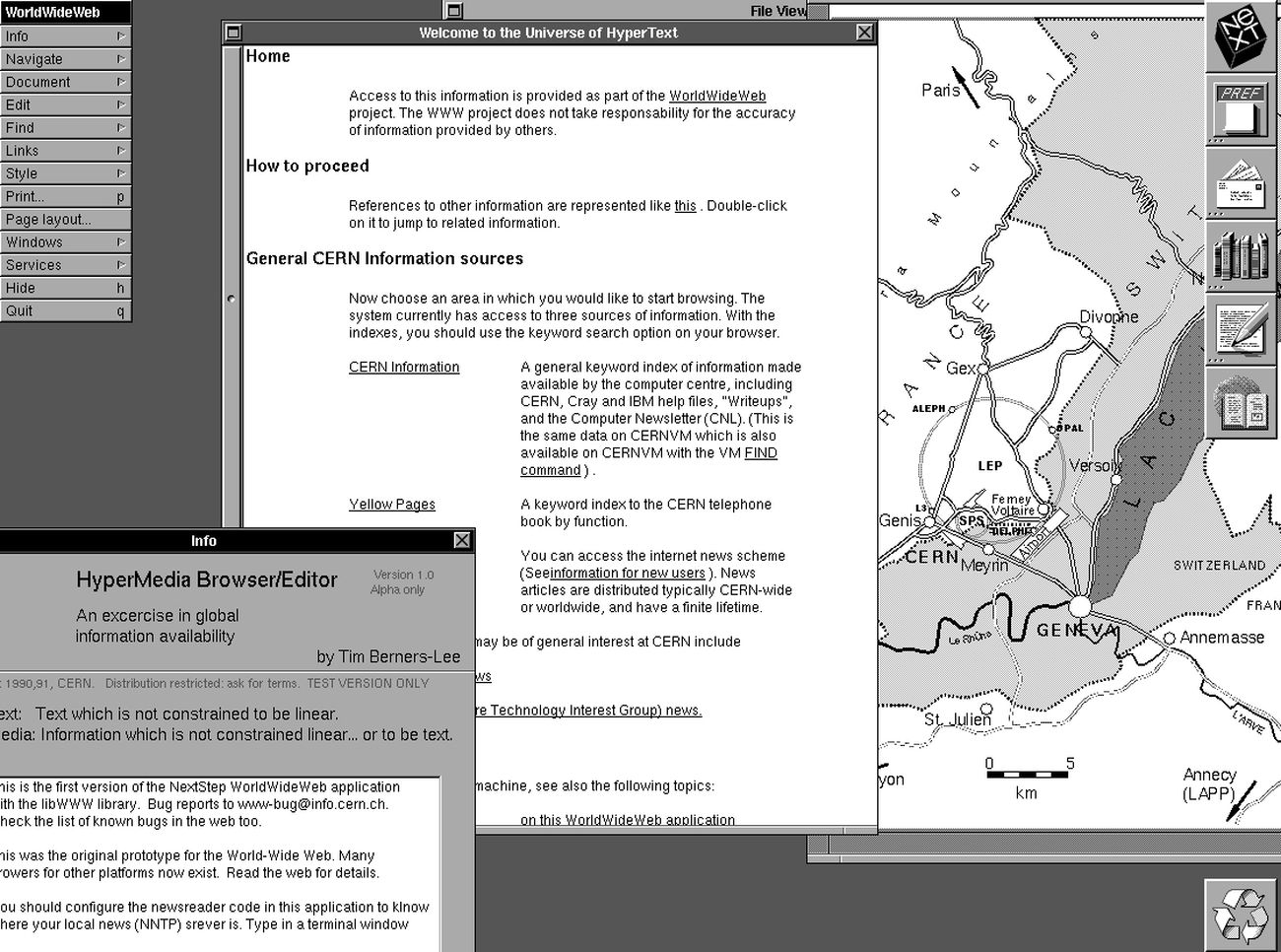
You seem to have responded that actually it wasn't because you could use it to download files of any type, including images (which you could display), and that years later it was able to display inline images (after pmarca added them to Mosaic in 01993). Well, that is true, but your implication that it contradicts what I said is false.
I'm not English native speaker, but I'm quite sure this sentence doesn't mean what you think it means.
I'll quote it again
> In earlier versions, images are displayed in separate windows, until NeXTSTEP's Text class gained support for Image objects
BTW, yes, everything you see in a browser's webview is "downloaded", even today
Inline or not, the web wasn't text only from inception (it was designed to support different media types according to the mime type mappings of the system, it's not a coincidence).
Lee called it hypermedia browser, not hypertext.
> years later it was able to display inline images
by years later I think you mean by 1990
This [1] is from the NEXTSTEP Reference Volume 2 (published in 1990)
read the last line
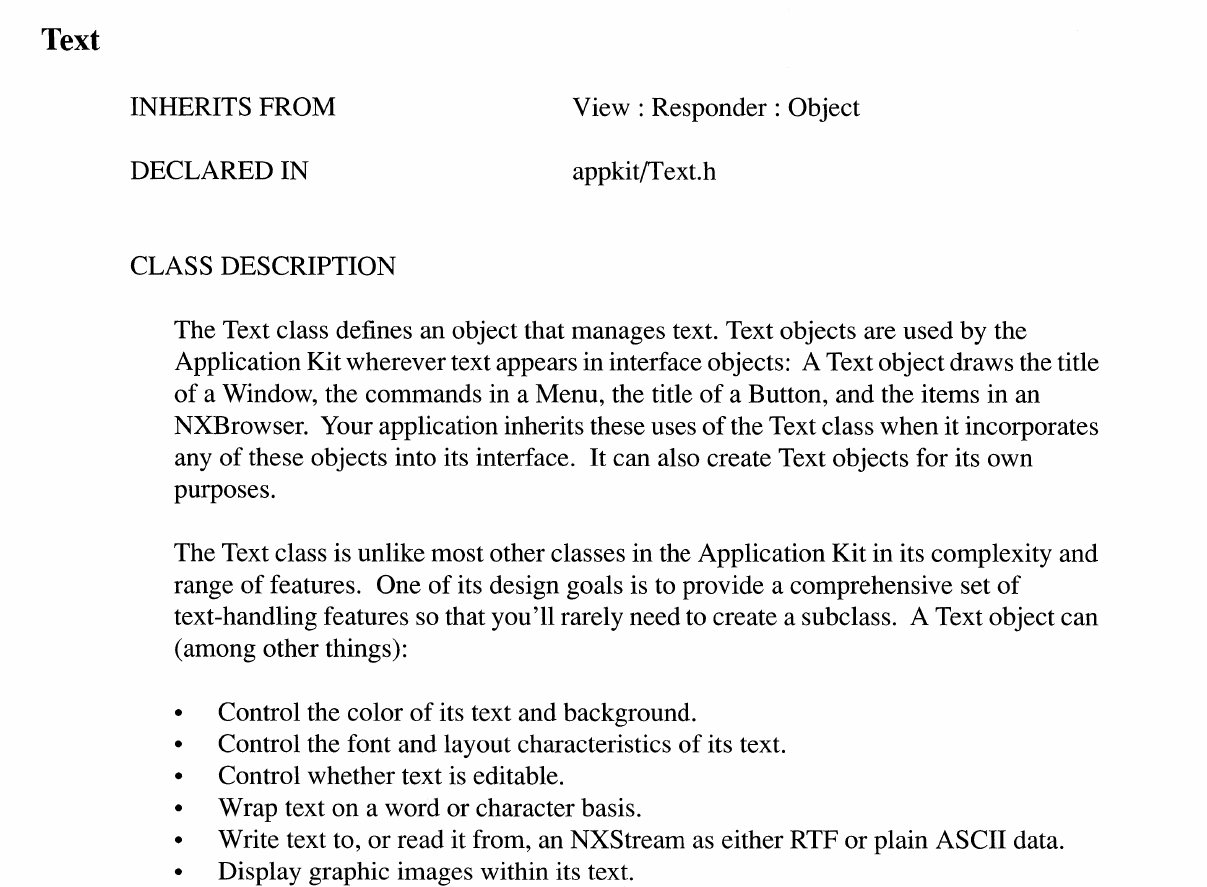
I didn't use the NeXT WorldWideWeb browser, so I don't have firsthand knowledge, but in http://web.archive.org/web/20110131164401/http://diveintomar... you can read TimBL commenting in 01993 about possible alternative ways of adding inline image support in ways that make it clear that he hadn't yet implemented any kind of inline image support. So I guess either the Wikipedia page is wrong or the page you posted is wrong about what NeXtStEp could support in 01990.
correct
but guessing the mime type is what many tools still do today
MIME types were one of the (many) emergent features added to HTTP out of necessity
like, for example, HEADERS
HTTP/0.9 had no headers, no status code it was basically nothing more than
- GET THAT
- HERE IT IS ITS RAW CONTENT
But Lee HyperMedia browser had support for different file types because he already envisioned it as a mean to browse a "web" of hosts in search of "resources of different kind"
WWW was text only the same way Excel was text only, meaning they could not show text and images side by side, not in the sense "VT100 text only"
Ask you this: was there another software that let you click on a link representing a file on another computer possibly on the other side of the planet, download it and show it to you in (almost) real time?
This [1][2] is the best Microsoft could do using all its resources in 1990, on a platform that was already very advanced for graphics (Word 1.1 for Windows looks like sh*t), T.B.Lee was basically himself writing the code for the server, the client on a platform that was still in its infancy while also having to learn the framework (NeXTSTEP)
[1] https://www.versionmuseum.com/images/applications/microsoft-...
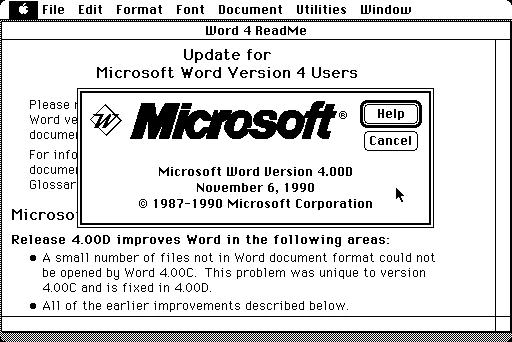
[2] https://www.versionmuseum.com/images/applications/microsoft-...
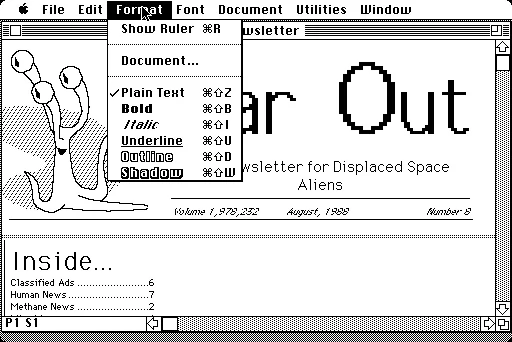
> or the page you posted is wrong about what NeXtStEp could support in 01990.
you can check by yourself by buying (or downloading) a copy of the manual
https://findingaids.library.cmu.edu/repositories/2/archival_...
There was "another software that let you click on a link representing a file on another computer possibly on the other side of the planet, download it and show it to you in (almost) real time"; specifically, Gopher, which came out at the same time as WWW.
Can you elaborate on what you're saying about Word 4.0 for Macintosh?