News for hackers. Stuff that matters.
Re:1k-cycle lithium-sulfur battery could increase electric v... by Gareth321 on Monday January 31, 2022 @08:05AM (#30147468)
It's not such a problem right now thanks to the supply chain crunch, but there are a lot of us sitting on the sidelines waiting for EVs to achieve better mileage before making the move. Our family has only one car, and it needs to be able to do not just the daily commute (for which I acknowledge at least 90% of the kilometers on this car will be used), but also the road trips. I rented a Model 3 LR to test out how realistic these trips are in Europe, driving 1,200km to Austria for a ski trip.

1. The stated range goes down the toilet at motorway speeds. Expected range plummeted from 500km to 300km. Actual range was more like 250km, probably thanks to the cold temperatures. This was a *50%* reduction.

2. We had to plan the trip carefully around chargers. There were 10 minute detours to find chargers, traffic jams at the chargers, and slow charging speeds (probably due to said cold). We tried to charge from about 10% to 80%, but this was taking more than an hour, and shifted to 10% to 60%, which was around 40 mins. Each stop averaged 1+ hour, including the detour, waiting, and charging.

3. There were no chargers at the lodge, and this meant a final charge before ascending the mounting to near 100% to ensure that despite the extreme cold we could make it all the way up and back down. We also wanted to ensure we had extra power in case we got stuck on the road and had heat. This final stop was another hour.

All up, the EV added more than *eight hours* to our round trip. Some of this time might have been spent on toilet breaks and eating anyway, but nowhere near *eight hours.* Bear in mind this was all on a near new Tesla with a near new battery and presumably the fasted possible charge rate and some of the best range available in an EV right now. This is just a huge fail for road trips, and I'm so glad I rented one to find this out before buying.

I'm hopeful battery technology like this makes it into production ASAP. There is so much R&D pouring into batteries right now.

Re:1k-cycle lithium-sulfur battery could increase electric v... by breytex on Monday January 31, 2022 @10:23AM (#30148889)
Did the exact same trip with a Model 3 2021, 1200km ski trip from Germany to Austria. Came back yesterday. I experienced it way differently.

- We were able to make 300km with 90% to 10% battery (to not hurt the battery longevity too much)

- Outside temp was -4 to +2 °C

- Inside temp set to 20°C, seat heating 2/3 for two passengers

- So a we made a charging break every 300km, so approx every 2-3 hours

- Recharging those 80% at a supercharger takes about 30-50min depending on the Supercharger-version.

- We had 0 traffic/wait times at the super chargers (we drove both directions on a sunday)

- We would do a 10-15min break anyway every 2-3 hours to grab a coffee or do magic pee, so the extension of the charging breaks over our normal breaks aren't event that long

- All superchargers had a <5min detour from the Autobahn

Overall we spent approx. 2hrs more on breaks as we would have with a conventional car. I think thats a fair trade-off for 2-3 vacation trips a year, figuring in the time saved for normal refilling stops with a non-EV cars during commutes (when you are able to charge your EV at home).

To me, the future of "driving into holiday fully electric" is already possible with a Tesla LR model. With other EVs without Supercharger-Access/smaller battery/slower charging speeds probably not so much.

You can even save more time by using tools like ABRP[0]. This even gives you better charge-planning with shorter, time-optimized stops also figuring in detour times.

[0]: https://abetterrouteplanner.com/

Re:1k-cycle lithium-sulfur battery could increase electric v... by hughrr on Monday January 31, 2022 @02:00PM (#30152497)
The thing that gets me with the success stories is the issue with risks and planning for success only.

When you’re driving in the colder parts of Europe it’s generally advisable to keep your tank at least 50% full all the time. If the shit hits the fan, like it did for me in Switzerland once, and you’re stranded for 4 hours due to a crash out of your control, your car becomes a fairly important life support system until the road is cleared. There is no recovery option when there are a few hundred cars in the same shit.

So you’re 3 miles from a supercharger with 15% battery left and your car is a frozen brick in under an hour. You can’t deliver more fuel to it and your efficient route plan is a liability and there’s a queue of bricked EVs waiting for flatbed recovery.

I’m not criticising the concept but the current execution and the perception of it.

Re:1k-cycle lithium-sulfur battery could increase electric v... by cogman10 on Monday January 31, 2022 @03:22PM (#30153710)
> So you’re 3 miles from a supercharger with 15% battery left and your car is a frozen brick in under an hour. You can’t deliver more fuel to it and your efficient route plan is a liability and there’s a queue of bricked EVs waiting for flatbed recovery.

There are a few things to consider.

First up, if you want to optimize for energy efficiency then the best option in an EV is to carry a blanket and rely on the seat heaters as much as possible.

Consider this scenario with a long range model 3. 80kwh, 15% means you have 12kWh available (Let's drop that to 8 due to cold weather). The seat heater consumes 500W at low power. That gives you 16/people hours of heat.

But let's say you just run the HVAC straight. You've still got 1 hour of heat (assuming it's using the 6kw restive heater. More if you are using the heat pump).

In any event, the approach to "I'm in an EV and stuck in traffic" is exactly the same as if you were in an ICE with low fuel. Shut things off. Wait until you are freezing, turn it on again. Ration your fuel/energy until you are unstuck.

To get to your charging destination in this scenario, you need roughly .9kwh of energy (300wh / mile, which is on the high end) or about 2% of your battery.

Re:1k-cycle lithium-sulfur battery could increase electric v... by aksss on Monday January 31, 2022 @04:11PM (#30154423)
This is good practical advice for how to maximize EV energy use in an emergency.

That said, these vehicles are clearly not made for a long haul cold weather existence. Can they be made to work for occasional use with some planning and prayer? Sure. But these stories and the counter-claims leave no doubt that people who park cars in -30F and do 300 mile one-way trips through mountain passes and deserted highways should stick to ICE vehicles. If you're doing some variant of this with regularity (say 0F and occasional 150mile trips), you should probably do the same for safety reasons, even though EV will probably be fine for all but the rarest disaster.

Regardless of ICE or EV, people doing this kind of driving are well-advised to prepare for having a non-functional vehicle. It's always best to stay with the vehicle if it's habitable and if rescue is what you can count on, but having cold-weather gear, food, shelter, means to create/use external heat sources, and ability to "hike out" are some basic rules of the cold road that even 'tourists' should abide by. If you're doing remote winter driving, basically also pack for winter backpacking. This in addition to road flares, small shovel, tow strap, etc. to support the vehicle. It's less necessary now than it was in, say, the eighties when vehicles were far less reliable, but it's still practical advice: be prepared.

Re:1k-cycle lithium-sulfur battery could increase electric v... by cogman10 on Monday January 31, 2022 @05:35PM (#30155686)
> That said, these vehicles are clearly not made for a long haul cold weather existence. Can they be made to work for occasional use with some planning and prayer? Sure. But these stories and the counter-claims leave no doubt that people who park cars in -30F and do 300 mile one-way trips through mountain passes and deserted highways should stick to ICE vehicles.

I'm guessing this is hyperbole, but really, this is a scenario that does not exist pretty much anywhere outside of Alaska and Russia. And even still, you'd probably be shocked (heh) at how many fast EV chargers present in these locations.

Every year, the situation with EV chargers has gotten better, by a lot. Consider the fact that John Day OR has a fast charger [1].

There aren't many places in the continental US more than 100 miles from a fast charger. Very little prayer is needed, though a bit of planning is nice. It's hard to find a location that you can't comfortably reach with an EV that has 300+ miles of range.

[1] https://www.plugshare.com/location/304770

Re:1k-cycle lithium-sulfur battery could increase electric v... by aksss on Monday January 31, 2022 @08:23PM (#30157433)
Canada has high latitudes as well. Only part hyperbole, which is why I make the statement that even if you're doing only 0F and 150m, the same prep is a good idea. Really any drive where, in the event of your vehicle breaking down exposure would be life threatening (Alps, Rockies, Cascades, you name it), you should prepare accordingly whether EV or ICE. Having climate control in your vehicle should not be your primary contingency in the event that forward movement ceases.

Considering EV's lose range based on temps, that charging stations are still sparse in hostile environments, that a passers-by can't siphon out fuel for you (I know an ICE can jump start a Tesla, but not sure how practical it is to charge a Tesla from an ICE), ICE engines are still a better bet if you're in such conditions.

Re:1k-cycle lithium-sulfur battery could increase electric v... by tcas on Monday January 31, 2022 @03:04PM (#30153483)
Car and Driver did a test using an older Model 3 with a resistive heater (the newer models use a much more efficient heat pump), and found that it used around 2.2% an hour to keep the cabin warm.

https://www.caranddriver.com/news/a38807463/tesla-model-3-cl...

In your example with 15% left, you'll use ~9% battery while in traffic for 4 hours keeping the heat and car on, leaving 6% to get to the next charger. At ~300wh/mile you'll arrive with ~4-5% left. There's also buffer under 0%, but it's not guaranteed.

4-5% is not a comfortable number to be at, but I think it's acceptable in a worst case scenario like this. That being said I would definitely turn down the heat, and drive slower for the next few miles (and check for alternate chargers) to minimize power usage.

Re:1k-cycle lithium-sulfur battery could increase electric v... by cogman10 on Monday January 31, 2022 @03:24PM (#30153752)
Man, the heat pump hvacs are impressive :). My 2018 model LR 3 has a resistance heater and a heat pump heater is the one thing I really wish I had.
Re:1k-cycle lithium-sulfur battery could increase electric v... by jhoechtl on Monday January 31, 2022 @04:09PM (#30154385)
I really wonder how a heat pump can achieve so much efficiency gain. Heat of electric resistance is about 99% energy efficient: almost all energy is converted into heat, nothing else.
Re:1k-cycle lithium-sulfur battery could increase electric v... by DeRock on Monday January 31, 2022 @04:40PM (#30154856)
A resistive heater directly converts electricity to heat, whereas a heat pump instead moves heat, from the outside to inside of your car. The heat your car gains is reflected by the heat the outside loses. In that way, they can be 300-400% “efficient”, because we do not care about the outside air around the car getting a little bit colder.
Re:1k-cycle lithium-sulfur battery could increase electric v... by jhoechtl on Tuesday February 01, 2022 @01:42AM (#30159354)
> whereas a heat pump instead moves heat, from the outside to inside of your car.

I completely forgot that the energy of the outside air is used, that explains it of course.

Re:1k-cycle lithium-sulfur battery could increase electric v... by withinboredom on Monday January 31, 2022 @04:20PM (#30154569)
It can be that efficient when set to some point that would cook you. For low human temperatures that we call comfortable, it is not so efficient.
Re:1k-cycle lithium-sulfur battery could increase electric v... by laurencerowe on Monday January 31, 2022 @05:54PM (#30155942)
What is the electrical energy converted into at lower temperatures if not heat?
Re:1k-cycle lithium-sulfur battery could increase electric v... by withinboredom on Tuesday February 01, 2022 @07:43AM (#30161713)
It just goes back to the battery to complete the circuit. Heat is created by resistance and if the energy going through the heater isn’t being resisted enough, there is no heat, just wasted energy. Most of these heaters regulate temperature by turning off/on/off and it’s the coming up to full resistance that is when the energy is “wasted” and doing it at human temperatures is a lot of off/on cycles. Also, it’s worth pointing out that not 100% of the energy is converted to heat, or you’d have a gigaton bomb instead of a heater.
Re:1k-cycle lithium-sulfur battery could increase electric v... by Yaggo on Monday January 31, 2022 @01:42PM (#30152177)
I do ~900 km trips with 2019 Model 3 SR+ multiple times per year in Scandinavia. -20°C winter temperatures are not unusual. Travelling with my family, including young kids. No problems. 2-3 hours driving, then 30-50 min charging. I actually like how EV forces you to have more breaks.
Re:1k-cycle lithium-sulfur battery could increase electric v... by kraftman on Monday January 31, 2022 @12:41PM (#30151060)
What's a magic pee?
Re:1k-cycle lithium-sulfur battery could increase electric v... by breytex on Tuesday February 01, 2022 @02:58AM (#30159771)
Go to pee even if you don't feel the urge to not feel it 20 min later when you are back in the road.

Heard it the first time when an American from California said it to their kids

Re:1k-cycle lithium-sulfur battery could increase electric v... by maxwell86 on Tuesday February 01, 2022 @02:21AM (#30159551)
A 50 minute per session.
Re:1k-cycle lithium-sulfur battery could increase electric v... by Gareth321 on Monday January 31, 2022 @10:42AM (#30149191)
Thanks for sharing your experience. If I may ask, how long was each leg of the trip in total?
Re:1k-cycle lithium-sulfur battery could increase electric v... by pulse7 on Monday January 31, 2022 @12:38PM (#30150981)
Not parent, but calculation from given data: 1200km, charging every 300km for about 30-50min -> 4x 30-50min -> 120-200min -> 2h-3.3h in one direction -> 4h-6.6h in both directions
Re:1k-cycle lithium-sulfur battery could increase electric v... by maxwell86 on Tuesday February 01, 2022 @02:20AM (#30159547)
I did a similar trip earlier in January. 1100 km from Germany to the alps (550km per way).

I had to stop once for the full 1100km trip to refuel (before leaving Austria on the way back cause it’s cheap to tank there, not because we actually needed to refuel).

It was ~4:30 per way. Nobody in the car had to pee, etc.

I think doing 15 min break per way would have been ok. But doing 1h per way or more if breaks is really not great. Particularly with kids in the car (we leave really early put them as sleep, they woke up for the last 2:30 h or so and that was borderline).

Re:1k-cycle lithium-sulfur battery could increase electric v... by jhoechtl on Monday January 31, 2022 @04:06PM (#30154350)
> - So a we made a charging break every 300km, so approx every 2-3 hours

> - Recharging those 80% at a supercharger takes about 30-50min depending on the Supercharger-version.

How is this so totally different to the above commenter? I also need brakes during my rides and after a three hour ride a break sounds totally reasonable. But nowhere between 30 to 50 minutes?

Re:1k-cycle lithium-sulfur battery could increase electric v... by evandijk70 on Monday January 31, 2022 @08:12AM (#30147519)
My brother and I made a very similar road trip (Skiing holiday to Austria ~ 1000 km.)

I drove a 'normal' car and he drove a tesla Model 3. He left an hour earlier and arrived 30 minutes after me (with a relatively full battery to avoid the need of destination charging). He has the car for a little over a year so he probably optimized the charging schedule a bit better, but I still wonder why there was such a big difference between his and your experience (1.5 extra hours vs 4 extra hours for a single trip). He did not have to wait at the chargers, so that could account for some of it..

We only stopped for gas, toilet breaks, and took a 15 minute break for coffee and lunch.

Re:1k-cycle lithium-sulfur battery could increase electric v... by Gareth321 on Monday January 31, 2022 @10:12AM (#30148729)
I'm not sure but to speculate:

1. I drove fast on the Autobahn. I'm usually cruising at 160kph+, and did the same with the Tesla. Doing some homework, this kills efficiency fast. I imagine your brother was driving slower. Probably more within the high efficiency band.

2. Temperature delta. It was -5C + wind chill for most of our trip, and much colder up the mountain.

3. I kept a healthy battery reserve when seeking chargers (10%+) Tesla owners seem to encourage letting the battery drop below even 5% as this means an even faster charge to 60%. I am told there is an optimal cadence to charging which I suppose one perfects over time.

4. I did not conserve heating, as I'm told many EV owners do on longer trips. My wife likes our car to be subtropical.

5. Our Tesla might have been abused, though I recall it having <20,000km.

6. 1,000km is 17% shorter than my trip, further compounding (reducing) these differences.

7. Maybe my regenerative braking was set to low. I didn't think or know to check.

8. My route took me to at least a few regular chargers instead of superchargers. Maybe if I had been smarter and spent more time planning I could have used only super chargers.

9. Perhaps you stopped for a lot of breaks, reducing the relative advantage you might have had in your car.

10. Perhaps he left more than an hour earlier than you.

11. Perhaps my charging lines were longer than his.

I'm sure there are many other factors I'm not considering.

Re:1k-cycle lithium-sulfur battery could increase electric v... by r00fus on Monday January 31, 2022 @12:57PM (#30151388)
You said motorway speeds, but then state you were on the Autobahn doing 100mph+. Most other jurisdictions/autoways this speed is illegal. I definitely see my battery going down massively at 80mph/130kph speeds+ on my non-Tesla EV.

In fact, going such speeds is probably massively inefficient for ICE cars as well, just that they're already incredibly inefficient already that you don't see much of a loss.

Re:1k-cycle lithium-sulfur battery could increase electric v... by jhoechtl on Monday January 31, 2022 @04:13PM (#30154446)
You are aware that on the German Autobahn, outside designated speed limits, there is no speed limit? Believe it or not ...

On Austrian highways its nominally 130km.

Re:1k-cycle lithium-sulfur battery could increase electric v... by withinboredom on Monday January 31, 2022 @04:25PM (#30154646)
I dated an vehicle design engineer once. She told me that cars create drag at a logarithmic rate at basically for every mph over 80, most people design them to use nearly double the fuel consumption to maintain. You can get some aerodynamic cars that are designed for 90mph, but it’s pretty rare in the consumer space. This was also nearly 10 years ago and I could be remembering it wrong.
Re:1k-cycle lithium-sulfur battery could increase electric v... by r00fus on Monday January 31, 2022 @05:09PM (#30155301)
Drag is the square of velocity, so not sure how your former date got logarithmic for that, sounds quadratic.

Equation [1]: F(d) = 1/2v^2CdA

Lowering the Cd (drag coefficient) and area can significantly reduce your drag.

[1] https://en.wikipedia.org/wiki/Drag_(physics)

Re:1k-cycle lithium-sulfur battery could increase electric v... by withinboredom on Monday January 31, 2022 @05:14PM (#30155402)
I think she was talking about fuel consumption and drag, not just drag. But like I said, it was a really long time ago.
Re:1k-cycle lithium-sulfur battery could increase electric v... by maxwell86 on Tuesday February 01, 2022 @02:25AM (#30159570)
In Germany, the autobahn is the motorway.

I typically drive at 180-190kph, that’s my “relaxed driving” speed. 160kph is “falling asleep” kind of speed unless you have a super loud car.

Re:1k-cycle lithium-sulfur battery could increase electric v... by Teknoman117 on Monday January 31, 2022 @12:58PM (#30151397)
The US interstate speed limits are at most 120 kph (75 mph) and are 105 kph on average (65 mph), and can be as low as 90 kph (55 mph), so that's almost certainly what Tesla bases their "highway" estimates off of.

160 kph+ (100 mph+) is way past the efficiency sweet spot :)

US interstate speed limits have their roots in fuel conservation for WW2 (or noise control in wealthier spots), safety was just a side effect at least at first.

Re:1k-cycle lithium-sulfur battery could increase electric v... by SECProto on Monday January 31, 2022 @01:11PM (#30151625)
> The US interstate speed limits are at most 120 kph (75 mph)

Minor nitpick: there are 80 and 85mph interstates/sections.

Re:1k-cycle lithium-sulfur battery could increase electric v... by Teknoman117 on Monday January 31, 2022 @06:36PM (#30156431)
Really?? Where?

I've lived in a few different states across the US and I've yet to happen across one. (I am an American, yes we all learn metric in school, you can blame Reagan canning the attempt to switch in the 80s)

Edit: https://upload.wikimedia.org/wikipedia/commons/thumb/c/c3/US...
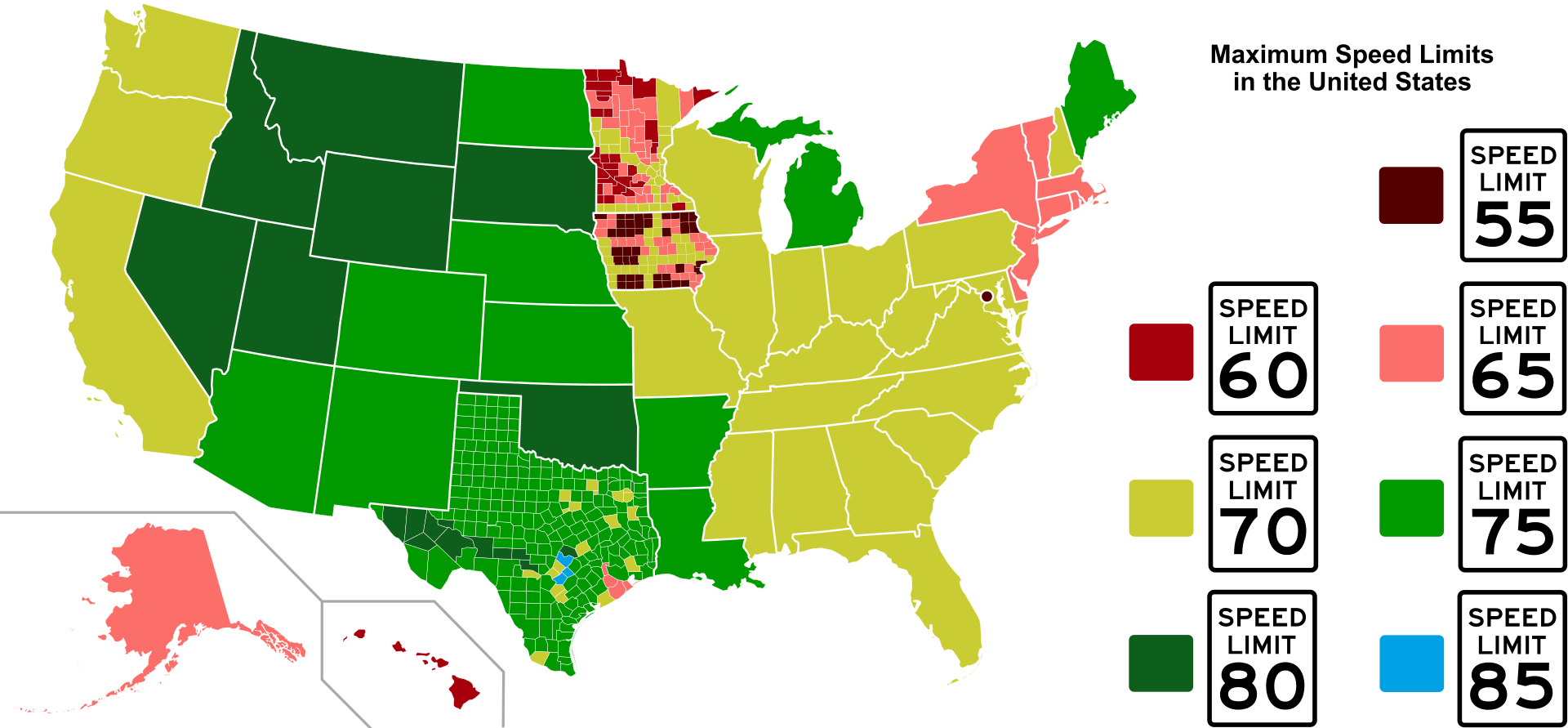
I've not spent much time in any of the dark-green ones (or the blue bit), so that's why.

Re:1k-cycle lithium-sulfur battery could increase electric v... by vondur on Monday January 31, 2022 @07:46PM (#30157100)
I've seen them in Utah in more rural sections of I-15.
Re:1k-cycle lithium-sulfur battery could increase electric v... by jliptzin on Monday January 31, 2022 @12:58PM (#30151411)
Wow, 160 kph! That's why. That extra drag really kills the battery. In the US I have never driven above about 130kph, anything higher is pretty much illegal everywhere.
Re:1k-cycle lithium-sulfur battery could increase electric v... by TremendousJudge on Monday January 31, 2022 @01:17PM (#30151750)
It's a normal speed in Germany. And yes, driving that fast also drains a gas tank very quickly. Not sure why GP is surprised -- an ICE car will also perform much worse than advertised at those speeds.
Re:1k-cycle lithium-sulfur battery could increase electric v... by Sharlin on Monday January 31, 2022 @01:28PM (#30151918)
But it's also pretty much only normal in Germany, and only on Autobahns. Almost everywhere in Europe the highway speed limit is 110 to 130 km/h, similar to the US.
Re:1k-cycle lithium-sulfur battery could increase electric v... by seer on Tuesday February 01, 2022 @02:55AM (#30159750)
Eastern Europe limit is usually about 140kph, and everybody frequently speeds a bit. With a waze app to check for cameras/policemen you can easily do 160kph in a dingy corolla.

People with expensive german cars usually go 220kph up to 280kph if they are pushing it. Doing 300kph on safe straight sections is not unheard of, but hard to pull off due to traffic.

Re:1k-cycle lithium-sulfur battery could increase electric v... by rad_gruchalski on Monday January 31, 2022 @05:48PM (#30155851)
140kph in Poland.
Re:1k-cycle lithium-sulfur battery could increase electric v... by maxwell86 on Tuesday February 01, 2022 @02:29AM (#30159589)
I drove a similar route as the GP, 1100km round trip for a ski trip to Austria, aiming at 190kph.

I didn’t have to tank for the round trip, but I decided to tank on the way back cause in Austria tanking is much cheaper.

My car isn’t particularly new, but the lowest I’ve seen it use is 4.5l/100km and at 180-190 it uses 6.5l/100km.

In Germany most people don’t drive huge SUVs. Mine is a relatively sleek station wagon.

Reducing the aerodynamic surface of cars significantly improved fuel economy.

Re:1k-cycle lithium-sulfur battery could increase electric v... by TremendousJudge on Tuesday February 01, 2022 @09:27AM (#30162825)
So consumption increases about x1.5 from the "best case" to "autobahn speeds"? Sounds about right -- a 500km range would get reduced to ~340km. It's better than the 500km -> 300~250km claimed by GP, but it's still a big reduction in range.
Re:1k-cycle lithium-sulfur battery could increase electric v... by maxwell86 on Wednesday February 02, 2022 @07:34AM (#30176650)
> So consumption increases about x1.5 from the "best case" to "autobahn speeds"?

Yes, pretty much. I wouldn't say 1.5x is a constant factor.

If I drive at 200+kph (e.g. 240kph) then consumption explodes.

This stuff must be online somewhere, but for me at least it seems that consumption increases exponentially (e.g. x^2), which makes sense since air resistance increases with v^2.

Re:1k-cycle lithium-sulfur battery could increase electric v... by breytex on Monday January 31, 2022 @10:28AM (#30148985)
You should checkout https://abetterrouteplanner.com/ for your next trip :)
Re:1k-cycle lithium-sulfur battery could increase electric v... by Gareth321 on Monday January 31, 2022 @10:36AM (#30149097)
Thanks, that's a cool site.
Re:1k-cycle lithium-sulfur battery could increase electric v... by marcosdumay on Monday January 31, 2022 @03:34PM (#30153890)
Oh, internal combustion vehicles also get their mileage very reduced at 160km/h. A 50% drop is completely normal. It's even on the small side.
Re:1k-cycle lithium-sulfur battery could increase electric v... by IgorPartola on Monday January 31, 2022 @08:37AM (#30147695)
The person you are replying to says they rented the Tesla and your brother owns one. I wonder if the rented vehicle was somehow abused or poorly maintained.
Re:1k-cycle lithium-sulfur battery could increase electric v... by izacus on Monday January 31, 2022 @10:12AM (#30148728)
Or there were longer lines at the chargers. Or they chose different chargers. Or the chargers were broken/slow (common occurence). Or the car burned more power due to lower temperatures.

There's a lot of variance that comes into driving an EV on a longer trip.

Re:1k-cycle lithium-sulfur battery could increase electric v... by situationista on Monday January 31, 2022 @12:29PM (#30150802)
I own a Tesla and regularly make very long trips. Travel in an EV requires a completely different mindset from ICE and takes a little getting used to. I'm not surprised that a one-off road trip experience was less than smooth, but once you get into the habits of EV travel it's already a perfectly satisfactory experience.
Re:1k-cycle lithium-sulfur battery could increase electric v... by MisterTea on Monday January 31, 2022 @08:58AM (#30147898)
> I wonder if the rented vehicle was somehow abused or poorly maintained.

Very likely. Though more likely is the owner of a Tesla is more apt to the nuances of charging and planning ahead.

Re:1k-cycle lithium-sulfur battery could increase electric v... by easton on Monday January 31, 2022 @08:49AM (#30147803)
Maybe the temperatures on the drive were higher in your case? That seems to be a downside of EVs at the moment, low temperature means bad range.
Re:1k-cycle lithium-sulfur battery could increase electric v... by breytex on Monday January 31, 2022 @10:31AM (#30149031)
1.5 extra hours would be my expectation as well. If we consider a long trip for vacation 3 times a year, the 4.5hrs invested into charging is offset by less day-to-day charging stops with an EV (if you can charge at home), the reduced costs of electricity vs gas and the reduced costs of maintenance.

I would optimize the car choice for the 90% use of daily commute instead of optimizing for the 3-times-a-year vacation trips.

Re:1k-cycle lithium-sulfur battery could increase electric v... by izacus on Monday January 31, 2022 @08:13AM (#30147527)
> 1. The stated range goes down the toilet at motorway speeds. Expected range plummeted from 500km to 300km. Actual range was more like 250km, probably thanks to the cold temperatures. This was a 50% reduction.

This, to me, is the worst part of buying an EV right now - the marketing does the Apple "30 hours of battery***" lie and it varies so horribly that it's hard to trust anything about it.

I guess it would be easy if you're just a daily commuter, but I regularly do 800km trips and all projections show that it'll prolong an already long trip for hours.

Re:1k-cycle lithium-sulfur battery could increase electric v... by anovikov on Monday January 31, 2022 @08:27AM (#30147636)
Absolutely so does the gas mileage of normal cars. Whatever number you see on the sticker (in Europe) is a laughable lie, real life mileage is about 1.5x worse, and no one makes a fuss about it - it's just one of life's lies everyone adapted to ignore.
Re:1k-cycle lithium-sulfur battery could increase electric v... by izacus on Monday January 31, 2022 @10:11AM (#30148716)
The difference between the number stated for my ICE car and the number actually achieved is a drop from about 750 to 650km at worst. It doesn't suddenly run out of gas when it's cold outside halfway through Germany.
Re:1k-cycle lithium-sulfur battery could increase electric v... by jaclaz on Monday January 31, 2022 @08:22AM (#30147602)
The 30 hours of battery life lie can be worked around with a (common enough nowadays) external battery pack/power bank, it's a lot of time I wonder how there isn't a market for "power bank trailers" for EV's, something that you can rent for the times you need the extra range (or actually buy if you need it often).

Driving a car with a (low, not prone to lateral wind effects) trailer is inconvenient but doable when needed.

Re:1k-cycle lithium-sulfur battery could increase electric v... by izacus on Monday January 31, 2022 @08:26AM (#30147622)
BMW gave out an ICE "range extender" for their i3s - so I guess that's the "power bank" approach to these.
Re:1k-cycle lithium-sulfur battery could increase electric v... by Teknoman117 on Monday January 31, 2022 @06:53PM (#30156611)
The commenter mentioned they were on the Autobahn at 160 kph/100 mph. The aerodynamic drag on your vehicle is 3 times higher going from 110 kph/70 mph to 160 kph/100 mph. No wonder the range went off the cliff.
Re:1k-cycle lithium-sulfur battery could increase electric v... by vlangber on Monday January 31, 2022 @09:02AM (#30147942)
Very strange. The Norwegian version of AAA just tested lots of different EVs in winter conditions. Most cars lost 10-25%.The link below is in Norwegian, but the results table should be easy to understand:

https://www.motor.no/aktuelt/motors-store-vintertest-av-rekk...

Re:1k-cycle lithium-sulfur battery could increase electric v... by Gareth321 on Monday January 31, 2022 @10:29AM (#30148992)
There is a lot of potential variation between their tests and my use.

* Norway doesn't have speed limits which go anywhere near 160kph. I was on the Autobahn for most of my trip. How fast were they driving? 50-80kph appears to be a lot more efficient than 160kph.

* Did they drive to maximise efficiency of power or time? I have a heavy foot accelerating.

* Were they using the heater liberally? We were. I'm told this uses a lot of power, especially on models which don't have a heat pump.

* Was brake regen high or low?

For the record, I'm not arguing that the Model 3 can achieve better efficiency than I achieved. I was simply explaining that in my case, it was poor.

Re:1k-cycle lithium-sulfur battery could increase electric v... by Teknoman117 on Monday January 31, 2022 @06:58PM (#30156659)
Regarding efficiency, for your "average car", driving at 160 kph requires 3x the energy as 110 kph (aerodynamic drag mostly), while only increasing velocity by 1.45x. Simply put, you're requiring 2x the energy per kilometer, which pretty neatly lines up with losing half the manufacturer rated range.
Re:1k-cycle lithium-sulfur battery could increase electric v... by isoprophlex on Monday January 31, 2022 @03:00PM (#30153423)
Isn't it true that in most of Norway you'd be hard pressed to find places where you can drive faster than 80-90 km/h?

Meanwhile, in germany, you have the autobahn...

Re:1k-cycle lithium-sulfur battery could increase electric v... by merb on Monday January 31, 2022 @05:02PM (#30155209)
in a few years the autobahn will be limited to 130 km/h aswell I guess.
Re:1k-cycle lithium-sulfur battery could increase electric v... by rad_gruchalski on Monday January 31, 2022 @05:50PM (#30155877)
Yup. So the ev owners can feel better about their choice.
Re:1k-cycle lithium-sulfur battery could increase electric v... by sandworm101 on Monday January 31, 2022 @01:44PM (#30152204)
>> Expected range plummeted from 500km to 300km. Actual range was more like 250km, probably thanks to the cold temperatures.

It is currently -17c where I am. Expected to go down to -28c in the next couple days. A 250km range in winter is simply unacceptable in my area (northernish canada). That is only a couple hours at highway speeds. But the real killer remains the absolute temperature limits on the batteries. If it cannot handle -45c without invalidating some warranty, then it just isn't useable. I cannot afford to spend that sort of money on something that I cannot park outside.

Re:1k-cycle lithium-sulfur battery could increase electric v... by xxpor on Monday January 31, 2022 @02:01PM (#30152519)
Where it can get that cold, are outlets near parking spots common for block heaters?
Re:1k-cycle lithium-sulfur battery could increase electric v... by sandworm101 on Monday January 31, 2022 @02:48PM (#30153257)
Common? They are ubiquitous. You won't see them at the mall, but every job location has them. At my work there are 4-foot poles at the end of every parking stall (1-pole for 4 spots) with outlets for everyone. The reality is that most cars start easily down to about -20 without external heat.

But those outlets mean nothing in term of whether I can buy an EV. If the power goes out then we loose those outlets. Or what if I need to park somewhere without outlets such as at the airport? It is one thing for a car to not start. You can always tow it and warm it up somewhere else. But a car that will take damage if it gets cold is totally unacceptable.

Re:1k-cycle lithium-sulfur battery could increase electric v... by xxpor on Tuesday February 01, 2022 @01:08PM (#30166576)
I agree with you, which makes me think that there's a misconception here. That seems completely insane, you can't predict the weather, especially say if you've parked at the airport for 2 weeks.

Looking at the current Tesla warrenty: https://www.tesla.com/sites/default/files/downloads/tesla-ne...

I think your info might be just out of date. I don't see any references to specific temps, just normal don't be dumb stuff (like exposing the battery to a fire)

I did find this from 2014 though: https://teslamotorsclub.com/tmc/threads/battery-warranty-and...

This says the warranty at the time said:

• Exposing the vehicle to ambient temperatures above 140°F (60°C) or below -22°F (-30°C) for more than 24 hours at a time”

So it sounds like they took it out eventually?

Re:1k-cycle lithium-sulfur battery could increase electric v... by smarx007 on Monday January 31, 2022 @08:16AM (#30147550)
> motorway speeds

Do you mean 110..130 km/h EU speeds or 150+ km/h Autobahn speeds?

Re:1k-cycle lithium-sulfur battery could increase electric v... by dagw on Monday January 31, 2022 @08:30AM (#30147646)
Driving 130 km/h can knock ~30% off your range compared to driving 90 km/h according to various sources[1]. Add cold on top of that and losing 50% over advertised range seems reasonable.

If you want to optimize for range you should apparently aim for holding a constant 50-55 km/h.

[1] https://teslike.com/

https://cleantechnica.com/2018/07/15/tesla-range-plotted-rel...

Re:1k-cycle lithium-sulfur battery could increase electric v... by bryanlarsen on Monday January 31, 2022 @08:37AM (#30147704)
50% loss in the cold is pretty darn high. You can mostly eliminate the cold range loss by:

- preconditioning the battery & cabin while the car is parked and plugged in

- using one of the newer models with a heat pump

- turn the cabin heat down and the seat heating up

The first point is the most important. We often have little range loss on our way to the destination but significant on the trip home because we couldn't plug in at our destination and the car got cold.

Re:1k-cycle lithium-sulfur battery could increase electric v... by cmrdporcupine on Monday January 31, 2022 @08:57AM (#30147891)
It is indeed unrealistically high, and I say this as a Canadian driving my Volt in a Canadian winter. I only see about 30% reduction even in -20C.

That said, the Volt will warm the system with the ICE if it gets below -10C. But I've heard similar numbers from pure-BEV owners.

Re:1k-cycle lithium-sulfur battery could increase electric v... by smarx007 on Monday January 31, 2022 @08:36AM (#30147686)
> If you want to optimize for range you should apparently aim for holding a constant 50-55 km/h.

I think rather 80-90 km/h, at least for Nissan Leaf, as well as from the table you linked (55 mph ~~ 89 km/h)

Re:1k-cycle lithium-sulfur battery could increase electric v... by gehen88 on Monday January 31, 2022 @09:08AM (#30148003)
I own a Nissan Leaf and can confirm 90km/h is about the sweet spot for trip duration. Above it, you're draining battery faster than you can recharge it. Below it is unsafe on motorways. I usually set it at 104km/h, which makes the estimated range pretty much exactly match reality.

However, for newer EVs the sweet spot will be at higher speeds, because those cars are able to recharge at much higher speed (at least 2 times faster).

Re:1k-cycle lithium-sulfur battery could increase electric v... by dagw on Monday January 31, 2022 @08:41AM (#30147742)
from the table you linked (55 mph ~~ 89 km/h)

The table doesn't show any data below 55 mph. This site: https://cleantechnica.com/2018/07/15/tesla-range-plotted-rel... has a graph that plots range vs speed all the way to 0 (for the Model S) and it shows the 'optimal' speed to be around 35 mph.

Re:1k-cycle lithium-sulfur battery could increase electric v... by smarx007 on Monday January 31, 2022 @08:45AM (#30147764)
My bad, didn't check the second link, thank you. The data looks too smooth. Is there raw data somewhere? Or analysis without too much regression applied?
Re:1k-cycle lithium-sulfur battery could increase electric v... by rad_gruchalski on Monday January 31, 2022 @05:53PM (#30155915)
And draft behind a truck! I know a guy who’s skoda has something silly like 3.6l average consumption over 250km.
Re:1k-cycle lithium-sulfur battery could increase electric v... by Teknoman117 on Monday January 31, 2022 @07:01PM (#30156693)
For your "average car", driving at 160 kph/100 mph requires 3x the energy as 110 kph/70 mph (due to aerodynamic drag), while only increasing velocity by 1.45x. Simply put, you're requiring 2x the energy per unit distance, which pretty neatly lines up with losing half the manufacturer rated range.
Re:1k-cycle lithium-sulfur battery could increase electric v... by maxwell86 on Tuesday February 01, 2022 @02:31AM (#30159606)
You can’t drive in a German motorway at 110kph. You’d be in the truck lane at 80kph for your whole trip, having to over take every single truck, of which there are many. So 130kph+ is the minimum unless you are towing.
Re:1k-cycle lithium-sulfur battery could increase electric v... by Gareth321 on Monday January 31, 2022 @10:18AM (#30148795)
I was doing 160km on (most of) the Autobahn from basically the top of Germany to the bottom.
Re:1k-cycle lithium-sulfur battery could increase electric v... by belter on Monday January 31, 2022 @12:38PM (#30150976)
Sounds incredibly dangerous. You mentioned you had most of the voyage at -5C. Were you worried about road ice?

Lived in Germany several years and it was not unusual to get wild game cross the street at the worst times. Most Authobahn have protections against, but some parts are badly maintained and I have seen some crossings...

"Wild Boar Crash Test Highlights Growing Accident Risk" https://www.spiegel.de/international/zeitgeist/road-carnage-...

In 2010 for example... "...A total of 27 people died and 3,000 were injured in a quarter of a million collisions with wild animals on German roads in 2009, not to mention the hundreds of thousands of animals that perished in the process..."

Re:1k-cycle lithium-sulfur battery could increase electric v... by Gareth321 on Tuesday February 01, 2022 @02:29AM (#30159591)
I was not worried. The Autobahn is one of the safest road networks in the world because of how well it's maintained and how well drivers follow the rules. Of course one should always stay vigilant. I've done the trip many times before and know the potential hazard zones. Wild animals jumping out at high speed is a risk almost anywhere in the world. According to your stats, that risk is exceedingly low compared with the actual miles driven each year.
Re:1k-cycle lithium-sulfur battery could increase electric v... by nicoburns on Monday January 31, 2022 @08:10AM (#30147510)
My understanding is that solid-state lithium ion batteries (which should roughly double capacity while also being much less fire prone) are likely to be the next big thing with pretty much all major car manufacturers working on bringing them to market and the estimated timeframe being 2025-2030.
Re:1k-cycle lithium-sulfur battery could increase electric v... by jabl on Monday January 31, 2022 @08:32AM (#30147663)
From what I've understood LFP (also much less fire prone) is poised to be the next big thing. But maybe that's more in the short term and for "budget" models.
Re:1k-cycle lithium-sulfur battery could increase electric v... by nicoburns on Monday January 31, 2022 @11:17AM (#30149654)
LFP is pretty much already here. It's mainstream enough that's it's shipping in Teslas. The catch is that while LFP is cheaper and less fire-prone than more traditional lithium ion batteries, it's less energy dense. So it's unlikely to be solving range issues any time soon.
Re:1k-cycle lithium-sulfur battery could increase electric v... by hvidgaard on Monday January 31, 2022 @09:19AM (#30148113)
It's cheaper but with less capacity, so I guess it's alright for the second car that is strictly used for commuting.
Re:1k-cycle lithium-sulfur battery could increase electric v... by wbsss4412 on Monday January 31, 2022 @05:52PM (#30155906)
Less energy density. Capacity is dependent on size of the pack.

Notably it’s lower energy density by weight, but not substantially by volume.

Re:1k-cycle lithium-sulfur battery could increase electric v... by hvidgaard on Wednesday February 02, 2022 @02:26AM (#30174774)
True, I was thinking about density. Unfortunately weight to size for an EV is complicated and more weight is not good.
Re:1k-cycle lithium-sulfur battery could increase electric v... by axiosgunnar on Monday January 31, 2022 @08:50AM (#30147816)
does LFP stand for less fire prone?
Re:1k-cycle lithium-sulfur battery could increase electric v... by jabl on Monday January 31, 2022 @09:00AM (#30147921)
LFP stands for LiFePO4, or lithium iron phosphate, a sort of battery chemistry. See https://en.wikipedia.org/wiki/Lithium_iron_phosphate_battery
Re:1k-cycle lithium-sulfur battery could increase electric v... by bryanlarsen on Monday January 31, 2022 @08:33AM (#30147674)
As a counter-anecdote, we did a 3000km one-way trip this summer in a Tesla. We spend a grand total of 15 minutes waiting for a charger. In other words, significantly less than we would have waited for gas pumps.

YMMV, but what enabled this:

- it takes a bunch of time to shuffle kids through bathrooms

- overnight hotel charging

- we didn't eat in the car

With a gas pump, you need to stay with the car while it's filling. With an electric, you can eat/bathroom/sleep. If you're doing a long trip with a family and want to stay sane, you need to budget time for that stuff anyways.

Re:1k-cycle lithium-sulfur battery could increase electric v... by buran77 on Monday January 31, 2022 @08:51AM (#30147834)
> With a gas pump, you need to stay with the car while it's charging.

Is that a realistic concern for anyone? The "charging" process at a gas pump takes around 1 minute (in Europe gas pumps have ~50 l/min flow rate, in the US it's 10 gal/min). At best you can get a battery recharge in 20min but more realistically today over 30min for 80% charge if the charging station hasn't reached peak charging capacity and starts lowering charging speeds for everyone.

Usually the longest wait is during holiday season where at the middle of the highway everyone needs to fill up around the same time/place and queues form. This is not something EV tech can help with intrinsically, if you don't wait today it's because there aren't enough EVs on the road.

Once most cars on the road are EVs wouldn't you have the exact same issue with queuing at busy charging station in holiday season? This will be exacerbated by the fact that charging takes longer than 1min, and too many cars charging at the same time would most likely lead to a drop in the overall charging rate of all cars in the station (it's unlikely charging station will support high-speed on all chargers simultaneously).

The way we drive and refuel now revolve around the concept of the quick refill gas pump. We need to adjust our expectations, driving style/planning/habits, and technology - induction charging roads, "third rails", things that address any shortcomings of EVs, not just adapting old solutions to new problems.

Re:1k-cycle lithium-sulfur battery could increase electric v... by bryanlarsen on Monday January 31, 2022 @11:14AM (#30149612)
We were driving through Northern Ontario for most of the trip, so the busiest we ever saw a supercharger was 3/8 stalls. Most of the time we were the only car using a charger. The car rarely got below 50% because the kids always asked to use the bathroom or get a snack before the car needed a charge.

> We need to adjust our expectations, driving style/planning/habits

Before I was married, I had a diesel car with a 1000km range. I made that 3000km trip in 36 hours total, which I never could have done with an EV car. Driving that far that quickly by myself without stopping to rest more was reckless and stupid, so not being able to do so is a significant side benefit.

Re:1k-cycle lithium-sulfur battery could increase electric v... by SketchySeaBeast on Monday January 31, 2022 @09:00AM (#30147923)
Are there penalties for staying on the charger longer than required? My concern with a half hour required time to charge is that people will go to "get a quick bite" and leave their car at the station. The 5 minute run in to pee at the gas station could become a half hour "the restaurant was busy" addition.
Re:1k-cycle lithium-sulfur battery could increase electric v... by buran77 on Monday January 31, 2022 @09:06AM (#30147989)
I have seen chargers that tax you per kWh and per minute and for the parking spot and sometimes also another per charge fee. So I have plugged into a charger that taxed ~€1.5 for plugging in, €0.5/kWh for charging plus another €0.05/min after 2h, and €2/h for parking.

It's up to the operator. When cars are smart enough they might even disconnect after a preprogrammed charge and move to a waiting area.

Edit. Updated currency for clarity.

Re:1k-cycle lithium-sulfur battery could increase electric v... by SketchySeaBeast on Monday January 31, 2022 @09:19AM (#30148122)
Is "2E" 2€? If so, isn't that basically just the charge for paid parking?
Re:1k-cycle lithium-sulfur battery could increase electric v... by jjav on Tuesday February 01, 2022 @02:07AM (#30159487)
> With a gas pump, you need to stay with the car while it's filling.

> With an electric, you can eat/bathroom/sleep.

With an electric, you can eat/bathroom/sleep because it takes so long that those things become possible. Yes, you can't sleep in the three minutes it takes to fill the gas car.

I don't stay with the car during fillups on road trips though, I start the fill and run into the convenience store to stock up on snacks and by the time I'm back 2-3 minutes later the tank is full and I can be back on the road.

Re:1k-cycle lithium-sulfur battery could increase electric v... by bryanlarsen on Tuesday February 01, 2022 @07:11AM (#30161488)
>I don't stay with the car during fillups on road trips though, I start the fill and run into the convenience store to stock up on snacks and by the time I'm back 2-3 minutes later the tank is full and I can be back on the road.

That's illegal in many jurisdictions, like Pennsylvania. It's dangerous everywhere. Those click off latches aren't infallible, gasoline filling needs to be supervised. You don't have to stand there -- wash your windows or check your oil.

Re:1k-cycle lithium-sulfur battery could increase electric v... by nhoughto on Monday January 31, 2022 @07:07PM (#30156756)
I don't have an EV but is in my future, and we do a long trip (500km) regularly, not sure how practical this is but i've always thought, is it worth buying a car for 100% of your needs? or get something for 90% and solve the 10% differently by renting?

Buy and use an EV for all the easy daily stuff, then rent something more suitable for the yearly/less frequent long trip. Other than range we have a similar problem with space, for big trips we end up with tons of stuff and more space is useful but day to day less so. So the 90% EV could be smaller as well and still solve the problem.

I do see the attraction of having one thing that solves 100% of the uses though.

Re:1k-cycle lithium-sulfur battery could increase electric v... by foxyv on Tuesday February 01, 2022 @10:23AM (#30163677)
I'm mostly waiting for the total cost of ownership to come down. Most TOC calculations are showing best case EVs against worst case ICE vehicles. With the difficulty to repair Teslas and with simple issues costing $15000+ to fix, I don't really feel comfortable spending an extra $20-40k.

If Tesla wants to get people who are more budget conscious or who will depend on their vehicle as a single car family then they need to really up their parts and repair game. I don't want to buy a John Deer EV that spends most of it's time at the dealer getting fixed until the warranty runs out.

Re:1k-cycle lithium-sulfur battery could increase electric v... by yholio on Monday January 31, 2022 @08:19AM (#30147569)
Charging rails alongside major roads is the obvious solution to this problem. It will enable much more than vacationing in urban EVs, also things like electric semis, long range buses etc.

Since it is a fixed capital expenditure, you need suficient EVs on the road for it to make economic sense, but from that point forwards it's a no-brainer compared to stuffing every vehicle chock-full of rare minerals for the unlikely case of a ski trip to Austria.

Re:1k-cycle lithium-sulfur battery could increase electric v... by elihu on Monday January 31, 2022 @05:11PM (#30155344)
That's the approach I've been advocating. Electrified roads (even if it's only short, regularly spaced intervals on major highways) make so much more sense than expecting everyone who wants to drive more than an hour or two from home to haul 800 pounds of batteries with them. No having to stop to charge. Less wear on the roads (from reduced vehicle weight). No need for diesel long-haul trucks. EVs can be cheaper, with more cargo room. Less dependence on cobalt or nickel (or you could use LFP batteries to get away from that entirely). Energy usage is shifted to the daytime (when solar power is available) when most people drive rather than charging overnight.

I think the thing that's lacking right now (despite political will) is standards for electrified roads. I like the general approach that Sweden is using, with rails embedded in the road surface: https://www.youtube.com/watch?v=VZNHZnyxCm8

Re:1k-cycle lithium-sulfur battery could increase electric v... by bmicraft on Monday January 31, 2022 @08:52AM (#30147843)
At that point you should probably make use of the preexisting "charging rails" and take the train (in central europe)
Re:1k-cycle lithium-sulfur battery could increase electric v... by rad_gruchalski on Monday January 31, 2022 @05:56PM (#30155970)
Recent headline from Handelsblatt: 1 in 4 trains does not arrive on time. No, thanks.
Re:1k-cycle lithium-sulfur battery could increase electric v... by yholio on Monday January 31, 2022 @09:01AM (#30147929)
Because trains are known to split into family sized units that continue the journey on roads using battery power?

The public transport trope is tiresome and unlikely to prevent the warming of the planet with a single fraction of a degree.

Re:1k-cycle lithium-sulfur battery could increase electric v... by Ourgon on Monday January 31, 2022 @10:07AM (#30148661)
Car trains (or "Motorails") do. Park your car on the train at the head station, drive it off the train at the destination after having spent the night in a sleeper cabin and drive on to where you want to go. Since trains are electric it would be easy to retrofit the car carriers with charging infrastructure to make sure EVs are topped up for the "fan-out". Everything but the charging infrastructure is already in place and in use, at least in Europe - from the Netherlands [1] you can take such trains to Switzerland, Germany, Italy, Austria, Finland, Croatia, Slovakia and Turkey (via Austria).

[1] https://www.treinreiswinkel.nl/reizen/autotrein

Re:1k-cycle lithium-sulfur battery could increase electric v... by 1234letshaveatw on Monday January 31, 2022 @09:07AM (#30147995)
You can buy an EV for commuting and swap it with a friend for road trips. My experience has been that non-EV drivers are very excited for the opportunity to borrow one
Re:1k-cycle lithium-sulfur battery could increase electric v... by Gareth321 on Monday January 31, 2022 @10:35AM (#30149083)
A cool idea but I'm the kind of person who would lose my cool if I found a scratch on my Tesla after friends borrowed it for a couple weeks. I would also feel decidedly uncool asking them to pay to fix it. We also have a strange law here in Denmark where if my friend is caught exceeding the speed limit by a significant margin, or driving dangerously, I lose the car.