One figure-of-merit, seldom emphasized, is how many tonnes of material per MW are required to create a generating facility/installation.
EDIT: That's a figure-of-demerit. MW/tonne would be the figure-of-merit, I suppose.
It's unbelievably safe, it has the among the lowest death toll per TWh of generated electricity. Depending on who you ask, it's lower than or in the same order of magnitude as solar and wind. [1]
It's definitely clean, they're ultra-low-carbon - and especially breeder or fast neutron reactors, generate tiny quantities of waste relative to the amount of power that comes out. And these spicy rocks can just be placed back down into the earth from whence they came.
Is it cheap? No. And that's ok, because that's not always the most important thing. However it's important to remember that nuclear prices in all externalities due to the public's fear and distrust. However, coal does not. The NRC uses a price of about $9M per additional death, and coal kills 9 million people per year. [2] If you price them at the same $9M per life, and divide by coal power generated - nuclear is cheaper than coal.
[1] https://www.statista.com/statistics/494425/death-rate-worldw...
[2] https://www.theguardian.com/environment/2021/feb/09/fossil-f...
I have never understood the rationale behind that measure. First of all, radiation only directly causes death in most extreme circumstances - but even before it will increase the likelihood of severe diseases like cancer or will cause birth defects in the next generation. Deaths/TWh captures none of that stuff.
Second, why is the energy output even in there? We know nuclear is a high-yield energy source. That doesn't tell me anything about the likelihood of accidents over time or my personal risk while living next to a power station (or next to a disposal site).
By the same logic, you could conclude that binge-drinking alcohol is safer than drinking water as it's deaths/hours of fun measure is lower.
Or that chucking Earth into the sun would actually be an even safer method of producing energy than nuclear: Sure that would cause some 8 billion deaths, but look at that energy output!
You are also not taking into account that it is impossible to insure nuclear power plants, the public does that. I.e. they do not bear their full costs, not even close. Look no further than at Fukushima's $500B - $1000B clean up cost.
[1]: Table ES3 https://esmap.org/sites/default/files/esmap-files/TR122-09_G...
Coal is unfortunately not a dying industry. [1]
My point isn't that it should be compared to coal but rather that it is actually not far and away the most expensive once you price in externalities. If we're talking subsidies, coal, oil, and natural gas received $5.9 trillion in subsidies in 2020. [2] Makes the once-in-a-generation Fukushima cleanup look cheap no?
I strongly suspect that renewables received huge subsidies too, the US alone threw a hundred billion or so their way in 2020.
Nuclear gets almost nothing.
To be clear I don't mind that renewables get subsidies - they should, and we should build them even if they're more expensive. Ditto for nuclear.
> A dollar spent on nuclear energy is a dollar not doing more work with renewables, that is the issue.
Por que no los dos? Solar requires a ton of footprint and wind requires mining rare earth metals in hellscapes in Mongolia. [3] There's no free lunch. More good lunches are good.
[1] https://www.washingtonpost.com/business/energy/far-from-dyin...
[2] https://e360.yale.edu/digest/fossil-fuels-received-5-9-trill...
[3] https://www.theguardian.com/environment/2012/aug/07/china-ra...
Completely agree that subsidies for fossil fuels should be gone. The issue is that Fukushima is not once in a generation. Seems to be about once every 10-20 years given TMI, Chernobyl, Fukushima and the near misses or other costly mistakes like https://en.wikipedia.org/wiki/Tokaimura_nuclear_accidents in Japan or https://en.wikipedia.org/wiki/Forsmark_Nuclear_Power_Plant#J... in Sweden where pure luck avoided a meltdown. Other nice ones include Monju in Japan https://en.wikipedia.org/wiki/Monju_Nuclear_Power_Plant.
Nuclear got the R&D subsidies for half a century without much to show for it. Nowadays renewables rightly has taken over that lead due to actual results.
https://upload.wikimedia.org/wikipedia/commons/0/06/Too_much...

Nuclear hasn't received meaningful funding in like 30-ish years. That's the period of time where the largest leaps would have been made.
From https://en.wikipedia.org/wiki/Nuclear_power_in_the_United_St...
By the mid-1970s it became clear that nuclear power would not grow nearly as quickly as once believed. Cost overruns were sometimes a factor of ten above original industry estimates, and became a major problem. For the 75 nuclear power reactors built from 1966 to 1977, cost overruns averaged 207 percent. Opposition and problems were galvanized by the Three Mile Island accident in 1979.[48]
Over-commitment to nuclear power brought about the financial collapse of the Washington Public Power Supply System, a public agency which undertook to build five large nuclear power plants in the 1970s. By 1983, cost overruns and delays, along with a slowing of electricity demand growth, led to cancellation of two WPPSS plants and a construction halt on two others. Moreover, WPPSS defaulted on $2.25 billion of municipal bonds, which is one of the largest municipal bond defaults in U.S. history. The court case that followed took nearly a decade to resolve.[49][50][51]
Eventually, more than 120 reactor orders were cancelled,[52] and the construction of new reactors ground to a halt. Al Gore has commented on the historical record and reliability of nuclear power in the United States:
"Of the 253 nuclear power reactors originally ordered in the United States from 1953 to 2008, 48 percent were canceled, 11 percent were prematurely shut down, 14 percent experienced at least a one-year-or-more outage, and 27 percent are operating without having a year-plus outage. Thus, only about one fourth of those ordered, or about half of those completed, are still operating and have proved relatively reliable."[53]
[...]
A cover story in the February 11, 1985, issue of Forbes magazine commented on the overall management of the nuclear power program in the United States:
"The failure of the U.S. nuclear power program ranks as the largest managerial disaster in business history, a disaster on a monumental scale … only the blind, or the biased, can now think that the money has been well spent. It is a defeat for the U.S. consumer and for the competitiveness of U.S. industry, for the utilities that undertook the program and for the private enterprise system that made it possible."[55]
For example:
> Nuclear isn’t cheap, but extremely costly.
We don't need it to be cheap (and it should be subsidized as far as consumers are concerned re cost). Who in the past few decades has successfully argued that nuclear is inexpensive? Nobody is making that argument, it's a straw-argument the author set up. We need it to produce energy at massive scale and reliably. Nuclear does that, and it's a technology we can keep improving upon (we should have spent the last 40-50 years aggressively improving upon it with large R&D expenditures; best time to plant a tree and all that).
Current US energy mix is coal at ~19.3% and nuclear at ~19.7% (2020 EIA numbers).
That's 93 nuclear reactors or less to wipe out US coal use. Hit the print button, get it to it already. In terms of US contributions on climate, that'd be a huge win. And more realistically, we could build toward 1/3 nuclear mix (instead of ~40%), while traditional renewables continue to expand, which would wipe out coal's share in tandem.
It boggles the mind that the armchair engineers continue to advocate for a technology subject matter experts conclude is a dead end. Nuclear advocates might as well be in the same camp as climate deniers.
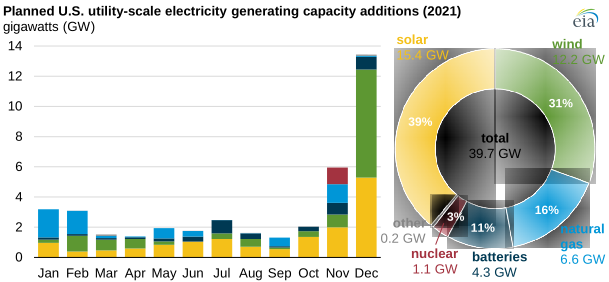
https://www.eia.gov/todayinenergy/detail.php?id=46416 (Renewables account for most new U.S. electricity generating capacity in 2021)
https://www.eia.gov/todayinenergy/images/2021.01.11/main.svg
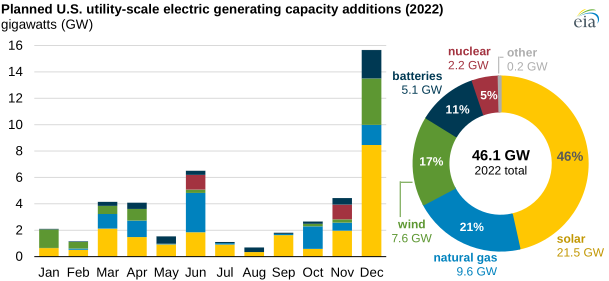
https://www.eia.gov/todayinenergy/detail.php?id=50818 (Solar power will account for nearly half of new U.S. electric generating capacity in 2022)
https://www.eia.gov/todayinenergy/images/2022.01.10/main.svg
https://pv-magazine-usa.com/2022/01/26/sunrise-brief-the-int... (Solar interconnection queue in the US jumped from 139GWac in 2019 to 639GWac today)
https://www.spglobal.com/marketintelligence/en/news-insights... (US renewable pipeline poised to add 172.5 GW through 2024)
Capacity doesn’t buy you much for volatile renewable energies since the capacity factors for PV and wind are relatively low and wind production is unpredictable.
> https://www.energy.gov/ne/articles/what-generation-capacity
Despite the huge growth in PV and wind capacity, nuclear is still the largest source of carbon-free energy in the US according Argonne National Laboratory and the Department of Energy.
> https://youtu.be/MlMDDhQ9-pE > https://www.energy.gov/ne/articles/5-fast-facts-about-nuclea...
It's also plainly not accurate to compare nuclear advocates to climate deniers. Whether nuclear is still a good option is still an entirely legitimate debate with good points to be had on both sides.
You obviously have no idea what you’re talking about, so you breathlessly appeal to those who agree with you, all the while comparing those arguing in good faith, to another group you disagree with.
In short, you’re a mess.
"It is difficult to get a man to understand something when his salary depends upon his not understanding it."
So, what’s your point?
Unlike the "former nuclear leaders", most aren't gonna bad mouth an industry they work or worked for - and to work for it, they also shared all its premises.
> https://en.wikipedia.org/wiki/Novovoronezh_Nuclear_Power_Pla...
Germany spends 20-30 billion Euros every year on its subsidies for renewable energies (EEG-Umlage):
> https://www.bundesnetzagentur.de/SharedDocs/Mediathek/Monito... (page 32)
Nuclear isn’t expensive if you do it right.
> On 21 December 2018, Fennovoima announced that it had received a new schedule to receive the construction license and start construction of the plant in 2021. The commercial operation should start in 2028.[21]
> In April 2021, Fennovoima announced that bringing the design and licensing material to the level of Finnish requirements has taken longer than expected. The company estimated that it could obtain the construction license in 2022 and that construction of the power plant would begin in 2023. Commercial operation of the plant would begin in 2029.[1]
- The Finish nuclear regulation is quite paranoid, even by "western" standards. Also add political pressure on the top of it.
- The project probably includes significant modification of the standard Russian design. Meaning additional design and certification costs. While Russia and most other foreign countries use mostly "standard" designs. But note that it's effectively a one-time cost, i.e. it will not apply to the same extent to additional reactors in the same country.
- It's a greenfield project, meaning the cost includes supporting infrastructure. Building additional reactors at an existing site or close to it will be noticeably cheaper (as the case with VVERs build today in Russia).
- Usually, in such projects the hosting side wrestles as much as possible for stuff to be built and procured locally. Meaning, labor and materials which are relatively cheap in Russia/Turkey/Egypt/etc. will cost 1.5-3x more in Finland.
Unsubsidized Wind is basically cheaper per the second graph on that report.
Unsubsidized Solar is right in the middle of nuclear
Coal is already uncompetitive, it's existence in the market is driven by availability of financing and material to replace it: energy companies are losing money on coal.
The holy grail is unsub wind/solar beating gas combined cycle, but I'll take subsidized. Coal and nat gas are implicitly subsidized: aside from the usual subsidies oil/gas get, they aren't subject to realistic carbon taxes.
I was going to make a comment saying the nuclear was fundamentally noncompetitive today, but that's not true per the graph. Nuclear is surprisingly still competitive, it's just that those plants are ancient and dangerous PWR/LWR almost across the board, Fukushimas waiting to happen.
What is needed is LFTR or other new generation projects, but the issue with those is they are 10-20 years out, even if we had a proven design. Solar/wind have a lot of price dropping still to go as economies of scale kick in. No one knows what the costs will be in 10-20 years, so how do you finance a nuke plant given you don't know a realistic profitable cost?
Also, Yucca mountain was a crappy idea. We should have had LFTRs in use at a minimum to be used to process/breed spent nuclear fuel rods and waste. As I understand it, LFTR can burn/use/convert nuke waste to power or other usable fuel.
Or we should have been on LFTR the whole time with its ability to use 99% of nuclear fuel.
But the boat was missed on this two or three decades ago. We are riding solar/wind and whatever remains for baseload/evening and storage.
What we NEED is a rapid phase-in carbon tax on coal/gas that is directly fed to consumer solar/storage and utility solar/wind.
Yeah, what do the experts in charge of nuclear evergy policies in 4 major western countries know.
It's better to trust the opinion of random nuclear fans on the web, or the "facts" of nuclear commercial industry astroturfers...
[1] https://www.eia.gov/international/data/country/USA/total-ene...
[2] https://www.eia.gov/international/data/country/jpn/total-ene...
[3] https://www.eia.gov/international/data/country/FRA/total-ene...
As it should, as those are the things we should be replacing with environmental friendly sources and consumers (e.g. EVs). So if nuclear can't cover energy uses of 'stuff' currently using gasoline and nature gas, it's no real good...
The point is that it was demonstrated in practice that high (~80%) nuclear ratio of electricity generation works well and results in stable and affordable long-term electricity prices, so you can scale it following mass migration to EV (it's a multi-decade process, so quite enough time to build new reactors). Meanwhile, we can see that grid starts to struggle when renewables get to 30-40% of generation capacity and you have to rely on fossil fuels to back them up during unfavorable conditions. Yes, in theory it could be solved, but those solutions have not been demonstrated in practice on large scale and long time frame.
In 2019, the 93 nuclear reactors in the US produced 809.41 terawatt-hours of electricity[0]. Each reactor, as an average, produced about 8.7 terawatt-hours of electricity per year. Using a list with the power consumption per country[1], it seems like everything beneath rank roughly 100[2] would have their entire power needs met by a single reactor performing at the avg return of a US reactor (assuming peaks can be met as well).
To me, that seems promising and exciting. Smaller (by landmass) countries may not have the same ability to deploy renewables across wide swaths of land. A nuclear power plant can offset some of the necessity for land to scale energy use in a green-powered world without relying on importing energy.
I'm not sure that this is a good enough argument on its own to develop nuclear, especially given some of the lifetime costs, but I think it's a reasonable concern to want domestic power stability.
[0] https://www.eia.gov/energyexplained/electricity/electricity-...
[1] https://en.wikipedia.org/wiki/List_of_countries_by_electrici...
[2] Ranking is not representing total energy consumption per year, it seems, since sometimes the energy consumption goes up as rank decreases. Roughly though, everything in the bottom half of countries is within the reaches of at most 1 reactor.
Edit: Edited for formatting on sources
See the province of Ontario where 50-70% of power is from nuclear generation ("Supply" tab):
* https://www.ieso.ca/power-data
A steady 10,000 MW. Hydro tends to supply another 3000 MW for baseload. As wind fluctuates, gas turbines can brought online as needed.
We could use another 3000MW of nuclear capacity IMHO.
(I live 50km from one of the nuke plants.)
https://www.sciencedirect.com/science/article/abs/pii/S03014...
" Dr. Greg Jaczko, former Chairman of the U.S. Nuclear Regulatory Commission Prof. Wolfgang Renneberg, former Head of the Reactor Safety, Radiation Protection and Nuclear Waste, Federal Environment Ministry, Germany Dr. Bernard Laponche, former Director General, French Agency for Energy Management, former Advisor to French Minister of Environment, Energy and Nuclear Safety Dr. Paul Dorfman, former Secretary UK Govt. Committee Examining Radiation Risk from Internal Emitters "
Reasons:
    Too costly in absolute terms to make a relevant contribution to global power production
    More expensive than renewable energy in terms of energy production and CO2 mitigation, even taking into account costs of grid management tools like energy storage associated with renewables rollout.
    Too costly and risky for financial market investment, and therefore dependent on very large public subsidies and loan guarantees.
    Unsustainable due to the unresolved problem of very long-lived radioactive waste.
    Financially unsustainable as no economic institution is prepared to insure against the full potential cost, environmental and human impacts of accidental radiation release – with the majority of those very significant costs being borne by the public.
    Militarily hazardous since newly promoted reactor designs increase the risk of  nuclear weapons proliferation.
    Inherently risky due to unavoidable cascading accidents from human error, internal faults, and external impacts; vulnerability to climate-driven sea-level rise, storm, storm surge, inundation and flooding hazard, resulting in international economic impacts.
    Subject to too many unresolved technical and safety problems associated with newer unproven concepts, including ‘Advanced’ and Small Modular Reactors (SMRs).
    Too unwieldy and complex to create an efficient industrial regime for reactor construction and operation processes within the intended build-time and scope needed for climate change mitigation.
Unlikely to make a relevant contribution to necessary climate change mitigation needed by the 2030’s due to nuclear’s impracticably lengthy development and construction time-lines, and the overwhelming construction costs of the very great volume of reactors that would be needed to make a difference.But something like this could happen trice right?!
Three Mile Island didn't kill anyone and no one was exposed to enough radiation to increase their risk of cancer. The accident happened because someone trained on submarine reactors misapplied that training and turned off the cooling system. No operating reactor allows an operator to do that anymore. The reactor did not blow up.
Only one civilian nuclear power reactor has ever "blown up", Tokyo was never in danger, no one died because of Three Mile Island, and even around Chernobyl the predicted incidence of cancer is failing to materialize.
Central Europe also doesn't have tsunamis.