It boggles the mind that the armchair engineers continue to advocate for a technology subject matter experts conclude is a dead end. Nuclear advocates might as well be in the same camp as climate deniers.
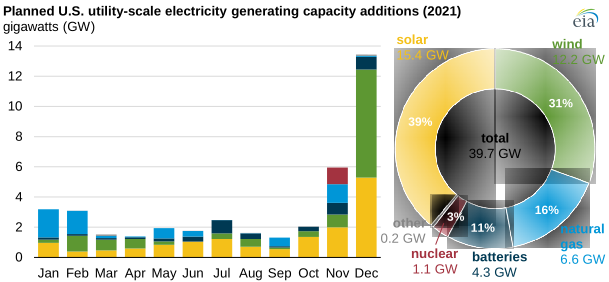
https://www.eia.gov/todayinenergy/detail.php?id=46416 (Renewables account for most new U.S. electricity generating capacity in 2021)
https://www.eia.gov/todayinenergy/images/2021.01.11/main.svg
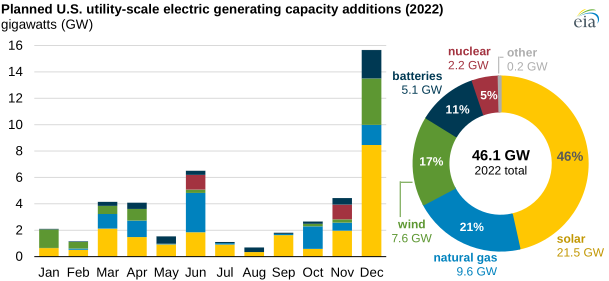
https://www.eia.gov/todayinenergy/detail.php?id=50818 (Solar power will account for nearly half of new U.S. electric generating capacity in 2022)
https://www.eia.gov/todayinenergy/images/2022.01.10/main.svg
https://pv-magazine-usa.com/2022/01/26/sunrise-brief-the-int... (Solar interconnection queue in the US jumped from 139GWac in 2019 to 639GWac today)
https://www.spglobal.com/marketintelligence/en/news-insights... (US renewable pipeline poised to add 172.5 GW through 2024)
Capacity doesn’t buy you much for volatile renewable energies since the capacity factors for PV and wind are relatively low and wind production is unpredictable.
> https://www.energy.gov/ne/articles/what-generation-capacity
Despite the huge growth in PV and wind capacity, nuclear is still the largest source of carbon-free energy in the US according Argonne National Laboratory and the Department of Energy.
> https://youtu.be/MlMDDhQ9-pE > https://www.energy.gov/ne/articles/5-fast-facts-about-nuclea...
It's also plainly not accurate to compare nuclear advocates to climate deniers. Whether nuclear is still a good option is still an entirely legitimate debate with good points to be had on both sides.
You obviously have no idea what you’re talking about, so you breathlessly appeal to those who agree with you, all the while comparing those arguing in good faith, to another group you disagree with.
In short, you’re a mess.
"It is difficult to get a man to understand something when his salary depends upon his not understanding it."
So, what’s your point?
Unlike the "former nuclear leaders", most aren't gonna bad mouth an industry they work or worked for - and to work for it, they also shared all its premises.
> https://en.wikipedia.org/wiki/Novovoronezh_Nuclear_Power_Pla...
Germany spends 20-30 billion Euros every year on its subsidies for renewable energies (EEG-Umlage):
> https://www.bundesnetzagentur.de/SharedDocs/Mediathek/Monito... (page 32)
Nuclear isn’t expensive if you do it right.
> On 21 December 2018, Fennovoima announced that it had received a new schedule to receive the construction license and start construction of the plant in 2021. The commercial operation should start in 2028.[21]
> In April 2021, Fennovoima announced that bringing the design and licensing material to the level of Finnish requirements has taken longer than expected. The company estimated that it could obtain the construction license in 2022 and that construction of the power plant would begin in 2023. Commercial operation of the plant would begin in 2029.[1]
- The Finish nuclear regulation is quite paranoid, even by "western" standards. Also add political pressure on the top of it.
- The project probably includes significant modification of the standard Russian design. Meaning additional design and certification costs. While Russia and most other foreign countries use mostly "standard" designs. But note that it's effectively a one-time cost, i.e. it will not apply to the same extent to additional reactors in the same country.
- It's a greenfield project, meaning the cost includes supporting infrastructure. Building additional reactors at an existing site or close to it will be noticeably cheaper (as the case with VVERs build today in Russia).
- Usually, in such projects the hosting side wrestles as much as possible for stuff to be built and procured locally. Meaning, labor and materials which are relatively cheap in Russia/Turkey/Egypt/etc. will cost 1.5-3x more in Finland.
Unsubsidized Wind is basically cheaper per the second graph on that report.
Unsubsidized Solar is right in the middle of nuclear
Coal is already uncompetitive, it's existence in the market is driven by availability of financing and material to replace it: energy companies are losing money on coal.
The holy grail is unsub wind/solar beating gas combined cycle, but I'll take subsidized. Coal and nat gas are implicitly subsidized: aside from the usual subsidies oil/gas get, they aren't subject to realistic carbon taxes.
I was going to make a comment saying the nuclear was fundamentally noncompetitive today, but that's not true per the graph. Nuclear is surprisingly still competitive, it's just that those plants are ancient and dangerous PWR/LWR almost across the board, Fukushimas waiting to happen.
What is needed is LFTR or other new generation projects, but the issue with those is they are 10-20 years out, even if we had a proven design. Solar/wind have a lot of price dropping still to go as economies of scale kick in. No one knows what the costs will be in 10-20 years, so how do you finance a nuke plant given you don't know a realistic profitable cost?
Also, Yucca mountain was a crappy idea. We should have had LFTRs in use at a minimum to be used to process/breed spent nuclear fuel rods and waste. As I understand it, LFTR can burn/use/convert nuke waste to power or other usable fuel.
Or we should have been on LFTR the whole time with its ability to use 99% of nuclear fuel.
But the boat was missed on this two or three decades ago. We are riding solar/wind and whatever remains for baseload/evening and storage.
What we NEED is a rapid phase-in carbon tax on coal/gas that is directly fed to consumer solar/storage and utility solar/wind.
Yeah, what do the experts in charge of nuclear evergy policies in 4 major western countries know.
It's better to trust the opinion of random nuclear fans on the web, or the "facts" of nuclear commercial industry astroturfers...
For example:
> Nuclear isn’t cheap, but extremely costly.
We don't need it to be cheap (and it should be subsidized as far as consumers are concerned re cost). Who in the past few decades has successfully argued that nuclear is inexpensive? Nobody is making that argument, it's a straw-argument the author set up. We need it to produce energy at massive scale and reliably. Nuclear does that, and it's a technology we can keep improving upon (we should have spent the last 40-50 years aggressively improving upon it with large R&D expenditures; best time to plant a tree and all that).
Current US energy mix is coal at ~19.3% and nuclear at ~19.7% (2020 EIA numbers).
That's 93 nuclear reactors or less to wipe out US coal use. Hit the print button, get it to it already. In terms of US contributions on climate, that'd be a huge win. And more realistically, we could build toward 1/3 nuclear mix (instead of ~40%), while traditional renewables continue to expand, which would wipe out coal's share in tandem.