There's something that feels off about this statement. It reads much like the articles that talk about how young millennials are "choosing" to live in pod houses/tiny homes when in reality they can't afford anything better. They are forced to live in these conditions which are then normalised by authors framing it as a free choice.
And to be honest, we’re always going to have to “force” people into some sort of living condition. There are more people than ever going to higher education, so people will have to accept either smaller living spaces, denser construction, higher costs, or longer commutes to school - space is (unfortunately) a rival good, and giving everybody a large dorm is likely not viable.
"conditions"? 1 in 20 UC students is homeless [1] and they want to a build a 5,000 single occupancy rooms for 1.5 Billion. But somehow everyone and their mother finds a reason to veto new development.
1. https://www.bloomberg.com/news/articles/2021-11-02/what-crit...
I don't why they cannot build simply longer buildings with each room having a window instead of big square one with most rooms not having window at all? Both such buildings would occupy the same amount of squares per meter.
A decade ago I was exchange student in Umea, Sweden and dorms were really good. In every corridor there where 8 rooms. Everyone had their own room + own small bathroom. Room was like 3x size of those in the article. Corridor had big shared kitchen and living room. Rent per month was like 450 euro. Campus was really big - it was basically a student city so there was a space for everyone. Those buildings were just simply longer. Building student campuses/universities outside of big cities also helped.
It is expensive.
> I don't why they cannot build simply longer buildings
It's not simple. They have to deal with zoning laws, land owned/available to the university, costs (which you already think are too high) and maximizing occupancy etc, etc.
> Everyone had their own room + own small bathroom. Room was like 3x size
Sounds nice in Sweden... meanwhile in the UC system 1 in 20 students are homeless.
No, it's effectively 300k per room, not per person. This structure will be up for more than 1 semester and certainly up for more than than length of one person living in it.
That being said, I have no frame of reference for the cost of similar structures. It definitely sounds fairly expensive considering the size of the room + common area.
I think as long as you get out during the day, and as a student, that’s probably likely, this sort of arrangement seems to make sense. But still offends me.
Furthermore you are dismissing the fact that there still is a market, with choices.
It's actually the opposite... It creates an option with different tradeoffs.
Everyone with their own money. The university with its own, the donors with their own.
The parent post makes no sense: Charlie Munger does not decide "what to build", he decides whether to participate.
Sure, this is a convenient way to look at this particular situation. Yet I google "strings attached donation university" and see many instances of this crap: Koch brothers, John Allison, etc. It's serious enough that Harvard recently issued a "Gift Policy Guide" discourage strings-attached giving. Ironically, only the elite private universities have enough cachet to make such a policy stick.
What other «way[s] to look at this» are there? Point of view or practical proposal, I do not get what are the other options.
But my more extreme view is that individuals should not be able to amass so many resources to begin with. It's absurd.
^1 For some time German universities had to require higher fees from students, officially to provide an improved learning experience. Seeing that universities now had an alternative income source some states cut public funding, they didn't care about the specifics, the courts did, some universities ended up not heating their buildings during winter because they couldn't legally touch the money.
There's nothing hindering students from renting an apartment, they don't have to use the 200$ million building.
I don't live in the US and don't know the local market, but a quick google says you need at least $2000 a month to get a basic apartment in Santa Barbara: https://www.apartments.com/santa-barbara-ca/. Who has that kind of money, especially combined with a full time education?
Your elitism is showing.
No one will be forced to live there, but that location is a much better alternative than homeless or not.
The ridiculous expense because of the acute housing shortage in SB. Which building the largest dorm in the country would help alleviate.
> they don't have to use the 200$ million building
1.5$ Billion Building
> They are forced to live in these conditions
I agree that the choice between crippling rent rates and having no access to windows is not a good one, but it seems a function of where we are economically. Base rents everywhere I've ever lived are much higher compared to minimum wage than they've been for past generations.
They are absurdly high and I think the people who are put in that position are doing what they feel is in their best interest. What worries and frustrates me is that many publications/people seem to be seeking to normalise the situation we're in rather than thinking about how we could provide a better standard of living to people.
In reality half the people get a massive debt burden and the other half live off-campus, but the complainers don’t really see that part.
See also: people who are vehemently opposed to building more density, because a detached house with a large yard is better for mental health
But I draw the line at windows. They are a basic human necessity and a fire hazard mitigation. I stayed in a hostel underground once in Liverpool, and it was aweful... I was not rich at college and shared crappy houses all the while, but I would not take this up under any circumstances.
The options can't be perfect or nothing. The options should be perfect, good and bad.
This design isn't because students can't afford buildings with windows, it's because a billionaire has a fantasy that it's the optimal design for such a building, thinks architects who disagree are "ignorant", and is making his donation contingent on it.
You have to admit that there is at least a chance that this is a good idea and Mr Munger has good advice on the subject? It isn't like the students are confined to their cell, they just need to sleep there. A lot of them may not consider a window important, particularly in the face of saving some money.
Months can go by without me raising the blind in my bedroom. While I certainly want a window there, I don't think it is essential.
Not every one. But it does seem likely that Munger has access to people with more experience building windowless bedrooms than anyone in the UK. I've heard from a source on the internet that it would be illegal to have such experience in the UK, so I doubt anyone does.
It is a trivially obvious one. You won't have people with experience in a technique available if it has been banned. It is a safe guess that the US architects will be better at this than UK ones.
Permanent accommodation which is multiple doors away from the nearest natural light source, relies on artificial means to circulate air and has a distinct lack of exits might find a few more supporters than child labour, but funnily enough the laws ended up in place for similar reasons. We saw what happened when we assumed that people must know best because they were rich enough to pay people to agree with them (and others were too poor and uninformed to have much choice)
What is trivially obvious is that you won't have a building design with windows in bedrooms if the person funding the design makes funding contingent on the building not having windows in bedrooms, as Munger states he's doing. In all probability the experts hadn't built masses of windowless cells backing onto windowless kitchens connected via windowless corridors to the outside world before (the reason the design is controversial, after all, is that its not exactly standard building practice in the US either) and probably had plenty of ideas on how to maximise floorplan whilst guaranteeing natural light to inhabited spaces, but they detailed this design because the person cutting the cheques told them to. Your implicit argument that a design constraint imposed by the ego of a billionaire design dilettante is likely to yield better advice than a design constraint imposed by regulators based on decades of built environment research is far from trivially obvious...
And if Munger had some insight the regulators missed, it's not exactly evident from the bizarre set of contradictions he offers up in the interview..
Can you demonstrate that this is true. AFAIK UK regulations consider fire-safety, and they have nothing to do with banning windowless-rooms outright.
Certainly. The problem comes when you present something that is bad as something that is good or perfect.
The Michigan one doesn't have windows in the bedroom, but does have windows in the apartment (shared kitchen/living room of 7 bedrooms, i.e., common area.).[1][2]
The 3d render of the apartment in this article doesn't have any windows at all, anywhere! The windows in common areas they seem to be talking about are study spaces outside the apartment.
[1] -- https://www.youtube.com/watch?v=5iRaug6kB14 [2] -- https://www.youtube.com/watch?v=qtkALW6Q2_A
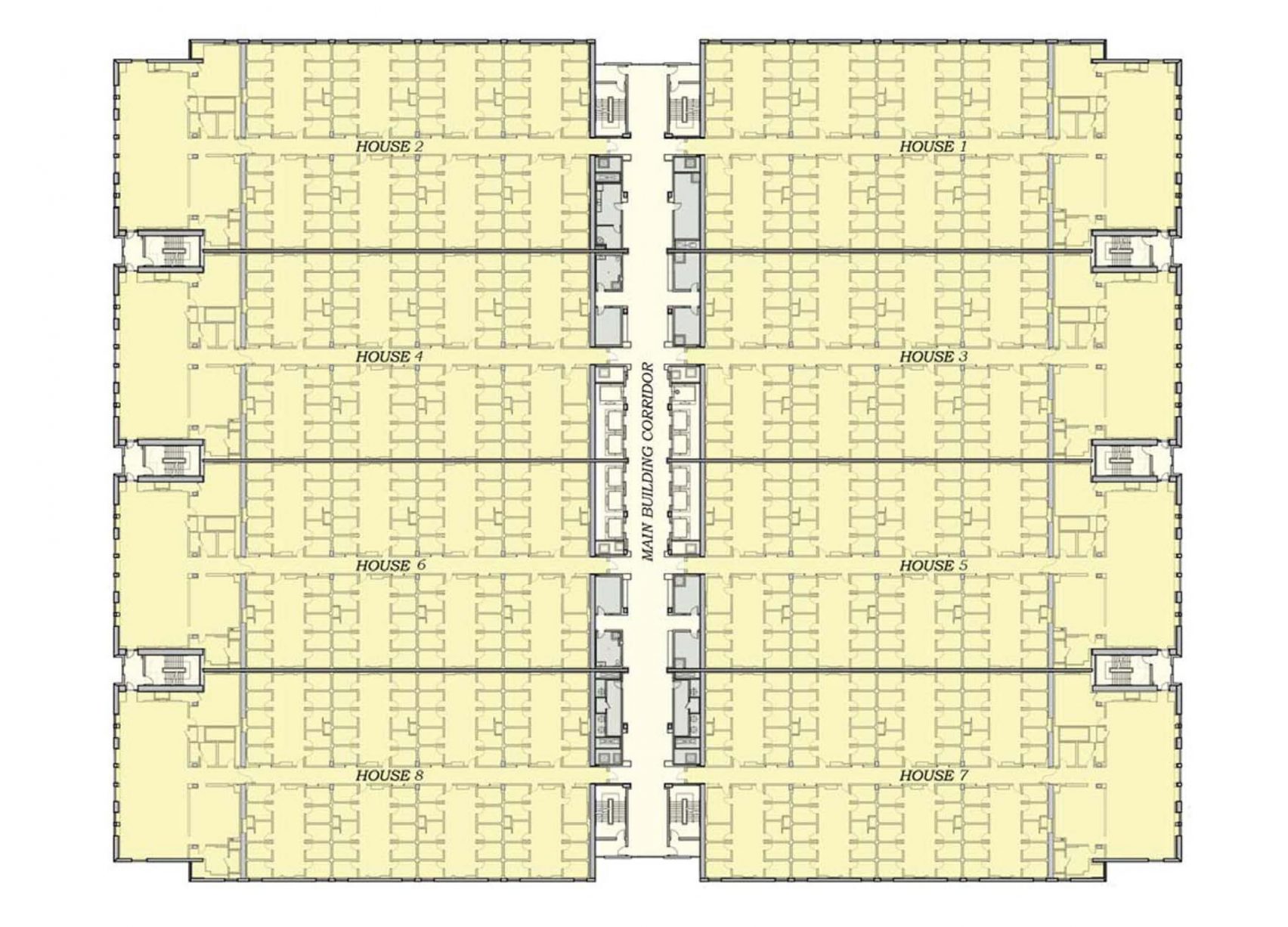
But in this proposed building? Look at that insane floor plan[2]! It looks like a maze! If you're in one of those inner rooms, you exit your bedroom (no windows) into your apartment's common area (no windows), exit that to a long corridor that eventually leads to your "House's" common area, which finally has windows. But is the opposite way from the building's exit.
Yeah this thing is insane.
[1] https://www.dezeen.com/2021/11/02/architect-resigns-grotesqu... [2] https://static.dezeen.com/uploads/2021/11/munger-hall-univer...
The bedrooms are much larger. They have individual bathrooms. And a number of reviews said at least the suites have windows. UCSB's wouldn't.
> or at least the kind of people that would sign up for res in a building like this
You added this later. It's tautological. And often undergraduate students don't get to choose their building.
[0] https://rde.stanford.edu/studenthousing/munger-graduate-resi...
Maybe Munger didn't have much input there.
[edit] downvoter is maybe unaware that I'm referring to the Stanford Munger building and not the proposed windowless building
Nobody heard about the building in Michigan, so nobody talked about it. Also, in Ann Arbor it's very likely that the CoL is not so high that students are de facto forced to tolerate these conditions.
It's not really Munger who's the villain here, he instead plays the role of an enabler. There's no inherent reason that housing costs should be so high that students have to live in these awful boxes, it's because of the policies chosen by the City of Santa Barbara. For context, the population density in SB is about a quarter of that in SF.
What's outrageous is that students pay the price in mental health and fire safety for housing policy that benefits the well-off and well-connected seeking aesthetics and investment returns. What motivates people to comment is the implied risk of this callous abuse of construction restrictions ("zoning") being extended to other vulnerable populations.
Looking at the layout it is positively dystopian.
People will say they feel a private room is better, but that’s no guarantee that it actually is.
Conversely, we have a lot of research showing that natural light brings all kind of benefits.
My initial reaction was to react against a windowless dorm room layout. But you make some good points.
What I still don’t get is why insist on such few egress paths and emergency exits?
Do you know if they are piping in some natural sunlight to the interior?
https://news.ycombinator.com/item?id=29038356
It’s worth noting that this isn’t the first mostly-windowless dorm he’s built. His previous work at UM has generally very good reviews and was built without much (if any) protest.
Michigan: https://www.veryapt.com/ApartmentReview-a7222-munger-graduat...
It sounds to me like the evidence so far is that Munger is correct, and on average people (or at least the kind of people that would sign up for res in a building like this) would rather have a small private room with a fake window and lower rent and than a shared room with a real window and higher rent. I’m not sure why this particular structure has provoked so much more outrage than the previous one.
Edit: I previously mentioned the Stanford Munger Graduate Residence as well, but it appears that one is of more “traditional” layout (and is relatively expensive). Thanks dkarp for pointing this out. I've edited it out of my comment as to not mislead.