An Aussie with a $1M home, and a $500k mortgage will have $500k in "wealth." But if that wealth is tied to their home, and all other homes cost the same or more, what good does that do them?
We're seeing the same happen in many US cities.
The other interesting part is that one has to pay annual tax and maintenance on that "wealth". Unless the market is very hot, primary homes are not a very lucrative investment compared to other assets.
It's certainly not the same thing as having that wealth in the bank, or as stocks.
In a given year, just over 1% of a typical city’s homes are transacted. Over a decade, about 10-15% are transacted.
I was shocked when i found out there's no 0% tax bracket in the USA. All that paperwork to collect tax from those who are struggling. Meanwhile the federal tax caps out at 37% and doesn't even consider very high wage earners. The higher minimum wages in Australia are also clear cut.
That isn't exactly true:
https://www.npr.org/sections/thetwo-way/2012/09/18/161333783...
Yes, the bracket isn't zero percent, but after deductions and the child credit, it effectively becomes that. That doesn't include payroll taxes however, which are much more regressive (in the case of social security with an income cap even more so). Does Australia exempt low earners from payroll taxes as well as income taxes?
There is functionally a 0% tax bracket in the US, because everyone gets a default tax deduction.
In general, I agree with you - particularly in the realm of healthcare and college educations - but there's a lot of nuance in the details.
Do you have any links to studies around this? From what I've heard of the past couple years, most economists believe only a marginal increase to around $10/hr would be beneficial. I'm not arguing against that, but $10/hr doesn't seem like it would afford those workers the opportunity to build wealth, and increasing it further is supposedly not going to provide any additional benefit to that group.
Given the other comments about the real estate situation in Australia it seems problematic to compare median wealth instead of disposable income.
Let's say you make $1,000,000 a year in California. Your effective tax rate is 11.78 percent because the top 12.3% rate is only applied to income you earned over $599k. (13.3% applies only on income above $1,000,000, which you are too poor to pay yet).
Same with federal taxes, that $1,000,000 earner is going to pay an effective rate of 33.3%. Combined, you are paying 45% state and federal income tax.
In California, the highest possible tax rate on earnings, would be 50%.
In Australia that tax on the highest earnings would be 45%.
Nowhere did I claim that all your income is taxed at the same rate. I was replying to the quote "federal tax caps out at 37%" which ignores the significant 13% additional tax in CA.
There is also an extra tax to pay for college that graduates (4 percent) pay if they make more than $39k (AUD I think, not sure what the basis that they have to pay is, however).
Both healthcare and college seem to be funded separately from income taxes.
It might be that overall the poor get a better deal in Australia. But surely it's not because of the income taxes (slightly higher than CA for low earners) or the consumption taxes (much much higher than CA). Maybe they get a better deal on health insurance and payroll taxes, plus the idea of paying for college via successful graduates is one that America should definitely consider adopting.
See e.g. https://www.bogleheads.org/forum/viewtopic.php?t=247046 where someone points out that CT does the same and calls it recapture.
https://www.nytimes.com/2003/05/12/nyregion/highest-tax-will...
https://www.empirecenter.org/publications/new-yorks-ugly-ste...
But the craziness with the most recent changes doesn't end there. From July 2021, employers are required to withhold from bonuses and overtime at the new supplemental rate of 13.78%, which is quite a bit higher than even the top bracket. That guarantees even more and larger refunds for taxpayers next year. Or, if you look at it another way, a bigger interest-free loan to the state.
> The Australian property bubble is the economic theory that the Australian property market has become or is becoming significantly overpriced [...]
IOW bubbles can only be called historically asset prices fall dramatically and even then typically in housing they don't fall that much.
Housing prices have been rising much faster than inflation in a lot of places due to historically cheap financing. The alternatives to "bubble popping" are that they plateau, or continue rising, or decrease moderately over time.
If I'm willing to sell my house in Sydney and move to rural Queensland, I'm wealthy. If I'm not, selling my $1M house means I have to go find another $1M house now.
(And yes, the median house price in Sydney is over $1M.)
According to https://en.wikipedia.org/wiki/Urbanization_by_country the urbanization rate in AU is ~2x the US, so people are moving to cities at a much bigger rate? Even in the face of the high prices.
But yep I still see what you mean, on the country-averages level the AU prices seem to have been constantly rising faster in AU than US.
If you consistently earn more but have less total wealth that to me reeks of the broken window fallacy. There's spending that could be done via more efficient means. eg. Australia spends less tax on healthcare per capita. America spends more tax and then on top of that essentially has a private insurance requirement as well. That's spending that doesn't need to happen but does due to inefficiencies. You could get rid of this but apparently efficiency created by government intervention is socialism (it's not but the USA political system is a mess and people have been swayed).
Although, some do think that the only thing standing between them and wealth like Bezos is a few hundred bucks a year in taxes (that they want to cut, ramifications be damned).
https://www.nytimes.com/2021/03/31/business/economy/biden-in...
Pretty obvious and orthodox solution, tried and tested worldwide in the last century, however: it goes against neoliberal creed and thus is anathema since the 80s.
Once upon a time (war time) the US had 94% top tax bracket[1]. Let that sink it.
Obviously there's no WW2 right now, and that extreme level of confiscation is probably unwarranted. But it makes you think how far the US has strayed and how impossible any slightly more progressive tax brackets seem today.
[1] https://teachinghistory.org/history-content/ask-a-historian/...
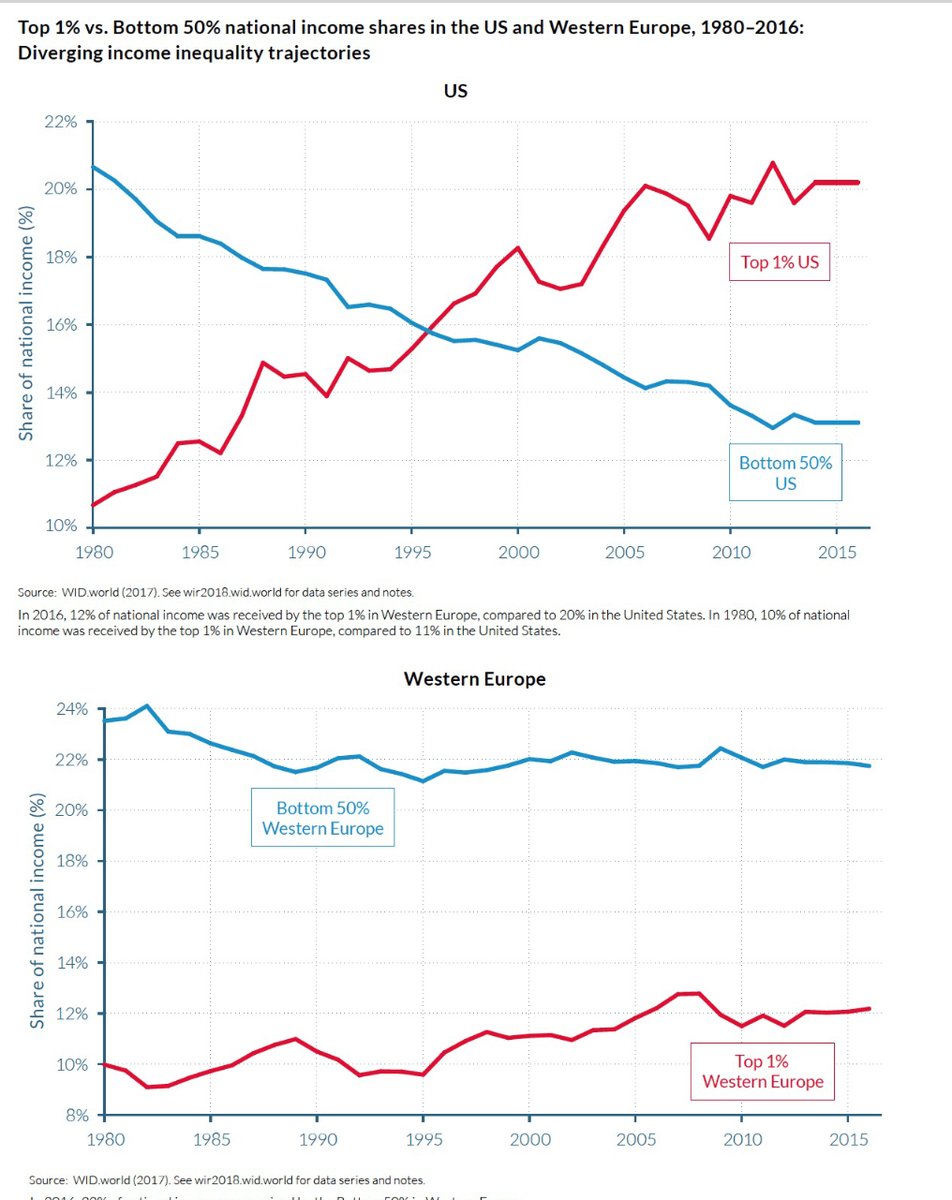
Things have objectively taken a downturn in the USA for the bottom 50% but somehow there's push back against this fact? People are arguing against numbers in this thread.
From talking to both Americans and immigrants from Asia and Eastern Europe about these issues it seems to me like a lot of Americans have never been outside of North America and have a warped view of the rest of the world, while immigrants from poorer nations still see America as a land of opportunity and compare the living standards of the middle classes in the US vs their home country.
It's really wild to hear Americans act like universal healthcare and free/affordable college is a radical communist agenda that's not fiscally feasible even though most other 1st world nations are able to do it (https://en.wikipedia.org/wiki/List_of_countries_with_univers...).
https://static01.nyt.com/images/2021/07/09/us/covid-fed-qe-p...

https://www.nytimes.com/interactive/2021/07/12/opinion/covid...
If you draw comparisons across similar population sizes and similar geographic regions, for example comparing the USA to all of Europe, the numbers look a lot more similar:
Europe median: $26k Europe mean: $174k
USA media: $82k USA mean: $505k
Both regions have roughly a factor of 6 difference between median and mean wealth.
[0] https://www.abs.gov.au/statistics/labour/earnings-and-work-h... (Table 1)
[1] https://www.census.gov/data/tables/2019/demo/income-poverty/... (Table A-1)
49,805 AUD is 37,039 USD.
I remember reading once that America is the land of the frustrated wannabe millionaire, and it’s kinda true. We’re all on a warpath to make a ton of money with no real incentive to fight the fight you’re talking about.
Isn't much of Australian household wealth built on surging property prices? Which is also backed by the same massive loans that Americans are dealing with? And also, the Australian government is forced to keep the property bubble going at all costs, even more so than the American government?
https://www.ratecity.com.au/home-loans/mortgage-news/rba-gov...
There are powerful forces fighting against what AnotherGoodName is suggesting. They have money and propaganda and lobbying. It’s a tough fight.
Well, we do for income tax. It's just that the cut off limit is extremely low ($12k). Based on tax credits, one can even pay $0 in tax and get money back.
Nobody ever complains about sales tax (which is the quintessential regressive tax) until you get deep in the weeds of policy discussion.
Some sales taxes have been sort of progressive. I don't know the current details but years ago the first $10k on a vehicle purchase was excluded. This was at a time when average/cheaper cars cost under that. Theoretically, that only impacts the wealthy people buying luxury cars. Of course I don't think they ever adjusted it for inflation and they may have even removed that exclusion. But yeah, it's mostly regressive. I do hear people complain about sales tax sometimes.
I think many people agree that the best kind of tax would be on money inflow (income, capital gains) rather than things like property, sales, etc. I think the implementation is the part nobody can agree on.
From a theoretical standpoint the best taxes would be on monopolies that extract economic rent and taxes on externalities. The prime candidates are the land value tax and carbon tax.
Can you expand on that? Does that include capital investment if one meets the loose "materially participated" stipulation?
"The prime candidates are the land value tax and carbon tax."
This doesn't seem like a good idea. A carbon tax is transactional, so it could be avoided. Maybe good for policy implementation but not good for revenue. Land tax seems very similar to property tax already. We are seeing pushes in many states to eliminate it due to the high burden on lower income families and the elderly. For example, you may be taxing them on "wealth" that doesn't exist. This places the government in a position to take assets someone already owns. It's also mostly regressive as property tax is now. If you tax the inflow of money, then you know there is money that can be paid and can even be collected before the person ever receives it.
It's not that me or anyone else wants higher taxes. We're willing to accept higher taxes for the benefits of living in a higher-taxes-for-the-wealthy society, specifically: a) enjoying high quality infrastructure, particularly around education, healthcare, and transportation, and b) getting to live in a place where the poorest are being properly cared for and have a path to reintegration, rather than being stuck on the street reminding you every day that society has failed them, and might fail you or your kids one day too.
You can't get either of these by giving away your own money, especially if you're only upper middle class.
People migrate from countries like Australia, or sit in their armchairs in Sweden and expect the US be on par with X or Y social infrastructure and rage perpetually at the citizens (like the GP, which prompted my response) when they find this isn't the case.
Why is it reasonable for the US to align social policy to every European or South Pacific developed nation when the scale of the US is not even remotely comparable? What is the philosophy 101 term for that level of delusion?
And why is OP justified in spitting venom at the citizens? Get real.
It's weird that the existence of ultra privileged positions somehow gives you the thought that therefore America is fine the way it is. It's clear for the remainder of America they'd be better off elsewhere in the western world. They'd be better off fighting for their situation.
"Mad they had to pay taxes" completely obfuscates (probably in bad faith) the fact that colonists had no say in what that taxation went toward, and the people who _did_ lived thousands of miles away before any real communication infra even existed. It's right there in the name. The way you speak about "conspiracy theory farmers" reveals your real agenda, which is to push narrative-snark bemoaning the origins of our country (even if it's at the expense of the historical truth).
If I smoke and I tell you smoking causes cancer, will you disbelieve me?
It's actually a strange form of argument from authority: you don't follow your own rule, and I believe your honest self that I think you're showing by not following it.
If anything it should tell you something that a guy who is milking the system says the system is broken. That at least is a first hand witness.
This has nothing to do with taxes. It's not even true in America. If high taxes are such a massive depressor of wages, why are all the highest paying jobs concentrated in the states with the highest taxes?
We’re still living in his world.
Australia has the second highest household debt to GDP ratio in the world, second to Switzerland. The US isn't in the top 10: https://en.wikipedia.org/wiki/List_of_countries_by_household....
As others have pointed out, a large part of this is due to increasing house prices, and it is fairly recent:
"Australian household debt levels have increased substantially over the past thirty years, with the ratio of household debt to annual disposable income rising from 68% in June 1990 to a recent peak of 188.5% in June 2019. Since June last year, the ratio has reduced slightly to 185.0%.
Most of the debt held by households is housing debt, which comprises around 76% of overall household debt. Thirty years ago housing debt comprised a much smaller 46% of overall household debt.
...
Most of Australia’s household debt accrual occurred between 1990 and 2010. The ratio of household debt to income increased by 45.7 percentage points between 1990 and 2000, and by another 49.3 percentage points between 2000 and 2010. The past decade has seen growth in the ratio more than half to 21.5 percentage points, with most of that growth aligned with the property boom between late 2012 and 2017.
Importantly, the value of assets held against the debt has recorded a more significant increase, pushing household net worth to new record highs at the end of 2019. Residential dwellings comprise by far the largest component of household assets, totaling $6.8 trillion, or 53% of household wealth."
-- https://www.macrobusiness.com.au/2020/11/could-australias-hi...
Australians took on massive debt to buy houses at increasing prices. As long as prices keep going up, their wealth increases. And what are they doing with that wealth increase?
"not all of that housing debt has simply been used to buy homes — many people have been cashing in on the rising value of their properties over the past two decades.
'Even for people who don't buy and sell a home, and stay in the one place, we're finding between 30 and 40 per cent of these people are increasing their debt from one year to the next,' Professor Wilkins says.
'When people are increasing their debt from one year to the next, they're essentially accessing the equity in their home ... people are evidently using that increased equity to fund consumption."
-- https://www.abc.net.au/news/2019-10-18/household-debt-leaves...
As long as prices keep going up, it will be fine. But I suspect I know how this story ends.
In the USA average wealth per adult is one of the highest in the world. This measures the wealth of a persons assets (car, home, etc.) minus their debts.
But the median wealth for the USA is much further down the list. The median is the midpoint so it excludes outliers like Bezos. It's common for Americans to boast about how rich they are but the honest truth is my home country Australia has a median wealth that's 3x greater than the USAs.
The difference in wealth between the typical USA resident and an Australian resident is the same as the difference between a USA resident and a Chinese resident.
Australian adult median wealth (USD $238k)
USA adult median wealth (USD $79k) not poor but definitely not at the top. Slighly below Taiwan and South Korea.
China adult median wealth (USD $24k) a similar difference.
Honestly as an Australian living in the USA it does show. I get rather annoyed when a USA resident boasts about wealth. You have massive loans dickhead. You should have been fighting this problem and instituting 0% tax for the lowest wage earners like Australia did 40 years ago. You should have increased taxes on the rich. You should have increased minimum wage.
But you didn't. And now your average American wealth, whilst not yet bad is below countries such as South Korea and Taiwan that have troubling neighbors that justify huge defence budgets. It's below Italy's which has long suffered corruption in politics. It's below Spains despite Spain being the cheap holiday destination for the wealthier European nations.
Stop fucking around and fight the fight you should have fought 20 years ago.
https://en.wikipedia.org/wiki/List_of_countries_by_wealth_pe...