News for hackers. Stuff that matters.
Re:In 2009, Two Nuclear Submarines Collided Under the Sea (2... by baobabKoodaa on Monday August 30, 2021 @11:16AM (#28356437)
So the submarines can't use active sonar, because their number one priority is to avoid detection... but then these subs are all parked in the same "parking spots" in the ocean. If the favored parking spots for submarines are so rare and small that collisions happen more than once, surely that undermines their stated number one priority of remaining hidden? If someone wanted to locate enemy submarines, surely they could just send a bunch of underwater drones to swim through these parking spots?
Re:In 2009, Two Nuclear Submarines Collided Under the Sea (2... by nradov on Monday August 30, 2021 @12:10PM (#28357152)
There are no parking spots. Ballistic missile submarines conducting deterrence patrols are assigned to large areas covering hundreds of square nautical miles. The sub then maneuvers inside that patrol area to remain as hidden as possible. They almost never stop as it's easier to maintain depth control with at least a few knots of steerageway. So a collision in open ocean is theoretically possible but highly unlikely.

The real risk of collisions comes with transiting through constricted navigational channels, typically when leaving or entering port. Those channels force a lot of vessels into a small area. There have also been a few incidents where submarines failed to do a thorough surface search before surfacing and collided with smaller boats.

During the Cold War there were supposedly a few incidents where NATO attack submarines were following Soviet submarines too closely and ended up colliding.

Re:In 2009, Two Nuclear Submarines Collided Under the Sea (2... by baobabKoodaa on Monday August 30, 2021 @12:20PM (#28357296)
> There are no parking spots. Ballistic missile submarines conducting deterrence patrols are assigned to large areas covering hundreds of square nautical miles ... So a collision in open ocean is theoretically possible but highly unlikely.

It's misleading to describe collisions as "theoretically possible" when we have evidence that these collisions have occurred. The fact that collisions have occurred makes me think that these submarines are not randomly located in a large area where it would be difficult to locate them.

Re:In 2009, Two Nuclear Submarines Collided Under the Sea (2... by nradov on Monday August 30, 2021 @12:44PM (#28357652)
You missed the point. The collision covered in this article occurred relatively close to port, not during an open ocean patrol.

A ballistic missile submarine's position isn't completely random, but they do move around somewhat randomly to reduce the risk of detection. They intentionally avoid repeating movement patterns or lingering in the same spot. And this also reduces the risk from spies on land. If a spy sees the patrol orders he'll only know a large general area but won't precisely know the submarine's position at any time.

Re:In 2009, Two Nuclear Submarines Collided Under the Sea (2... by baobabKoodaa on Tuesday August 31, 2021 @04:55AM (#28365438)
> You missed the point. The collision covered in this article occurred relatively close to port, not during an open ocean patrol.

So you're saying the collision _didn't_ occur at a time when the sub was trying to stay hidden, you're saying that the operators could have / should have used active sonar? Is that it?

Look, either the sub was trying to stay hidden at the time it accidentally collided with another submarine, or it wasn't trying to stay hidden. In either case it didn't do a good job. If it wasn't trying to stay hidden, then it shouldn't have collided. If it was trying to stay hidden, then its location was not as unpredictable as it should have been.

Re:In 2009, Two Nuclear Submarines Collided Under the Sea (2... by ttepasse on Tuesday August 31, 2021 @11:10AM (#28369089)
That the collision happened close to port is weird in itself. France has its SSBNs stationed south of Brest; the UK to the west of Glasgow. One would assume the individual routes to the patrol areas would be rather different. What would the HMS Vanguard do less than a days travel from Brest?
Re:In 2009, Two Nuclear Submarines Collided Under the Sea (2... by dragonwriter on Monday August 30, 2021 @12:25PM (#28357360)
> large areas covering hundreds of square nautical miles.

That's...not very large.

> The sub then maneuvers inside that patrol area to remain as hidden as possible.

Given that the same concerns will drive “as hidden as possible” concerns in any sub, that further narrows the space. And unless the decisions made within that space are made in a truly random manner which approaches all equally good options equally (and tolerates a loose enough sense of “equally good” not to excessively narrow the space to start with), common cognitive biases, etc., will result in common decisions.

Re:In 2009, Two Nuclear Submarines Collided Under the Sea (2... by sealeck on Monday August 30, 2021 @07:41PM (#28362282)
Royal Navy subs have been known to surface directly underneath sailing boats in the Firth of Clyde (in Scotland).
Re:In 2009, Two Nuclear Submarines Collided Under the Sea (2... by hinkley on Monday August 30, 2021 @11:39AM (#28356744)
Sounds like the FAA altitude problem all over again.

As altimeters got more accurate, the odds that you were flying at exactly 28000 feet went up. If an air traffic controller fucks up and puts two planes at 28000ft, they can now collide because they're ±10ft instead of ±200ft. That was the RCA of that mid-air collision over Brazil a while back.

The more you try to control a thing the more problems you can have. A parking lot for stealth ships is... I don't want to say dumb but confusing for sure.

Re:In 2009, Two Nuclear Submarines Collided Under the Sea (2... by richwater on Monday August 30, 2021 @11:48AM (#28356858)
Re:In 2009, Two Nuclear Submarines Collided Under the Sea (2... by pjerem on Monday August 30, 2021 @11:50AM (#28356888)
Thank you, pretty interesting
Re:In 2009, Two Nuclear Submarines Collided Under the Sea (2... by bambax on Monday August 30, 2021 @12:11PM (#28357169)
> That was the RCA of that mid-air collision over Brazil a while back.

Yeah the article made me think about that incident too, described here in detail:

https://www.vanityfair.com/culture/2009/01/air_crash200901

It's a great read.

Re:In 2009, Two Nuclear Submarines Collided Under the Sea (2... by tablespoon on Monday August 30, 2021 @06:16PM (#28361541)
> The more you try to control a thing the more problems you can have. A parking lot for stealth ships is... I don't want to say dumb but confusing for sure.

https://en.wikipedia.org/wiki/Navigation_paradox

Re:In 2009, Two Nuclear Submarines Collided Under the Sea (2... by yummypaint on Monday August 30, 2021 @11:56AM (#28356956)
These days there are special collision avoidance systems on big commercial planes:

TCAS II provides the pilot with specific instructions on how to avoid the conflict with traffic. These instructions are known as a “Resolution Advisory” (RA) and may instruct the pilot to descend, climb, or adjust vertical speed. TCAS II systems are also able to communicate with each other to ensure that the RA provided to each aircraft maximizes separation.

From https://nbaa.org/aircraft-operations/communications-navigati...

My understanding is these automated instructions override those from ATC

Re:In 2009, Two Nuclear Submarines Collided Under the Sea (2... by aaronmdjones on Monday August 30, 2021 @12:57PM (#28357836)
TCAS does not work if your transponder (or theirs) is off, which is how that collision in Brazil happened.

https://en.wikipedia.org/wiki/Gol_Transportes_A%C3%A9reos_Fl...

The Legacy's pilot footrest places the end of your shoes dangerously close to the transponder standby button.

https://www.bangaloreaviation.com/wp-content/uploads/2014/04...
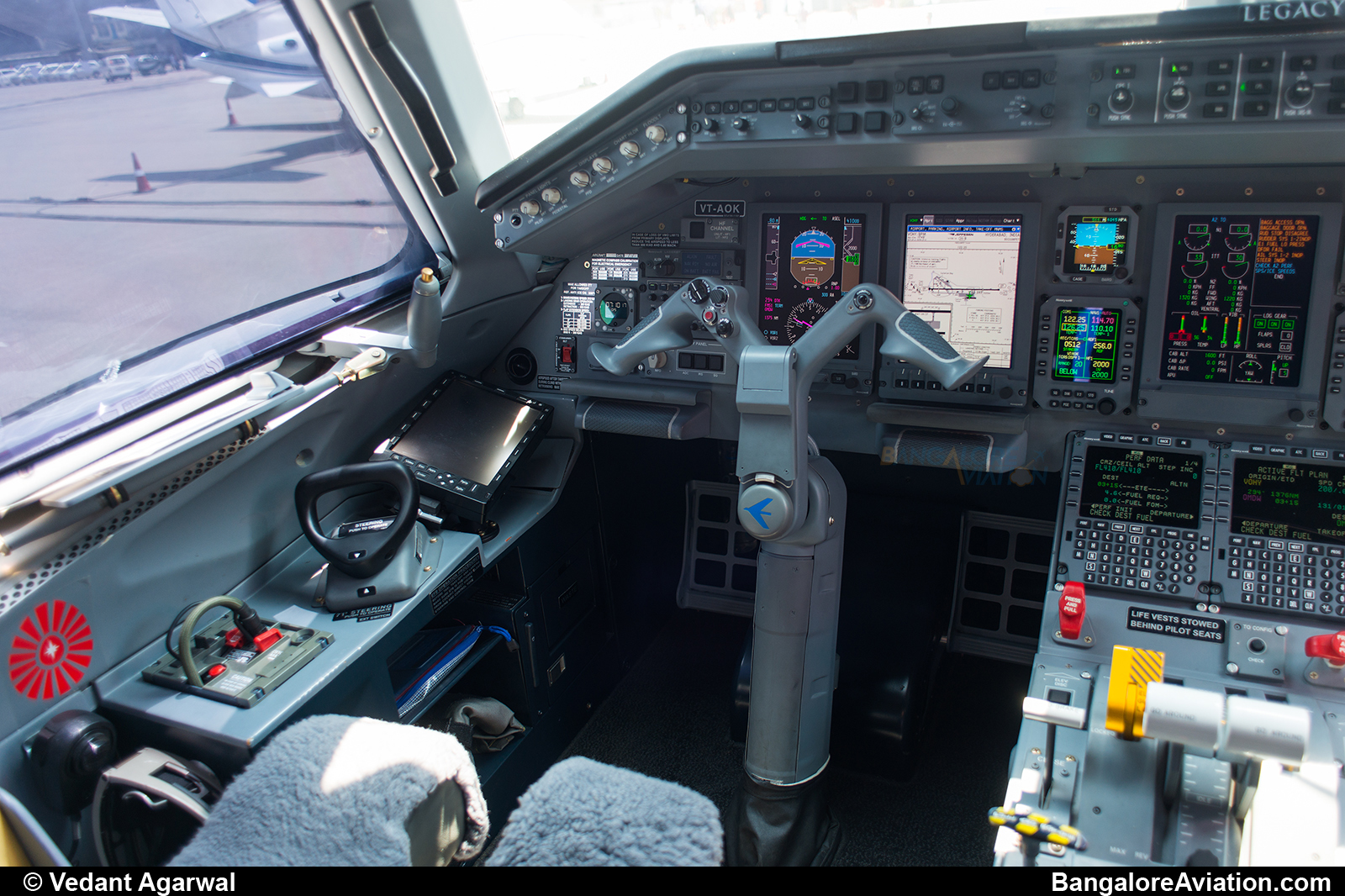
The footrest is below the white screen with the navigational chart on it. The radio and transponder panel is the black screen to the right of that, with the yellow and green text on it. The 0512 is your transponder code (squawk); the button to the left of that and down one row turns it off.

This resulted in the Legacy losing its TCAS ability, and the 737 it collided with being unable to see the Legacy.

Re:In 2009, Two Nuclear Submarines Collided Under the Sea (2... by etimberg on Monday August 30, 2021 @12:27PM (#28357391)
I believe TCAS is built off of ADS-B which is terribly insecure https://youtu.be/CXv1j3GbgLk
Re:In 2009, Two Nuclear Submarines Collided Under the Sea (2... by jrockway on Monday August 30, 2021 @09:31PM (#28363017)
TCAS isn't built off of ADS-B (it existed long before ADS-B was ever conceived), but it's the same basic idea (mode c / mode s transponders) and probably has the same theoretical security vulnerabilities.

There's a pilot at the controls so that the technology doesn't have to be perfectly secure.

If you want to walk around broadcasting fake ADS-B or Mode C signals, someone will probably find you in hours, and the only effect it will have is maybe reducing the throughput of the busiest airports if the weather happens to be particularly marginal that day.

Re:In 2009, Two Nuclear Submarines Collided Under the Sea (2... by wil421 on Monday August 30, 2021 @11:20AM (#28356494)
You don’t need drones. Planes and helicopters already drop sonar buoys for the exact reason you stated.

A better solution would be for an escort when they get into crowded lanes. Surface ships can use active sonar to scan for other subs while being some what close to their sub. The only problem is other listeners can pick up on what is reflecting off your active sonar as well. Also the subs try to avoid ever being detected because they can save your signature for comparison later.

Re:In 2009, Two Nuclear Submarines Collided Under the Sea (2... by nradov on Monday August 30, 2021 @12:14PM (#28357220)
It's not like any navy has spare surface warships with active sonar available to escort submarines through constricted navigational channels. There are also environmental concerns with active sonar due to impacts on marine life, especially cetaceans. During peacetime it's usually only allowed in designated exercise areas.
Re:In 2009, Two Nuclear Submarines Collided Under the Sea (2... by wil421 on Monday August 30, 2021 @04:15PM (#28360381)
I have sonar on my kayak. You can certainly use a power that is not going to hurt sea creatures. A lot of Navy ships including submarines have off the shelf sonar as well as military sonar. I’ve seen a pic of a sub with Raymarine radar they use when surfaced in channels. The subs don’t want to use their own military grade stuff because then the enemies have the frequency signature so they use off the shelf for navigating in public areas.
Re:In 2009, Two Nuclear Submarines Collided Under the Sea (2... by nradov on Monday August 30, 2021 @04:45PM (#28360679)
That's simply not how it works. The active sonar on your kayak has nowhere near enough power or resolution to detect a military submarine at sufficient range for reliable collision avoidance. Due to the inverse square law, active sonars have to put out a huge amount of power to detect submarines at any useful range. This is a proven risk to marine life.

https://www.frontiersin.org/articles/10.3389/fmars.2017.0029...

Re:In 2009, Two Nuclear Submarines Collided Under the Sea (2... by wil421 on Monday August 30, 2021 @06:19PM (#28361566)
The escort ships would know exactly where the sub they are escorting is. They could easy see the bottom or a massive blob passing underneath (an unknown sub) or even an undersea mountain. You don’t need enough resolution to tell if it’s a sub or even a whale you just need enough to say watch out.

My middle of the road Garmin can see 1,100 feet deep in salt and side scan 500 feet in either direction. You can see bottom features and schooling fish. The higher end stuff is so much better.

Re:In 2009, Two Nuclear Submarines Collided Under the Sea (2... by nradov on Monday August 30, 2021 @09:13PM (#28362915)
You're really missing the point. No navy would ever assign one of their limited number of surface warships to that mission. There aren't enough to go around. And if a ship detects a massive blob passing underneath it's already too late. 1,100 feet isn't nearly enough range for collision avoidance; a ballistic missile submarine can't turn on a dime and a collision risk can come from any direction including astern. None of your suggestions are even remotely practical in the real world.

When submarines actually need to be sure of avoiding collisions they just run on the surface and follow the same rules of the road as any other vessel.

Re:In 2009, Two Nuclear Submarines Collided Under the Sea (2... by bell-cot on Monday August 30, 2021 @09:55PM (#28363149)
I suspect that wil421's idea is that the "near-harbor escort" job does not need anything near so grand as a surface warship. A low-end tugboat or similar would more than suffice.
Re:In 2009, Two Nuclear Submarines Collided Under the Sea (2... by imwillofficial on Monday August 30, 2021 @09:59PM (#28363169)
Surface ships often escort subs in dangerous waters.

Ref: Dolphin wearing submariner.

Edit: Removed extraneous statements.

Re:In 2009, Two Nuclear Submarines Collided Under the Sea (2... by imwillofficial on Monday August 30, 2021 @09:57PM (#28363161)
No the escort ships do not know exactly where the sub is.

On my first submarine duty, we nearly surfaced right in the path of our escort. We had to dive hard to avoid getting run over. “Clearing baffles” is not an exact science.

Re:In 2009, Two Nuclear Submarines Collided Under the Sea (2... by bell-cot on Monday August 30, 2021 @10:28PM (#28363308)
If the surface escort (whether a fancy warship, or a modest Harbor Patrol boat) was running a cheap commercial sonar set in active mode, and the sub's orders were "stay right under your escort, so long as its course seems reasonable" - with details of 'reasonable' spelled out in written orders - would that be easy to execute without incident?
Re:In 2009, Two Nuclear Submarines Collided Under the Sea (2... by imwillofficial on Tuesday August 31, 2021 @09:38AM (#28367911)
Short answer to your question is no.

Longer answer: A cheap commercial sonar isn’t going to find a submarine, even if you know where you’re looking. Submarines are incredible stealthy, and the ocean greatly effects sonar effectiveness, especially from the surface. Due to how it works, surface sonar is nearly useless when trying to locate a submarine.

A popular joke was for us to surface right in the middle of a fleet during war games, or sneak up behind them and take pictures of people smoking and send them to the surface ship’s captain just to mess with them.

With things like towed sonar arrays, and sonar bouys, the playing field can be evened out a bit, but in all the war games I was in, the surface guys could not find us even we told them exactly where we were.

Now imagine that, with an inexperienced submarine crew doing testing, and a surface ship practically incapable of keeping track of us…

“CON, ESM, EMERGENCY DEEP! Hold high signal strength contact bearing 087!”

Re:In 2009, Two Nuclear Submarines Collided Under the Sea (2... by bell-cot on Tuesday August 31, 2021 @12:38PM (#28370221)
I'm thinking more of a busy shipping area, and the essential mission is only to provide a surface exclusion zone, which a submarine could take advantage of as it (say) enters / leaves a harbor. The sonar's job is to broadcast a "your (say) Coast Guard Auxiliary moving exclusion zone is right here" signal to the sub's passive listening equipment. The CG Auxiliary guys up top don't even know if a real submarine is in the area - vs. a practice mission, or maybe the Navy is sailing a cheap decoy past some Russian fishing boat that's lingering where it ain't welcome.

(From exDM69's comment, I'll figure that the active sonar's power needs to be dialed way down. The theory that a sub's fancy listening gear could get a good fix on a sonar signal that's too weak to give a usable reflection seems hand-wave plausible to a landlubber.)

Re:In 2009, Two Nuclear Submarines Collided Under the Sea (2... by imwillofficial on Wednesday September 01, 2021 @02:25AM (#28376939)
Sonar has to hit something and bounce back.

Detecting sonar doesn’t.

No hand waving needed.

When transiting places like that, there is either an escort, or the sub is surfaced, or the sub moves reaaally carefully. All depends on the mission.

Check out the book “Blind Man’s Bluff” for more info.

Re:In 2009, Two Nuclear Submarines Collided Under the Sea (2... by exDM69 on Tuesday August 31, 2021 @01:49AM (#28364377)
That would avoid incident but the sub might as well run surfaced with active sonar on.

The active sonar from the escort would reveal the sub it is escorting to any passive observers. It would need a directional sonar (not a cheap commercial sonar) and avoiding prop noise that can also reflect off the sub.

And if all subs were escorted this way, the navies of adversaries would quickly pick up this habit.

Re:In 2009, Two Nuclear Submarines Collided Under the Sea (2... by trhway on Monday August 30, 2021 @06:37PM (#28361748)
USSR concept of naval bastions

https://en.wikipedia.org/wiki/Bastion_(naval)

>If someone wanted to locate enemy submarines, surely they could just send a bunch of underwater drones to swim through these parking spots?

back then it were US attack submarines which USSR tried to actively track and push out of the bastions.

Re:In 2009, Two Nuclear Submarines Collided Under the Sea (2... by NickNameNick on Monday August 30, 2021 @09:53PM (#28363131)
Clearly with limited success -

That article links to https://en.wikipedia.org/wiki/Submarine_incident_off_Kola_Pe...

Which in turn links to https://en.wikipedia.org/wiki/Submarine_incident_off_Kildin_...

So there have been at least two other submarine collisions.

Re:In 2009, Two Nuclear Submarines Collided Under the Sea (2... by yborg on Monday August 30, 2021 @11:22AM (#28356502)
How are the drones going to detect them apart from randomly running into them? Simpler approach is for an adversary to just cruise attack boats through these areas, which you would want to do anyway since once you detect them you want to sink them in wartime.
Re:In 2009, Two Nuclear Submarines Collided Under the Sea (2... by feral on Monday August 30, 2021 @11:30AM (#28356603)
> How are the drones going to detect them apart from randomly running into them?

In this context the idea would be that drones can use active sonar, because they are relatively expendable.

Re:In 2009, Two Nuclear Submarines Collided Under the Sea (2... by earthbee on Monday August 30, 2021 @11:29AM (#28356593)
If the passive sonar filling the entire nose of a huge submarine can't hear another submarine, why would a much smaller sonar in the nose of a drone be able to detect a submarine?
Re:In 2009, Two Nuclear Submarines Collided Under the Sea (2... by feral on Monday August 30, 2021 @11:31AM (#28356630)
Because it could be active?
Re:In 2009, Two Nuclear Submarines Collided Under the Sea (2... by earthbee on Monday August 30, 2021 @11:45AM (#28356827)
Then you could hear them coming and avoid them
Re:In 2009, Two Nuclear Submarines Collided Under the Sea (2... by omni on Monday August 30, 2021 @11:58AM (#28356981)
If you can hear them, they've already found you
Re:In 2009, Two Nuclear Submarines Collided Under the Sea (2... by gpm on Monday August 30, 2021 @12:05PM (#28357082)
Surely not.

The submarine with the larger more sensitive instruments in a quieter environment ought to be able to detect sound levels below that which their active opposition can.

If X amount of noise-energy hits the submarine, it only reflects Y<X of that energy, and only Z<Y of that reflection goes in the right direction to be detected by the opposition. The noise should be louder at the submarine, than at the thing detecting the submarine.

Both of these weigh in favor of the submarine detecting the searcher before the searcher detects the submarine.

Re:In 2009, Two Nuclear Submarines Collided Under the Sea (2... by addingnumbers on Monday August 30, 2021 @12:42PM (#28357623)
... so the sub discovers the active buoy 0.66 seconds sooner for every kilometer of distance between them.

I don't imagine that knowing you'll be detected 40 seconds before they know you've been detected changes the tactical situation a whole lot.

Re:In 2009, Two Nuclear Submarines Collided Under the Sea (2... by gpm on Monday August 30, 2021 @01:10PM (#28358056)
No, nothing I was talking about was related to the speed of sound in water (which is where I assume you're getting 0.66 seconds/km, since it's about right). I agree the speed of signal propagation seems unlikely to matter much in most situations.
Re:In 2009, Two Nuclear Submarines Collided Under the Sea (2... by addingnumbers on Monday August 30, 2021 @01:28PM (#28358341)
My point is in this scenario there's no appreciable difference between "if you can hear them, they've already found you" and "if you can hear them, they'll find you in 40 seconds"

The observation that they are "detecting the searcher before the searcher detects the submarine" is academic and inconsequential when we're talking about such a negligible amount of time between detections.

Re:In 2009, Two Nuclear Submarines Collided Under the Sea (2... by gpm on Monday August 30, 2021 @01:42PM (#28358531)
But there is an appreciable difference between "if you can hear them, they've already found you", and "if you can hear them, they might never find you because you can see them looking from farther away than they can see, and they might just be outright searching the wrong area".

All my arguments went to the latter kind of problem, not the former. Your 40 seconds number seems to be based on the speed of signal propagation, not the range at which things can be detected.

Even in the event where they do find you, the arguments I gave would suggest that it would take vastly longer than the speed of signal propogation to do so, because they would have to move closer to you. Giving you substantially more notice than 40 seconds.

Re:In 2009, Two Nuclear Submarines Collided Under the Sea (2... by addingnumbers on Monday August 30, 2021 @02:02PM (#28358804)
I see where you're coming from. Good points.

I was taking it for granted that knowing the location of an unmanned, expendable sonar buoy or probe before you're discovered is not tactically important.

Now that you have me thinking, it would clearly allow you to stay out of detection range if you had the good fortune for their pings to initiate within your detection range but outside theirs.

Re:In 2009, Two Nuclear Submarines Collided Under the Sea (2... by imwillofficial on Monday August 30, 2021 @10:01PM (#28363179)
Not only your own detection range, but those of other vessels and listening stations that are aligned with you.
Re:In 2009, Two Nuclear Submarines Collided Under the Sea (2... by omni on Monday August 30, 2021 @12:38PM (#28357562)
I'm fully willing to admit I'm talking out my ass here, but does it not make sense to assume that both a) the active drones are going to be much faster than a submarine trying to maintain silence, and b) there are likely to be many drones converging from different directions if they're searching a known submarine parking spot? Still seems like advantage drones to me
Re:In 2009, Two Nuclear Submarines Collided Under the Sea (2... by gpm on Monday August 30, 2021 @01:13PM (#28358103)
I'm not more of an expert of submarine tactics than you are, I was just taking issue with the physical claim that they already know where you are by the time you hear them.
Re:In 2009, Two Nuclear Submarines Collided Under the Sea (2... by imwillofficial on Monday August 30, 2021 @10:02PM (#28363190)
No such thing as a sub parking spot. Think of the ocean and sound conductance like layers of a cake.

I’m sure drones will get there, but right now advantage is the subs

Re:In 2009, Two Nuclear Submarines Collided Under the Sea (2... by kragen on Monday August 30, 2021 @07:43PM (#28362300)
The path loss for active sonar is, logarithmically, twice the path loss for passive sonar. If the signal is 0 dB at 1 meter, it will be -40 dB at 10 km away (barring SOFAR, a regions these submarines probably try to avoid, and ignoring the reflections off the surface and seafloor), and the reflection (assuming an isotropic reflector) will be -80 dB. At 100 km, it's -50 dB and -100 dB.

So, if both sides can detect a -50 dB signal, the passive-sonar target will be able to detect the active-sonar probe 100 km away, while the active-sonar target will be able to detect the reflection from the passive-sonar reflector 0.316 km away. Or maybe 0.315. And that's assuming perfect discrimination.

(By transmitting a signal you can barely detect, you can reduce this discrepancy: if you reduce the signal amplitude by 30 dB at 1 m in this example, the probe can detect the target at 10 m, or maybe 11 m, but the target can't detect it until they're within 100 m.)

However, this massive advantage for passive sonar only really true if it's just as easy for the target to recognize the signal as it is for the probe. In fact, the probe has a huge advantage: it knows what the signal was. If it's just an ordinary chirp, this is of no help, because that's easy to recognize, unless you confuse it for a humpback whale song or something. But if it's Gaussian white noise, it's impossible for a single hydrophone to distinguish from the background noise of the ocean, except by amplitude. Advantage: probe.

But that's a single hydrophone. In fact, though, a point source of white noise is the easiest thing for a phased-array beamforming passive-sonar system to localize. The Triomphant is 138 m long, so if you stuck hydrophones all along its length, you could detect directional sources of sound with an angular precision of about λ/d, the one-dimensional Airy limit. The λ for your active sonar needs to be chosen to be small with respect to the targets you're looking at so it doesn't just diffract around them, so this is probably on the order of 0.1 radians, about 5 degrees.

Two can play that game, though, or thousands. The network of tiny drones can form a single ocean-sized phased array by squirting data back and forth over short-range ultrasound or laser links.

But guess who already has ocean-sized phased arrays of hydrophones for passive sonar?

sca4 posted this very worthwhile link, which talks a bit more about the scene: https://www.aspistrategist.org.au/prospects-for-game-changer...

Re:In 2009, Two Nuclear Submarines Collided Under the Sea (2... by gpm on Monday August 30, 2021 @10:08PM (#28363214)
> barring SOFAR, a regions these submarines probably try to avoid, and ignoring the reflections off the surface and seafloor

For anyone wondering what is being discussed here, this is a great document (SOFAR is a sound channel): https://man.fas.org/dod-101/navy/docs/es310/SNR_PROP/snr_pro...

Turns out sonar signals don't actually move in straight lines...

Re:In 2009, Two Nuclear Submarines Collided Under the Sea (2... by kragen on Wednesday September 01, 2021 @04:32AM (#28377543)
I meant "a region", not "a regions". Oops.

Thanks for the FAS link!