Since then they have taken even more control of the media, diverted the majority of EU and state funds to loyal businessmen (a regular gas-fitter became the wealthiest man in the country in a few short years, believed to be the straw man of Orban himself), filled all major positions with their own people (including most recently the high court), created laws directly against the civil society and LMBTQ+ people, stopped most of the funding to towns that have elected politicians from the opposition, taken control of all universities and actively worked on getting rid of CEU (one of the best, independent university, which was criticised due to being funded by George Soros), signed secret business deals for enormous amounts of money with Chinese and Russian interests that will almost certainly never be beneficial for Hungary, etc.
The comparison to Belarus is not correct in the sense that in Hungary violence has not been used (fortunately), but apart from that the governing party has done everything else they can to keep their power and crush everyone else.
Think the figures are somewhat higher: Party/FPTP: 49.27%/47.89% [0]
[0] https://en.wikipedia.org/wiki/2018_Hungarian_parliamentary_e...
The point is the same though: due to the nature of the Hungarian voting system, the winner can easily get more mandates than what would follow from the raw results, and this is why it is beneficial to manipulate the voting areas.
- The UK has got a bunch of boundary changes queued up that have been pending for years, which will benefit the ruling party. It sounds bad when put like that, however the boundary changes themselves were recalculated using census data (I think) in a neutral way, so although it helps the ruling party that isn't what led to the changes.
- It's hard to understand for a non Hungarian exactly what the voting rule changes might be about, but it sounds like it may be related to postal voting (people in neighbouring regions can go there physically). A lot of countries either restrict or want to restrict postal voting because it's drastically more susceptible to fraud, and there are constant allegations that left wing parties in particular like to abuse postal voting. Again the UK has exactly the same problem and some conservative MPs want to tighten the rules over who may vote postally due to a string of scandals related to it.
- Using the state to fund their own political campaigns. Again, any consistent standard that said this is evil would need to have considered the UK a rogue state in 2016, because the government at the time used vast sums of government money to fund the campaign to remain in the EU. For example the government sent a mailshot to everyone in the entire country, which alone cost more than the theoretical spending limit for the entire campaign. Government resources were routinely deployed in other ways to try and win the vote. Yet unsurprisingly, nobody in the EU complained at the time.
- "Gradually taking control of all media outlets" sounds like a reference to supporters of Orban coming into editorial positions rather than the government literally passing a law that gives Fidesz direct control over the press. Is that not so? In which case, under what standard can that be described as illegitimate? European media is totally dominated by supporters of the EU Commission and centre-left parties to the extent that in some parts of Europe, Eurosceptic conservative media hardly exists at all. Clearly the same thing has happened with different political movements in other parts of the world.
- Filling major positions with their own people and other such things, that's exactly what governments are meant to do. It's a necessary step in order to govern, in fact. No government can run a country if all major positions are controlled by people who oppose the government. Again, the UK is an interesting counter-point: it has major constitutional problems due to the lack of the government doing this, with the result that various organizations that are technically parts of the government are run by people who see themselves as some kind of quasi-official opposition, and who constantly try to undermine the actual elected government instead of doing their job.
There were several businessmen who became extremely wealthy within a very short period, either by working directly for the government (usually with all the typical signs of corruption), or by getting financed directly or indirectly by the government in the form of huge free loans, grants, etc. These businessmen then started buying different media outlets, some of which were 'usual' business transactions, while others were very nasty stories in themselves (the ownership change of the news site Index.hu was probably the biggest scandal). At some point all of these supposedly independent businessmen decided to give away ALL of the media companies they owned for free to a new non-profit entity. This transaction was given a special exemption by the government from all the usual checks and requirements (like antitrust), even though hundreds of media outlets were concentrated in a single entity, which now governs the majority of print newspapers and radio stations. Since this has happened, all of them transfer exactly the same messages - for example look at the following picture to see the front page of the 19 or so county news sites the day before the last election, where the headline says "Both votes for Fidesz!". These used to have independent editorial boards and focused on local news previously.
https://assets.4cdn.hu/kraken/78sQpRcFFKsevwZIs.jpeg
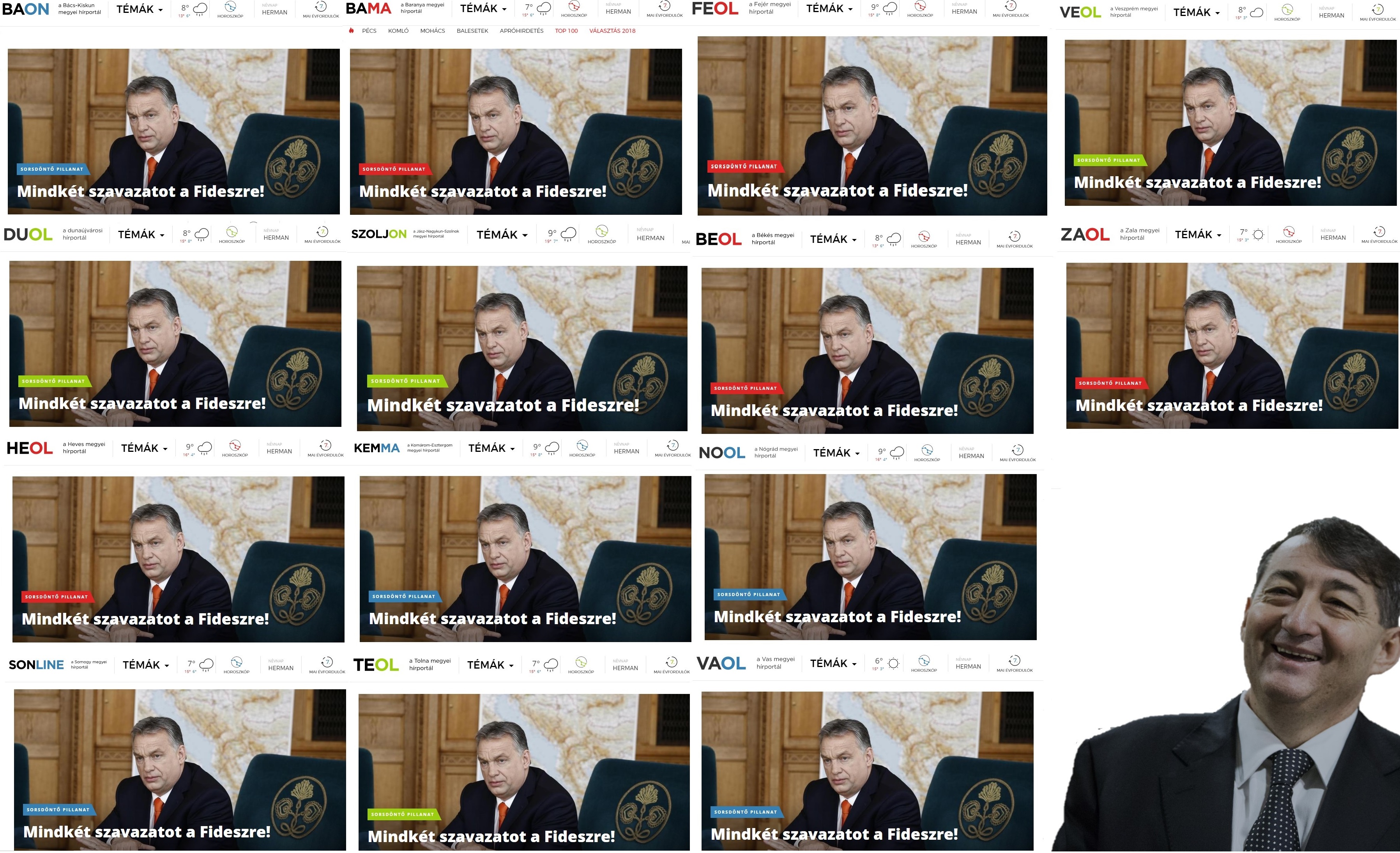
The state-owned national media holding MTVA (like the BBC in the UK), which of course is supposed to give an unbiased view of the world, also transfers exactly the same messages - there were several scandals where it became public that even senior editors had to send their content for review to Fidesz's people for review, and they got detailed instructions on what and how to say.
Viktor Orban, the prime minister for 10 years, refuses to answer questions or give interviews to any media that is considered to be 'the opposition', even the sites with the highest number of daily readers. At the same time members of the opposition parties are given close-to-0 airtime on the state-owned national channels, and even when they are shown, it is in a negative context.
The national media regulatory body does not check any of the previous issues, but they have been very active for example in revoking the license of one of the last non-Fidesz-friendly radio stations (Klubradio) recently, which also became a scandal.
The work of journalist is made more and more difficult because the state refuses to give information to them or even answer basic questions - for example during the corona virus epidemic, Hungary had by far the least informative site on the topic, yet it was filled with propaganda news. For example to create a chart of the daily cases, journalists had to manually check the site every day and save the currently shown numbers. In order to get a breakdown per county about the cases, they had to submit an official inquiry, where first they said that such data is not available (!), then used all 45+45=90 days to give an answer. Of course the answer only contained the data for the time period when the questions was sent, so it was basically impossible to get up-to-date information.
Viktor Orban still frequently uses the same defence that "they are working in an unfriendly media environment and only try to restore balance", but that is simply not true.
"Belorussian-style regime", to name a few:
- control of state media packed with non-stop propaganda
- openly friendly towards dictators / other regimes
- suppressive, openly anti-liberal laws
> - openly friendly towards dictators / other regimes
Trump cuddling with Kim-Jong Un and being a good buddy of Putins.
> - suppressive, openly anti-liberal laws
US Republicans are working on overturning Roe v. Wade, opening the door to more anti-liberal laws. Heck, in some states, women have to drive hundreds of miles to the next abortion clinic and risk getting intimidated by big guys with guns on their way in. Cause freedom.
> - control of state media packed with non-stop propaganda
I give you that, the non-stop propaganda in the US is privatized, e.g. Fox News, Washington Post, OANN, MSNBC, etc. Still propaganda.
This is not Hungary and we are heading towards the opposite direction.
Hungary is not worse than the rest.
You are partially right: they won the elections conclusively. However, their supermajority was due to fraud. I am not even sure whether that can even be called "allegations" at this point, it's more like "everyone knew on election night already but what could you do".
I think the best description of the events in English can be found at https://www.unhackdemocracy.eu/en/investigation Summary:
> Unhack Democracy’s year-long investigation into the April 2018 Hungarian Parliamentary elections indicates Prime Minister Viktor Orbán secured his one-seat supermajority thanks to a combination of outright fraud, gerrymandering and by engineering the electoral system.
> Our findings reveal extensive polling station irregularities including forged voter logs and intimidation of ballot counters; a suspicious ticket splitting rate twice as likely in areas where there we no opposition delegates; electoral clientelism involving large-scale vote buying and intimidation of voters, the unlawful transportation of voters from Ukraine, Romania and Serbia; missing absentee ballots; and a mysterious failure of national election software.
And the full version goes into "fake" parties and more.
https://en.wikipedia.org/wiki/Elections_in_Hungary#The_votin...
“Belorussian style regime” I assume is in reference to freedom of press/expression/artists/minorities etc in the country.
As much as I would like this to be true, I don't think it is. In practice - and to a certain extent also in theory, if you at least add add some nuance - in every democratic country the majority has power to decide who's granted full rights and value, and who isn't (think of voting rights for inmates or immigrants, right to be elected, right to obtain a job etc.). Even when the constitution sets those rights "in stone", a vast majority has the legal right to change the constitution.
Update: part of the nuance is that democracies won't technically change the value of a person, to use your term. But by removing their rights, the effects are hardly different.
AFAIK Lukashenko also has some no-fraud elections under his belt. You don't need an election fraud to go from a democracy to a dictatorship.
To be honest, my comment was mostly a jab at the GP for their touch anxiety when using the word “liberal”, although it’s less obvious now, when their followup comment is dead.
In Orban like states you loose that free access to all media and you are forced into the state one.
For those that are not aware countries that were under former Soviet boots all have a state television, which is the default source of information for older people (they are used to it), whichever party wins the elections sets up this TV broadcast to their liking.
All other TV broadcasters need to have a special privilege approved by the state - do you see what can happen here?
Most countries in the world have state-owned television.
> In Orban like states you loose that free access to all media and you are forced into the state one.
So many people own smartphones and have internet access. Even older ones, who learn to use them faster than PCs. People can consume whatever media they want. And people can certainly teach their parents how to consume non-government news.
> So many people own smartphones and have internet access. Even older ones, who learn to use them faster than PCs. People can consume whatever media they want. And people can certainly teach their parents how to consume non-government news.
Still not everyone has access to the internet, especially in rural areas. For some people the only news source is television and the radio, both which are predominantly owned by the government.
Now all the major opposition parties have united into a single electoral slate for the next election. Primary elections are being held for the first time to determine the compositions of the electoral slate. One minor problem is that the coalition would be very incongruous. But hey, still gonna vote for them (personal opinion).
But while it is not a dictatorship, it is, as Orbán himself puts it, an "illiberal democracy". And the government's attitudes and laws create a ton of problems. And that's not even getting into the corruption and so on...
- The election system has been changed in a way that overcompensates the winner. Fidesz is supported by about 50% of the voting population, yet it has a 2/3-s supermajority which enables them to pass any law they wish without any resistance.
- Fidesz has built up a MASSIVE database of the voting population over the years, basically they can tell the voting preferences for each home address. There is video evidence of this, I am not talking out of my ass.
- Based on this database large scale gerrymandering took place in the past years.
- The governing body overseeing the elections is run by long standing Fidesz cadres. Many polling districts especially in rural areas only had Fidesz-affiliated polling-clerks during the last election.
- Thousands if not tens of thousands of Ukrainian citizens (many of whom have Hungarian ancestry, but many do not) have been registered in the Eastern part of the country with voting rights. They are eligible for pensions multiple times the amount they would receive from the Ukrainian government because of an old agreement made bw the Soviet Union and Hungary. In exchange they are voting for Fidesz. Again, this may sound like bullshit, but it is a documented fact.
- Small cities are told that they won't get any EU funding from the government if they elect a non-Fidesz mayor.
- There is a massive amount of very poor people dependent on government distributed "public work" in the countryside. It's basically modern day servitude. These people are also often threatened that if they vote the "wrong way" they will not get work.
- Most of the relevant news outlets (TV, Radio, Newspapers, online media) are owned by Fidesz-frienly businesspeople and they are in 24-7 propaganda mode. I am talking about 1950-s style Stalinist propaganda, not some kind of "pro-government bias". There have been by now basically one TV station and a handful of small websites left that are not controlled by Fidesz.
- And add to that that any opposition leader, any journalist critical towards Fidesz or any businessman who is not part of their circles can be monitored by these spy softwares and then you will understand what the term "hybrid regime" stands for.
Yes there are elections every four years, but they are just for show.
Afaik Orban's party has won the last rounds of elections pretty conclusively, with no fraud allegations involved (unlike what currently happens in the US, I'm talking about election fraud allegations). What's with this "Belorussian-style regime" nonsense?