To be clear this "legal authorization or protection" is not necessarily over regulation. Depending on the market, sometimes monopolies are the result of too much government regulation and sometimes they are the result of not enough government regulation. For example, most of the big tech monopolies do not exist because of regulatory capture. They exist because the government never put in enough effort to stop the monopolies from forming.
Is it possible they exist because the immense economies of scale and near zero marginal cost that software provides makes for a winner take all market?
As a customer, why would one use the 2nd best option, when the best option is available at no extra cost or very little cost?
Their ad system was pretty much ported from FB, one assumes, and their ads were sold by FB reps as part of a package.
I honestly don't know if they would have made it independently (and we'll never know, I guess).
The snapchat thing was different. Snap had a policy of focusing on iOS, while FB, IG and Whatsapp (all of which cloned their core feature) were available on Android. I personally think Snapchat shot themselves in the foot with bad product strategy.
And look at TikTok. They are definitely the biggest competitor FB have ever faced, so I'd imagine that the future competitive landscape for them looks much more difficult than the past.
Seems to have worked out poorly for them.
I'm not convinced by this assumption as i've seen contrary evidence. I've seen monopolies doing a great job, and i've seen competition destroy quality of service and price.
I would agree that the government needs to mitigate private actors. This regulation can take the form of splitting a monopoly but it can also take the form of keeping it a monopoly and regulating it by having a presence on the Board or through law.
The idea that we need multiple groups of people working on solving the same goal concurrently doesn't strike me of a one-size-fits-all approach. Multiple competing restaurants in a town is probably the way to go. Having virtual operators on the back of one physical infra as is the case with phone carriers for instance I would say is probably causing lots of overheads. I've seen it first hand from the inside. Turns out it's really complex to virtualize infra and have tenant-based billing. The only real difference is now you have 5 companies competing on marketing and offers on top of the same physical reality. Marketing costs can't vanish so the consumer is losing that money one way or another
A consumer shouldn't chhose the second if they don't want to. But governments should step in to ensure that the market remains competetive.
I think all monopolies are violence enforced or they are competitive otherwise somebody would step in and undercut their costs and the government has a monopoly on violence so...
It's reasonable to conclude that Facebook and Twitter have benefitted greatly by not having expenses to properly monitor their platform due to section 230 safe harbor exemption. They are able to get away with selective enforcement on their platform and not pay a monetary penalty for doing so.
That's a real issue to be addressed, but generally I agree that making it easier for people to help other people is better than throwing up obstacles.
I think that was better for most cases.
And with the lack of certification requirement, someone will start cutting corners to make an extra chunk of profit. Just imagine a faulty hearing aid that fails while a person is driving, and the person causing an accident as a result. Good luck suing anyone over that one. Or people mis-tuning hearing aids leading to more damage than before.
Another thing I can easily imagine is unscrupulous manufacturers using banned chemicals to manufacture the hearing aids. We have enough of this sort of shenanigans with nickel allergies in jewelry.
And why wouldn't someone be able to sue successfully?
Deaf people still are unable to properly hear so are more unsafe when driving. They're legally allowed to do so because of deaf people lobbying legislators to force them to be allowed to do so.
For this to be a real danger, either the driver would have to not notice that they suddenly couldn’t hear anything, or the faulty hearing aid would have to pass through some sounds but not others. Both of those scenarios seem pretty unlikely.
Meanwhile, from some quick googling, it seems to be common for completely deaf people to drive; apparently there are devices that can translate sirens and such into visual cues, but such devices are not universally used. To be fair, it’s a bit different if you’re not expecting it or practiced at it.
https://www.npr.org/podcasts/381444600/marketplace
https://www.bose.com/en_us/products/headphones/earbuds/sound...
Only $850? That is a new use of the word only as far as I'm concerned. These things, which are in many ways similar to if not identical with bluetooth earbuds should not cost more than those - and given the fact that Apple managed to convince people that $200 is a normal price for these things that should leave more than enough margin for an unhealthy profit margin seeing as how the ones I'm using cost ⅐ of that while achieving a longer battery life.
There was an IndiGogo project aiming to produce 2-in-1 earbuds/hearing aids, it was funded in 15 minutes...
https://www.indiegogo.com/projects/olive-pro-2-in-1-hearing-...
Having hearing aids myself, the big thing is amplifying the sound without the noise. The device needs to figure out what to focus on. If I'm in a restaurant with lots of background noise and people talking, what should be amplified. Most hearing aids use multiple microphones and program settings to identify what to focus on. And there are different kinds of noise like car engine noise or HVAC noise. And don't forget the wind noise on the microphone when you are walking. Also hearing aids compress the dynamic range and frequencies to extend the range of hearing to improve comprehension. And if there is a sudden loud noise it shouldn't go beyond a comfortable power level.
Yes, a hearing aid is not the same as a noise-cancelling earbud, they use different algorithms and the former needs to be more configurable than the latter. Then again, this functionality is implemented in firmware and uses common audio processing algorithms on off-the-shelf low-power DSPs, just like those noise-cancelling earbuds. The IndieGogo example I mentioned seems to be able to sell a pair of multi-purpose buds for around $250 a pair, $600 for 3 pairs. Assuming they are actually making a profit on these sales - and I don't see why they wouldn't, the hardware seems quite standard for noise-cancelling earbuds - this is proof of what I stated before and gives lie to the "overhead" excuse for the high mark-up, especially given the small size of the company behind the things. Of course I do not know whether the buds sold through IndieGogo are as capable hearing aids as "regular, overpriced" ones and I do notice that the stated running time (18 hours) is that of the buds and the charging case together - the buds themselves last for 7 hours between charges. They're specified for "mild ~ moderately-severe hearing loss" and seem to have the required amplification and equalizing capabilities [1]. Maybe give them a try? I don't need hearing aids myself but my mother does use them so I'm thinking about getting her a pair of these once her current pair is in need of replacement.
[1] https://c1.iggcdn.com/indiegogo-media-prod-cld/image/upload/...
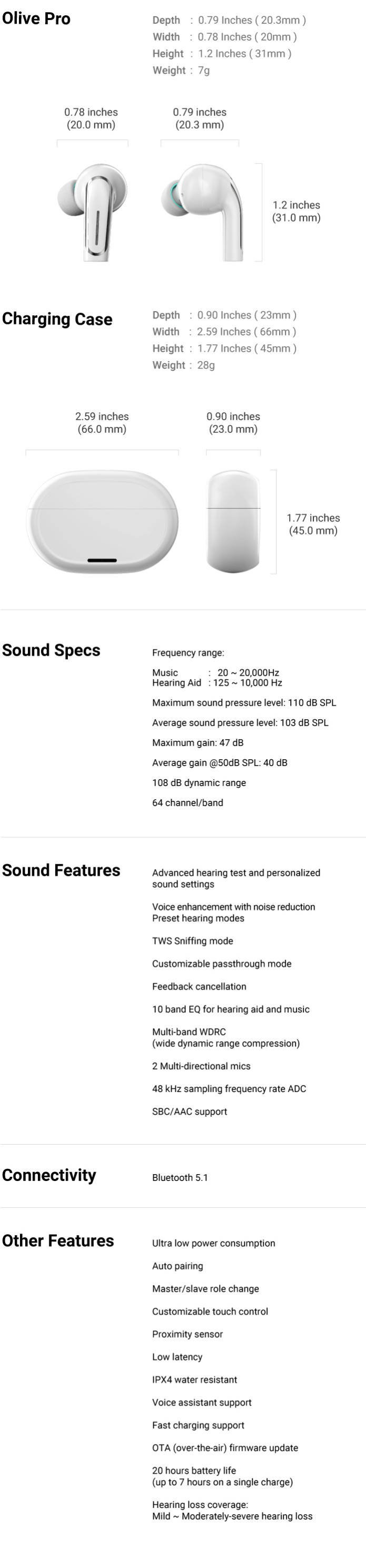
Good hearing aids are also environmentally aware. They will adjust the amplification to be different in a car, bus, and quiet conference room. Cheap hearing aids rarely do this well. There is a very drastic difference between 800 dollar hearing aids and 10,000 aids. Trust me, I’ve tried both of them.
At best these Bluetooth headphones / earbuds you mention can just make all noises louder, across all environments. That helps a bit but it is not the same as what a good pair of hearing aids can do today.
At Costco you can get what seem to be high end hearing aids for $699 each. The current generation are rechargeable and support bluetooth. This includes the free hearing test free fitting ("real ear", which is current best practice) and followup so long as you have a membership.
The key thing that is lacking is a decent app or api for me to write my own. Oh, that and phone conversations using the hearing aid's bluetooth is pretty bad.
The gap between "too soft, doesn't help you hear" and "too loud, damages your hearing" can be narrow.
Usually it's more of a problem in the other direction, with doctors playing it safe and tamping down the aid to the point of uselessness.
Or something.
There are already dozens of companies making them:
https://www.amazon.com/Hearing-Amplifiers/b?ie=UTF8&node=377...
The entire point of patents...
Well, if that were so, you would expect them to be secret and to never expire. The fact that are published and expire after a relatively short period belies the simplicity of that statement.
I mean, we have CEOs of biomedical companies admitting that they aren't basing prices off of what it costs to research, develop, and deliver a therapy, but rather base it off of what a deaparare person is willing to pay for it. This is the very thing antitrust laws were supposed to prevent, but the patent system is used to create a similar environment.
Since the problem seems to come a lot, maybe the problem is the role of money in politics and we should address the root cause. Just a thought.
Sure some protection is necessary. You could make it based on development costs and have much shorter times for things that were cheap to do.
"maybe the problem is the role of money in politics and we should address the root cause. "
There are a lot of problems in politics that should be fixed - rules for thee but not for me (rule of law ignored), basically insider trading, high lifetime pensions, long careers, two party system, media bias/lies, and even problems in the voter base (us v them). Money is an issue, but it's really only good if the constituents are gullible or believe in the ends justifying the means. The real root of all of this is that politicians are a separate class from the rest of us and aren't accountable to anyone unless their transgressions are egregious, and then only sometimes. Rule of law has become a joke.
I am more familiar with the 510(k) that most people are. It bypasses some testing, but there is still a fair amount of work. It has nothing to do with R&D expenditures that may or may not be behind an submission.
Benefit of rnd is being first to market. You will capture much of the market while everyone else catches up and you are in a better position to innovate.
Also without these legal barriers if somebody can improve on it and make it better that's better for the community and consumer at large and allows for constant iteration.
Also there is a lot of bad behavior and things encouraged by the patent system. You have judges giving patents over technical nuances they can't possibly learn in a courtroom. You have companies like Intel spending millions on legal teams to enforce things rather then engineering innovation, which is great until you are no longer the dominant player and global players don't play by those rules.
They preemptively sued me in a state I've never worked in or entered for that matter because the favorable corporate law there, and that is why they have their hq there. They would file a bullshit motion, get everyone in front of the judge. Somebody would point it out, they would retract it, and immediately file a new one and request everyone have time to review it. All the while bleeding me dry at 500$ an hour for litigation on top of travel expenses plus the regular legal fees of multiple lawyers across two states.
The whole thing was bullshit, lots of red flags but I lacked the capital to assert my agency legally..
The ip/patent framework as it is today helps nobody but big co and promotes regulatory capture. It prevents the kind of reverse engineering you see in China and why we don't have things like removable battery cell phone mods and other "hacks" here. It's why the right to repair is an issue at all, if they didn't have this legal framework they wouldn't be able to enforce any of it legally. Somebody would come along and offer a service to do it at a fraction of the cost. Why do I have to keep buying the same media over and over again on different formats. It's amazing to me seeing the most authoritarian regime in modern history leverage the free market better than the "capitalists". Sorry for the rant but this shit is imo the reason for most of the corporate bullshit today. It's what empowers the lawyers.
I really don't know. Your experience is awful and clearly unjust and an abuse of the system. You didn't mention Texas, but I'm guessing Texas. What happens there is a national disgrace.
As just one laughable example, I had a magistrate think that requesting the case to be dismissed with prejudice was me calling him prejudice. You dont even need to have a law degree or pass the bar to be a magistrate.
An example of how many (most?) monopolies are able to exist because of some sort of legal authorization or protection. Regulatory capture.
There are dozens of companies who would no doubt start making inexpensive hearing aids tomorrow. Absent government regulation, they already would be.