So apologies are good but this seems the weakest sort of apology possible.
And he still believes that some ethical line was crossed.
Oh my, this is a classic poor response to this. Though you did apologize, which is good. You still are saying the intern is wrong, which isn’t good. This response may cause more issues than it solves.
That’s a good thing. That’s what happens when you have integrity. There is no reason to change his position on the subject of ex-employees making clones of the product.
Obviously I completely agree with this in a vacuum, but you seem to imply that that is what happened in this case. It was pretty clear from all the emails posted, assuming they were materially unaltered, that this isn’t what happened here. So your comment seems like a bit of a non sequitur, unless you’re saying that is what happened here?
A lot of people are very unclueful about this, especially young people, and maybe Mr. Masad could have had a gentler touch. But for the blogger to have cloned the product or part of it without (pinky swear!) actually taking any IP from the employer, that might in fact be legally true, but it’s a walk across a tightrope.
This also applies to your nod toward “a novel fair use argument” in a sibling comment. Fair use has absolutely nothing to do with this or any hypothetical like it. You may as well have cited bird law.
Copyright isn’t the blanket IP concept people think would cover most disputes. These types of cases get into trade dress, patent law, and other legal concepts. The fundamental limits of copyright are why software techniques are patented in the first place and one reason among many why you sign assignment when you join a company.
IANAL and my comment is U.S. biased. At least in the U.S., the fixed and tangible aspects of copyright are bite-sized enough to understand without a J.D. Given how murky this entire field is when it comes to IP, it’s extremely important to understand these concepts for even a line engineer, as well.
Theft of intellectual property in the case you cited also barely touches copyright. Put another way, copyright status of the property in question is largely immaterial to securing a conviction on the allegation.
Again, you’re coming off uninformed here and relying on Wikipedia (which doesn’t speak to that context) isn’t really helping.
Clean room design doesn’t protect you from patents. That’s not how patents work, simple as that.
I know how patents work. I hold 15 and I’ve defended two at trial. I’m tapping out here, since you’re simply competing with me to be less wrong the deeper this goes, and I’ve rapidly run out of patience to have intellectual property law explained to me by someone who doesn’t understand the fundamental purpose nor qualifications of copyright, and thinks it and fair use doctrine has any bearing on “I built a clone of Facebook”.
If you have the time later I’d love to hear how you can legally infringe on a patent with clean room design.
> Fair use has absolutely nothing to do with this or any hypothetical like it.
Yes, it does. The commercial effect of the usage is a factor in determining fair use, and that might distinguish a “show and tell” project from a “production-ready” OSS project.
And this is in fact false. See https://m.facebook.com/permalink.php?story_fbid=191354689554...
There’s nothing here that says he’s stolen code or any IP. The CEO doesn’t even claim that he’s stolen real IP. Everything that’s similar is public knowledge and the burden of proof is to point out what’s been stolen.
Which the CEO could! Because the work was open sourced. So he could reply and say, “hey, you implemented this part in a way that is in code you worked on. It’s also a pretty atypical solution to this problem, so it seems reasonable that you took that from us.”
He doesn’t.
Instead, he gets insecure that a kid implemented a similar product in a couple days and decides to rail on him, then offer a half-apology well after it has blown up.
Taking the analogy of the punch/stab example from one of the cousin comments above, it would be really strange for people to believe that because you apologized for retaliating the original act of getting punched was blameless.
Of course the analogy of physical violence is more explicit, less vague, less nuanced than the context of IP. If he wants to explain/assert his moral/philosophical ideas on IP, then it should be done separately in a more nuanced, detailed manner than what he's been doing all this while, which is acting out in retaliation of a seemingly small threat.
This also shows insecurity/weakness. He could have acted as/been the bigger person but gave up on it on every turn.
> The lesson for me here is that I now have a responsibility towards our community and supporters to be kind and model better behavior. I'm sorry I let you down and I promise to do better in the future.
Fixed it for ya!
> The lesson for me here is to internalize that even though I'm just an unfrozen caveman lawyer, I still have a responsibility towards our community and supporters to be kind and model better behavior. I'm sorry I let you down and I promise to do better in the future.
1) You apologize, but basically the other person did something wrong?
2) You invoke sympathy for being a "struggling kid from Jordan fighting for more than a decade to build something" ; so what? So now you're the victim?
Your reaction to all of this is comedy gold. Hire a PR person (who never would have signed off on your comment), do some management/communication courses and start being professional. You're running a business, and you don't look the part. Did anyone in your company screen your comment and say "this is a good response, post it"? I doubt it.
The lesson here is never apologize on the internet because that'll be thrown back in your face.
But besides honing communication skills and maybe tune back his ego some (for the future), do you really think the whole situation (including his apology) would not have been vastly improved by consulting with someone knowledgeable in PR?
If you think his apology sounds sincere and is worded appropriately, or his Twitter activity since the fiasco, does (or has done) him any good, then I guess we disagree on this.
Say someone punches me and out of anger I stab him. I apologize for stabbing him. But I'm not going to say I was the bad guy unequivocally, because I wasn't. He punched me and he punched first. He's at least, like, 10% the bad guy. That doesn't mean my apology for stabbing him is insincere. I regret that part 100%. But it's not wrong for me to say "I still think he shouldn't have punched me" because otherwise it's like I'm admitting to stabbing him for no reason, which isn't true.
I get that one goal of an apology is to make amends to people who have been hurt/offended. Those people understandably want to see the apologizer grovel without hesitation. But humans have both a head and a heart, so shouldn't being accurate in one's apology be an equally important goal?
Not taking a side here either way. Just something I've noticed about the social expectations around apologies in general.
Not “I apologize for stabbing them BUT they started it”
The latter is just trying to justify and excuse the bad behavior and save face. A true apology shows remorse and that’s it.
Ok, but in the example that was given, it does justify it, a little bit.
It doesn't justify it completely, but I would absolutely have more empathy for someone who stabbed someone out of some amount of self defense, than I would for someone who stabbed someone for no reason.
Do you really believe, that in the stabbing example, someone who stabs someone, for literally no reason at all, is exactly the same as someone who did it, in response to being assaulted first?
You think these 2 actions are the same, or is it that 1 situation is probably not as bad?
Kindly take your sealioning elsewhere.
Ok, and in the situation of the stabbing/assault, you really think it would be unreasonable for someone to point out that they got attacked first?
That does not seem unreasonable. If someone got attacked, and then responded with too much force, it would still be reasonable to point out that someone got attacked first, while also saying that attacking back with too much force was bad.
In the case of someone getting attacked first, it is both OK to point that out, and also say that the response was over the top.
If you disagree then you are basically saying that attacking someone unprovoked is equivalently bad as to attacking someone in response to an attack.
And I am not sure why you don't recognize the importance of also pointing out that an attack was in response to another attack.
That seems pretty important to point out.
It is pretty reasonable to both recognize that something went too far, while also explaining that there was a cause to it, and that it was in response to another attack.
Have you ever been obnoxious to anyone? How would you hope others would treat your apologies for poor behavior?
Textbook abusive behavior.
I'm not saying that Radon was wrong or Amajad was right, by the way. I'm constructing a hypothetical about how one should respond if they really didn't do something wrong, because an apology seems inappropriate, and this comment seems like it's taking the assumption that Amajad is in the wrong without actually backing up that position.
So? The wording of his apology leaves doubt about its sincerity, which (in addition to the whole ordeal to begin with) lets me believe he would greatly profit from training and advice on matters of communication.
I don't understand what you're trying to imply. That 'PR' automatically seems insincere somehow? Well, better a safely worded statement written by PR than a crude comment that lets your ego shine through, doesn't really remedy the situation and worsens it?
uh, yes? I think that is a pretty reasonable statement. I am not wise on the ways of PR firms but my expectation is that it would involve a lot of some one else using your voice to smooth feathers while you went and were absent for a while. I'm just not seeing a world where hiring a PR firm results in better more sincere apologies. That would make a frankly incredible article though.
The vast majority of people just don't have any experience with public communications. Most people write shit that does not get read by anyone, especially as they develop their skills.
When a person without these skills attempts to communicate matters that require a certain amount of care, they are bound to fuck up. Now, does this mean that they're actually a "bad" person? Maybe. Should they learn how to communicate in ways that don't inflame the situation, but calm it down? Absolutely. Irrespective of what their character or intentions are, being able to communicate effectively is absolutely crucial.
In this case though, my personal opinion is that this person is just a huge jerk. He seems to have raised a lot of money, seen someone do a legitimately better job than what his firm (which raised a lot of money) did, had conflicting feelings, and just wanted to seemingly quash this little person with his new found power. Regardless, a PR firm would have at least been someone he could practice his message with, get feedback on it, maybe that process itself would make him reconsider his actions.
And importantly (arguably, more importantly), how it interacts with perception of sincerity. I don't know about other people, but to me, if PR is involved, I treat every word as manipulation, unless there's a strong reason to believe otherwise. Maybe there are PR firms that enforce 100% honesty in communication, but if they are, it doesn't seem to be a common occurrence.
And doubly so given the context. Amjad may be a CEO, and the apology is public on HN, but this is still mostly a personal conflict - it would be weird to involve a PR company in a personal dispute.
Incidentally, I have no opinion on whether he should apologize or who's more in the right. I just think it would be beautiful to see a person in his position be completely honest, disinterested, and forthright
Using a PR firm might result in him just having some nice sounding text, instead of understanding the error of his ways and fixing it.
What did this kid steal from you, by the way?
I remember when repl.it was a black shell that evaluated Java expressions. It was quicker to Google your page and type some Java one liners, than to create a main.java file and use javac. Once you added that ugly online code editor, it was all downhill. Now it's some kind of online coding platform. Gone are the days of that quick and useful repl.
That said, I think behind the 20MM and the shiny designer buttons, the core tech boils down to that same little black shell, which must be why you felt so threatened by a junior dev with too much time on their hands.
And if we are being honest here, 20MM from investors is not that much. I routinely see investments of 500M or more in various startups, so sit down and focus on your core product, before another intern decides to run compilers in a docker instance.
You let investors get into the head of that kid from Jordan long enough to become the litigious villain.
For shame.
[1]: https://twitter.com/pnegahdar/status/1402018604233732098?s=2...
You haven't let _us_ down, you are only harming yourself and your company. I believe what you need is some self reflection, and a PR agent who can handle these situations for you with bland neutral language. Without these you will never do better in the future.
[1] https://intuitiveexplanations.com/assets/replit-email-9.png
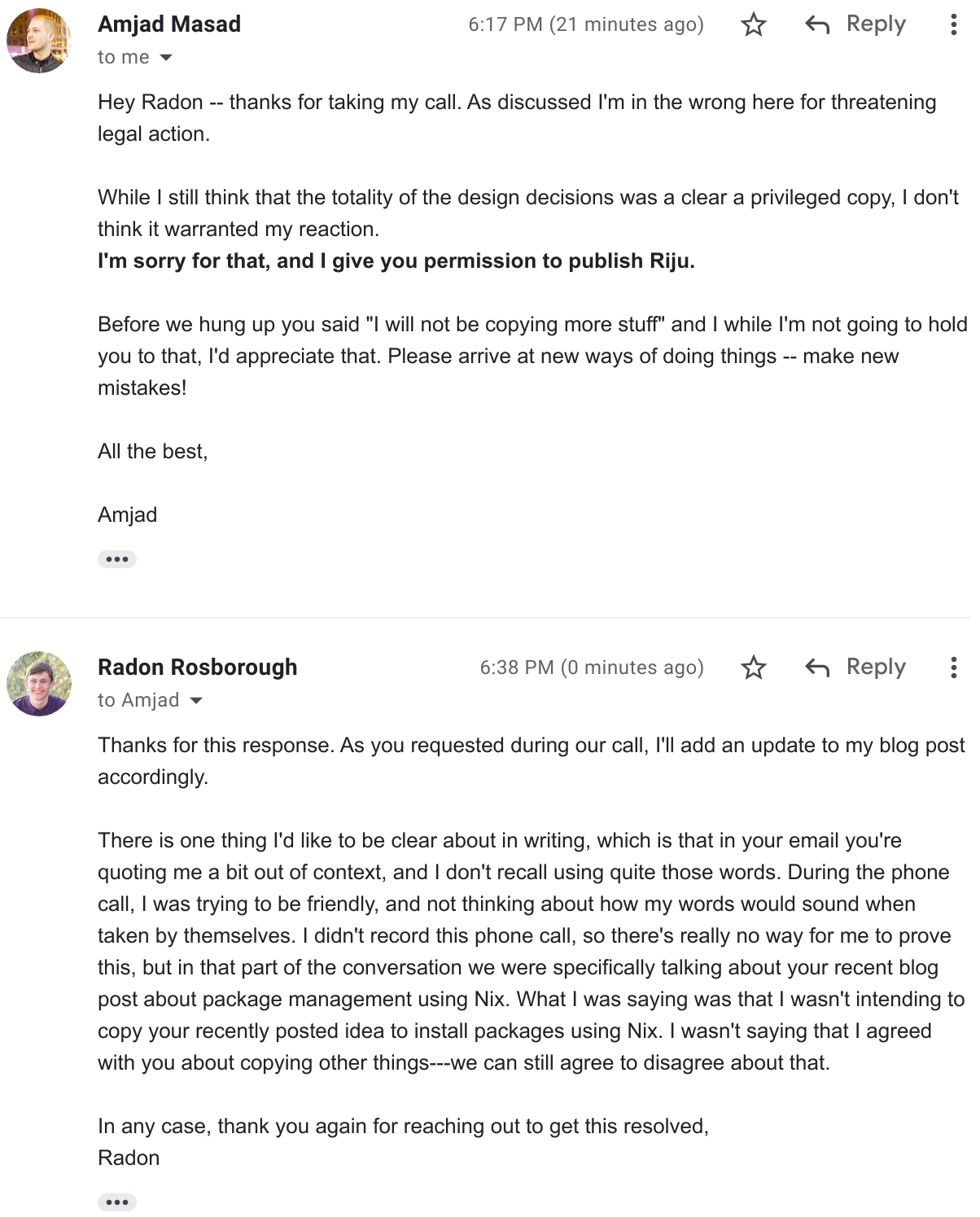
“I guess it’s just because of how I had to be as a struggling kid in Jordan” is the tell. He obviously has no idea why this feedback is happening if that’s his conclusion, so how can he apologize for any of it? He’s still retweeting sympathetic viewpoints on Twitter as we speak, so you can compute the honesty of this apology based on that fact alone.
Read “do better” as “avoid generating compromising receipts wherein I twice trot out lawyers and my ability to pay for them like I’m dramatically unsheathing Anduril, while privately maintaining my view that I’m being ripped off at every turn because someone had the gall to use Docker to build a REPL and I consider that clearly genius architecture to be sensitive intellectual property.” His takeaway going forward is to threaten people in a smarter way, and I’d bet my next paycheck on that.
Honestly, this whole saga is a hell of an invitation to compete against repl.it, in displaying such a severe decision-making and tactical weakness at the executive level.
"Second, we’re also excited to announce one of the first (of many!) projects that Amjad has worked on with us: Codecademy Labs, the easiest way to play with JavaScript, Ruby, and Python online." (http://www.codecademy.com/resources/blog/amjad-joins-codecad...)
Hmmm...
Lmao amasad, this shit is priceless. LOL
Use that "lot of money" to get top PR instead of "top lawyers", and maybe some "getting head out of ass" classes, cause humility and decency is something clearly you won't be able to learn.
Replit will be fine... think of the level of effort it takes to create a truly great product and all of the polish your platform already has. The key for you is to just stay focused on innovating and serving your customers!
All the best!
--harris
It's easy to become emotional and protective of a project you've poured blood and tears into, which probably kept you up at nights, amidst all the FUD.
At the end of the day, the world is better with Replit than without it. A world where any kid can learn to program with a dirt cheap device anywhere in the world without dealing with dependency hell is worth fighting for.
A lot of young kids and future builders and innovators look up to you! Please remember to be humble and kind as Replit, snd you, gather more influence.
What is ethically wrong is bullying a former intern with legal threats. You need to learn this, I guess the hard way.
This is why such a statement should have been avoided altogether, especially if the other side seemes to be cooperating.
If they copy your idea they can literally destroy your existence given their resources, size, visibility, infrastructure, etc. If you copy their idea you first have to make many things better than them before even scratching on their turf.
And before anyone says power dynamics are not relevant in ethics: In my philosophy studies I also studied ethics and yes — power dynamics are very relevant for ethics.
I mean, yes, that's definitely the case, isn't it? Punching below your weight is seen as unethical, right? The power dynamic is an important aspect of deciding the ethics of actions.
Who says this? Certainly we have intellectual property laws to protect novel, recent, and specific ideas. However, “Running code on another machine” doesn’t seem to meet any of those criteria.
Not a popular opinion on a mostly US site, I know, but as you can likely guess I'm not American (or Chinese or Russian for that matter).
The problem is when a large company muscles small ones out unfairly (using their clout, money or lawyers to push competition out).
The lesson for me here is to internalize how I'm no longer the struggling kid from Jordan fighting for more than a decade to build something, and that I now have a responsibility towards our community and supporters to be kind and model better behavior. I'm sorry I let you down and I promise to do better in the future.