News for hackers. Stuff that matters.
Re:Microfarms come to South L.A. frontyards, bringing fresh ... by iammisc on Thursday May 13, 2021 @08:16PM (#27149149)
Great hobby (I really mean that... my wife and I grow, process, and preserve a significant portion of our own produce in our front lawn), but ultimately, these are only marginally less wasteful than lawns. The distribution costs (environmental and otherwise) of having many small farms easily overpowers the current situation, which allows for more efficiency. Plus, it takes quite a bit of intense effort to farm enough to support people.

We'd do better with large-scale reforms like stop paying farmers to grow food that goes to waste or encouraging more meat consumption (meat is pound for pound more efficient at energy storage for humans, and allows the conversion of faster-growing native species into actual food, if we did it right).

Re:Microfarms come to South L.A. frontyards, bringing fresh ... by cageface on Thursday May 13, 2021 @11:04PM (#27150216)
meat is pound for pound more efficient at energy storage for humans

Citation definitely needed here. Meat is an extremely inefficient vehicle for getting calories into humans.

Re:Microfarms come to South L.A. frontyards, bringing fresh ... by jazzyjackson on Thursday May 13, 2021 @11:57PM (#27150530)
There are a lot of calories in a pound of beef, I think that's what OP was saying.

The other side of the equation is it takes way more energy per calorie to produce.

Re:Microfarms come to South L.A. frontyards, bringing fresh ... by hypertele-Xii on Friday May 14, 2021 @02:14AM (#27151267)
According to Wolfram Alpha, cashew nuts have over twice the calories of beef. [1][2]

[1] https://www.wolframalpha.com/input/?i=calories+in+1+pound+of...

[2] https://www.wolframalpha.com/input/?i=calories+in+1+pound+of...

Re:Microfarms come to South L.A. frontyards, bringing fresh ... by iammisc on Friday May 14, 2021 @09:32AM (#27154102)
Except one steer gives you about 400 pounds of beef (https://www.skipperwbreeders.com/recommendations/quick-answe...).

400 pounds of Cashew nuts? Man that's a lot of trees. Not to mention the other nutrients in beef. A piece of beef contains everything a human needs to live. You could just eat beef and you'd probably not be great, but have all your nutritional requirements met. Cashew nuts... no.

According to https://www.quora.com/How-much-fruits-and-nuts-does-one-Cash..., to produce 500 pounds of Cashews, you need 2.47 acres. Now compare this to a pig, which, if you slaughter it at around 270lbs, yields about 154 pounds of meat. That means 3-4 pigs will give you enough meat as 2.47 acres of cashews, and pigs eat everything. Pigs can be kept with about 8 sq ft per pig: https://familyfarmlivestock.com/how-much-space-do-i-need-to-...

Beef is definitely less efficient as a form of meat. It's also not the only form of meat. If you had a few acres to grow things, you should grow some vegetables and a whole lot of forage for your pigs, which will constitute the base of your diet.

Re:Microfarms come to South L.A. frontyards, bringing fresh ... by namibj on Friday May 14, 2021 @01:57PM (#27157479)
You forgot that the pigs/cattle need food.
Re:Microfarms come to South L.A. frontyards, bringing fresh ... by cageface on Friday May 14, 2021 @11:32PM (#27162088)
You could just eat beef and you'd probably not be great, but have all your nutritional requirements met

You'd get scurvy, just for starters. Not to mention what a job a complete lack of fiber would do on your digestive system.

Re:Microfarms come to South L.A. frontyards, bringing fresh ... by adrianN on Saturday May 15, 2021 @01:23AM (#27162652)
You need to eat at least some of the meat raw, but humans can survive on a 100% animal product diet (it might not be particularly healthy though)
Re:Microfarms come to South L.A. frontyards, bringing fresh ... by bryceacc on Friday May 14, 2021 @12:26AM (#27150677)
seems fairly intuitive if you just think of fat and protein calories all being densely packed in a piece of meat vs a literal pound of lettuce? Just like people joke with celery being net negative calories, you would lose a good amount of calories just chewing all that lettuce. Almost that entire pound would be water.
Re:Microfarms come to South L.A. frontyards, bringing fresh ... by adrianN on Friday May 14, 2021 @01:38AM (#27151096)
Lettuce is not consumed for its calories. Grains, legumes, and oils are the vegetarian sources of calories.
Re:Microfarms come to South L.A. frontyards, bringing fresh ... by iammisc on Friday May 14, 2021 @09:34AM (#27154115)
Grains are incredibly inefficient. Legumes are good, but not very good at calorie density.

The idea that oil seed is more efficient than meat is funny, and really shows how the vegetarian-industrial complex has gaslighted the world. Oil seeds are incredibly inefficient, extremely environmentally harmful, and incredibly resource intensive. Not to mention a good portion of modern oil seed relies on petrochemicals to extract the oil...

In terms of calorie density, tubers like Potatos, Sweet Potato, Yam, Cassava, etc, are better calorie stores on microfarms. You're not going to grow enough grain on an acre to feed anyone.

Re:Microfarms come to South L.A. frontyards, bringing fresh ... by adrianN on Friday May 14, 2021 @10:16AM (#27154575)
A good chunk of the grains and legumes we grow is fed to livestock.

I had to laugh at "vegetarian-industrial complex" :D.

Re:Microfarms come to South L.A. frontyards, bringing fresh ... by clairity on Thursday May 13, 2021 @08:38PM (#27149282)
beyond the fact that farming & industry use most of our water in CA, shouldn't greywater/runoff recapture+storage (instead of using fresh water) help with water usage? and because it's a hobby, there is little wasted opportunity cost, in either land or labor.

and though it's unlikely to make any difference in the farming calculus, south LA is underserved by fresh grocery, so this seems a nice little intersection of empowerment and quality of life improvement in regards to that problem.

Re:Microfarms come to South L.A. frontyards, bringing fresh ... by mc32 on Thursday May 13, 2021 @09:21PM (#27149543)
Is grey water treated enough to ensure we don’t get e-coli from its use?
Re:Microfarms come to South L.A. frontyards, bringing fresh ... by clairity on Thursday May 13, 2021 @09:33PM (#27149632)
my understanding is that e.coli contamination (by the harmful strains) is usually an artifact of cross-contamination from industrial farming. gardeners don't typically have to worry about it. just wash everything like you'd normally do anyway.

edit: also, greywater in this case is usually captured from rainfall, not recycled from sewage, like you might be thinking.

Re:Microfarms come to South L.A. frontyards, bringing fresh ... by mc32 on Thursday May 13, 2021 @09:38PM (#27149663)
Unless surface to capture rainfall is clean, it can be contaminated with animal droppings. Also if it's treated sewage, I'm not sure if it's treated enough against pathogens.

Contaminated crops usually uptake the pathogens from their water intake rather than from "dirty handling" and given it's within the produce itself, you cannot "wash it off". Cooking solves the issue, of course, but not all produce gets cooked.

Re:Microfarms come to South L.A. frontyards, bringing fresh ... by anonAndOn on Thursday May 13, 2021 @10:06PM (#27149840)
Any dirt outside is going to be contaminated with animal droppings. It's where animals go #2.
Re:Microfarms come to South L.A. frontyards, bringing fresh ... by silly-silly on Thursday May 13, 2021 @10:33PM (#27150029)
> Unless surface to capture rainfall is clean, it can be contaminated with animal droppings.

Your going to have a bad time when you find out what most organic fertilizer comes from.

Re:Microfarms come to South L.A. frontyards, bringing fresh ... by mc32 on Thursday May 13, 2021 @10:42PM (#27150096)
Heh, sure... but hopefully not with unneutralized disease carrying pathogens.
Re:Microfarms come to South L.A. frontyards, bringing fresh ... by AngryData on Friday May 14, 2021 @12:04AM (#27150565)
The only neutralization cow shit gets is the sun beating down on it and the microbes within it decomposing it. Cow and other herbivore shit is unlikely to make you sick though, it is incredibly well digested.
Re:Microfarms come to South L.A. frontyards, bringing fresh ... by floren on Friday May 14, 2021 @10:54AM (#27154944)
Well, horse shit is incredibly poorly digested, so poorly that it's basically just stinky straw, but I never got sick from using it as fertilizer either :)
Re:Microfarms come to South L.A. frontyards, bringing fresh ... by clairity on Thursday May 13, 2021 @10:22PM (#27149960)
e.coli is everywhere, including inside us, so that's not a fruitful avenue to assessing risk. only a few strains cause sickness, and as i understand it, those are largely found in, and make it into our food supply from, industrial farm settings.
Re:Microfarms come to South L.A. frontyards, bringing fresh ... by mc32 on Thursday May 13, 2021 @10:38PM (#27150068)
Right, but it’s through contaminated water. Industrial or not, water is the medium.
Re:Microfarms come to South L.A. frontyards, bringing fresh ... by clairity on Thursday May 13, 2021 @11:13PM (#27150270)
but the rainwater's not already contaminated... unless you perhaps happen to live directly downstream from a factory farm, but even then, e.coli isn't airborne, so it wouldn't be in collected rainwater. there are certainly no factory farms in south LA to worry about.
Re:Microfarms come to South L.A. frontyards, bringing fresh ... by iammisc on Thursday May 13, 2021 @09:12PM (#27149491)
Growing more things in the place of lawns in Southern CA ain't gonna cut down on water usage. I was born and raised in SoCal and the only thing meant to grow there is the natural chaparral. Definitely not leafy greens.
Re:Microfarms come to South L.A. frontyards, bringing fresh ... by clairity on Thursday May 13, 2021 @09:29PM (#27149609)
the article says that one of the gardens uses 8% of the water of the grass it replaced. the point is that, while it's not gonna significantly reverse socal's water deficit, it is a net benefit.
Re:Microfarms come to South L.A. frontyards, bringing fresh ... by iammisc on Friday May 14, 2021 @09:34AM (#27154119)
And if the area was planted as native chaparral it would use 100% less of the water? I'm not saying this is as bad as a lawn. It's obviously not. It's just not obviously great either.
Re:Microfarms come to South L.A. frontyards, bringing fresh ... by sjg007 on Thursday May 13, 2021 @10:27PM (#27149993)
There's no turf in LA.. the only grass is weed; the rest of it is concrete.
Re:Microfarms come to South L.A. frontyards, bringing fresh ... by AngryData on Thursday May 13, 2021 @11:59PM (#27150542)
We aren't paying farmers to waste food, we are paying farmers so that big stores don't have shortages or have to increase the price of bread 10x over because there was a bad wheat season. With a 1-2 year lead time on crops, you can't afford to accidentally not produce enough food just because the midwest got a bunch of hail or flooding that year. People can't put off eating for a year while we grow more.

I agree crop subsidies are mismanaged and often way more is spent on crops that don't need subsidization, but without crop subsidization at all you end up with price shocks in the food market and potentially/inevitably shortages and famines.

Re:Microfarms come to South L.A. frontyards, bringing fresh ... by philips on Thursday May 13, 2021 @08:34PM (#27149258)
Do you have any references to back up these claims?
Re:Microfarms come to South L.A. frontyards, bringing fresh ... by iammisc on Thursday May 13, 2021 @09:19PM (#27149531)
For my first claim (that rapid decentralization will not achieve the climate ends), this is my own analysis based on the fact that growing enough food to feed the world requires fertilizers as inputs. Currently the fertilizers are transported in trucks to farms and spread over large swaths of land by machine. The alternative is for it to be packaged up and spread by hand or with small machines. This would require more resources, for packaging, distribution, and machine production, so would seem intuitively worse for the environment.

For the meat (not saying you should consume a meat based diet but rather one that's mostly plants that properly incorporates meat as necessary... i.e., a traditional diet): https://link.springer.com/article/10.1007/s10669-015-9577-y .

Also, as an aside, if you don't want to turn veggie farming into mining with some extra steps, you need to raise animals that you can grind up into fertilizer. Otherwise, you have to mine petrochemicals or bat poop, which is extremely bad for the environment.
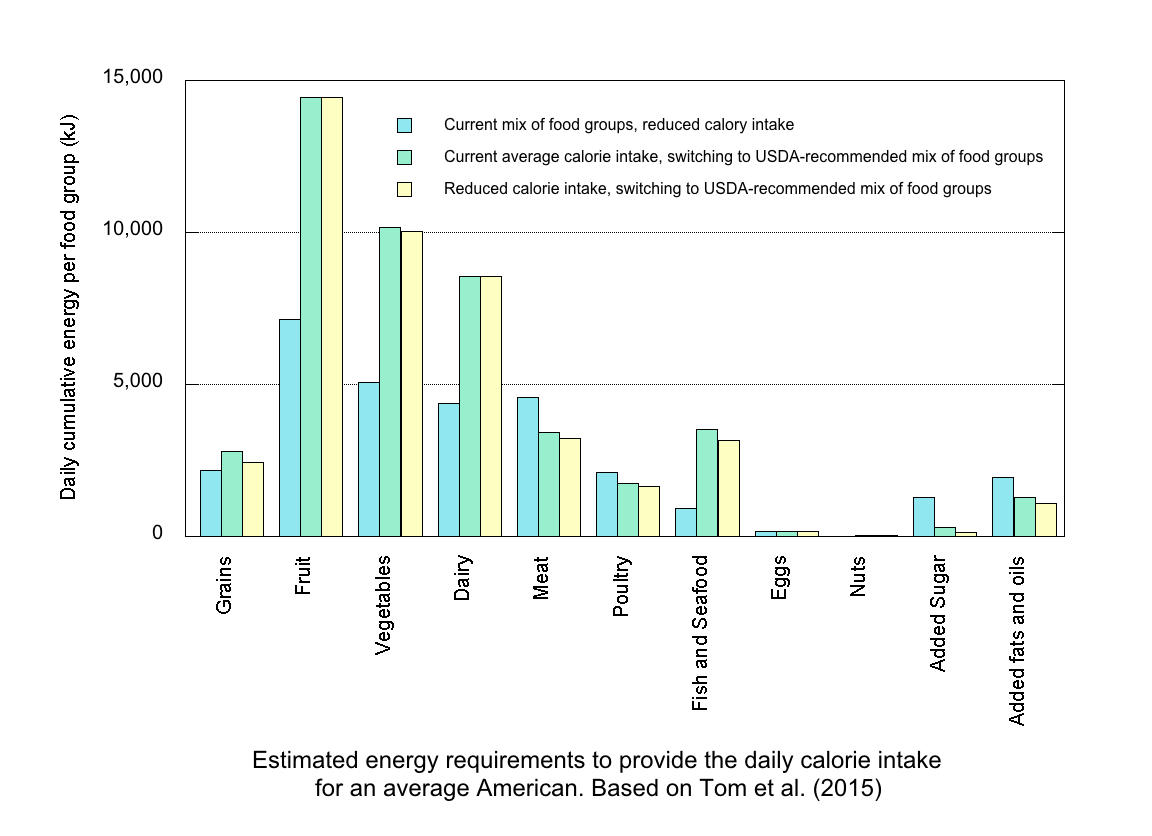
Re:Microfarms come to South L.A. frontyards, bringing fresh ... by qqqwerty on Friday May 14, 2021 @12:18AM (#27150652)
Something is seriously off with the study you cited. This image leads me to believe that the scenarios they are comparing are not remotely close in calories, which would invalidate their conclusion: https://2020science.org/wp-content/uploads/2015/12/Diet-and-...

Additionally, the study is using the USDA guidelines in their model scenarios. Those guidelines are heavily influenced by food lobbyists and are not entirely in line with what sustainability advocates have been pushing. For example, the emissions assumptions made in that paper are assuming that the replacement calories are coming from our "traditional" food system and they are not modeling in any increase in local production. i.e. replacing a chicken breast from Iowa with a bag of Apples from Chile might indeed be a net negative in terms of emissions. But that is not what food advocates are pushing for. It is more like: replace a steak with a head of broccoli from your local CSA. That would likely be very net positive in terms of emissions.

Re:Microfarms come to South L.A. frontyards, bringing fresh ... by iammisc on Friday May 14, 2021 @09:38AM (#27154154)
> It is more like: replace a steak with a head of broccoli from your local CSA. That would likely be very net positive in terms of emissions

Except the brocolli is less nutritious and less caloric than the steak. 8oz of steak is more calorie dense and is a form of complete nutrition, whereas a head of brocolli gives you a very tiny amount of calories, some fiber, and a lot of vitamin C. It's missing vital nutrition. Growing enough brocolli to make up for the missing calories is quite environmentally taxing, and consuming enough brocolli to make up for the steak would be sickening.

Re:Microfarms come to South L.A. frontyards, bringing fresh ... by qqqwerty on Friday May 14, 2021 @10:22AM (#27154634)
Here is a generous interpretation of my comment: Sustainability advocates are pushing to replace high emissions foods (like meat and non-local produce) and unhealthy foods (like soda and chips) with locally grown produce.

You linked to a study that critiques USDA guidelines, which has nothing to do with the changes that sustainability advocates are pushing for. And now you are picking apart a short internet comment analogy to try to make the case that beef consumption is a good thing. The fact is, beef is one of the highest emissions foods per calorie that a person can eat. Until you directly address that argument, you should stop "encouraging more meat consumption" (from your top comment).

Re:Microfarms come to South L.A. frontyards, bringing fresh ... by jazzyjackson on Friday May 14, 2021 @12:04AM (#27150563)
Not here to say you're wrong but I think you may be interested by the book "Farmers of Forty Centuries" if you haven't already come by it, basically describing the amount of labor it takes to feed the population dense areas of China/Japan/Korea ~100 years ago off very small plots of land.

Basically the answer is a long growing season: getting 3 rounds of crops out of the same field each season, and keeping the dirt rich by collecting everyone's "night buckets" and preparing the hu-manure to turn nutrients back into the soil.

My impression is that growing produce and composting organic matter can produce more calories per acre than industrial farming methods, but the cost is labor, selling vegetables is only profitable with the petro-fertilizer methods.

Re:Microfarms come to South L.A. frontyards, bringing fresh ... by iammisc on Friday May 14, 2021 @09:37AM (#27154141)
Thanks, I love books like these!
Re:Microfarms come to South L.A. frontyards, bringing fresh ... by philips on Thursday May 13, 2021 @10:42PM (#27150094)
Thanks for the study link.

Is the article asserting that they can feed the world this way? Also the word climate didn't appear in the article either but I might have forgotten in the few hours since I read it. I saw the story more as a calorie supplement like a victory garden in WW2.

I garden in a small space like the article quite a bit as well and find that worm compost from cooking scraps is sufficient for keeping my soil healthy without specially purchased fertilizer. I imagine most households have quite a bit of organic waste products produced from groceries and could support a modest garden in their yards too.

Re:Microfarms come to South L.A. frontyards, bringing fresh ... by iammisc on Friday May 14, 2021 @09:36AM (#27154131)
Yes, you're right that for home gardens composting is enough. However, we are able to sustain the current population -- most of whom is not engaged in farming -- on the current arable land by intense agriculture. This means planting extremely hungry crops that produce high caloric foods.

Your home garden is not intensively cultivated the way most farmland is.

Yes, more people should garden. No one should think it's the end-all answer to our food problems, or even that it's going to make a huge difference. Still good to know where your food came from and some stuff tastes better.

Re:Microfarms come to South L.A. frontyards, bringing fresh ... by briefcomment on Thursday May 13, 2021 @09:29PM (#27149611)
Interesting study. I think most people think the complete opposite. Science communication seems pretty broken.