For $15 you can add Bluetooth and Wifi [5] if you really want. Instead I chose to treat myself to $21-$40 worth of eMMC5 storage for the OS [6].
[0] $80 https://pine64.com/product/rockpro64-4gb-single-board-comput... [1] $45 https://pine64.com/product/rockpro64-metal-desktop-nas-casin... [2] $4 https://pine64.com/product/rockpro64-30mm-tall-profile-heats... [3] $13 https://pine64.com/product/rockpro64-12v-5a-us-power-supply/... [4] $6 https://pine64.com/product/rockpro64-pci-e-x4-to-m-2-ngff-nv... [5] $15 https://pine64.com/product/rockpro64-1x1-dual-band-wifi-802-... [6] https://pine64.com/product/16gb-emmc-module/?v=0446c16e2e66
I love raspberry pis but pi-mania is absolutely out of control. I can't count how many $100+ programmer hours I have seen wasted waiting for a $10 pi to boot, build, or generally stop being slow. I have witnessed the deep shame of a multi-million dollar exhibition center-featuring a RPi kiosk deployed in front of customers that chugs so hard the sales team takes shifts intercepting people before they can poke at it and realize how much of a dog it is. But at least they saved $200 on not using a laptop, right?
If you want to dip your toes in the hardware world from the comfort of ubuntu at impulse buy prices, pis are great, but they stop making sense very quickly once you exit that specialized vertical.
https://www.phoronix.com/scan.php?page=news_item&px=Raspberr...
"It's not as fast as a new Intel processor" is not new information...
Example eBay listing: https://www.ebay.com/itm/DELL-OPTIPLEX-7040-SFF-DESKTOP-INTE... (no storage drive on this, but it has NVME, so for $50 you can add more storage than many use cases need, and it'll be much faster and more durable than SBC eMMC or SD solutions).
And it literally was in lightly used (basically perfect) shape and no issues at all.. they even threw in a cheap WiFi dongle.
It’s amazing what you can get on eBay for value as far a large used computers go.. obviously it’s YMMV as far as the seller you happen to buy from and the condition of the item you receive.. but for me, this machine was super awesome and fast (I hadn’t bought or built a desktop PC in at least 10 years prior to this)...
4 x64 AMD Puma cores at 1.5GHz, dual-channel DDR3 4GB SODIMM (1600MT/s), 16GiB m.2 storage, mPCIe, gigabit ethernet, 6x USB 2.0, 2x USB 3.0. 7W in idle and it's fast enough to run Gentoo. I paid 25 EUR for it. You can expand RAM (up to 16GiB) and storage if you wish for a little bit more.
PC recycling companies buy these by weight and there is very little in terms of secondary market. Most of these end up in landfills, while being perfectly capable little home servers.
Would it be any good with a bunch of H265 5mp cameras hanging off it?
I want to put security cameras around my house, but naturally I want to DIY.
Intel QuickSync for H265 might be what you're looking for; should be able to find a few 7th gen processors that support it.
https://www.intel.com/content/www/us/en/support/articles/000...
That site is honestly incredible.
But the Pi4 can use as much as 15W, it has left the realm of "low powered" devices long time ago.
I have a very old(2013) HP workstation that I use as a NAS, with a 2nd gen i5, and when running it uses 20W of power, measured by myself.
Some current Intel NUC models can manage less than 5W idle power as well, e.g. https://www.anandtech.com/show/15571/intel-nuc10i7fnh-frost-... but don't have the limitations of the Pi.
Either I got lucky with the two I own, or your environment was to harsh for them?
[1] https://ark.intel.com/content/www/us/en/ark/products/52207/i...
With the Intel AX200 WiFi 6 and BT 5.0 disabled, it idles at barely 12W. Running a bunch of virtualized loads (nothing crazy) in XCP-NG, it's consistently under 20W despite no matter what's running on it. If I had it going flat out (with a 5GbE NIC plugged in via USB Type-C) under something like heavy video rendering (CPU+GPU+storage) loads it peaks at about 48-50W.
We're entering an era of pretty fantastic power consumption, especially if you shy further away from Intel SKUs at the moment. The Intel SKUs are pretty frugal, but the AMD ones genuinely sip power and are only getting better.
TDP is worst case sustained heat output for selecting heatsinks, not representative of typical consumption at all. Typical CPU fans are also like 12V/0.25A max with power variable between 50 to 100% or so. 20W idle is thus very believable for a build by a sane person[2].
1: https://www.gamersnexus.net/images/media/2017/CPUs/tr-1950x/...
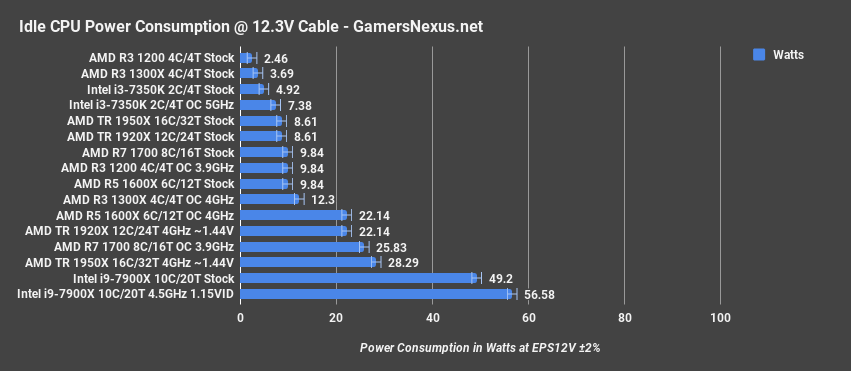
2: Personally I often end up with more substantial configurations like 12V/1.5A 80mm with couple 12V/1A as sides but my suspicion is my lack of sanity is a huge contributor to that
So AMD and Intel measure TDP differently because obviously they do.
Intel's TDP is based on the max the CPU can generate while AMD is based on what an average user would encounter.
https://www.extremetech.com/computing/319402-intels-desktop-...
"It’s easy to see why Intel hasn’t changed the way it defines or communicates TDP to its customers: It would make the company’s high end look vastly worse compared with AMD. A Core i9-10850K will draw up to 265W. If you want an AMD CPU with that kind of power budget you have to buy a Threadripper."
1.https://www.raspberrypi.org/documentation/hardware/raspberry... 2. https://ark.intel.com/content/www/us/en/ark/products/52207/i...
If you're not too picky about specs, eBay will give you one of these nodes for around $200, although you might have to supply the NVMe.
This website gather specs on them and you can find used ones as low as 20 bucks on eBay. Many will draw 10-20 watts, like a Raspberry.
1: https://dareneiri.github.io/Asus-Chromebox-With-Full-Linux-I...
You might go slightly over budget with an i3 (unless you shop for a deal). You need to install a NVMe yourself, as well as RAM. The i3 can be run in a silent mode, but there are some third party cases around which let you go fanless. I don't understand why Intel is not selling a fanless NUC with an i3 / m3. There's a lot of potential. Same for AMD.
From what I could find the RPi chips are made in 27nm, and while you can't exactly linearly extrapolate from that, I wouldn't be surprised to find that a 7nm smartphone chip can get you the same performance as the RPi at 1/3rd the power consumption.
https://www.raspberrypi.org/blog/raspberry-pi-4-on-sale-now-...
I think once AMD spools up with 7nm we'll have machines like this with even lower power.
RPI really doesn't belong in this type of a device you're describing.
New batch due soon.
It's got a DDR3 ram slot and can host 8GB ram, along with a sata port and a slot for a 2.5" disk. It also has 4GB of on-board storage that I really don't care about.
The processor is a single-core atom that clocks at about 1.4GHz with a TDP of about 5W.
I don't really care much about speed for this machine because it will become a home vpn gateway running PFSense. The CPU has AES-NI instruction, and that's what convinced me to get it.
My current vpn gateway is a Dell Optiplex FX160 which is still an atom and performs okay-ish, but has got no AES-NI and no internal storage beyond a dumb 2GB disk-on-module, on which pfsense barely fits and consumes about ~17 Watts powered on.
If you're optimizing for price and power consumption get an older SKU with an Atom, if you want more horsepower anything 10th gen with 4 cores will handle just about anything you can throw at it, and the idle power consumption is quite good too.
You can find Atoms and Celerons (e.g. N3060) just as low power (5W). Plenty of such low-power mini PCs are available. Ones with 128GB are well within your price range... here's just one for $158: https://amazon.com/dp/B08T71WXL3
Or you can go with one of the few which include M.2 slots... I have a couple, myself.
Amazon and Minisforum are good places to start.
Argon40 has a M.2 (SATA B and M keys) to USB 3 addon part as well. So if you have a Pi4 that has already been configured to boot from USB, this is a drop in part.
I find that my Pi4 has trouble maxing out the USB3 and SATA M.2 SSD's throughput. NVMe seems like overkill.
https://smile.amazon.com/gp/product/B07WP8WC3V/ - Argon ONE V2 Raspberry Pi 4 Case for the RasPi 4
https://smile.amazon.com/gp/product/B08MHYWJCP/ - Argon ONE M.2 Raspberry Pi SSD Board
What I like about this case is that the entire case acts like a heatsink for the CPU and Ram... and the internal daughterboard provides full size HDMI ports.
IMNSHO, it's a no brainer if you already have a Pi... but even a NUC isn't a turnkey solution if you're set on Ubuntu. Still need to install that as well.
[1] https://geekworm.com/collections/raspberry-pi/products/raspb...
Usually NASes are thought of as not too power efficient; but that’s because of the HDDs in them. Remove the spinning rust, remove the problem.
Surprised me since the NAS is running an Intel processor.
Idk about Ubuntu though. Raspberry Pi OS is based off of Debian and optimized for the pi.
Edit: Ah I was unfamiliar but of course there is an Ubuntu release for the pi. https://ubuntu.com/download/raspberry-pi
Edit2: Ah I jumped straight to the Tofu board but I didn’t see that TFA features another nice board for this purpose.
Or is it about having it all pre-built and pre-installed?
edit: Ok sorry, apparently I miscalculated and it's actually possible to build this for less than $200.
8GB Pi4 is $75
256GB NVMe M.2 SSD is ~$40
cases with a fan are ~$25
power supply is like $10 but let's say $20
That brings us to $160 give or take. Where is the extra $90 going?
I think $200 is doable with a healthy profit margin.
Yes I can build it myself, but shopping for, gathering all the parts etc is time consuming and I'd rather be writing my apps etc to run on the device instead...
EDIT: formatting