Massive change due to tech is always just waiting to happen. Here's to hoping it just changes society without destroying it.
Great quote! Gradually and unknowingly you approach a tipping point until some factor pushes you over the edge like the proverbial "straw that broke the camel's back".
I believe Sale was/is broadly right. Some of Nassim Taleb's ideas also play into this viz. our inability to predict the future and the catastrophic effect of non-linear and "black swan" events. It is not "Technology" that is the problem but our stewardship of it. We simply are not taking a holistic system view of it which is absolutely necessary when our system (i.e. our planet) is "closed".
>We have made untold advances in the medical sciences
Out of reach of a lot of humanity and for those that can access it it is not without risks (just look at the medical devices debacle in the US). It also isn't as good as we often seem to believe. For example the US is number 7 in Deaths by heart attack but it is still double the amount of deaths as number 1[0].
>we are rapidly divorcing ourselves from our reliance on fossil fuels
Acording to EIA[1] "The share of U.S. total energy consumption that originated from fossil fuels has fallen from its peak of 94% in 1966 to 80% in 2018". 80% is not "divorcing ourselves from our reliance on fossil fuels". It will be at least ten years before we see another 10% down in the US.
>we are living in a time when there is an unprecedented level of awareness for basal human rights
Yet human rights, press freedom and economic freedom are all on a downswing in the US[2][3][4].
0: https://en.wikipedia.org/wiki/List_of_countries_by_quality_o...
1: https://www.eia.gov/todayinenergy/detail.php?id=41353
2: https://en.wikipedia.org/wiki/Index_of_Economic_Freedom
That is a great soundbite for the news but is it actually as great as it sounds? If we take it as fact that "one billion humans have been lifted out of extreme poverty" what about how many are in extreme poverty? Note that how many is outside extreme poverty doesn't say anything about the amount in extreme poverty, just that more are now above it. The world population grew by 1.6 billion between 1990 and 2010 according to the UN. So on one side we have the "one billion have been lifted out of extreme poverty" but on the other we have "1.6 billion more humans" with the greatest growth in poverty stricken countries like Nigeria. I don't know the numbers but I don't believe that the "about a billion people have been lifted out of extreme poverty" is the whole truth since AFAIK the amount in extreme poverty have grown.
EDIT: Looking up the numbers it hasn't "grown" but "extreme poverty" is seen as "statically less than 1.9 international dollars per day". Is it a lift to $3 or $30? $3 is still living in squalor and destitution if you ask most people in the West I'm sure. IMO extreme poverty haven't declined outside statistics.
This is a simple and knowable answer. And it doesn’t change the facts the sound bite is based on. Extreme poverty is lower now as a percentage. There are fewer born into extreme poverty now, etc.
You can also pick other cutoffs and they are improving as well. Obviously the goal is to raise people higher than $3/day, but this is just an existing measure that’s getting better.
It’s frustrating to me when people nitpick unimportant details as if they were significant.
I don’t think anyone who established the extreme poverty cutoff thinks that it is the end goal, or that $3/day is as good as $30/day. So everyone agrees that 10x is better. But there are measures for extreme poverty because it’s a problem and needs to be addressed differently to get people from $.01/day to $3/day differently than interventions for $3 to $30 (and $30 to $100).
Pinker’s book, Angels of our Better Nature, goes into this quite a bit. And there’s a lot of global health primary sources to also help answer your questions.
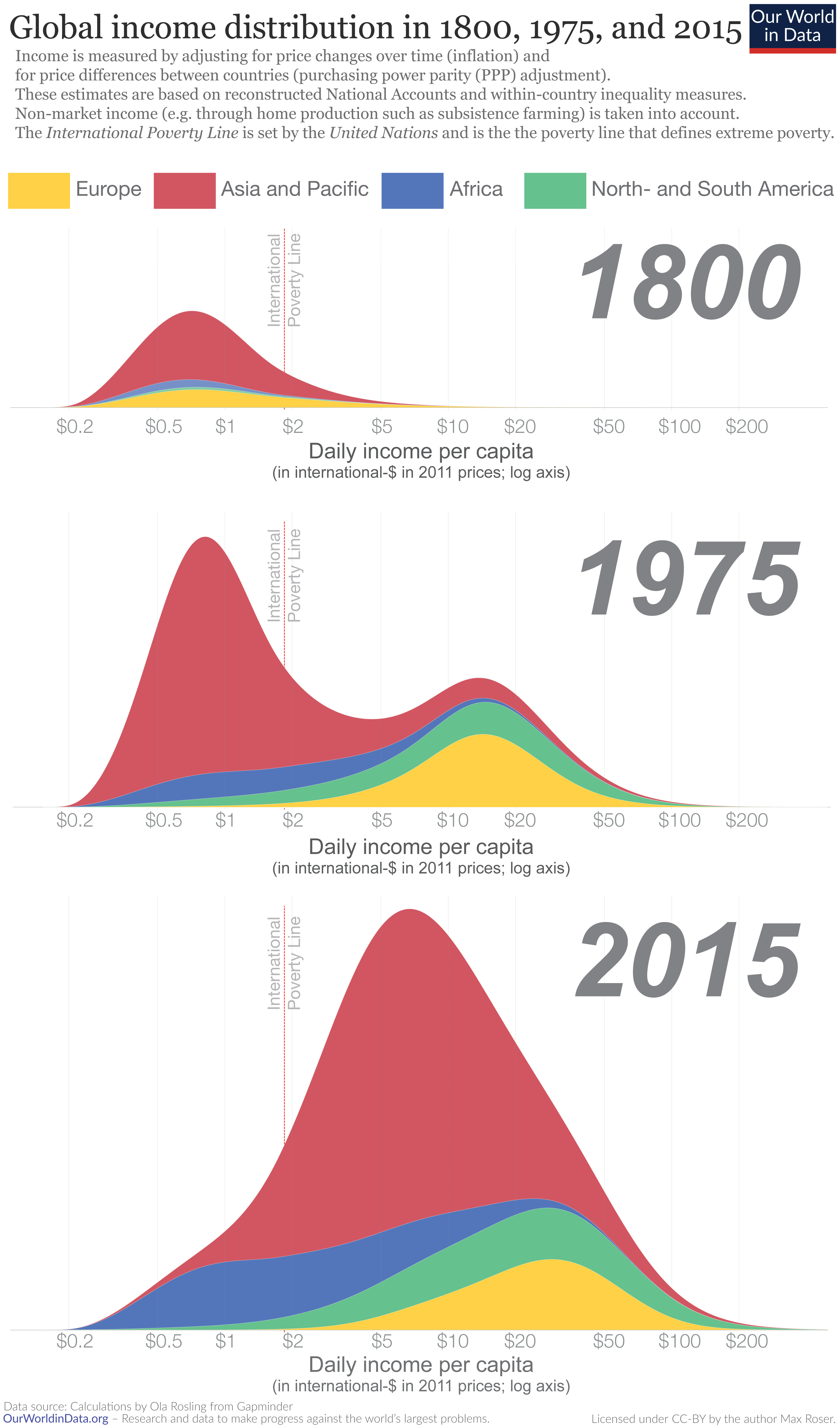
From: https://ourworldindata.org/global-economic-inequality
And I think you’re underestimating the marginal utility of going from $1.90 to $3 — both would suck for someone with a baseline of Western expenses, but it is the difference between a literal hand-to-mouth life of subsistence farming in a shack, versus a family that all works being able to collectively afford to rent a basic concrete flat with terrible plumbing on an unpaved street (citation: my ex took me to Nairobi a few years ago, we met one of her local friends, the friend’s flat was about $800/year to rent, $800/year is the increased income from two people going from $1.9 to $3 per day).
The situation in Africa isn't so good, but has substantially improved. Of course the cost of this has been stagnant wage growth and anaemic employment in the developed world, as hundreds of thousands of people in China and South East Asia joined the global labour pool.
Too many folks gulped Pinker’s nonsense without further inspection because it suited their priors.
I don't have a strong opinion one way or the other -- I guess my prior is that I am skeptical of broad narratives one way or the other and I think Pinker is prone to facile generalizations -- but most of the rebuttals I've seen to Pinker seem offended by the idea of progress, rather than taking his arguments seriously.
> The global poverty line has been on steady decline
That's about right. We measure poverty as less than $2 per day. It's an arbitrary number. It would need to be $7.50 to prevent malnutrition and lower than 50% mortality. If we use the 7.50 mark the number of people in poverty has increased dramatically since the 80s.
This seems surprising to me. What do you think is the best source for me to learn about this metric? I found a lot of info on the methodology behind $1.9/day [0] but couldn’t find much by looking for the $7.50/day mark and how it has changed over time.
I found this guardian article referencing $7.4/day [1] but the link they give to Peter Edward on an ethical poverty line doesn’t work. When I search for Edward’s concept I find papers from him [2] but they seem to reference $2/day.
Edit: I was able to find a gapminder analysis [3]. They break income into four groups, less than $2, less than $8, less than $32, more. The shift in poverty is still positive so I’m not sure what measure is being used to show 1B more under $7.5/day. This may be due to demographic trends where that group is growing faster. It is important to consider the overall proportion, not just absolute number, as well as the alternative of where they would have been (ie, a billion under $7.50 is better than a billion under $1.9).
But it’s hard to discuss without source data and methods.
[0] http://iresearch.worldbank.org/PovcalNet/methodology.aspx [1] https://www.theguardian.com/global-development-professionals... [2] https://www.tandfonline.com/doi/full/10.1080/014365905004327... [3] https://www.gapminder.org/tools/#$state$time$value=2020;;&ch...
The author addresses this question, along with how the UN has continually shifted the goal posts to reinforce the narrative that poverty has been reduced.
This quote mixes the two concepts “ Since 1960, the income gap between the North and South has roughly tripled in size. Today 4.3 billion people, 60 per cent of the world's population, live on less than $5 per day.” and doesn’t provide context on whether the percent of the worlds population living in less than $5/day is better or worse than in 1960.
Trying to boil down a very diverse global population, which may or may not even be paid, into a single $/day seems a bit ridiculous to me personally.
This is not the method described in the world bank web site. I don’t think the intent is to boil down to a single measure.
Tracking data globally is really challenging, so a consistent and meaningful measure is required to even have a hope of a perspective across countries. It’s useful in eradicating poverty to both measure progress or failure as well as to prioritize investment for areas of greatest need.
This also isn’t the only measure of poverty as there’s many others and there’s quite a bit of literature in global health on other measures as well.
That being said, I think there is room for improvement both in developing more useful metrics as well as improving accuracy of measures.
What does 50% mortality mean here?
Note that it is not just Sale (though of course he is quite extremist in his views) who has pointed to the deleterious effects of our Technology, Social systems etc. which may lead to "Collapse" of our Civilization; you also have Nassim Taleb, Jacques Ellul, Michael Ruppert espousing similar arguments in different contexts.
All that you mention are "local effects" having their own unforeseen long-term negatives, due to self-limiting feedback loops, for example (without making any moral/judgemental/ethical calls);
>global poverty line has been on a steady decline over the last three decades
Debatable and for a certain definition of "poverty". Inequality has only been increasing and if i am unable to afford stuff even though i make more today then i did a few years ago, that is not "alleviation of poverty". Even if we accept your argument we now have the problem of increased middle class population leading to rampant consumerism and pressure on both social and natural resources.
>untold advances in the medical sciences
True but the other side is also adapting itself to work around our efforts eg; "Superbugs". We also don't know what the long-term effects of genetic engineering would be. There is also the problem that advanced medicine leads to longer lives and thus more pressure on social safety nets and healthcare.
>we are rapidly divorcing ourselves from our reliance on fossil fuels
Wishful thinking; we have a long way to go and given our propensity for short-term fixes we may very well run out of time.
>when there is an unprecedented level of awareness for basal human rights
Awareness does not necessarily lead to Usage/Implementation.
The above is not to say that "good old days" were "very good" and we should blindly roll back our scientific and technological use. On the contrary just like we have realized that Atomic warfare is unlike anything ever experienced by mankind and hence has to be prevented and dealt with in a whole different way than we have ever handled our "differences", so should our use of Science/Technology towards the betterment of our Societies, Other Species, Natural Resources and ultimately the whole Planet.
Taken globally, and looking at purchasing power. Things have been massively improving for the very poorest. Because developing countries are doing just that, developing.
Inequality and poverty are two distinct things. Poverty is having lack of access to things you need. Inequality is becoming a big issue, and poverty is far from being solved. There certainly are opportunities to solve both problems. But the depth of poverty for a lot of humans has lessened the last few years, and that is undeniably a good thing.
Modern politics and weaponry changed transmuted tribal wars into contemporary wars, some with systematic massive massacres and such.
If true it may mean that most 'classic' tribal wars were way less damaging than WW1 or WW2. In any case it seems hard to imagine how even some extreme tribal war may be more damaging than a total nuclear war.
Not sure where this comes from. Tribal wars frequently ended in genocide, mass destruction, etc. The book Sapiens covers some of the evidence for how Neanderthals were exterminated.
I agree though that total nuclear war would be way worse than all the tribal wars in history. Although, interestingly, it seems like threat of nuclear war has prevented lots of wars. There have been no wars between major powers since nuclear wars. Maybe the closest was the Korean War, but China wasn’t a nuclear power back then.
AFAIK Neanderthals went extinct due to climatic change and disease.
Moreover tribes are everywhere defined by a complex and dynamic system of relationships. Neanderthals where another human species, or at least subspecies, and as far as I understand we cannot be sure that such relationships were established or even possible with another human species.
The threat of nuclear war ("MAD") may have prevented wars between major powers, but it didn't prevent many proxy wars, some of them quite destructive, and assuming that the net effect was positive is only an opinion (probably not shared by many in Africa and Asia).
I’m not sure there are any modern tribal wars. I’m not sure I’d consider Rwanda a tribal war, but it was tribes fighting.
I was thinking more about pre-historic tribal warfare. Or at least pre-bronze age before Egypt, Indus, Greece, etc. The tribes in the Amazon, Africa, Papua New Guinea [1] frequently had wars of extinction that eliminated their opposing tribe.
This kind of brutal warfare seems in our genes as even other primate have these genocidal wars where entire communities are wiped out [2].
There were certainly many proxy wars and lots of death, so I don’t think MAD means absolute peace. But it did stop world war 3 (while almost starting it quite a few times) and it’s most likely the reason why there haven’t been any large wars with casualties that existed prior to MAD (ww2,ww1,sino-japanese,Napoleon).
[0] https://en.wikipedia.org/wiki/Neanderthal_extinction
All of these things are more true now than they were in the average subsistence based society. Amazon warehouse workers have a worse deal than serfs, and a much much worse deal than hunter gatherers.
Oh and this
we are rapidly divorcing ourselves from our reliance on fossil fuels
Isn't just wrong, it's laughable. https://en.wikipedia.org/wiki/Energy_return_on_investment
If you want a really long read - https://www.goodreads.com/book/show/31850765-energy-and-civi...
The tl;dr is that renewables cannot provide equivalent levels of surplus energy to fossil fuels, cannot offer the same reliability as fossil fuels, cannot perform the same functions as fossil fuels (e.g. shipping). Not now, not ever. Not possible.
And of course you can make liquid fuels by cracking water and then doing chemistry to add carbon (which can be from atmospheric CO2). This is what Musk has planned for Mars, the process is from 1897: https://en.m.wikipedia.org/wiki/Sabatier_reaction
Further chemistry can turn that into long chain hydrocarbons, from what I remember of school.
I don't think that's accurate at all. For one, we no longer have prevalence of childhood leukemia that we used to have. You could run down a long list of similar examples related to health.
For another, we have robust labor standards in most of the world which we didn't didn't used to have. Warehouse workers do indeed have appalling work conditions measured by modern standards, and we should be incensed by those. But I think any serious consideration of what, say, dust bowl Texas was like prior to rural electrification, or what an experience of hunter-gatherer life would be like for a person who actually wanted to go out and try it, I think it would be nuts to say such conditions are preferable.
As others have mentioned, your own link to EROI doesn't appear to make the point that you think it does.
Conventional oil reserves are declining so this article merely proves that renewables are superior.
...if you’re a well compensated tech worker having gourmet lunch delivered by benefit-less contractors paid slave wages.
Could you back this claim up? I don’t find it at all plausible.
I don't know what that is going to look like though so I'm not taking any concrete bets. I certainly don't know what comes after.
I think the following factors, broadly speaking; will be our (i.e. Civilization as we know it today) downfall;
  * Environmental Disaster as a consequence of rampant consumerism. The planet simply cannot sustain it. Our current "Renewables/Recyclables/Carbon Credit etc." policies are a joke. We have forgotten that our planet is a closed system with finite resources.

  * Our "Baser" Instincts - We will always subvert any and all technological advances towards the pursuit of power, wealth, and greed and exclude "others" (i.e. those not belonging to our group) thus increasing the "inequalities" in our society.

  * Non-linear "catastrophic" effects of many of our social systems - As Nassim Taleb points out in his books, many of our systems are non-linear in their effects and inherently fragile. Thus our ability to predict the long-term future is non-existent.

  * The rise of mono-culture biological and social systems. Evolution has always proceeded as a loosely coupled federation of highly cohesive units eg. Madagascar/Australia vs. Asia/Europe, small self-sustaining villages/kingdoms bartering amongst themselves vs. megapolises with huge populations and pegged to a "common currency". This makes the entire system fragile to local shocks.

* Adaptation and Evolution of other species against our measures towards controlling them eg. "Superbugs".> Evolution has always proceeded as a loosely coupled federation of highly cohesive units
No, it did not. Evolution does what it does, things that are good enough at surviving survive. For instance, multicellular organisms, and in particular large animals, are "megapolises with huge populations and pegged to a 'common currency'". Fragility is a more nuanced topic too, large coupled systems are vulnerable to internal problems, but they can also withstand external forces that would kill the equivalently populous "loosely coupled federation". All in all, evolution is probably not the best thing to draw lessons about organization from, because a) any system of organization you can think of is likely already effectively used in some organisms, somewhere, and b) evolution doesn't care about well-being of individual cells, but we care about the well-being of individual humans. That last constraint means we can't just do thing the way evolution does, which is throwing crap at the wall and seeing what sticks.
He did not think the currency issue was close at all, "Not much contest here" and granted that one unequivocally to Kelly.
On the others I don't agree with Patrick at all. On environment we are quite possibly heading towards a disaster, but it's still very far off. I doubt we'll even be in a situation to unequivocally call this one for Sale even in another 25 years. Maybe in 50, sure, but the bet was about the conditions in 2020, not 2045 or 2070.
As for war between rich and poor, I think it should be judged compared to historical examples. Are we in a higher level of conflict between rich and poor now than in the past? I'd say no. Occupy came and went. The global economy recovered ok from the crisis in 2008 by historical standards. Advanced technology is already solving the pandemic for us, and we should be back to normal economically within a few years. Only 4 years ago a Billionair won a US election on a platform of cutting taxes for the rich, which he did. If there's a war going on between rich and poor, I'm not seeing it.
And this is what scares me. From my point of view, we are already well into multiple major environmental disasters. I wonder how much worse it has to get before more people realise that.
I’d argue the drivers for the war are already here, but the only reason the war isn’t class based is the rich and powerful have convinced the lower classes to attack each other instead of them. They’ve successfully driven in dividing lines such as race and religion to distract us as the plunder to their hearts content.
I mean it sort of relates to the 2nd amendment idea that private citizens at home with firearms can overthrow a tyrannical government if need be. When it was minutemen vs foot soldiers that was a drastically different equation to now when it's AR-15s vs a military-industrial apparatus with drone strikes, tanks and automated mass surveillance.
The observation that "the rich and powerful have convinced the lower classes to attack each other instead of them" seems like a reasonable tactic for the society (or the rich) to prevent such a war from occurring, and this might plausibly succeed for a prolonged time in the future - as you say, "successfully driven in dividing lines" that are long-lasting. I see Kirkpatrick Sale's position as essentially claiming that the tensions are stronger than the societal bonds that favor status quo and centralization, that these tensions can cause a society to collapse - and the last 25 years have shown the opposite, that an increase in these tensions is still tolerable and does not lead to a collapse.
Thank you for catching that, I stand corrected with respect to the judging of the economy. It's interesting that there are commenters here taking issue with my point disputing that, when it turns out not even the judge, Bill Patrick, felt that question was close! People will really debate anything.
As you point out, Bill did, however, remark that the other questions were close, and asserted that Kirk was not merely close, but correct(!) on the other two questions. I am surprised about that, for reasons more or less along the lines you mention.
He predicted society's "collapse", that by now we'd be living in small bands. Global warming steadily making the worse a crappier place is an awful thing, to be sure, but we're nowhere near collapse, at least not at the moment.
The first part of the bet is a good one: the dollar -- the world's reserve currency -- becoming worthless is something that makes sense as a part of society collapsing, and more importantly, it's fairly objective to judge. The other two are far more ambiguous.
Yeah, this is exactly the thing I'm stuck on when I go over these responses. I feel like people really aren't grasping the difference in scale between (a) 2008 financial crisis was pretty bad and (b) dollar becoming "worthless".
People are talking as if those two things are close, or taking up the tone of cautionary finger wagging and saying "well, you know he wasn't too far off" and going off to say this or that about a given poverty statistic.
My best theory as to what's going on here is that people are just cannibalizing the question and using it as a digression into various world problems in ways that don't clearly connect back to the wording of the question.
If I your were in India which was a deep socialist state in 1980s and 1995 just when the seeds of 1992 reforms were sowed, it was a complete shithole compared to the India of 2020 even with COVID.
I would rather live in an unsustainable India of 2020 than in sustainable India of 1985.
Debt is not really much of a problem for India as debt of gdp ratio is pretty low. Debt is not a problem in terms of sustainability either, when the proverbial shit hits the fan the country might go into massive recession but even in the worst of worst cases and even with terrible politicians at help recessions don't last very long. But the gain upto that point are all real. (India has over 50M more young and healthy people purely because the country has eliminated Polio and dozen other diseases that were common 40 years ago).
Rising population and rapid urbanization would require India to manage its forests, water and other resources better and India is not equipped to do so because of government control of key industries and bad policies. But we can hope things will change for better as a more competent government is at helm.
>“The first [measurement] would be an economic collapse. The dollar would be worthless, the yen would be worthless, the mark would be worthless—the dislocation we saw in the Depression of 1930, magnified many times over.
The dollar is not worthless and not close to worthless. There's no reasonable interpretation of that outcome, or of reality, where the dollar becoming worthless was "close" to an accurate prediction. I truly, honestly don't know how to reason with someone who is going to dispute that.
Another prediction was that we would be in an active global military conflict between rich and poor nations. Also not close.
Another prediction was "Africa, from the Sahara to South Africa, becomes unlivable."
If words actually mean things, none of these were close.
> an economic disaster that would render the dollar worthless, causing a depression worse than the one in 1930; a rebellion of the poor against the monied; and a significant number of environmental catastrophes.
Now, you sound like you have a source other than the article, and the article sounds like it might be a paraphrase. But it's kind of hard for me to judge without knowing what your source is.
But, using the wording from the article: Were we close to the first of those in 2008? When Lehman collapsed, if there hadn't been intervention the dominoes would have continued to fall. How far would they have continued to fall? Hard to tell now, but at the time it looked like they were just going to keep falling...
Yes, they were the words of the bet.
>I bet you US$1,000 that in the year 2020, we're not even close to the kind of disaster you describe—a convergence of three disasters: global currency collapse, significant warfare between rich and poor, and environmental disasters of some significant size. We won't even be close. I'll bet on my optimism.
It seems like in the actual terms of the bet Kelly paraphrases Sale. That is how I would read it sans an actual signed legal document. But then again I'm not a lawyer or anyone versed in gambling etiquette and protocol.
Why would anyone take this bet? If you're right, then $1000 USD probably won't be worth very much after the "global currency collapse", so you'd basically be saying "I'll give you $1000 in 2020 if it's worth anything"
So ask yourself the question again. Why would two public intellectuals make a public bet, when neither stands to gain any monetary benefit from it? My goodness, it's a mystery.
The other (perfectly plausible) answer is that the part of one's brain that believes the claim, and the part of ones' brain that believes in the power of bets and value of money that make bets interesting, are brain regions that haven't reconciled with one another.
It would seem to be against the spirit and intention of the bet, in any plausible reading, to grant Sale a win on the grounds that (2) comes true but not (1), when (1) was attempting to paraphrase (2).
In US terms it seems clear that financial support in excess of that available in 2009 onwards will be provided.
Vaccines are being delivered and economic activity will increase as the fear of COVID-19 subsides.
Is this based on political gridlock after the next set of US midterms? Something not COVID-19 related?
I am surprised that this was regarded as a close decision. I guess a lot depends on wording, but when one person is predicting the dollar will be worthless, and the person in the role of judge claims that given global economic uncertainty, it's a "close" question, I wonder if they're just saying that to be diplomatic.
Obviously there's a lot of uncertainty, but one way to think about it, is that it can get so much worse than it currently is. And it seems like the predictions being wagered over were pointing to the "so much worse". I think the same holds for the environment, and for the proposed war between rich and poor.
I get the temptation to treat those as close, because there's tensions that you could imagine leading to some worst case scenarios. And so one might want to acknowledge the tension, and you want to put that acknowledgment into some sort of partial credit. But I think that way of thinking gets all confused and hair splitty, and comes from a place of thinking everything's a trick question, and not wanting to be perceived as overlooking nuances.
Anyhow, credit to all parties involved for formalizing their discussion and getting a bet out of it. I think those kinds of conversations are valuable, and I think it helps to get people thinking about what it takes for beliefs to be true over the long run.