Another point I have a bit of a gripe with is that the person fails to point out the misdeeds associated with the ideology he (probably) is more sympathetic towards. Interestingly, the view that people should not be able to freely share ideas with one another and judge ideas on their merit with their own cognitive capacity seems to be common among those sympathetic to this ideology. I wonder how the author feels about those people controlling the environments where discussion happens and policing discussion on extreme topics sympathetic to themselves.
The only truly safe environment is a very strict prison where inmates are not allowed to do basically anything, because anything can be risky and ultimately lead to death. Ideally, thinking should also be restricted for the same reason.
Danger cannot be removed from trying new things and learning unknown things. Danger, suffering, and death are inseparable from any progress.
So it goes. Don't try to make an environment too safe, because it's inevitably stifling.
Personally I think free speech is worth it but we can't pretend there's not a cost.
What is this cost exactly? Censors have shown an utter and complete lack of evidence that censorship reduces violence whatsoever when you look at the long run and broader picture. They also love destroying the economy as well as art. Censorship at the end of the day always ends up being a particularly evil form of power politics regardless of the noble intentions it sets out with. Outside of a very narrow scope of things that ought to be censored (calls to violence which would include 8ch, defamation, fire in a theater, etc)
That's because the scale and untracked nature of such noncensored sites make their impact difficult to quantify. We know that social contagions exist, but we don't know the extent to which they affect people.
School shootings are far, far more common than they used to be. They started to really rise around the same time that sites like 4chan glorified the shooters and discussed the issue like it was a game. They spoke of becoming an hero(sic), talked of getting a high score, and made memes of their dead bodies.
The world tends to loathe extremes. We know that extreme censorship causes social issues. Why wouldn't complete non-censorship combined with anonymity cause issues too?

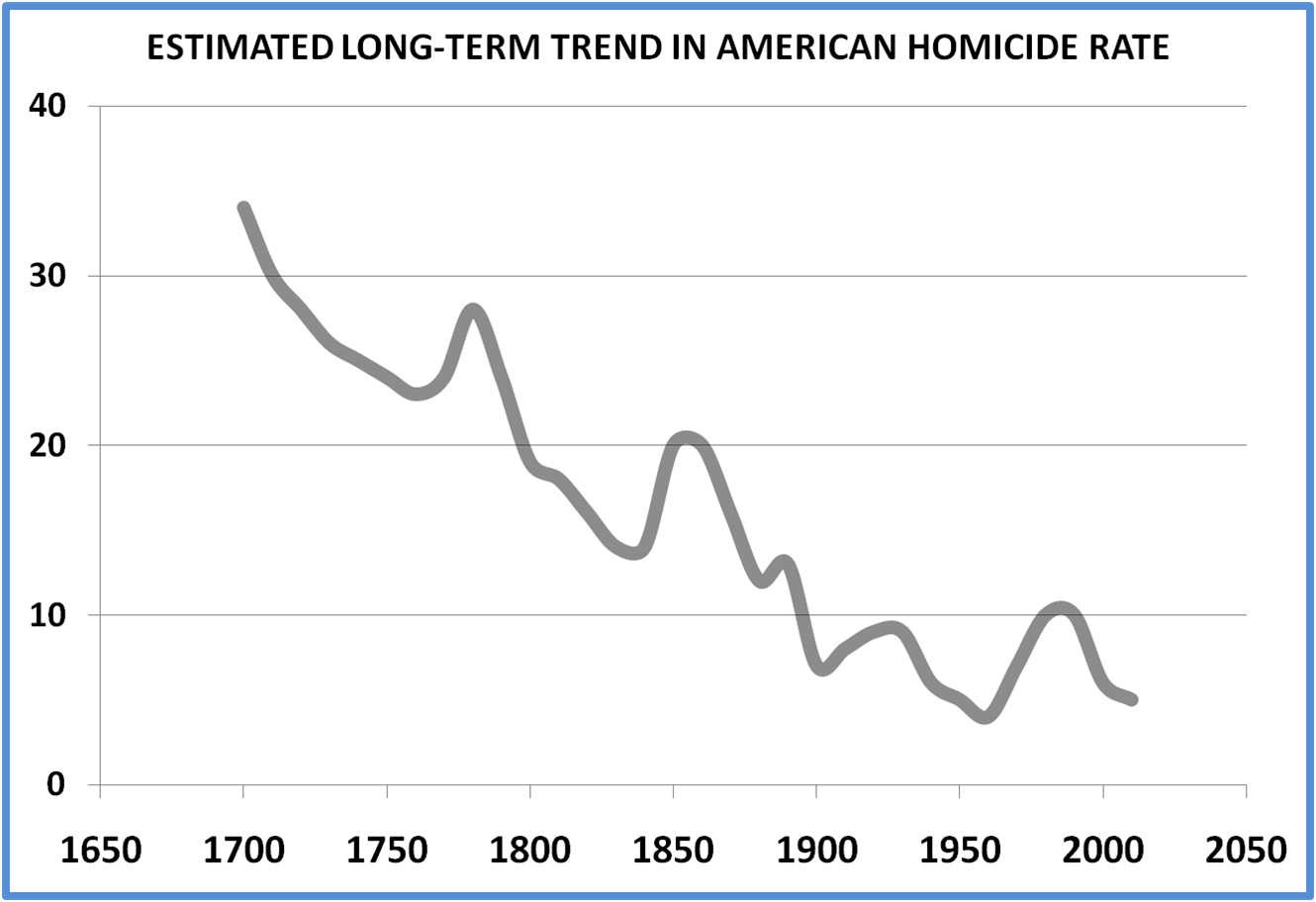
https://marginalrevolution.com/wp-content/uploads/2011/05/Vi...
https://theintercept.imgix.net/wp-uploads/sites/1/2018/02/Sc...

https://external-content.duckduckgo.com/iu/?u=https%3A%2F%2F...
the world is roughly 100000% less violent than it used to be, and the violent crime rate has not increased much in the past 5-10 years. this is a total lie.
I'm not saying that social media causes a flood of violence, I'm just saying that there are violent social contagions that should be addressed. Think of ISIS's social media campaigns for recruitment.
Not sure what makes you think that. Free speech certainly has helped, but so many other different things and changes has happened the last 100 years.
In any case, hateful let's-do-a-genocide ultra free speech didn't help.
Such things I think it's good to censor.
Absolutely it did. We get to see who the crazies are. We get to see what extremist ideologies threaten our peace. We get to talk to people that hold those ideologies, understand them, sometimes demonstrate the error in their view and sometimes simply prepare for them.
They exist whether we hear their voices or not. It's better to hear their voices than not.
I start wondering if you've gotten your worldview messed up
That you over estimate how dangerous various ideologies are
Compared with traffic accidents, and possible worse, those who sometimes get elected as presidents in your country.
I'm wondering if the places on the internet you apparently visit, slightly have brought you into a fantasy world now, where you worry for and want to prepare for the wrong things. I'm wondering if you believe you need weapons to defend yourself? Whilst being less interested in climate change and wildfires?
But never mind me and have a nice day
have you read 1 thing by any political revolutionary of the past? ones you like. washington. lincoln. malcolm x. rosseau. they're quite violent, and would get censored by your 'lets-do-a-genocide free speech' laws.
Stay away from the outrage machine. Be polite. Assume your partner in a dialogue is neither a fool nor malevolent. Quench flames. Try to understand, not to prove you're right.
Sounds easy and obvious, doesn't it?
No, it's not clear. Please elaborate.
The strongest weapon against extremist ideas is other views on the issues that created the extremism in the first place. Most extremists don't want their people to communicate freely, for a reason.
That by no means seems to be a sure assumption today. If anything, the question now is whether the latter state of affairs might not be the default, and if so, whether it is reversible at all.
Echo chambers were created by people censoring viewpoints within their networks. The solution to that problem is not more censorship.
The web is a complex system that is more than capable of producing outcomes that are drastically different from the sum of its inputs (i.e. "people"). Based on what kinds of mechanism design and incentive structures are put in place, it is not only probable, but more mathematically likely that even a web filled only with rational correspondents will eventually devolve into a mess filled with falsehoods and echo chambers.
The important corollary to this insight? There's an entire class of structural remedies we can take that you're not even considering, before we even approach anything remotely resembling censorship on the individual.
It was slower than Twitter/Facebook but the effect is exactly the same as the social media problem. I have a relative who went down the conservative conspiracy theory rabbit hole in the years after 9/11 and the web was a huge accelerant for his intellectual decline because once he found a community of fellow travelers he’d stay in that network of blogs where they strenuously resisted outside sources or the general idea of objective reality. When those communities moved primarily onto social media, they moved faster and got wider range but the practices didn’t change at all.
I agree with you insofar as Mill's free market of ideas is the best remedy against bigotry and extremism, but you have the wrong idea about how to achieve that -- unregulated laissez-faire "freedom" on the web does not result in actual free discourse. On the contrary, that's just a recipe for a web overrun by all manner of adware, malware, spyware, propagation of unconscious self-censorship by means of universal targeted and mass surveillance, and straight-up disinformation ops and public opinion manipulation from hostile actors. How are you going to have sincere exchanges of ideas at scale over all that noise?
Similarly, there’s not that big difference on “policing” - the social media companies enforce very basic terms of service but most people use web hosts with relatively similar terms. The major difference is the discovery mechanism (and the fact checking applied to certain politicians’ accounts which aren’t banned on public interest grounds) which is closer to how search engines avoid sending links to certain sites with bad reputations. A lot of what Twitter/Facebook block will also be dropped by Google or many free web hosts. You can definitely get away with more but I don’t see much reason to believe that it’s a major difference rather than minor variations depending on which companies and content you’re talking about.
True. But what if other, more virtuous things thrive more ?
If you look at the polarization of politics in the united states, both sides hate each other and they won't talk. Maybe if there was some kind of discourse, things wouldn't be so bad. Right now the only words exchanged are insults, all republicans are alt-right, all democrats are communists. It wasn't always like that. It used to be possible for people who vote differently to be friends, or even live in the same household.
Nazis don’t deserve to be handed the “2 Live Crew effect.” For those who don’t know this was a mediocre booty rap group whose record went triple platinum after attempts were made to ban it.
A parent poster raised another great point: the echo chambers that are full of this toxic stuff are themselves not free speech zones. They are heavily moderates safe spaces for specific ideologies and cultures. I am not convinced that this stuff would fare so well on a level intellectual playing field. It’s asinine.
On a final note it’s important to point out that the original explosion of e.g. Qanon happened not via some decentralized free speech zone or even the chans (where it was always ironic or a prank for most) but on social platforms with algorithmic timeline.
The algorithmic timeline is what has really ruined online discourse and promoted an explosion of insanity. Discourse on these sites is not equals but is weighted toward what will maximize engagement. Trolling, demagoguery, shock mongering, and various forms of “porn” (outrage porn, fear porn) are what maximizes engagement.
The algorithmic timeline would be extremely hard to implement in a decentralized system. That’s perhaps a good thing. It might look more like the genuinely flat forum world of the old Internet where discourse was comparatively far more reasonable.
This is a really good point. I think it's important to point to this as the root of the problem, and realize that what's good for Facebook and Twitter isn't what's good for society.
If the goal of the site is to maximize engagement, that’s going to be extremism, edgelording, porn, and trolling.
As I said: negativity maximizes engagement.
Let me give you a simple example. Lets say I walk past you on the sidewalk and say hi. Not much engagement. Now lets say I walk up to you and punch you. I have just maximized engagement. Which is a better interaction?
The internet was full of conspiracy theories, crackpots, and silliness, well before the facebooks, youtubes, and so forth. The key difference is that these were hard to find. Early on, the most effective discovery infrastructure was based on hand-curated indexes (e.g., [1,2]). These moved slowly and were hard to game. Now, those same indexes are generated by algorithms, the gaming of which has spawned an entire cottage industry.
The parent's viewpoint and TFA are not incompatible, as long as we don't assume that content distribution and content discovery have to come from the same service. The open internet survived for over 2 decades without bringing down democracy. At the same time, it would be a good idea to see a bit more editorial responsibility from services driving discovery. Better still, if hosting and discovery are decoupled, there's no network effects or content archive creating a captive audience if editorial power is abused.
Tying things back to TFA, and perhaps the point that you're trying to make here, amadeuspagel: IPFS seems mostly aimed at providing hosting infrastructure rather than discovery. I'll emphasize the point again: censorship-free hosting has been largely unproblematic for the past two decades. What's been getting us into trouble now is discovery without editorial review (and forcibly tying discovery to hosting).
[1] https://en.wikipedia.org/wiki/Yahoo!#Founding [2] https://en.wikipedia.org/wiki/Whole_Internet_User%27s_Guide_...
I thought about what you said, and immediately connected it with several other claims of things that also rise with tech advancement... marginal impact of weapons, medicine, intelligence, entrepreneurship/luck, sports, games, entertainment, communications...
So if the marginal impact of everything rises, then maybe that’s just the way of technology? It increases leverage. But then in relative terms, all those things still have the same impact? Or maybe the ratios between them change (e.g. weapons/nukes became more more powerful than communications)? Or maybe there’s other areas that massively reduced in marginal impact (e.g. production of food)...
So, you're saying: "At least a nuke went off?" or that a nuke going off is a fantasy? You know that plenty have gone off, and a few killed a lot of people, right?
I don't have any big problem with nuclear power, but I don't want to see a nuke go off.
There are dead people, because 8chan was allowed to exist.
That is not something that you should be fighting for. You are not fighting for any greater good there. You are promoting something that leads to actual, real people dying.
The reality is the reason why people commit crimes, including violent ones such as murder, is a deeply complex subject that has the full time focus of many highly educated people. A simple one-liner attributing extremism to a specific site you find distasteful isn't constructive IMO.
Here's a quick primer on the history of crime and criminal psychology walking through the various phases of understanding why people commit criminal or violent acts. https://law.jrank.org/pages/12004/Causes-Crime.html
Favorite execrpt from link above:
> Children who are neglected or abused commit substantially more crimes later in life than others. (© Roy Morsch/Corbis)
I have an absolutism posture on free speech. Everyone should say whatever they want without fear or retribution. This includes offensive speech. If this incites violence, so be it. Why not invest in mental health care instead of suppression of speech? The history of mental health care in the USA is abysmal.
https://www.healthaffairs.org/doi/full/10.1377/hlthaff.11.3....
My personal opinion is that positions such as your own can also be characterized as radical.
This is not a logically sound stance to take. Violence, by its nature, stifles speech of its intended victims.
You are only promoting the free speech of the boldest or most ruthless. You are not promoting free speech for those who would be victimised by them.
However, that doesn’t mean to me that speech should be free from consequences. To do so, you’d have to make it free from side-effects (including changing others’ minds) which would make it pointless.
There are dead people, because the New York Times was allowed to exist.
That is not something that you should be fighting for. You are not fighting for any greater good there. You are promoting something that leads to actual, real people dying.
Whilst the media can influence people, including politicians, there is very little in common between the lead up to the Iraq war and the mass murders the parent poster is referring to.
I’d be happy if both NYT and 8chan didn’t exist.
https://en.wikipedia.org/wiki/FCC_fairness_doctrine
I'd be happy if this was successfully reintroduced. I can't imagine why this isn't widely supported, especially by those who detest "fake news" and want misinformation to be suppressed.
>> Records indicate that there were 3,613,732 motor vehicle fatalities in the United States from 1899 to 2013.
Also 70 - 80 million people died in just the second world war.
So your first claim is wrong by well over an order of magnitude. If you meant just US deaths in both wars, you should say so. But in this case, I feel you should choose another comparison. To be so selective would be disrespectful to approximately a hundred million non-American war casualties.
https://en.m.wikipedia.org/wiki/Motor_vehicle_fatality_rate_...
Yes, you are correct that I meant to say Americans and not total all deaths like I typed. However, the point that vehicles are acceptable even though they cause vast deaths, yet for some reason if one thing someone doesn't like causes hardly any deaths, they can strongly condemn anyone being allow free speech and create a slippery slope.
If you were to add automobile accidents in all other countries combined with the US figures, you do get obviously a much higher figure. Automobile accidents are very high up on the list of cause of death.
(The article also only takes into account US traffic deaths since 2000 being greater than both world wars, and of course there were magnitudes more deaths going back to the 1970s, likely in the earlier decades as well I wasn't trying to be super pedantic, which is why I'll still leave my above post intact.)
The "wisdom of crowds" depends on the question asked, the algorithm used, and the countermeasures that keep people from gaming it.
A simple example: if you want to have good restaurant reviews, it's a good idea to exclude people who never ate at the restaurant in question. That alone isn't necessarily going to get good results, but it will help.
Just letting strangers do whatever they want in group activities online typically has bad results. This has been tried many times. If you want to get good results you need some kind of structure.
Who imposes this structure? The people building the system.
Trolls, bots, socket puppets, propaganda, gaming the algorithmic recommenders, flooding the zone with bullshit, etc.
CLICK AND WIN --- YOU HAVE (3) NOTIFICAIFIOTIONS
I hope it's sarcasm.
My goal is to break feedback loops. Authenticated speech empowers us (the receiver). Like spam filters for news (outrage).
I don't care if other people are gas huffing QAnon, just so long as I don't have to ever hear about it.
And you might notice that the http level is not where the existing problem occurs.
You're free to not connect to their platform either way (and to be subject to their limitations regarding contents and behaviour), whereas setting up an onion service can be about stuff that people aren't free to avoid (i.e. censorship by the only ISP they might have, by a state, etc). There's no issue with consistency there.
Likely it will devolve to regional or country specific centralized web with those currently in the lead making the decisions. That doesn't sound too great...
> It’s offered a megaphone to those promoting dangerous ideas like white supremacy, Islamophobia, anti-Semitism, homophobia and other anti-LGBTQ positions, and sometimes outright Nazism.
This group always seems to willfully ignore or is ignorant of 20th century history WRT Russian and China.
It’s possible I misinterpreted you and you meant “anything they like” in the sense of being able to hold (almost) any opinion and be able to express it, provided it’s expressed politely and in good faith. In that case, I would still argue that it’s only the selective moderation of impoliteness and poor faith arguments that keeps this site bearable.
At my prior job we were fairly big (1000+) and had internal meetings more or less instructing people how to vote. We had a significant social reach and the ability to promote arbitrary articles such as news. We had editorial guidelines forcing us to be politically biased. As much as I disagree with the current president I do think there was some sort of attempt at manipulation. Whether it was successful or not is beyond my ability to analyze.
I would have thought that even people who are in favor of some censorship recognize that most censorship is not "benevolent". That even though they might dislike that IPFS will make it harder for facebook and youtube to decide what people are allowed to think, they would like that it will also make it harder for the governments of russia and china, and that this would more then make up for it.