Audit rates of people making $1m or more are down by 80% since 2011. Now "the top 1% of taxpayers by income were audited at a rate of 1.56%. EITC recipients, who typically have annual income under $20,000, were audited at 1.41%."
Source: https://www.propublica.org/article/irs-now-audits-poor-ameri...
Assuming the IRS is underfunded, saying they focus on low income people as a consequence, when it would be more lucrative to target high earners, makes no sense. The claims could all be true, but they don't appear to be connected.
Why would the total amount of funding force the IRS to spend less on individual cases? An alternative hypothesis might be that it actually is more cost effective to target people with less money, for instance, people paid mainly in cash tips, but I don't have any idea if that is plausible, I'm just saying the narrative doesn't make sense to me.
In general, targeting rich people seems obvious because rich people "have the money", but mathematically, it depends on how many there are when you multiply it out.
Anyway, I am very open to the idea that the IRS is being stupid and counterproductive, or politically avoiding prosecuting the rich, but I think it raises the question of "why" that is not answered by saying "underfunding". They still have funding to go after one or more high earners, right, so the total amount is irrelevant if it's taken as a given.
The IRS also sends the letters to people that they owe money. This year my accountant didn’t realize I was owed a credit. The IRS mailed me a check and a letter explaining why they adjusted my return and issued the credit.
It's hard to know where to draw the line but you could reasonably argue that chasing low income people for small amounts is net negative societal utility, even when you get them to pay up.
The thing that is often ignored, unknown, or forgotten, is that it doesn’t have to work this way. Some countries send you an end of year report on how much they collected from you and you can audit them as well. It’s less laborious than our system. I am blissfully unaware of the complications of such a system but I’d like to think that it works better. I’d like to think the people of the IRS would prefer that too.
They can't choose to spend more, knowing they will make it back.... they don't have the money to invest in going after rich tax payers. They can only spend the budget they are given, and that isn't enough to go after rich people, even if it would bring more money in.
I expected this was a big reason for the seemingly illogical behavior, but am curious how it shakes out. Where does money they recover go?
It would seem to make sense to seed a high income investigative unit, checked by the courts, and then allow them to retain a substantial portion of their recoveries to self-fund.
> It would seem to make sense to seed a high income investigative unit, checked by the courts, and then allow them to retain a substantial portion of their recoveries to self-fund.
For an example of how this could go horribly, horribly wrong, look at police use of civil forfeiture. https://www.nbcnews.com/think/opinion/police-abused-civil-fo...
If you limited their targets to high net worth individuals, I daresay they'd be able to afford a robust (and as fair as we can make it) defense.
Unlike the abuses in civil forfeiture, where the primary targets tend to be without legal recourse.
And a fast resolution doesn't seem required in this case. High net worth individuals don't seem like they'd be impacted by {potential tax bill and penalties} of their assets being frozen for multiple years while a case plays out. Relative to their total assets, any tax bill is going to be manageable.
The only problems actually preventing the IRS from conducting this enforcement are (1) political cover from direct Congressional interference & (2) lack of resources due to general defunding by Congress.
Given a choice between the dangers of establishing a self-funding high net worth tax prosecution arm and not prosecuting those individuals, I feel the greater risk to democracy is the later.
"Make your check or money order payable to “United States Treasury.” "
That's, you know, the federal government. Not the department called the IRS. The IRS gets a budgeted amount of funds.
I don’t understand how Republicans can argue cutting funding to the IRS will save the government’s spending. Instead their goal is to make the tax base richer by cutting taxes of the rich. Many of them are all about cutting taxes to the rich and corporations, doubling down on the trickle down. They even blocked payroll tax cuts to the lower and middle class:
http://www.washingtonpost.com/politics/house-republicans-def...
So yes, you're correct. Analyzing whether or not someone is eligible for EITC (those making less than ~$50,000) can be automated and if flagged, a letter sent telling them they aren't eligible or asking for more information.
[1]https://www.taxpolicycenter.org/briefing-book/how-do-irs-aud...
Seems like institutional failure if I have to vote for IRS expansion, the same people going after my tiny coffer, for the IRS to go after anyone else. That's a dumb conflict of forces.
That's deft political engineering. Congress is to blame. They tweak the budget to protect themselves and their true constituents (megadonors and lobbyists).
We're in a peculiar situation where democrats and republicans are both on the "right" in their fiscal policies. Any blush of "left" policy is shouted down by bipartisan echoes of McCarthyism. The politicians of both parties are, by and large, upper class, and they collectively pit the middle class against the lower class.
We don't need a new IRS, we need a new breed of politician. And enough funding for the IRS that it can audit those politicians and their donors fearlessly.
To sociologists, economists, and academia, those who rely on a salary or wage to live are considered working class compared to those who don't.
That's a perversion of the definition.
I don't think your handsome graphic there is offering much insight into the topic at hand. The richer someone is, the less likely they are to cheat on their taxes.
EITC not withstanding you need to have income to hide it.
According to Brookings, the bottom 50% pay 14% of the taxes but are responsible for only 12% of evasion.
The better distinction is the source of income. Farms, landlords and sole proprietorships are the leaders in misreporting income. W-2 salary reporters account for <1% of evasion. Between those two groups are misreported tips (typically lower end) and capital gains (typically higher end)
Both could survive on far less.
Hell no. If you're in the top 1% of income (~$400k per year) you are wealthy.
And yes, I believe that if you sell your labor for a living, whether it be for $400k at Apple or otherwise, you have more in common with someone making $24k bussing tables than you do with the person who owns property for a living.
If you're making $400k per year, how long before you start to accumulate substantial wealth? Pretty quickly I'd say. Sure it might not be millions, but if you sock away $200k at age 25 after 3 years, you have more wealth than 99% of people your age.
"Wealthy" is not limited to wealth alone. If you're making $2M a year and have no savings, you're still "wealthy".
And people with large amount of wealth (your definition) can still become destitute. There are plenty of examples.
That $400k post tax is mostly going into housing.
Some might say that with that luxury comes the responsibility to improve the situation.
The kinds of rich people being discussed in this thread are still a very small percentage of six-figure+ earners. I would venture to say (no pun intended) that most HN readers are not accredited investors.
So I continue to think that the six-figure norm people talk about is within a "reality distortion field".
Another thing, many countries expect rich people and rich companies to hire government-certified accountants to verify your fillings (known as a Statutory auditor https://en.wikipedia.org/wiki/Statutory_auditor ). This makes it harder for these companies to do stuff the non-audited guy can easily do.
This also plays out in other ways: Intuit spreads a ton of money around trying to prevent the kind of automatic tax and online filing which happens in most of the world because thinking of taxes as hard provides them with a steady stream of customers.
There are some super rich tax evaders who can hide many millions from the IRS, but they are few in number and it will cost millions to recover that money after going through all the obstacles such rich people can afford to put in place.
On the other hand, imagine 100 million people all under-reporting $1200 - that's $120 Billion Dollars, or about 6 NASAs. If you actually had to go after everyone, that would be extremely expensive, but if you go after just a small percentage of people, the rest will be scared into properly reporting their income. We all know one or two people who have run into serious trouble with the IRS: enough that we are familiar with the consequences but not enough that it seems like a common and socially acceptable strategy. This is by design.
With the very wealthy, this strategy doesn't really work. Just because you manage to get one bank in switzerland to hand over some data doesn't mean my bank in the caimans is going to do the same. Even if the IRS were to catch up to me, I can afford to wait to cross that bridge when I come to it. You can take billions from certain people and they will still have net worths greater than some nation states - those who can afford to lose can afford to play the game.
It's also worth noting that the tax code has plenty of loopholes that wealthy people and corporations can use to legitimately reduce their tax burden. IRS recovery isn't going to be able to do anything about that. If you have billions of dollars, you can afford an accountant who will make sure there's nothing for the IRS to go after.
Really changing the funding of the IRS is irrelevant - were we to simplify the tax code to eliminate loopholes and make it easier for people who can't afford armies of accountants to properly pay their taxes we could both collect more money and spend less on recovery. It may be impossible to get congress to actually do that, but anyone talking about playing around with the IRS's funding is just trying to look like they're addressing a problem they really have no intention of solving.
https://taxfoundation.org/summary-of-the-latest-federal-inco...
> In 2017, the bottom 50 percent of taxpayers (those with AGI below $41,740) earned 11.3 percent of total AGI. This group of taxpayers paid $49.8 billion in taxes, or roughly 3 percent of all federal individual income taxes in 2017.
> In contrast, the top 1 percent of all taxpayers (taxpayers with AGI of $515,371 and above) earned 21.0 percent of all AGI in 2017 and paid 38.5 percent of all federal income taxes.
> In 2017, the top 1 percent of taxpayers accounted for more income taxes paid than the bottom 90 percent combined. The top 1 percent of taxpayers paid roughly $616 billion, or 38.5 percent of all income taxes, while the bottom 90 percent paid about $479 billion, or 29.9 percent of all income taxes.
> The income tax is not the only tax collected by the federal government — far from it. Just half of the taxes collected by the federal government come from the income tax. About a third come from payroll taxes — which fall much more heavily on working people, since they’re largely levied only on the first $130,000 or so of earned income.
..
> Second, the wealthy naturally pay a disproportionate share of federal income taxes because they make a disproportionate share of the country’s income. In other words, these numbers to some degree demonstrate exactly the opposite of what those who use them claim: They’re not an indication that the superrich are beleaguered, but are in part a sign of America’s staggering wealth inequality.
..
> the top 1 percent — with an average income of about $2 million — made 20.9 percent of America’s income, but paid 24.1 percent of America’s taxes. Few people will perceive this as a monstrous injustice.
> Meanwhile, the middle 20 percent of Americans— with incomes between $41,000 and $66,000 per year — make 10.9 percent of America’s income and pay 9.4 percent of America’s taxes. The bottom 20 percent, making less than $23,000, make just 2.8 percent of America’s income and pay 2 percent of America’s taxes.
https://theintercept.com/2019/04/13/tax-day-taxes-statistics...
The rich pay taxes roughly in proportion of what they earn.
https://theintercept.imgix.net/wp-uploads/sites/1/2019/04/ch...
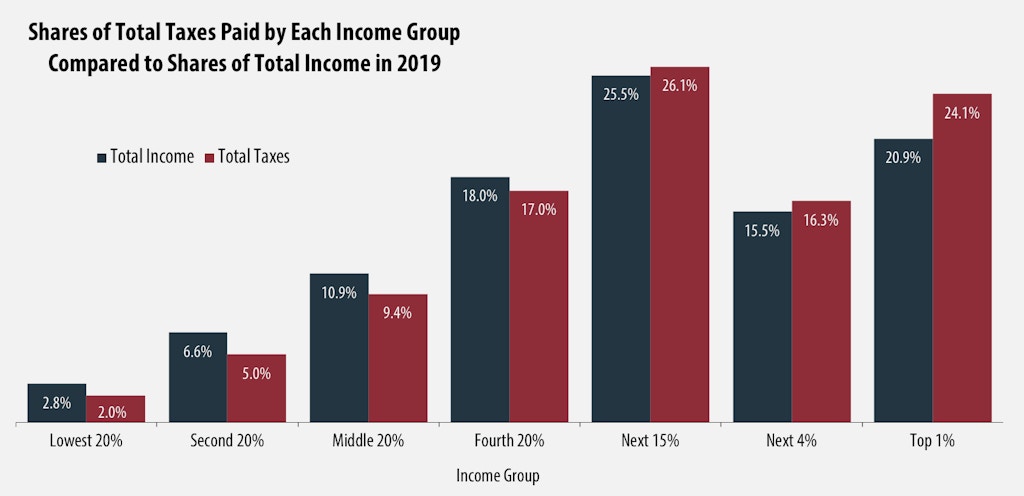
Other big issue is the super rich typically have full control over when, where, and how, a taxable event happens. For the wealthy most wealth building doesn't involve taxable events. One of my beliefs is the mortgage interest deduction is a sop to the middle class. Because otherwise the wealthy would out compete middle class families for single family homes.
Grouping together wages, capital gains, and misc under the label "income" rhetorically hides the unfairness of our regressive tax regime.
GP's point is the IRS is unfairly focusing on the weakest while ignoring the worst offenders. No reasonable person disputes IRS's own repeated statements to that effect.
We can only guess the motives of any one still in denial.
This is Vox's explainer of the same topic.
Who pays the lowest taxes in the US? https://www.youtube.com/watch?v=kXCGbAv8YPw
Just from skim reading, theintercept's article is based on a study from ITEP and Vox's data comes from taxjusticenow.org. I'd have to dig deeper to see if they're referencing the same data of if these are just complimentary studies.
That's not correct. 4.5% of returns account for almost 60% of taxes. 17% of returns account for almost 80% of taxes. And that was before the Trump tax cuts.
https://www.pewresearch.org/fact-tank/2017/10/06/a-closer-lo...
The only reason the IRS is involved is because the payment is a tax credit, rather than just a payment from some govt body.
22M Americans receive EITCs and the average payout was $3200, for a total of $70B per year.[1]
[1]https://www.cbpp.org/research/federal-tax/policy-basics-the-...
If the IRS doesn't go after any kids waiting tables, no kids waiting tables will bother paying tax. And that's, in aggregate, a lot of money.
This is a similar fallacy to the idea that cops should not investigate minor crimes - say, burglaries - until it's solved all murder. If they actually do that, burglaries will effectively be legalized, and anarchy ensues.
The bigger mental trap here is I guess a failure to consider second order effects.
Innumeracy among even educated people is why our policies are the mess they are.
You may be right.
Maybe my point is better made by saying that minor spending enforcing these taxes bring in a lot of money.
> Innumeracy among even educated people is why our policies are the mess they are.
I'd say it mostly just reflects the relative power of various interests.
Did you owe it?
IIRC, the IRS assumes some amount of tips per time worked and expects taxes for that.
The flip side of this is that many servers don't document because, well, they make above the standard assumption.
Look at the various reported tax games with Donald Trump, though--many involve situations where the other side of the transaction is cooperating. If both sides are dirty the IRSs job becomes much harder. Also, the more complex financial transactions can't be distilled down to standardized reporting so well, it's much harder to match both sides.
The IRS needs to prioritize its resources by going after the big fish, not obsess over kids waiting tables. A bigger IRS doesn't change the fact that it's apparently toothless against the rich and has nfi how to allocate its resources.
My attempt at optimism: going through a downsize cycle is perhaps good to compel healthy internal reorganization inside systems (biological, business, etc) that can prepare it better for a future expansion cycle.