Or other societies realized widely broadcasting noise is bad for whatever reason. Maybe they're composed of something sensitive to certain wavelengths. Like humans don't use xrays to transmit data, maybe radio waves are harmful in some way.
Or maybe broadcasting widely resulted is a case study for getting your civilization invaded, so they avoided it it or only send signals as strong as they need to be.
Or maybe it's so consistently and universally done that we simple see it as cosmic background radiation.
Or maybe something like quantum entanglement someday makes wave transmissions for communication seem as backwards as smoke signals.
Humans have only observed a tiny slice of space over a very tiny time span--less than 100 years. It's like being born in a barren desert and never venturing out and realizing most of the world is ocean and full of activity. We don't know what to look for or where. An observer 200 light years away from earth could easily conclude that there's no life here, since all they'd have to go by is inconclusive signs of some gases in the air.
> Or other societies realized widely broadcasting noise is bad for whatever reason.
> Or maybe broadcasting widely resulted is a case study for getting your civilization invaded, so they avoided it it or only send signals as strong as they need to be
Every other society realized it at the same time? Which would imply every other society is roughly born at the same time, which sounds unlikely. So some of them (like us) should not yet have discovered the danger of broadcasting signals.
> Or maybe it's so consistently and universally done that we simple see it as cosmic background radiation.
I don't think you can possibly mistake the CMB with some artifical radio signals coming from point sources.
> Or maybe something like quantum entanglement someday makes wave transmissions for communication seem as backwards as smoke signals
Definitely a possibility, but again, that would assume some kind of synchronicity between all other societies (no one is still figuring out quantum communication). But since radio signals are hard to pickup at a long range, it's possible. But we also haven't seen any other traces of civilizations: probes, dyson spheres etc.
And I'll play Devil's Advocate to your Devil's Advocate. :)
It's entirely possible that there have been other technological civilizations over the past 13.7 or so billion years. That's a long time. As such, any civilization that stopped broadcasting in our direction, if they ever did so in the first place, any more than 100,000 or so years ago, would be completely undetectable to us -- ever.
What's more, as was pointed out in another comment, we haven't been looking for such signals for long (~60 years) and haven't surveyed anything close to the entire galaxy.
I guess the most accurate thing we can say would be that we haven't detected another technological civilization within 60 light years or so in the few places we've looked.
Given the lack of data, the Drake equation[0] is less a predictive device than a way to categorize our ignorance.
The Fermi Paradox[1] and its "where is everybody?" question is more in line with what I perceive to be your point.
Given that we haven't looked very hard for very long (as I mention above) in an enormous galaxy that's existed for billions of years, it seems to be in a similar position as any predictions from the Drake equation.
It's interesting to speculate, but without enough data, speculation is all it is.
But this is assuming radio signals are the only way we could detect a civilization, what about probes (von neuman or regular), dyson spheres etc. ?
> I guess the most accurate thing we can say would be that we haven't detected another technological civilization within 60 light years or so in the few places we've looked
The signals we received in the last 60 years come from the entire observable universe (it's how we define the observable universe), not just from a 60 ly radius. But the furthest the signal comes from the hardest it is to detect (or the strongest it would have to be to be detectable).
> It's interesting to speculate, but without enough data, speculation is all it is.
I certainly hope that everyone is aware that is pure speculation ;)
A fair point. I should have been more specific and limited my statement: "we haven't detected another technological civilization, currently broadcasting electromagnetic signals in our direction, within 60 light years or so in the few places we've looked."
However, that doesn't mean such civilizations don't exist, nor does the fact that we haven't detected any such signals at any distance, or any other indications of such civilizations, extant or not.
Why restrict yourself to those 60 light years? We haven't heard about any other civilizations in the entire observable even if their transmission happened a long time ago and they may be extinct by now.
It's only true in the other direction: only a civilization less that 60 ly away could possibly have detected our radio signals so far.
That’s trying to find a needle in a universe sized haystack, and we’ve only just started digging. Concluding that there’s probably not a needle when we’ve only just started digging our hands in is premature.
But that is the whole point of the fermi paradox. Given the staggering numbers of planets in our galaxy/universe, and given the staggering age of the universe (when compared to our history), it should not be like trying to find a needle in a haystack.
If it is, then that means life is extremly rare, which already answers part of the question.
How likely is it that by the time humanity would be a space faring society that we’d be pumping turbo charged radio signals that are easily distinguished from noise when doing a quick sweep? How likely is it that societies are using radio signals or something similar for a long period of time, and not simply using some better method that humans have yet to discover?
Of course everything is just speculation, for every hypothesis on one side of the argument you can find 2 hypothesis from the other side that counter it. But the point is, to go back to the original question, that the right answer is definitely not obvious and if someone's opinion is that we are alone, or at least that life is very rare, it's not completly crazy.
Even the discovery here was somewhat random and required someone to start digging through recorded data.
Also remember the search space isn't even just a single galaxy, it's the entire observable universe with a hundred billion galaxies, give or take.
Yeah, that's the Dark Forest book in effect.
If you broadcast, other civilizations could attempt to destroy you, so most civilizations find some way to dampen transmissions or limit them somehow.
Precisely, and in the Dark Forest book we (humans) did indeed detect radio signals from other civilization very early after we built the radio telescopes capable of doing so. So the fermi paradox is not present in this alternate reality.
In our reality we haven't detected anything yet, hence the paradox.
Does this not happen with eyes, limbs and especially blood which have evolved independently many times? Maybe whatever the reason is is actually quasi-inevitable and we're missing the few that fall outside of that evolution for some unrelated reasons.
People overestimate the detectability of our own signals. I don't have a reference, but I read an article a few years back where someone calculated how far away we would be able to detect our own signals with our current technology. The answer was about 20 light years. There are only around 100 stars in that sample. About all we can say is that there is not a civilisation similar to ours in that sample. Anything further away would have to be deliberately trying to communicate with us. If they are similar to us, they wouldn't know we are here. If they are much more advanced, we might be uninteresting to them for any number of reasons.
Technology advances, and this situation will change. The Square Kilometre Array, for example, will give us the resolving power to see whether excess radio "noise" is coming from a planet rather than a star (which might be an indication of an intelligent origin). This will increase our bubble of detectability much further out. Unfortunately, I don't have a number on that, but it is still an incredibly small volume compared to the size of the universe.
This is a very common trap. I see this way of thinking applied to the presence of life on Earth all the time. It’s gilded in the Drake equation. It is very possible that Earth is the only planet in the galaxy or even universe with life on it. As the most powerful species on that planet, we should make responsible decisions. There is zero evidence, or even a compelling argument using existing data, that contradicts this possibility.
It turned out since the planets are abundant. Planets being abundant increases the chances of life countlessfold, so there is a reason for cautious optimism.
I think you mistake the meaning of the "we are not special" statement. From a statistic point of view, we have to assume that everything about us is roughly average (and so far our observations kind of confirm this), otherwise any probabilty you come up with is completly skewed by the bias you introduced by assuming from the get go that we are special.
But interestingly, by assuming that we are average and knowing the abundance of other planets, we should see a lot of activity out there, but we don't. So maybe that indicates that we are, in fact, not average.
This is the part I disagree with. It’s a hasty generalization to extrapolate from a single data point (Earth). The law of small numbers is alluring, but we must stick to our proper statistics guns and not fall into intuitive traps.
But we have no choice, we have to extrapolate. And if you have a single data point, assuming that this datapoint is average makes more sense.
If there is an urn containing 100 balls some red some green, 99 of one color and 1 of the other color, and you blindly pick one ball from it that is red, you should bet that there are 99 red balls and 1 green ball, not the other way around.
We can ponder the possibilities as long as we don’t start playing favorites. Saying “we aren’t special” is playing favorites. Saying “we may be special” is not.
We aren’t even confident about the state of life in the solar system. There could be life on Venus, Mars, and/or Europa. Earth may have seeded that life or those places could have seeded Earth, maybe a common ancestor seeded all three, or maybe genesis is common. Maybe life is all over the universe, or maybe Earth is the epicenter, or maybe something in between. We can say next to nothing about the state of life in the universe.
All we know for sure is that we are alive and stars have periodic dips in light intensity. We should act like we are the only life in the universe when weighing the pros and cons of self-inflicted armageddon, at least until proven otherwise.
I don't think anyone is making a generalization in the sense you seem to be implying. No one is saying: given our current observation we have concluded that we are (or not) the only ones around. Things are being discussed in term of likelyhood, not in term of certainties.
> You can say next to nothing about a bin of balls from one sample.
You can definitely say something: That there are 99% likelihood that the urn was filled with 99 red balls and 1 green ball, and 1% that it was the other way around.
We can say the universe can support life because here we are. We can say nothing of how common it is other than it has occurred at least once in 10^24 planets over 10^9 years. It’s difficult to overstate how insignificant this amount of data is in a statistics sense.
From https://space.stackexchange.com/a/13013
> uoting from Tarter (2001): "At current levels of sensitivity, targeted microwave searches could detect the equivalent power of strong TV transmitters at a distance of 1 light year (within which there are no other stars)..."
We barely have the sensitivity to detect the existing strong TV transmitters of today within a 1ly sphere. The inverse square law becomes rather cruel. For a 2ly sphere, we'd need 4x the sensitivity. 3ly, 9x. To get 100 stars in the sphere, we need 21ly sphere, and that would need 400x the sensitivity that we have... and in that list of 100 nearest stars, there's only 6 G type stars.
So yes... there may be. But we're very small ( http://www.rainydaymagazine.com/RDM2011/RainyDayScience/Radi... ). Our own radio signals have barely made any significant coverage of the galaxy. Our own signals are also becoming harder to detect as our radio technology becomes better (DTV only needs 1/5th the power of analog TV).
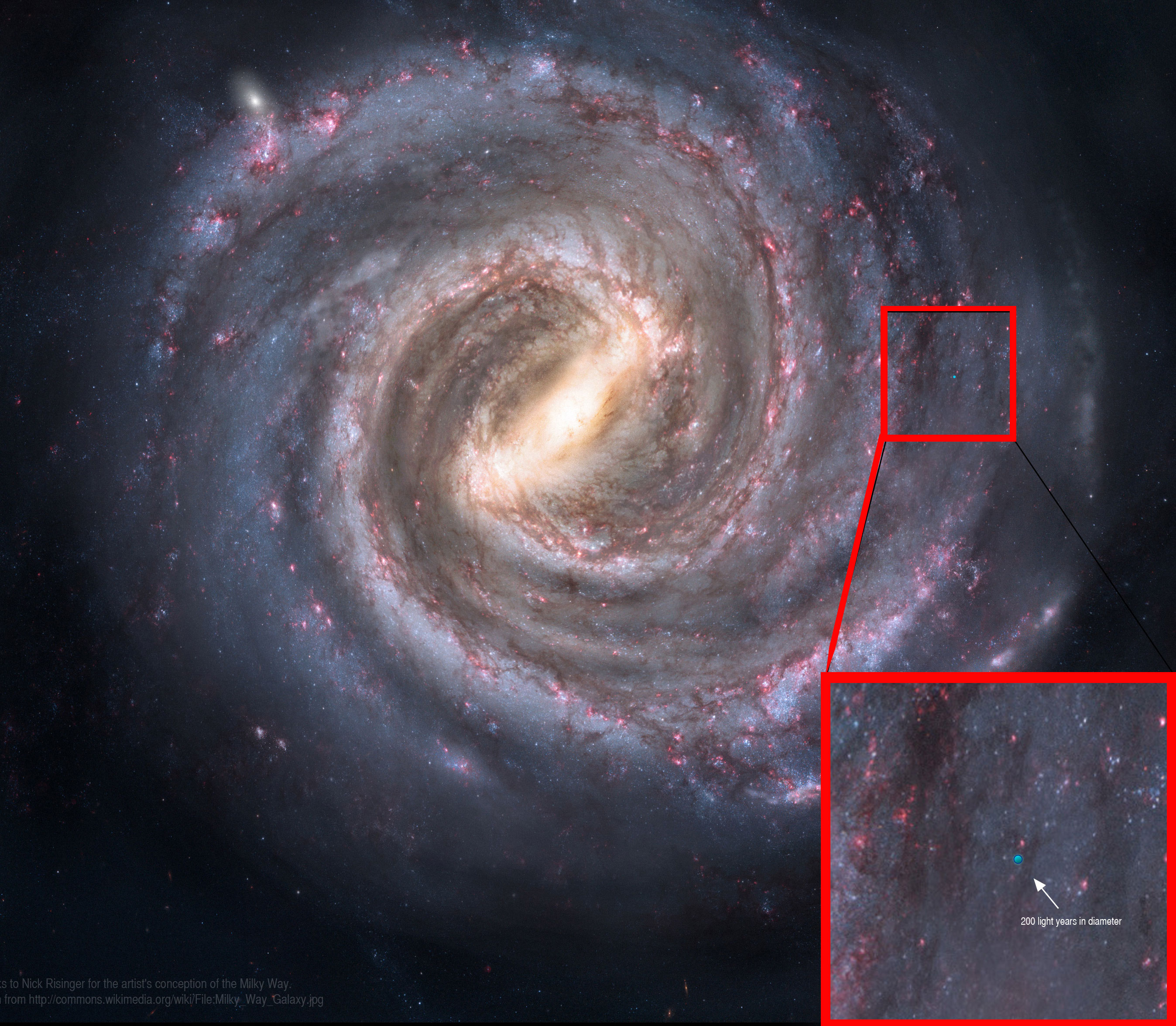
That we're not hearing any random signals akin to what we've been broadcasting for the past century isn't surprising.
Von Neumann style probes, Dyson spheres etc.
Current estimates place the number of planets in our galaxy at 100 billions. And some of the stars in our galaxy are ~6 billions years older than our sun, that's a hell lot of time for a civilization to develop massively considering the technological progress we have had in a just a few thousands of years.
This is not my argument at all, it's actuall quite the opposite.
The argument is that, if everything about us is average (including our host planet), and given the tremendous amount of planets everywhere, we should see life basically everywhere. But we don't! So there indeed maybe something special about us, maybe our planet, maybe some extremely rare step in our evolution.
Similarly signals from other civilisations will probably become scrambled by distance and because they might overlap heavily with the radiation emitted by their sun.
Or one of the first things civilizations figure out is to not broadcast your presence.
Or ... Everyone else in the universe found peace by stopping at the stone age , before all this social media made us miserable.
It's just conjecture, but I imagine aliens exist, but they might not even be in a form re recognize.
I'll make up something scifi like. On planet x they use short term Seismic wave to move data around. How would we on earth ever pick that up
Because the universe is 15+ bilions of years old.
Considering the speed at which we have evolved technologically, assuming life developed on earth in a perfectly average way (i.e. we are not special), and given that our solar system didn't appear particularily early, there should be a lot of much older civilizations (and thus much more advanced) around, even within our galaxy. Thus, the fact that we are unable to detect any signal from even a single other civilization is quite puzzling, we should be inundated by those signals.
P.S: I don't know if many people in the scientific community really believe that we are the only ones out there, more so that intelligent life forms could be extremely rare.