News for hackers. Stuff that matters.
Re:Wildlife in ‘catastrophic decline’ due to human destructi... by AlexandrB on Friday September 11, 2020 @03:50PM (#24446618)
I think the future is very grim for biodiversity. Even if we stopped destroying habitats tomorrow, many larger animals are already living in small, isolated pockets surrounded by roads, farms, and industry. Meanwhile, plants and smaller animals face intense competition from invasive species - often brought in by accident thanks to the constant flow of goods around the globe. We're probably headed for a pretty homogeneous global ecology - where "economically significant" or highly adaptable plants and animals thrive, while the others are relegated to zoos, national parks, or extinction.
Re:Wildlife in ‘catastrophic decline’ due to human destructi... by throwaway894345 on Friday September 11, 2020 @05:15PM (#24447384)
The glimmer of hope that I have is that the same sort of market forces that create these problems can be marshaled to solve them. For example, if the wealthiest countries implemented a carbon tax including a border adjustment (accounting for goods from countries with a laxer carbon policy) would give governments a single, simple dial that the could turn to lower carbon emissions. Similarly, we ought to be able to implement other kinds of ecological taxes to great effect. However, arriving at that kind of policy is a purely political problem.

In the meanwhile, there are other market-based solutions, like organizations who certify products' sustainability. The certifier allows the manufacturer to place the sustainability trademark on their products if they pass the required audits. I'm of the impression that this has made a significant impact for forest-derived products via the Forest Stewardship Council (https://fsc.org/) with a handful of activists decades ago pushing the largest retailers (e.g., Home Depot) of forest-derived products to invest significantly in FSC-certified products.

Re:Wildlife in ‘catastrophic decline’ due to human destructi... by acituan on Friday September 11, 2020 @11:56PM (#24449712)
> market forces that create these problems can be marshaled to solve them. For example, if the wealthiest countries implemented a carbon tax including a border adjustment (accounting for goods from countries with a laxer carbon policy) would give governments a single, simple dial that the could turn to lower carbon emissions.

Taxes are not market forces, they are exogenous interventions on markets. Which means having wealthiest countries implement a carbon tax is not riding market dynamics for free, but a difficult multi-agent cooperation problem that makes defecting competitively very advantageous. This includes for example requiring cooperation with India (5th in GDP) and China (2nd in GDP) who have been enjoying high, multi-year economic growth, whose de-carbonization would hurt their economies disproportionately, unlike other rich countries. Unfortunately exports only account for ~20% of their GDPs so there is only so much leverage to apply there either.

Re:Wildlife in ‘catastrophic decline’ due to human destructi... by throwaway894345 on Saturday September 12, 2020 @03:09AM (#24450518)
Taxing carbon is just removing the carbon subsidy that we currently enjoy because it isn’t sustainable. If we decide we want to subsidize India’s pollution or whatever, we can still do that. Anyway, you don’t have a market at all without government and you don’t have a government without taxes so appeals to taxes being an intrusion aren’t persuasive IMO.
Re:Wildlife in ‘catastrophic decline’ due to human destructi... by bodono on Saturday September 12, 2020 @05:02AM (#24451027)
Google 'black market'.
Re:Wildlife in ‘catastrophic decline’ due to human destructi... by throwaway894345 on Saturday September 12, 2020 @11:32AM (#24453217)
I'm not sure what point you're making. Even if the tax leads to a small black market for unregulated pollution, the legitimate market would remain regulated and thus our society would reap enormous environmental benefits. Moreover, the effort to thwart the tax constitutes a cost in and of itself, albeit the cost would necessarily be lower than the tax (to the extent that it's not lower, there is no incentive for a black market at all, which is also a real possibility)--this increased cost of pollution will also deter pollution just like the tax itself. Note that we tax lots of things effectively: gasoline, cigarettes, etc, and in none of those cases have a significant portion of the legitimate market moved to a black market--those taxes are quite effective. Lastly, Europe already has its own carbon taxes without the (rather silly) hypothetical consequences raised by critics in this thread.
Re:Wildlife in ‘catastrophic decline’ due to human destructi... by acituan on Saturday September 12, 2020 @04:54PM (#24455569)
> Anyway, you don’t have a market at all without government

That is not true, in fact most of the markets in history operated either without currencies (e.g. barter, farm labor etc) or with currencies that have inherent value (e.g gold, silver). A switch to fiat money implies state backing indeed, but a) it doesn't have to be one particular state (e.g. can do business with US dollars in some 3rd world countries) and innovations like bitcoin enable markets without any centralized currency.

> If we decide we want to subsidize India’s pollution or whatever, we can still do that.

That is the crux of the criticism you say you find silly. How exactly? Please show your work, because I am curious how we can subsidize China or India's emissions resulting from their domestic economy.

> Europe already has its own carbon taxes

Again please pay attention to domestic vs imported carbon. Most of the claims of approximating carbon neutrality is much smaller than in reality, because of the increasing consumption of carbon positive goods from developing countries.

Re:Wildlife in ‘catastrophic decline’ due to human destructi... by throwaway894345 on Saturday September 12, 2020 @08:59PM (#24457291)
Government != currency. In the most general sense it’s just the system that defines, interprets, and enforces property rights. That can be a tribal chief or the US government or the WTO.

> That is the crux of the criticism you say you find silly. How exactly? Please show your work, because I am curious how we can subsidize China or India's emissions resulting from their domestic economy

Writing them a check would be the most obvious way.

> Again please pay attention to domestic vs imported carbon. Most of the claims of approximating carbon neutrality is much smaller than in reality, because of the increasing consumption of carbon positive goods from developing countries.

I agree, there needs to be a border adjustment, and claims of carbon neutrality need to be similarly adjusted for imported carbon. I don’t see how that materially changes the calculus. Maybe the argument is that wide-scale border adjustments haven’t been proven out, and fair enough, but let’s maintain perspective: we’re speeding toward a cliff and we can’t be too concerned about bumps off to the left or the right.

Re:Wildlife in ‘catastrophic decline’ due to human destructi... by acituan on Saturday September 12, 2020 @10:45PM (#24457802)
> Writing them a check would be the most obvious way.

How much the check should be for exactly? This is important because even if we assume we can get perfect compliance if we paid for it, you might find the amount required surprisingly, I dare say impossibly, high.

As a thought experiment let's say we are going to subsidize the transformation of China's non-green energy production. For comparison I will use a levelized cost of energy which rolls in capital costs, operating costs, operating capacity efficiency (which is low for renewables) and depreciation. The figures are about 0.1$/kWh for new coal (though most coal already has the infrastructure so will only have non-capital costs) and roughly 0.2$/kWh for solar (similar for other renewables). If you write a check to convert 2019 China's non-green energy production (7000TWh * 70%) the figure we get is $1 trillion, which is roughly the discretionary spending of annual federal budget, %5 of US's GDP and 1.3% of the world's GPD. That is for China only.

No political apparatus in a democracy can muster the political will to justify subsidies of this scale.

Re:Wildlife in ‘catastrophic decline’ due to human destructi... by throwaway894345 on Sunday September 13, 2020 @01:19AM (#24458575)
I’m not arguing that we should subsidize China at all. Frankly we subsidize them too much already, but that’s a separate topic. My only point is that we taxing carbon doesn’t preclude subsidizing them to whatever extent we choose. It seems like you’re arguing that if we pass a carbon tax it will hurt China’s economy because business will move to greener countries (countries who are now competitive after adjusting for pollution, which is what a carbon tax aims to do), and that the US has a moral obligation to reimburse them (China) for that lost business. If I’m misunderstanding, I apologize and perhaps you could clarify; however, if I understand correctly, then I strongly disagree. The West in general and the US specifically has already made China’s economy world class and that at the expense of the environment and arguable to our own economic troubles (particularly inequality). We have no moral obligation to China, IMHO.
Re:Wildlife in ‘catastrophic decline’ due to human destructi... by acituan on Sunday September 13, 2020 @02:52AM (#24458946)
I guess I don't quite get what you suggest we should subsidize. China and India are two of the big, emerging polluters, and their exports only account for roughly 20% of their GDP. So a good 80% chunk will run on non-green energy even if we devised the perfect policy to make the remaining 20% of the entirety of their exports green. (US imports only a portion of that but let's assume entire world cooperated).

This is not accounting for the havoc it would wreak in international trade obviously, hurting China's exports is never hurting them alone, because trades not only go both ways, but also through; meaning depending on a lot of Chinese intermediary goods that we export affects US's GDP, and also worlds GDP. If I am understanding suggestion correctly, for example a carbon tax on iPhone's manufacturing would reduce how many iPhones are sold in the entire world, not just US, and ultimately would impact US's economic power in the form of a reduction, which also reduces the ability of "writing checks" for other interventions.

This is why policy design is tricky.

Re:Wildlife in ‘catastrophic decline’ due to human destructi... by throwaway894345 on Sunday September 13, 2020 @10:41AM (#24461162)
I don’t think we should subsidize anyone, neither China nor India, but only pointing out that a carbon tax doesn’t prevent us from doing so if we wanted to.

Ultimately I still don’t understand why you’re claiming that we depend on China and India to implement their own carbon taxes in order for us to be successful. If all wealthy countries implement a carbon tax with a border adjustment, China and India will either have to invest in greener tech and practices to compete in the wealthy first world market or be content in a less valuable market where pollution is allowed to be externalized.

> This is not accounting for the havoc it would wreak in international trade obviously, hurting China's exports is never hurting them alone, because trades not only go both ways, but also through; meaning depending on a lot of Chinese intermediary goods that we export affects US's GDP, and also worlds GDP.

Of course it’s going to hurt our economy. We’ve been living partly off of unsustainable environmental debt, and the whole point of a carbon tax is to reckon with that. Economic pain drives us toward greener solutions so we can enjoy a sustainable economy. The only “trick” to a carbon tax is deciding what the carbon tax rate should be at any moment in time to balance economic pain with necessary environmental goals. We should want to avoid an abruptly high carbon tax rate and prefer an initially low rate that rises gradually to allow our economies some time to invest in and implement green technologies, but waiting longer to implement the tax means the carbon tax rate will have to grow more steeply which translates to greater economic hardship.

Re:Wildlife in ‘catastrophic decline’ due to human destructi... by ncmncm on Saturday September 12, 2020 @12:27AM (#24449849)
Just about everything humans do is an exogenous intervention on markets, one way or another. And markets respond to them, via the cited market forces. The notion of the "free market" is a toxic fiction. Any market that works for its participants is intricately curated.
Re:Wildlife in ‘catastrophic decline’ due to human destructi... by acituan on Saturday September 12, 2020 @02:43AM (#24450384)
> Just about everything humans do is an exogenous intervention on markets, one way or another

Markets is simply the name for a particular collective of human interactions in response to pricing signals based on supply and demand, it is not a separate entity of its own. Taxes are exogenous in that they distort the equilibrous price points. That is not saying that it is always bad, because markets do fail.

> The notion of the "free market" is a toxic fiction.

Free market is a useful fiction for some economic modeling. No one has invoked the notion that real world markets has to/can be free, as mentioned, they do fail. But also interventions on them do fail catastrophically too.

This is important, because whether to intervene with markets or not is not as hard as the question of exactly in what manner to intervene. Our pet economic policy/intervention ideas might sound nice but rarely work exactly the way intended without side effects. Lack of a carbon tax is doesn't have to be due to a conspiracy of misanthropic apocalyptic evil but simply due to the difficulty of the multi-agent cooperation it requires based on the current incentive structures.

Re:Wildlife in ‘catastrophic decline’ due to human destructi... by throwaway894345 on Saturday September 12, 2020 @09:50AM (#24452404)
Can you elaborate on multiagenct cooperation? I grant your abstract point that markets are hard, but carbon taxes specifically are pretty straight forward and we can see that Europe has no disastrous consequences in their implementation. Further, we know to a very high degree of confidence that continuing our carbon subsidy will have disastrous consequences. A carbon tax is the simplest and most elegant solution.
Re:Wildlife in ‘catastrophic decline’ due to human destructi... by acituan on Saturday September 12, 2020 @09:57PM (#24457554)
> Can you elaborate on multiagenct cooperation?

In short what Paris Agreement intends and what it fails to achieve. It assumes signatories will be voluntarily reducing their carbon emissions without binding enforcement, and they don't.

For a while let's assume that energy production is the only activity that causes carbon emission. Compared to staying at status quo, reducing carbon emissions is at least expensive for its infrastructure transition costs, but can also be more expensive for its operating costs if the country was particularly rich in non-green energy resources. This means, making a transition while others are not is particularly disadvantageous to that state's economy; they will be producing everything for more expensive while buying cheaply produced non-green imports from non-abiding countries. This is even worse if we consider that no single country's carbon neutrality means much for meeting global warming targets.

This means defecting is very profitable for any given country, which creates a game theoretic equilibrium at no one doing any decarbonization. Transitioning to the other equilibrium (where everyone is handicapped equally with green production) requires every agent to be ensured that other agents are not defecting in a lockstep fashion, and current policy tools cannot achieve that (at least yet).

Re:Wildlife in ‘catastrophic decline’ due to human destructi... by throwaway894345 on Sunday September 13, 2020 @01:00AM (#24458501)
It seems like you’re correctly identifying the tragedy of the commons nature of environmentalism, but then advocating that we ruin the environment because if we don’t someone else will, which is to say the only sure-fire way to lose. Maybe I’m misreading—it’s late. Hopefully you will correct my error.
Re:Wildlife in ‘catastrophic decline’ due to human destructi... by acituan on Sunday September 13, 2020 @03:05AM (#24458997)
I am not advocating that, in fact I am with you in how bad it is, but I am also telling what the incentive structure looks like and what would it take to move it to the other equilibrium point. There are many and different types of agents in this game and appeals to morality or apocalypticism just don't work on them. There needs to be a concrete, depolarizing, global leadership that coordinates this transition, to make sure parties don't defect despite cheating being very profitable, and they also believe that this will be the case with others.

Paris agreement was an attempt at this but also demonstrated that we still couldn't muster the political will to do anything sufficiently concrete. Unlike nuclear weapons, which has much fewer agents to coordinate with and a more immediately imaginable impact, climate change proves to be difficult problem regarding the nature of coordination it requires and ease of popularizing the policies around it. We need tools to match that difficulty.

Re:Wildlife in ‘catastrophic decline’ due to human destructi... by throwaway894345 on Sunday September 13, 2020 @10:58AM (#24461258)
Thanks for clarifying. I don’t see why the Paris Agreement is a useful analog for a carbon tax. A carbon tax doesn’t depend on the good faith of partner countries, but the border adjustment itself incentivizes other countries to reduce their emissions (they want to trade with us). The more wealthy countries who implement a carbon tax with border adjustment, the stronger this incentive mechanism becomes. There is a political problem in getting a larger block of wealthy countries on board, but it’s not unrealistic to think of Europe and North America forming that initial block, and surely there’s enough wealth in those markets that it would incentivize other countries to get on board.

In whatever case, I can’t imagine an environmental solution that won’t have the same (or worse) political problems. As far as I can tell, border adjuster carbon tax most neatly and efficiently aligns incentives.

Re:Wildlife in ‘catastrophic decline’ due to human destructi... by ncmncm on Saturday September 12, 2020 @01:58PM (#24454182)
Yet people are continually intervening in markets, almost always without causing failure. An intervention that produces undesired results can be stopped or modified, provided it it not forced by legislation or biased perception, and something else tried. That is how most ongoing interventions have evolved.

In the US, the necessary flexibility is provided by agencies issuing regulations under statutory authority.

While lack of a carbon tax might not be the result of active evil -- throughout history it has been the result, instead, of garden variety ignorance and sloth -- evil can certainly play a role, and does.

In the US, failure ever to apply laws on the books enabling direct prosecution of corporate officers, or revoking corporate charters, or regulating behavior of monopolies, are indications of evil at work.

Re:Wildlife in ‘catastrophic decline’ due to human destructi... by acituan on Saturday September 12, 2020 @04:31PM (#24455370)
> Yet people are continually intervening in markets, almost always without causing failure. An intervention that produces undesired results can be stopped or modified, provided it it not forced by legislation or biased perception, and something else tried

I find that perspective very naive. Economy doesn't have an undo button. If that was the case we could have reverted all the financial crises, depressions etc before they spiraled out. History is full of such failures caused by or made worse with interventions. Economists get a lot of crap for not being a proper science or not being able to predict the future perfectly, but they are what stands between such failures and the impression of "almost always without causing failure". Economy is like a pool table, in which you might aim for your ball to one hole, but might inadvertently hit your opponent's ball into a hole or mess up the table otherwise. There is no undo once you make the hit. Job of the economists is to find the best angles.

> In the US, failure ever to apply laws on the books enabling direct prosecution of corporate officers, or revoking corporate charters, or regulating behavior of monopolies, are indications of evil at work.

Well good luck with that then, because I don't know any solution to solve "evil" other than calling the priests. When we turn these dynamics into conspiratorial archetypes, we shoot ourselves in the foot because it messes up with the framing of our agency. We either give up in resentment to the "evil", or we need to be a force of "good" and fight it, while forgetting that we are dealing with massively complex, dynamical, emergent systems with parameters too many and too big to optimize by a single person, ideology or solution. Just like we don't debug code by invoking "good and evil" because it is a stupid dichotomy that doesn't match the sophistication of the problem, we most likely can't debug society/economy/ecology with that either.

Re:Wildlife in ‘catastrophic decline’ due to human destructi... by runarberg on Friday September 11, 2020 @07:18PM (#24448349)
This comment is currently being downvoted, seemingly only for political reasons. It provides a clearly stated opinion not hostile towards anybody.

I guess the HN crowd is not the once who like to hear that carbon tax might actually be a good solution.

Re:Wildlife in ‘catastrophic decline’ due to human destructi... by throwaway894345 on Friday September 11, 2020 @11:49PM (#24449670)
Dang, I thought it was because I said “market based” and “market forces”. I can’t tell if I’m too left wing or too right wing.
Re:Wildlife in ‘catastrophic decline’ due to human destructi... by runarberg on Saturday September 12, 2020 @12:37AM (#24449879)
That is actually the reason I was surprised to it being downvoted. The comment gives both right wing and left wing solutions. But it’s not being downvoted any more, so I guess HN-ers are now reading the full answer, instead of hitting that down arrow as soon as they see a praise for a tax.
Re:Wildlife in ‘catastrophic decline’ due to human destructi... by samatman on Friday September 11, 2020 @05:03PM (#24447302)
That's the direction things are heading.

It's (past) time to start collecting genomes and marrow samples from as many critically endangered species as possible. Unextinction is a difficult problem, but without the necessary material, it's impossible.

Sure, that's going to favor charismatic megafauna. But we like those, it's right in the name. And it's no substitute for building wildlife corridors, managing park lands better, extirpating invasives, and all the rest. But it doesn't draw resources away from those things either.

Re:Wildlife in ‘catastrophic decline’ due to human destructi... by throw51319 on Friday September 11, 2020 @08:37PM (#24448820)
Another pseudo-intellectual "solution" in the same realm as... let's go to Mars!

This planet is made for us, we are made for it. We need a top down approach to limit damage to nature and make sustainability the "GDP" of tomorrow.

Re:Wildlife in ‘catastrophic decline’ due to human destructi... by fsociety on Friday September 11, 2020 @08:41PM (#24448838)
They aren’t mutually exclusive - believe it or not.
Re:Wildlife in ‘catastrophic decline’ due to human destructi... by bostik on Saturday September 12, 2020 @02:35AM (#24450353)
> We need a top down approach to limit damage to nature and make sustainability the "GDP" of tomorrow.

I'm ready to say that most us know, instinctively, what the solution needs to be. It's just that we are morally obliged not to even consider it, let alone propose it.

Thanos lacked ambition.

Re:Wildlife in ‘catastrophic decline’ due to human destructi... by giantg2 on Friday September 11, 2020 @06:52PM (#24448150)
It doesn't really matter if we collect the genetic material if we aren't reversing the actions that caused it to become extinct. For example, arable land is shrinking and population growth as well as an increase in consumption will not leave much (if any) suitable space for some types of wildlife.
Re:Wildlife in ‘catastrophic decline’ due to human destructi... by samatman on Friday September 11, 2020 @07:28PM (#24448408)
Which is why I specifically said that those actions are important also.

But it does matter regardless, because rewilding in the future is distinctly possible. If we're able to rebuild an acceptable habitat, and we have the genetic information on hand, we can conceivably unextinct a species and reintroduce it. Without the genetic material, this is impossible.

It's similar to the logic of cryostorage, although I would estimate the odds of it working for wild species to be much higher than those for frozen humans, let alone their brains.

Re:Wildlife in ‘catastrophic decline’ due to human destructi... by giantg2 on Friday September 11, 2020 @07:42PM (#24448523)
I guess you're just much more optimistic than me when it comes to shrinking the population below the current level and reducing consumption.
Re:Wildlife in ‘catastrophic decline’ due to human destructi... by samatman on Friday September 11, 2020 @07:52PM (#24448575)
The second derivative of population is decidedly negative, as is the slope throughout the high-consumption regions of the world; optimism on that front is rational.
Re:Wildlife in ‘catastrophic decline’ due to human destructi... by giantg2 on Friday September 11, 2020 @08:13PM (#24448696)
We'll all be long dead before that results in a population less than today's, so I guess it's a moot point either way.
Re:Wildlife in ‘catastrophic decline’ due to human destructi... by rch on Friday September 11, 2020 @07:56PM (#24448601)
Bio-banking is worthwhile in some cases, but generally speaking it's on par with escaping to Mars in terms of practical utility. Genomes without a hospitable environment would be mostly anachronistic.
Re:Wildlife in ‘catastrophic decline’ due to human destructi... by jacobwilliamroy on Friday September 11, 2020 @08:33PM (#24448807)
What you propose is like putting humpty dumpty back together, except you're also drunk, blind-folded, and one of your arms is handcuffed to a hippo. I think gene-banks are a novelty, nothing more. Definitely not part of any serious wildlife conservation strategy.
Re:Wildlife in ‘catastrophic decline’ due to human destructi... by sethherr on Friday September 11, 2020 @06:21PM (#24447958)
... wait, how is what you’re suggesting different from zoos?
Re:Wildlife in ‘catastrophic decline’ due to human destructi... by samatman on Friday September 11, 2020 @06:29PM (#24448000)
In a zoo, we take an animal out of the wild, and keep it alive. Ideally breeding them as well.

In my suggestion, we tranquilize an animal, take a blood sample, and extract marrow from the hip. We then perform a full genome sequence on the blood, and freeze the marrow down, with compounds which vitrify the cells such that they can be revived at any point in the future.

We should do both. But the latter has advantages: the animal stays in the wild, it scales better, and the only ongoing input is a bit of energy to keep the cells cold.

We don't have the technology to print a whole genome from a file, but I expect we will. Stem cell cloning is well understood, and will only get better.

Doing this to as many individuals as possible will preserve genetic diversity. It's insurance, basically.

Re:Wildlife in ‘catastrophic decline’ due to human destructi... by jacobwilliamroy on Friday September 11, 2020 @08:36PM (#24448817)
It's like a zoo where everything's dead. Which actually simplifies things quite a bit for us. There are many animals we still haven't figured out how to keep in captivity, because studying wild animals in the wild is very expensive. Crazy expensive. Especially ocean animals.
Re:Wildlife in ‘catastrophic decline’ due to human destructi... by rch on Friday September 11, 2020 @07:51PM (#24448570)
My perception is that climate change policy hasn't been sufficiently focused on biodiversity, maybe because it has taken so much effort to get the public on board with the idea that the science is real.

That's going to have to change.

Re:Wildlife in ‘catastrophic decline’ due to human destructi... by jessaustin on Friday September 11, 2020 @08:29PM (#24448779)
There isn't much overlap between these two issues. Climate change is associated with using fossil fuels to produce energy. Decreases in biodiversity are associated with human land use such as agriculture, transportation, and construction, and also with pollution. Politically, tying one issue to the other just poisons them both. The only variable they share is the human population. Growth in human population is already slowing dramatically.
Re:Wildlife in ‘catastrophic decline’ due to human destructi... by coronadisaster on Friday September 11, 2020 @06:50PM (#24448136)
> often brought in by accident

also often brought on purpose

Re:Wildlife in ‘catastrophic decline’ due to human destructi... by bamboozled on Friday September 11, 2020 @07:35PM (#24448447)
Yup, I guess the best strategy is to sit on the internet and talk about the doom to come?

Why don’t you do something about it ?

Re:Wildlife in ‘catastrophic decline’ due to human destructi... by rewgs on Friday September 11, 2020 @07:38PM (#24448486)
Surely you see the irony here.
Re:Wildlife in ‘catastrophic decline’ due to human destructi... by x87678r on Friday September 11, 2020 @05:21PM (#24447429)
You're right. On a good day I think end of biodiversity is basic Darwinism in in the new environment.
Re:Wildlife in ‘catastrophic decline’ due to human destructi... by air7 on Friday September 11, 2020 @05:24PM (#24447461)
That might be over pessimistic as "95% Of The World's Population Lives On 10% Of The Land"

https://www.sciencedaily.com/releases/2008/12/081217192745.h...

Re:Wildlife in ‘catastrophic decline’ due to human destructi... by nostromo on Friday September 11, 2020 @05:35PM (#24447560)
And what about land we use for food. And for watersheds. And for lumber and metal. And for electricity.

The amount of land we live on is tiny compared to the amount of land we use.

Re:Wildlife in ‘catastrophic decline’ due to human destructi... by hh3k0 on Friday September 11, 2020 @05:34PM (#24447556)
The important part of that statement is "lives".

According to the IPCC, humans have transformed _more than 70%_ of all ice-free land if you take stuff like agriculture into account.

Edit: It'd seem that I've had remembered outdated figures.

Re:Wildlife in ‘catastrophic decline’ due to human destructi... by andai on Friday September 11, 2020 @07:26PM (#24448396)
What's the latest stat?
Re:Wildlife in ‘catastrophic decline’ due to human destructi... by hh3k0 on Friday September 11, 2020 @08:30PM (#24448787)
Ah, sorry. It'd seem that my edit note was confusing.

The >70% figure mentioned in my previous comment is recent (2019).
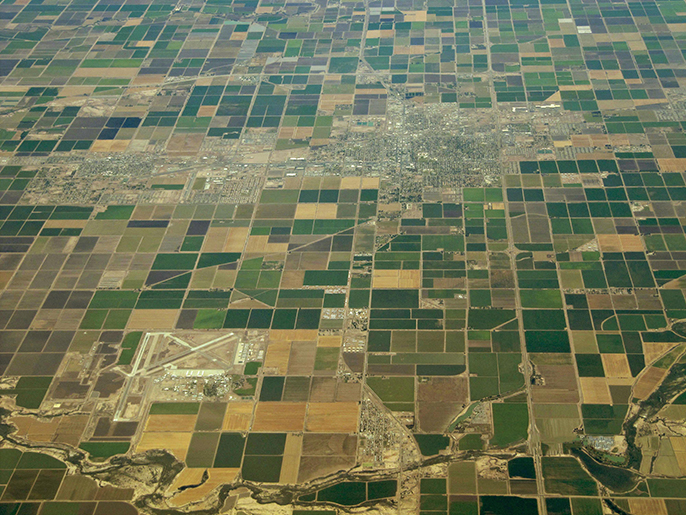
Re:Wildlife in ‘catastrophic decline’ due to human destructi... by bosswipe on Friday September 11, 2020 @07:22PM (#24448381)
We don't live on land that looks like this but it's destroying biodiversity anyway https://www.gettyimages.com/detail/news-photo/general-view-t...
Re:Wildlife in ‘catastrophic decline’ due to human destructi... by 0-_-0 on Friday September 11, 2020 @07:38PM (#24448487)
To be fair, that's a desert so technically speaking agriculture increases biodiversity there
Re:Wildlife in ‘catastrophic decline’ due to human destructi... by bosswipe on Friday September 11, 2020 @08:28PM (#24448769)
Ok maybe something like this makes my point better since it shows a town where we live and outside of town where we don't live https://www.universityofcalifornia.edu/sites/default/files/u...
Re:Wildlife in ‘catastrophic decline’ due to human destructi... by titzer on Friday September 11, 2020 @08:31PM (#24448792)
Biomass maybe, but biodiversity no. There is a myriad array of weird desert things adapted to such a climate, just not huge numbers of them.
Re:Wildlife in ‘catastrophic decline’ due to human destructi... by elihu on Friday September 11, 2020 @05:34PM (#24447559)
Still, even sparsely populated rural humans have a pretty big effect on the natural habitat. We've pretty significantly displaced wild animals with humans/livestock/pets everywhere: https://xkcd.com/1338/
Re:Wildlife in ‘catastrophic decline’ due to human destructi... by julienb_sea on Friday September 11, 2020 @05:35PM (#24447568)
Fragile species will continue to be in decline. Long term, large species will remain in protected environments like national parks. The idea that humans are incapable of protecting larger species is belied by a visit to Yellowstone.

Our living environments create opportunities for well-adapted species to flourish. This will certainly shift the makeup of our planet's biodiversity.

You mention all of this in passing, but I think these effects make the prognosis on biodiversity somewhat less than "very grim".

Re:Wildlife in ‘catastrophic decline’ due to human destructi... by e_dv1 on Friday September 11, 2020 @09:20PM (#24449030)
The United States went through a roughly 100 year period or so where conservation efforts were... er, not terribly great. It took about 100 years for humans to shoot an incredibly large passenger pigeon population into extinction, and bison which once numbered millions on the plains was reduced to mere hundreds. Fortunately, in the mid 19th century to early 20th century in particular, people began to notice and started protecting areas. Thank goodness for that, but a large portion of ecosystems did get wiped out (to give one example, roughly 95% of the California redwood forests).

Megafauna do get most of the attention, but a lot of the hidden economic / scientific benefits of maintaining biodiversity I think comes from smaller parts of the ecosystem -- for instance, drug discovery. Or, the widely used polymerase chain reaction (PCR) technique for copying DNA... which for all we know is a technique that might not even exist today had preservationists not had the foresight to preserve the Lower Geyser Basin of Yellowstone National Park, where the crucial enzymes for this technique were found.

Re:Wildlife in ‘catastrophic decline’ due to human destructi... by burlesona on Saturday September 12, 2020 @12:06AM (#24449761)
Unfortunately that period also roughly corresponded with the rise of the middle class and lifting the majority of the population to a level of material comfort that was (at it's peak at least) the envy of the world.

Most of the worst environmental damage today is not happening in the highly developed west, it's happening in the rest of the world that - understandably - doesn't care as much about saving the local animals as it cares about catching up to the material standards of the wealthy world.

Re:Wildlife in ‘catastrophic decline’ due to human destructi... by newacct583 on Friday September 11, 2020 @07:13PM (#24448312)
> Our living environments create opportunities for well-adapted species to flourish

That statement is a tautology. "Some" species will flourish in all productive biomes, by definition. But the ecosystems that existed will be highly disrupted. So we're replacing large predator marine species with jellyfish. Beavers with rats, wolves with feral cats, etc... And the plant diversity is quite a bit more impacted.

Your point amounts to "well, all life isn't going extince, so what's your problem?". The problem is that there is moral value in preserving what exists. Some of us like to believe that "causing a mass extinction event due to entirely preventable causes" is, y'know, a bad thing.

Re:Wildlife in ‘catastrophic decline’ due to human destructi... by mongol on Friday September 11, 2020 @05:50PM (#24447714)
I don't think it is a matter of what humans can do if they make enough of an effort, but what is most likely to happen.