News for hackers. Stuff that matters.
Re:Portland passes low-density zoning reform by klyrs on Wednesday August 26, 2020 @11:35AM (#24283403)
I like almost all of this. I have one minor concern, the maximum home size is dropping from 6750 to 2500 square feet. Which is probably fine for a nuclear family, but in my neighborhood, such homes are largely occupied by multigenerational families. In areas closer to colleges and universities, those homes end up being shared by large groups of students. Both of these populations will take a hit under this policy.
Re:Portland passes low-density zoning reform by cptskippy on Wednesday August 26, 2020 @12:34PM (#24284103)
> ...2500 square feet. Which is probably fine for a nuclear family...

Post-War homes (e.g. after WWII) in America were intended for the nuclear family and were typically under 1000 sq/ft. Most 60s and 70s ranch homes were 1200-1700 sq/ft and considered spacious.

A modern 2500 sq/ft house is at a minimum 3 bedroom, 3.5 bath, and a bonus room.

Re:Portland passes low-density zoning reform by jschwartzi on Wednesday August 26, 2020 @01:21PM (#24284708)
You can live in a 1200 square foot home as long as you have access to outdoor spaces and a third place down the block. I live in an 1100 square foot post-war home with my fiance and it's plenty of space for what we want to do with our lives. Other homes in the neighborhood are much larger but don't have a back yard or trees on the lot. So we're basically in this beautiful thoughtfully-built 40's era home surrounded by cedar trees, while our neighbors are these huge ugly 2-story houses rammed right up to the back edge of their lots with no yard.

You do have to get creative with second bedrooms by installing Murphy beds or otherwise reducing furniture size and floor space. Modern furniture is way too big to fit in the rooms of a post-war house. A stacking washer/dryer is very useful. Basically anything that substitutes vertical space for horizontal space will help immensely. Ikea has stuff that's size-appropriate but very cheap.

The reason most houses are 2500 square feet nowadays is because you have to maintain a space for all the things you want to do inside your house. Whereas if you share space with your community for those things that many people do then you don't have to maintain a separate space for it.

Re:Portland passes low-density zoning reform by rconti on Wednesday August 26, 2020 @01:28PM (#24284818)
We live in an 1140sqft house, just 2 of us. With just 1 (small) bathroom it is less than ideal, particularly when we have guests, but it works -- just. It is basically a box of a house with 3 bedrooms, a living room, a kitchen, and a place to eat. There is no "extra" space aside from the rooms -- no wide hallways, no sitting areas, no extra horizontal surfaces to put junk.

Of course, we have more space than we "need" -- 2 additional bedrooms. But, again, they're just large enough for what they do. 1 has a guest bed (and not any room for anything else, really) and the other is an "office" which is handy during covid-19 for sure.

If we had kids, there would be room for them to sleep, but no playroom, for example. Our laundry is in the garage, as is our "workout room". That space is not counted in the official size of the house, because the garage is converted.

Re:Portland passes low-density zoning reform by Judgmentality on Wednesday August 26, 2020 @02:03PM (#24285270)
That sounds like a pretty cushy setup to me. What exactly is it you're lacking?
Re:Portland passes low-density zoning reform by rconti on Wednesday August 26, 2020 @04:50PM (#24287130)
It is pretty "comfortable", but that's to say, "just enough". Each room is 12x12, there's no "free" space. There's no "extra" space in the house in general; for example the kitchen table is where all of the projects happen (wife was making some jewelry the other day, I've soldered and built computers and so on there).

The additional things we'd want are all luxuries.

* Indoor room where we can work out (treadmill, bike, elliptical are all in the garage)

* Master bathroom with an actual walk in shower, space where we don't have to squeeze past each other getting ready, etc.

* Closet space

* Garage that can be used for parking cars and bikes, working on things, etc. (I've had a bike on a stand in the backyard for a month now, as I work on building it, and parts strewn all over a patio table)

All totally unnecessary, of course. But given that we have a decently-sized lot for silicon valley (6000sqft) it would be nice to have more indoor space. Especially since I spent all my waking hours in here now :)

Re:Portland passes low-density zoning reform by seanmcdirmid on Wednesday August 26, 2020 @01:58PM (#24285199)
1200 SQF is fine if you have some kind of storage to rely on, don't need two home offices for two people WFHing, have only one kid, and don't need space for a musical instrument of some kind. Otherwise...it isn't workable.

Maybe if we didn't have a kid? Or if I could convince my wife to give up some things? We were just in the housing market and had to pass on these smaller houses very quickly. Not only that, but bigger houses were only 10-20% greater in cost than smaller ones...it was a no brainer to go with 2000 SQF.

Re:Portland passes low-density zoning reform by neutronicus on Wednesday August 26, 2020 @02:20PM (#24285494)
Most of your objections essentially agree with parent comment's coda:

> The reason most houses are 2500 square feet nowadays is because you have to maintain a space for all the things you want to do inside your house. Whereas if you share space with your community for those things that many people do then you don't have to maintain a separate space for it.

If you go to an office and keep your instrument in a locker someplace with practice rooms and your kids spend a lot of time elsewhere (outside, neighbors' houses, etc) then it probably is?

But yeah, for my wife and I (who only have one kid, but may want more) it was still the same thought process as you. We've been living in 1200 square feet with an 8 month old and we make it work but we're both working / studying / networking from the living room and going a little batty in the process, not to mention that our kitchen is tiny and probably not ventilated well enough given that the stove and oven are gas.

So we went for 2500 rather than enter the market and incur closing costs again if we want another kid or both wind up permanently remote post-COVID.

Re:Portland passes low-density zoning reform by gurkendoktor on Wednesday August 26, 2020 @01:17PM (#24284645)
To spare fellow non-Americans the jump to Google:

2500 sqft = 232 sqm

1000 sqft = 92 sqm

I am living in the latter with my wife plus one small child, and it's clear to us that we want more space for children later. 2500 sqft seems pretty large, but not crazy large either, especially with ~3 kids (=just two generations).

Re:Portland passes low-density zoning reform by cptskippy on Wednesday August 26, 2020 @01:21PM (#24284706)
In my opinion, 2500sqft/232sqm is more than enough for a family of 6.
Re:Portland passes low-density zoning reform by rconti on Wednesday August 26, 2020 @01:25PM (#24284766)
Agreed. I grew up in a 2400sqft house, there were 4 of us. Ample bathrooms and bedrooms and an office, and 2 living rooms plus a separate dining room. Not massive, but larger than necessary for 4.
Re:Portland passes low-density zoning reform by honksillet on Wednesday August 26, 2020 @02:51PM (#24285860)
That just your opinion, though. Others may want more.
Re:Portland passes low-density zoning reform by PaulDavisThe1st on Wednesday August 26, 2020 @06:34PM (#24288089)
"The earth has enough for everyone's needs, but not for everyone's greed" - Ghandi
Re:Portland passes low-density zoning reform by bluGill on Wednesday August 26, 2020 @03:16PM (#24286153)
The houses at my local historical center were much bigger. Sears sold many different sizes of house in the early 1900s and some were pretty large even by today's standards.

I have noticed that as houses approach 2000 Sq feet that luxury goes up faster than space, almost as if there is an asomtomic limit in that area. That is people buying smaller than 2000 seem to be looking for more space for the money, while those looking bigger are willing to spend more for the space to make it nice.

Re:Portland passes low-density zoning reform by hinkley on Wednesday August 26, 2020 @01:20PM (#24284687)
Am I correct in thinking that attic space doesn't count as square footage? There are hardly any attics in Seattle, they've all been converted to cramped living space and everybody stores their crap in the garage.

You can put a lot of people in 2500 square feet if you design it well instead of just slapping walls together.

Re:Portland passes low-density zoning reform by ghaff on Wednesday August 26, 2020 @01:39PM (#24284959)
The usual is to count "finished" space. So if an attic has been converted to a bedroom like the house I grew up in, that would normally be counted as part of the house space. Same with basements. My current house has both an attic and a basement but they're very unfinished. My basement can get wet so I don't store much down there but there's a lot up in the attic. Having storage space outside of the living quarters makes a big difference.
Re:Portland passes low-density zoning reform by alistairSH on Wednesday August 26, 2020 @02:59PM (#24285953)
This is true, usually.

It leads to interesting quirks in real estate listings, where identical houses get listed with very different sizes. Example, my house was listed at 1500sqft. Same model one row over was listed at 2000sqft. The 500sqft different is the basement - it's finished in both homes, but was not part of the original building listing (1972).

Re:Portland passes low-density zoning reform by tunesmith on Wednesday August 26, 2020 @01:49PM (#24285084)
I guess the corollary is that 2500 square feet can be eaten up very quickly if you don't have a good floor plan, which is pretty common.
Re:Portland passes low-density zoning reform by hinkley on Wednesday August 26, 2020 @02:05PM (#24285286)
A lot of these construction companies have figured out that most of the labor is in the walls. In a square room, the walls are sqrt(2) of the area. Bigger rooms = lower cost per square foot.

Another hallmark of these houses are complete lack of trim. They're just big boxes.

A more future-proof way to get around these building code limitations is 1) attic space, and 2) higher ceilings. You get a better feeling of space, and you can get more board-feet of storage in the same footprint.

Seattle is also full of illegal remodels, only some of which a lender will balk at (source: bought a quirky home, the owners had to remove features for us to buy it).

Re:Portland passes low-density zoning reform by ghaff on Wednesday August 26, 2020 @03:23PM (#24286231)
If you don't have a garage, a decent attic, or a basement--and maybe you don't have great closet space--you're now possibly talking about taking up a "bedroom" as a storage area. And, to another comment, I generally like the main area of the house being fairly (though probably not 100%) open. But having big bedrooms and bathrooms may or may not be something you value, but they're not generally super-efficient unless, say, you want your bedroom to also be your office.
Re:Portland passes low-density zoning reform by ip26 on Wednesday August 26, 2020 @03:52PM (#24286527)
3 bedroom is not some kind of ridiculous luxury if you have teenage son(s) & daughter(s).
Re:Portland passes low-density zoning reform by stickfigure on Wednesday August 26, 2020 @02:15PM (#24285426)
A friend of mine has four kids and three au pairs. Plus frequent overnight guests like grandparents. That's not going to fit in 2500 sq ft.
Re:Portland passes low-density zoning reform by cptskippy on Wednesday August 26, 2020 @02:37PM (#24285711)
Would you say that's the norm? One au pair is a luxury, 3 seems lavish.
Re:Portland passes low-density zoning reform by stickfigure on Wednesday August 26, 2020 @03:03PM (#24285996)
It's certainly not the norm. But we're not talking about average house size, we're talking about maximum house size. You're clipping off the edge of the bell curve. People with big families don't get to live in Portland?

FWIW he's a single dad, and au pairs aren't always on duty. It's less lavish than it sounds.

Re:Portland passes low-density zoning reform by driverdan on Wednesday August 26, 2020 @04:46PM (#24287088)
> It's less lavish than it sounds.

People in tech are so out of touch. Being able to hire people is lavish.

Re:Portland passes low-density zoning reform by maxerickson on Wednesday August 26, 2020 @03:09PM (#24286072)
It'd be interesting to take a look at how much existing housing exceeds 2500 square feet, and how it is occupied. It's quite possible that not allowing new construction over that size would leave plenty of it available.
Re:Portland passes low-density zoning reform by microtherion on Wednesday August 26, 2020 @03:52PM (#24286518)
> People with big families don't get to live in Portland?

Nothing in the legislation prohibits big houses. All it does is legalize small ones.

Re:Portland passes low-density zoning reform by GurnBlandston on Wednesday August 26, 2020 @04:28PM (#24286891)
The image near the top of the article explicitly states the previous maximum house size was 6750 sq ft, and new maximum house size for a "1-plex" is 2500 sq ft.

This is a prohibition on new big houses.

Re:Portland passes low-density zoning reform by microtherion on Wednesday August 26, 2020 @05:37PM (#24287569)
You're right — there are new limitations, which I overlooked at first. But it appears those don't apply to R10 and larger lots, so it's not a complete prohibition: https://www.portland.gov/sites/default/files/2020-08/exhibit...
Re:Portland passes low-density zoning reform by noelwelsh on Wednesday August 26, 2020 @12:02PM (#24283725)
2500 square feet is considered a large house in most of the world. I have lived with a group of students, a nuclear family, and with multiple generations in houses smaller than that. It is definitely fine for all the use cases you list.
Re:Portland passes low-density zoning reform by ericd on Wednesday August 26, 2020 @01:33PM (#24284869)
Keep in mind that Americans on average have been raised in different environs, and likely different habits from the people you lived with. If you've always lived in close proximity, you've developed ways to cope, which people who've lived in copious space haven't. As an example, people who grew up in the country often find cities to be claustrophobic, impersonal, and uncomfortable. So you can't really say "it works for people in X culture, so it'll be fine for people in Y culture."
Re:Portland passes low-density zoning reform by noelwelsh on Wednesday August 26, 2020 @02:45PM (#24285796)
I don't understand the point you're trying to make. Culture is not a fixed thing. The majority of present day US citizens do not believe slavery is acceptable, but in the past a majority were prepared to tolerate slavery. Yes, changes to housing will bring about changes of attitudes to housing, but so what? That has already happened---US houses have grown by 40% since the 1980s per the BBC article. Why could this not happen again?
Re:Portland passes low-density zoning reform by alistairSH on Wednesday August 26, 2020 @03:04PM (#24286005)
Culture isn't fixed, but it can be slow and resistant to change.

To use your example, ending slavery took a civil war that almost ended the US. And we're still dealing with the aftermath (economic equity, police brutality, etc).

Re:Portland passes low-density zoning reform by ericd on Wednesday August 26, 2020 @03:16PM (#24286149)
My point is that it doesn't seem like you've bothered to put yourself in the shoes of the people that this will affect. You're effectively saying "it's what I do, so it'll be fine for them".

The change in housing size that you're talking about encompasses a 40 year period, your slavery example, much longer. Culture can change, but it doesn't happen suddenly, by fiat, it happens on generational timescales.

Re:Portland passes low-density zoning reform by noelwelsh on Wednesday August 26, 2020 @03:33PM (#24286320)
Do you think every house in Portland is going to be bulldozed and rebuilt inline with the new regulations? More likely it will take decades before the changing regulations are reflected in the housing stock.
Re:Portland passes low-density zoning reform by ericd on Thursday August 27, 2020 @01:08PM (#24295835)
I don't think that, but sometimes people want to build their own houses, and they will immediately start butting up against this.
Re:Portland passes low-density zoning reform by rayiner on Wednesday August 26, 2020 @12:06PM (#24283782)
Most of the world lives in housing poverty compared to American norms.
Re:Portland passes low-density zoning reform by noelwelsh on Wednesday August 26, 2020 @12:28PM (#24284039)
What does "housing poverty" mean here? As far as I can tell it means "houses smaller than I am used to". In which case I have to ask what is the concern with houses less than 2500 sq ft? I can't find any evidence that housing size, above some minimum[1], is correlated with happiness. See e.g.

https://www.bbc.co.uk/news/business-45420795#:~:text=The%20U....

https://link.springer.com/article/10.1007/s10902-016-9732-2

or do you own search.

This desire for extremely large houses just seems to be a combination of prior expectations that houses will be large and status seeking. Expectations can adjust over time and I don't put much value on status seeking.

[1] The BBC article lists "4 rooms per occupant" as the threshold beyond which there is no increase in satisfaction.

Re:Portland passes low-density zoning reform by likpok on Wednesday August 26, 2020 @01:55PM (#24285158)
4 rooms per occupant is huge.

Consider a 3/3 with a kitchen, dining room and living room. For 4 people (two kids and two parents) you have 9 rooms, or a little over 2 per person.

This family would need to double their house size before maxing out.

Re:Portland passes low-density zoning reform by noelwelsh on Wednesday August 26, 2020 @02:31PM (#24285651)
Yes, I misinterpreted the article. I assumed it was 4 rooms that each occupant could access, including shared rooms such as living rooms. A better summary is:

* moving to a larger house leads to a small increase in "housing satisfaction" in most cases;

* houses larger than 4 rooms per occupant bring no increase in satisfaction with increasing size.

Re:Portland passes low-density zoning reform by pkulak on Wednesday August 26, 2020 @01:08PM (#24284537)
My family is considered "underhoused" by the US government, because we have fewer bedrooms than occupants. I certainly don't feel it myself. We have three bedrooms for the four of us, and even chose to use the third as a media room until the kids get sick of the bunk beds.
Re:Portland passes low-density zoning reform by ericd on Wednesday August 26, 2020 @01:28PM (#24284805)
We've lived in both sorts of situations in the recent past. Extra rooms give you flexibility and the opportunity for privacy, which is really nice with young children who aren't sleeping well yet, and might disturb their siblings if they were bunked. There are trade-offs involved in both situations, which one is better for you just depends on what you value.

I generally think that there's too much of a slant toward large houses in the new housing stock in the US, though - they're more expensive to buy and maintain, and generally not the best choice for young people.

Re:Portland passes low-density zoning reform by jungletime on Wednesday August 26, 2020 @01:14PM (#24284595)
Most of the US still lives in really crappy old homes built in the last century, with asbestos insulation, tar shingles, fiber board, and wood rot. Doesn't really compare with building standards in Europe, even Eastern Europe. China also has modernized and built some awesome cities. Middle East, and Asian cities are also pretty modern. I'm not really sure who you are comparing to? India? Africa?
Re:Portland passes low-density zoning reform by kube-system on Wednesday August 26, 2020 @03:00PM (#24285958)
US homes are relatively new compared to many of the homes in Europe, so I'm not sure why you're calling them 'old'.

Also, Europe's prevalent masonry construction might "feel" solid, but that doesn't equal a high level of "building standards". A whole lot of western safety/environmental/plumbing/electrical/accessibility standards have changed in the past 20-70 years.

Much in the way chrome-adorned '60s US cars "felt" solid, and older people scoffed at the inornate "plastic cars" of the '90s, this perception of quality didn't translate to actual engineering superiority.

Some of the over-sized chintzy boxes that are built in the US are actually built to pretty dang good standards, i.e.: https://en.wikipedia.org/wiki/Florida_Building_Code

Re:Portland passes low-density zoning reform by dmitriy_ko on Wednesday August 26, 2020 @01:38PM (#24284943)
Average US home is twice as big as European. Only Australian homes are bigger: https://www.theglobeandmail.com/report-on-business/average-h...
Re:Portland passes low-density zoning reform by ClumsyPilot on Wednesday August 26, 2020 @03:02PM (#24285979)
Thats not neccesarily contradicting his point, the house coild be large but poorly built. In fact that could make sence
Re:Portland passes low-density zoning reform by PaulDavisThe1st on Wednesday August 26, 2020 @06:43PM (#24288157)
1) asbestos wasn't really used widely for insulation in the normal sense of that word. 2) in the right climate, tar shingles are actually extremely effective as a roofing solution. 3) the US does not have large supplies of bricks, and many areas do not have easy access to stone suitable for building (which is also extremely expensive in terms of labor). Hence wooden frame construction. 4) fiber board, when properly isolated from the weather, is an extremely durable and strong material. it is unfortunate that it tends to require environmentally unfriendly resins to manufacture. 5) there is a LOT of poor construction in the USA, but picking on particular techniques isn't the way to describe the problems. 6) there are many cheap houses in the USA that have much better energy efficiency than classic old houses across Europe, specifically because they use wood frame construction and moderate levels of insulation and air sealing.
Re:Portland passes low-density zoning reform by lkbm on Wednesday August 26, 2020 @03:04PM (#24286004)
Depends on the group of students or size of a multi-generational household. I live in a 14-person house, and previously a 19-person one.

Students frequently enjoy larger communities, especially since it's often a lot more affordable to have a large house split 10-20 ways than a medium house split five. ("Medium" is a stretch, since five bedrooms is a large house in the US.)

These aren't the most common arrangements, but that doesn't mean they should be prohibited.

Re:Portland passes low-density zoning reform by crooked-v on Wednesday August 26, 2020 @12:36PM (#24284128)
> Which is probably fine for a nuclear family, but in my neighborhood, such homes are largely occupied by multigenerational families.

In that case, build a duplex or triplex designed with easy (but lockable) access between units. That gives you a lot of living area, and the same building is also suitable for housing multiple families if it ever changes hands.

> In areas closer to colleges and universities, those homes end up being shared by large groups of students.

Multi-unit buildings with each unit shared between two people, or (now also allowed by the new zoning) 'cottage cluster' arrangements with a number of physically separate homes sharing one driveway/common area.

Re:Portland passes low-density zoning reform by tandr on Wednesday August 26, 2020 @12:49PM (#24284291)
These rules (lockable access between units) work well for student-occupied dwellings, but not so much for multi-generation families, that have a completely different dynamics of what "shared" and "private" areas are, and how they are used.
Re:Portland passes low-density zoning reform by crooked-v on Wednesday August 26, 2020 @01:11PM (#24284563)
I don't really understand what the drastic difference there is supposed to be. If you want to use all the units as a shared living space, just leave the common-area connecting doors propped open. This is functionality that many duplex and triplex units already have.
Re:Portland passes low-density zoning reform by SaintGhurka on Wednesday August 26, 2020 @02:01PM (#24285241)
Wouldn't joining 2 duplexes needlessly duplicate common areas? I would think a large multigenerational family might want a large family room rather than 2 small ones. Likewise the kitchens. They'd have 2 kitchens, one extraneous and both of them insufficient for the task.
Re:Portland passes low-density zoning reform by ogre_codes on Wednesday August 26, 2020 @11:47AM (#24283518)
I missed that part. Though both multigenerational families and college students could be served well by multi-structure setups as well. Or in many cases, better served.
Re:Portland passes low-density zoning reform by klyrs on Wednesday August 26, 2020 @11:56AM (#24283641)
Maybe the college students -- but in my experience, rent in large houses is cheaper per-room than smaller apartments. My brother is a professional musician and lives with others near/at the poverty line -- they simply can't afford to live in smaller places. Maybe that will change on the supply side, but more likely, demand will rise just as fast.

Multigenerational families are not better served. If they're doing a new build, it can work. But imagine trying to purchase not one, but four houses on the same lot. That's a helluva coincidence to wait for, for them all to be vacant simultaneously.

Re:Portland passes low-density zoning reform by ogre_codes on Wednesday August 26, 2020 @12:02PM (#24283726)
Have you lived in a multi-generational home?

I am right now and have done so in various ways for the past 25 years, it is vastly better to have some separation.

I'm not going to generalize. But for us, multi-generational homes happen over time as opposed to moving the whole family at once regardless. Kids grow up and need space, but can't afford to buy a place. Parents get older and move in with kids, etc etc.

Re:Portland passes low-density zoning reform by klyrs on Wednesday August 26, 2020 @12:26PM (#24284019)
No, I haven't. Some of my immediate neighbors do; one household immigrated as a family so they're on the forefront of my mind. I appreciate your perspective; thanks for sharing.
Re:Portland passes low-density zoning reform by ogre_codes on Wednesday August 26, 2020 @12:46PM (#24284252)
Also, I think the point about big homes and multi-generational families is on-point and wasn't trying to disparage it. I just was pointing out that there is at least some mitigation.
Re:Portland passes low-density zoning reform by bradleybuda on Wednesday August 26, 2020 @12:01PM (#24283713)
Or, maybe armchair central planners like you and I and the Portland City Council shouldn’t decide what’s best for people we’ve never met and let them decide instead.
Re:Portland passes low-density zoning reform by ogre_codes on Wednesday August 26, 2020 @12:04PM (#24283757)
> shouldn’t decide what’s best for people we’ve never met and let them decide instead.

I totally agree!

I didn't mean to imply this bit about house size is good. In general, this measure removes piles of restrictions on land use and that's one of the big reasons I like it. I was just pointing out that there are some work-arounds.

Re:Portland passes low-density zoning reform by tick_tock_tick on Wednesday August 26, 2020 @02:27PM (#24285588)
I mean at this point I'm confident every armchair planner is more competent.
Re:Portland passes low-density zoning reform by mech4bg on Wednesday August 26, 2020 @02:51PM (#24285861)
I was a little confused by this, but correct me if I'm wrong but the 2500 sq ft limit is just for R5 lots correct? Larger lots, like R10, can have much larger dwellings on them still.
Re:Portland passes low-density zoning reform by jungletime on Wednesday August 26, 2020 @01:06PM (#24284515)
This is an issue in Vancouver. One large house built to house an extended family of sometimes as many as 20 people.

Its a way of depriving city of property taxes, that would have otherwise have taxed multiple dwellings for the same amount of people. So the 2500 sqft limit is to collect more tax.

Re:Portland passes low-density zoning reform by klyrs on Wednesday August 26, 2020 @01:24PM (#24284747)
I live in vancouver and I don't have a problem with high occupancy houses that are actually utilized. It's the jerks in GRVD who have unoccupied mansions that have been blowing up housing costs that I have a real problem with. Vancouver has addressed that, but afaik Burnaby, tricities and north van haven't.
Re:Portland passes low-density zoning reform by jasondclinton on Wednesday August 26, 2020 @11:47AM (#24283519)
The removal of the off-street parking mandate will also impact EV adoption. Parking is already difficult to find in many older Portland neighborhoods.

Edit: You need a place to plug-in your EV at night.

Re:Portland passes low-density zoning reform by jeffbee on Wednesday August 26, 2020 @11:53AM (#24283610)
That's just reality. EVs solve a specific aspect of cars but they still have the main problem: they are unreasonably large. The future of urban mobility is also its past: walking.
Re:Portland passes low-density zoning reform by crooked-v on Wednesday August 26, 2020 @12:59PM (#24284414)
I would say that the main problem with EVs right now isn't that they're large. You can get an electric Smart or Twizy and those aren't much more than driver's seats on wheels. And don't let the perfect be the enemy of the good: plenty of people who have full-size cars now would switch to something like one of those to save money once it was cheap enough...

...if not for the actual practical problem, which is that for a lot of people living in dense urban areas, there's no way to keep an EV charged up. Street parking and surface lots don't have chargers, old parking garages and almost all new parking garage construction doesn't have chargers, apartment buildings or shared houses with official or ad-hoc parking don't have chargers.

I have that problem myself: I'd probably have replaced my car with an EV already if only I actually had somewhere to plug it in.

Re:Portland passes low-density zoning reform by neutronicus on Wednesday August 26, 2020 @02:10PM (#24285362)
The parent comment is saying that all cars, even ones that are small for cars, are unacceptably large. The implication of their conclusion is that they even think the same of bicycles and electric scooters, which, after all, still take space to park.

However I agree with the rest of your comment. My wife and I looked into plug-in hybrids (all the tax credit, none of the range anxiety) but there's no place to charge it so we just got a regular hybrid.

Re:Portland passes low-density zoning reform by jeffbee on Wednesday August 26, 2020 @02:27PM (#24285587)
Eh, smaller electric cars don't help in practice because various regulations require buildings to come with a parking space of a certain size. Nobody is out there building smaller parking spaces for smaller cars. Indeed, Bay Area city Sunnyvale infamously outlawed "compact" parking spaces.

Electric bicycles by contrast take up the same space as any other bicycle.

Re:Portland passes low-density zoning reform by derg on Wednesday August 26, 2020 @12:39PM (#24284165)
Walking and biking with some public transit to fill the gaps honestly.

Outside of the obvious downsides to a car centric culture, the united states would definitely have healthier people if it were feasible to walk to more destinations. And I don't mean this just on an individual fitness level either. Getting out of the car and actually walking and interacting with people is an important community aspect, which this country severely lacks.

Re:Portland passes low-density zoning reform by jasondclinton on Wednesday August 26, 2020 @12:48PM (#24284280)
Bold claim. No city has managed to implement a walking-only mobility plan, yet. I'd like to see that future but it seems increasingly unlikely.
Re:Portland passes low-density zoning reform by d1zzy on Wednesday August 26, 2020 @02:40PM (#24285741)
Smart Electric seems as small as always. Goes about 65 miles (plenty for a suburban living needs, not going to work for travel of course).
Re:Portland passes low-density zoning reform by driverdan on Wednesday August 26, 2020 @04:49PM (#24287114)
Smart pulled out of the US.
Re:Portland passes low-density zoning reform by toomuchtodo on Wednesday August 26, 2020 @11:59AM (#24283696)
I think this is easy to wish but hard to realize, considering the US population is rapidly aging. There is a balance between prioritizing pedestrians and cyclists while still supporting reasonable mobility for those not in their prime as well as daily freight/parcel services.
Re:Portland passes low-density zoning reform by jeffbee on Wednesday August 26, 2020 @12:05PM (#24283770)
That's why you can't have a city based on cars. The very old cannot drive! I don't know why this perfectly obvious and globally well-known fact is so little-known to Americans.
Re:Portland passes low-density zoning reform by toomuchtodo on Wednesday August 26, 2020 @12:23PM (#24283976)
There are entire retirement communities where the elderly use their golf carts and cars to get around (Sun City, FL, The Villages, FL, etc).

Not only do the very old still drive, many prefer it because they’re old.

Go talk to some old folks. I did when I put together a community funded Tesla Model 3 rideshare for them in a retirement community. The pool is their preferred exercise method to walking, especially in inclement weather (you ever walk a mile in the July Florida/Texas/Arizona heat? I have in all three, and I would not recommend it).

EDIT: @jeffbee Responding here as HN has throttled my comment replies.

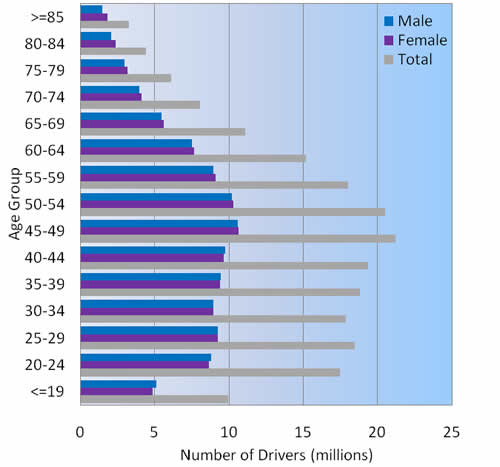
> That's contrary to all available data. People over 70 are the least-likely group of adults to have drivers' licenses and have the highest public transport mode share or any group, take the fewest trips, and travel the smallest distance per day. The elderly are arguably the people who stand to gain the most from compact patterns of development.

And yet, they choose to live in low to medium density areas that require an automobile versus urban areas. Behold the revealed preference!

https://www.prb.org/which-us-states-are-the-oldest/

https://www.census.gov/library/visualizations/time-series/de...

https://www.census.gov/content/dam/Census/library/visualizat...

https://i2.wp.com/www.brookings.edu/wp-content/uploads/2019/...

Re:Portland passes low-density zoning reform by jeffbee on Wednesday August 26, 2020 @12:34PM (#24284101)
That's contrary to all available data. People over 70 are the least-likely group of adults to have drivers' licenses and have the highest public transport mode share or any group, take the fewest trips, and travel the smallest distance per day. The elderly are arguably the people who stand to gain the most from compact patterns of development.
Re:Portland passes low-density zoning reform by kube-system on Wednesday August 26, 2020 @03:08PM (#24286052)
> People over 70 are the least-likely group of adults to have drivers' licenses

Not in the US! It's pretty common for them to continue driving until they have enough accidents that they're dropped by their insurance company.

https://www.businessinsider.com/young-people-drivers-license...

Re:Portland passes low-density zoning reform by jeffbee on Wednesday August 26, 2020 @03:15PM (#24286141)
I was going by this 2009 data which you have to mentally compute the rates from:

https://www.fhwa.dot.gov/policyinformation/pubs/hf/pl11028/i...
Re:Portland passes low-density zoning reform by kube-system on Wednesday August 26, 2020 @03:21PM (#24286206)
More than mental computation -- you'd need to find an additional source of the total number of people in those groups to compute a rate.
Re:Portland passes low-density zoning reform by jeffbee on Wednesday August 26, 2020 @01:02PM (#24284453)
I think you've mistaken revealed preference for supply constraints.
Re:Portland passes low-density zoning reform by toomuchtodo on Wednesday August 26, 2020 @01:33PM (#24284878)
Let's get to the bottom of this then. Propose 3-5 questions that you think would provide sufficient insight into the senior housing preferences of this older/elderly cohort and I will get them to a contact at Pew Research to inquire and provide objective data back (unless you have citations you have not provided in thread).
Re:Portland passes low-density zoning reform by danans on Wednesday August 26, 2020 @12:09PM (#24283823)
> I think this is easy to wish but hard to realize, considering the US population is rapidly aging.

The Florida retirement developments figured this out a long time ago: electric golf carts.

If I recall correctly in one they even recently conducted a golf cart based political rally in support of a presidential candidate.

Re:Portland passes low-density zoning reform by kiliantics on Wednesday August 26, 2020 @12:07PM (#24283791)
This is ridiculous. Yes, of course, provide alternatives for the less able but that is a very small population at any age group. My grandmother at age 86 gets around in Germany on foot and by bicycle just fine. She doesn't have a car and has access to the subway for longer distances. We can still heavily pedestrianise while also allowing for deliveries and the less able, there are many successful examples.
Re:Portland passes low-density zoning reform by ska on Wednesday August 26, 2020 @12:16PM (#24283908)
"automobiles" is an idiosyncratic answer to "how do we deal with mobility issue of an aging population?".
Re:Portland passes low-density zoning reform by baybal2 on Wednesday August 26, 2020 @01:54PM (#24285150)
> "how do we deal with mobility issue of an aging population?"

Exercise?

Re:Portland passes low-density zoning reform by ohples on Wednesday August 26, 2020 @11:56AM (#24283638)
What does this have to do with EVs?

I agree that getting rid of government mandated parking will decrease government-subsidized car storage (which is good across the board). Sure that will affect EVs, but it will also affect ICEs equally.

Re:Portland passes low-density zoning reform by jdminhbg on Wednesday August 26, 2020 @12:01PM (#24283721)
> What does this have to do with EVs?

Having a driveway/garage allows you to charge your EV while parked. An ICE you can just park wherever.

Re:Portland passes low-density zoning reform by klyrs on Wednesday August 26, 2020 @12:01PM (#24283722)
I hope this can be addressed at the municipal level through a program to install charge points in residential areas in response to local demand.
Re:Portland passes low-density zoning reform by toast0 on Wednesday August 26, 2020 @02:35PM (#24285685)
There won't be local demand unless the charge points are already there. If you rely on on-street parking, and your neighborhood doesn't have chargers, you're not going to buy an EV and hope someone installs a charger. Maybe, you'll buy a plugin hybrid for other reasons, and there might be demand that way[1]. Of course, if you do have an EV already, then you have a lot harder time finding a new rental.

[1] although, my plugin has very good range on gas, and next to nothing on a full charge, so I really only charge if it's free, gives me good parking, or to exercise my backup generator.

Re:Portland passes low-density zoning reform by throwaway0a5e on Wednesday August 26, 2020 @02:40PM (#24285745)
Then the people who can afford to adopt early get charging stations and the blue collar neighborhoods don't because they don't have as many EVs and then of course the politicians pile on by passing fuel taxes or registration surcharges because a) they're largely unaffected b) the state loves money and c) "only backwards hicks drive ICEs in 2030 anyway" (or something like that) and it becomes yet another regressive tax.

I think the sentiment is good but I see it going wrong quickly unless you have some way to ensure that every neighborhood gets at least enough charging to adopt EVs in the first place.

Re:Portland passes low-density zoning reform by TheGallopedHigh on Wednesday August 26, 2020 @11:50AM (#24283561)
It stated that off street parking was optional...
Re:Portland passes low-density zoning reform by jasondclinton on Wednesday August 26, 2020 @12:45PM (#24284246)
Isn't that exactly the definition of the removal of a mandate?
Re:Portland passes low-density zoning reform by TheGallopedHigh on Wednesday August 26, 2020 @07:37PM (#24288545)
Yes you’re right.
Re:Portland passes low-density zoning reform by alistairSH on Wednesday August 26, 2020 @03:08PM (#24286051)
Why wouldn't the market solve this? If people want a parking spot with their new home, they'll demand the builder create one.
Re:Portland passes low-density zoning reform by makomk on Wednesday August 26, 2020 @06:55PM (#24288246)
The market will probably solve this, but it might not necessarily do so in a way you like. No widespread EV adoption and cars running on oil indefinitely because EVs are not viable for most people would be a perfectly valid free market solution to the problem.
Re:Portland passes low-density zoning reform by alistairSH on Wednesday August 26, 2020 @07:48PM (#24288623)
That seems unlikely. If people demand off-street parking as part of a new home, they can also demand a charger. Or install one themselves. There is no prohibition on off-street parking linked to these changes.

As for on-street parking, I don't feel particularly inclined to subsidize (via my tax payments) parking for the public's gross overuse of cars. I'd rather my tax dollars go to transit and alternative infrastructure.

Re:Portland passes low-density zoning reform by jabl on Wednesday August 26, 2020 @03:59PM (#24286607)
Strange that a country that so strongly professes its belief in the power of free markets can't allow said free market to figure out the optimal amount of parking.
Re:Portland passes low-density zoning reform by nicoburns on Wednesday August 26, 2020 @02:21PM (#24285511)
Perhaps it will lead to public transport infrastructure being built out. Well, we can dream.
Re:Portland passes low-density zoning reform by dfxm12 on Wednesday August 26, 2020 @12:07PM (#24283787)
but in my neighborhood, such homes are largely occupied by multigenerational families.

In my neighborhood, these are also duplexes (maybe coincidentally, maybe not, I dunno), which are allowed to be bigger.

In areas closer to colleges and universities, those homes end up being shared by large groups of students.

Yeah, but these big houses are probably old. In the universities near me, such large houses haven't been built in my lifetime. I doubt it's too much different in Portland.

Re:Portland passes low-density zoning reform by crooked-v on Wednesday August 26, 2020 @12:49PM (#24284286)
As somebody living in Portland, there just aren't many existing homes over 2500 square feet (relatively speaking, compared to other homes) in the first place. We have skinny blocks through most of the city, so there's less places for McMansions to even fit. The ones that do exist within city limits are generally $700K and up - if you want under that you'll need to look in a high-crime neighborhood.

If you want an existing home over 5000 square feet within city limits, expect to pay upwards of $1.2 million if you want to live out towards the suburbs, or $1.5 million for something closer to dense walkable neighborhoods.

Re:Portland passes low-density zoning reform by noodlesUK on Wednesday August 26, 2020 @02:30PM (#24285629)
There’s a big difference between 2500 sqft and 5000+
Re:Portland passes low-density zoning reform by imtringued on Thursday August 27, 2020 @04:45AM (#24291403)
5000 sqft was mentioned because those types of buildings are no longer allowed.
Re:Portland passes low-density zoning reform by stirbot on Wednesday August 26, 2020 @11:58AM (#24283680)
Would these groups still choose to share a kitchen, bathrooms, etc if they could find co-located, individual units at a similar, affordable price? I doubt it.
Re:Portland passes low-density zoning reform by lkbm on Wednesday August 26, 2020 @03:16PM (#24286152)
Some of us would, but even if not, why would it be the same price? More housing should lower the cost for both, and paying for 4 bedrooms + 1 kitchen should always cost less than 4 bedrooms + 4 kitchens.

Personally, I'd like a private bathroom, but prefer the shared kitchen, dining room, and living room.

Re:Portland passes low-density zoning reform by zjaffee on Wednesday August 26, 2020 @03:14PM (#24286127)
You can still have homes up to the full size you're talking about so long as they're multifamily, if anything that's better for multigenerational homes...
Re:Portland passes low-density zoning reform by novok on Wednesday August 26, 2020 @05:04PM (#24287241)
That infographic says 2500 feet, but the article says '2500 sqft in a hypothetical 5000 sqft lot'. So it's a ratio, not a set limit.
Re:Portland passes low-density zoning reform by dgellow on Wednesday August 26, 2020 @12:43PM (#24284225)
2500 sq feet ≈ 232m²
Re:Portland passes low-density zoning reform by throwawaysea on Wednesday August 26, 2020 @12:26PM (#24284015)
Also why is it the city’s business to limit max home size?
Re:Portland passes low-density zoning reform by onion2k on Wednesday August 26, 2020 @11:58AM (#24283681)
While that's unfortunate it's probably worth it in order to block a small number of people taking up far too much of the available space.
Re:Portland passes low-density zoning reform by foogazi on Wednesday August 26, 2020 @01:19PM (#24284672)
Can’t they still have really large lots ?