Interesting comparison. So here we're talking about the risk of dying from Covid-19. What about the risk of becoming seriously ill? What I'm curious is about is the percentage of people (younger or otherwise) who either develop no symptoms or develop symptoms so mild as to not be attributed to the virus. Do such people exist?
I was pretty ill in March (and, to a lesser extent, in April), which necessitated some time off work. Testing availability in my country was useless at the time, so I have no formal confirmation as to what it actually was. The govt also intervened, preventing my order of a private sector antibody test being fulfilled, so who knows.
The experience after recovery for me, though, was anything but straightforward and I really struggled with lasting fatigue, breathlessness and just general exhaustion. I was only able to work half-days for a decent chunk of time. I still don't feel 100% now. My GP thinks it was likely Covid-19 and offered a diagnosis of post-viral fatigue after some tests.
I'm 23. Statistically, this should have barely affected folks in my age group.
It's not an isolated case: https://www.bbc.co.uk/news/uk-scotland-north-east-orkney-she...
This category of outcomes is honestly much scarier for me.
Good luck with your recovery.
My spouse and I both work in a hospital. She got covid and so did one of our two siblings. Neither of them had any symptoms (spouse is in her 50's, our sibling is twenty plus.) I never got it nor did our other sibling. I also don't have antibodies. Go figure... it makes no sense to me.
As a side note: we are not in patient care, however when this was at it's early peak here in the States--I don't know how the nurses, aides, and doctors were able to do their jobs everyday. It was fricken scary walking through the halls and passing workers dressed in plastic; what with all the unknowns at that time, and the news reports of death throughout the world. Those workers deserve respect if not outright awe and a Huge Cash Bonus... Huge.
I know it's anecdotal but it's interesting that your spouse contracted the virus but you did not. I'm assuming you live together. But then again I imagine it is quite common for one person in a household to catch a cold whilst everybody remains unaffected...I'm not equating covid-19 to the common cold. It came to mind as something that appears to spread in the same way.
Yes, absolutely. Many countries such as England do community infection studies. Essentially they pick a random sample of people and test them every week to see many people have the disease, even if they don't know it.
In the England study, they report that ~70% of positive tests involve people who didn't report any symptoms ever. That implies there are lots of people who had it who didn't know they had it.
> Out of those people that tested positive for COVID-19 over the study period, only 23% (95% confidence interval: 15% to 32%) reported experiencing one or more of the various symptoms at the time of their test. Out of those who reported testing positive, 33% (95% confidence interval: 23% to 44%) reported experiencing symptoms at any point in the period around testing positive. This was at the time of the visit, or at either the preceding or following visits.
https://www.ons.gov.uk/peoplepopulationandcommunity/healthan...
Of course, the question is do these people get counted later in other ways - i.e. what percentage of them would show up in antibody surveys? That is currently a difficult question to answer with a high level of certainty for several reasons. Right now, we don't know for sure what level of infection causes you to develop detectable immunoglobulins, we don't know how long those stick around, and we don't know how much our immune system leans on T cells instead to fight COVID which don't show up in the existing antibody tests at all and are much more difficult to test for.
And it's also worth pointing out that it's not clear that asymptomatic infections are as infectious as symptomatic infections. So don't assume they are equal. A recent study showed that asymptomatic people could shed the virus for 3 weeks, but it's really hard to know if that's active virus that could infect someone or not. There's a lot more research to be done.
See https://blogs.sciencemag.org/pipeline/archives/2020/06/22/th...
Yes it is clear (they're not)! Superspreading events are caused by people who are clearly symptomatic but don't act responsibly. Most spreading in total happens via nonsymptomatic or presymptomatic people, because covid19 is a coronavirus and that's how coronaviruses work. No point in pretending this is some kind of big unknown.
If you don't believe me, let's look at this story of army recruits. Those who tested positive were isolated, those who remained tested negative and trained together with masks and social distancing. Result, 8 days later 142 out of 640 tested positive. https://outline.com/dK2TWd
But what is the odds that you survive but then require kidney transplant or lung transplant or have leave ICU only to face weeks or months of recovery. This latter bit is a unknown to me, so I don't know what my actual risk is.
FTR, this also happens with other respiratory diseases. You can also take quite a bit of time (months) to fully recover from "regular" pneumonia.
Even the reported brain infections (neural invasion) aren't a unique feature of this virus, but are recorded as happening with other coronaviruses (the most common ones, not SARS or MERS).
Second the rampage the T-cells are doing elsewhere to fight suspected virus cells. They might attack way too many healthy cells everywhere. This is called the cykotine storm, treated with standard cykotine storm suppressors. The virus itself is doing nothing, it just causes the immunosystem to overreact.
This line of defense completely ignores the long term damage that we know occurs in some Covid cases, even those in young people. Pneumonia can cause long term damage too. Saying the risk (I assume of death) is less ignores the incalculable risk of life long lung damage.
Absolutely not. The scientific approach is to look at the new disease and see how it compares to other similar RTIs. For instance, covid19 was discovered around October at the start of the seasonal flu season in the northern hemisphere and it was a coronavirus, which makes it 95% likely to be strongly seasonal, highly infectious, and mild. It also should lead us to assume that exposure to prior viruses gives (some) protection, and that the elderly and immunocompromised are the most at risk. In addition, we know that diseases like this spread highly unevenly (powerlaw distribution) with a small number of big hotspots and many places that are left largely unaffected.
This is the BASELINE SCENARIO, based on the knowledge we have of hundreds of similar respiratory infections. Covid19 could be a different animal, but for that we'd have to carefully look at the data.
But what did we do? We took seriously the doom-saying of scientists that extrapolated from comically unrepresentative cruise ship data and other hot spots. This is junk science, because data from a hot spot doesn't say --anything-- about how infectious a hotspot disease is or how deadly, except that it's possible for people to die from it, but that's also entirely unsurprising for a RTI.
> At the peak of this epidemic in hard-hit places like the UK, something like only 1 in 400 people are known to have been infected at a time.
Impossible. Covid reached Europe by December, and has spread like wildfire since.
> Many younger people (as much as 70%) show absolutely no symptoms when they are infected.
Oh no, way more than 70%. How many kids got visible symptoms? Close to zero. And many got infected because the virus is absolutely everywhere. At least 70% of people in the 50-65 age group have no visible symptoms, so for young people the number must be drastically higher.
> The disease is astronomically worse for elderly people.
All cause mortality isn't high worldwide. We had two mild flu seasons in a row and that left us with many elderly with a negative life expectancy.
I think the the scientific approach is to use the best data you have at a given time and update your understanding as you get new data. You make a lot of big claims that contradict multiple specific studies with published results. It's clear you hope that the epidemic is over (as we all do). But hope isn't enough.
To quote Derek Lowe [1], a scientist working in drug discovery:
"Everyone will have seen the various population surveys with antibody testing that have suggested, in most cases, that a rather small percentage of people have been exposed. Think of the various ways you could get such a result:
(1) it’s just what it looks like, and most people are unprotected because they have so far been unexposed.
(2) the antibody results are what they look like – low exposure – but people’s T-cell responses mean that there are actually more people protected than we realize.
(3) the antibody results are deceiving, because the antibody response fades over time, meaning that more people have been exposed than it looks like.
(3a) the antibody response fades, but the T-cell response is still protective
(3b) the antibody response fades and so does the T-cell response. That last one is not a happy possibility."
So we essentially have 4 plausible scenarios that explain our best study results. We all hope it's (2) or (3a). But I wouldn't say that we have a lot of actual evidence to prove that yet.
[1] https://blogs.sciencemag.org/pipeline/archives/2020/06/22/th...
My objection was that many early predictions disregarded this null hypothesis and only looked at preliminary data thereby discarding everything we've learned about RTIs in the past 200 years. That's how you end up with predictions that are off by 1000x or more. That is a huge blunder, and really inexcusable.
You say we don't have a lot of actual evidence yet, but I think we do. For instance we see that Sweden that didn't lock down has practically indistinguishable All Cause Deaths outcomes as the neighboring Nordics[1]. Many predicted that Sweden would have catastrophically worse outcomes but it hasn't. How is that possible when clearly the virus is spreading freely in Sweden but the outcome isn't any worse? Locking down a country 5 months into the Flu season is completely pointless because by that point too large a percentage of the population is infected already, so you wouldn't expect that to make any kind of meaningful difference. And that's consistent with the data. In the VS abnormal deaths were at a 6-year high in November[2]! The notion that Covid19 was contained for --months-- in China is an absurdity, given how much we travel by air. Antibodies were also found in sewage from December all over Europe, which proves beyond a doubt that virus spread without us even realizing it for months! If I had more time I could give you countless more sources, but the evidence clearly points in one direction: New coronavirus just like other known coronaviruses.
[1] https://pbs.twimg.com/media/EZlnYQCU0AA0jkv?format=png&name=...
[2] https://pbs.twimg.com/media/EZNQ9arUEAAS9W9?format=png&name=...
> For instance we see that Sweden that didn't lock down has practically indistinguishable All Cause Deaths outcomes as the neighboring Nordics[1].
Sweden had very high excess mortality compared to its neighbors and is still showing abnormally high. For Norway and Finland the numbers remained flat. Your plot sums up the entire winter and stops at week 18! It's decidedly not fine-grained enough to judge lock-down effects.
> New coronavirus just like other known coronaviruses.
Even for younger people we haven't seen a peak in deaths like that in a while. Looking at Euromomo the age bracket 15-44 years saw a 15% increase in deaths during a whole month. An unprecedented increase in the last five years. We don't know how much worse the numbers would be without lock-down. And it's not over yet.
Please don't say that the virus is "just like other coronaviruses". Most of them are benign and not even tracked that much. So we know little about them. SARS-Cov2 can well be compared to SARS-Cov which is extinct. Luckily.
Euromomo data is preprocessed data and not suitable for analysis. Get the raw all cause mortality statistics (by age group if possible) directly from each country health agency, and use that instead.
I'm not aware of a flaw in the Euromomo collection. Why discount it? I think they're more competent at collecting death-tolls than I am. What would be the benefit of me collecting the numbers myself?
Do you disagree with my estimate of 15% excess mortality in the 15-44 age-bracket? Or do you know of a Coronavirus epidemic in the past that had a comparable effect?
The most recent phylogenetic analysis on 7000+ viral sequences from isolates points at the end of October as a possible date.
Can you source this claim?
That's one.
And CDC data shows that Covid was already widespread in October 2019:
https://pbs.twimg.com/media/EZNQ9arUEAAS9W9?format=png&name=...
With a spike in abnormal deaths 24 days later in November. For covid deaths to be clearly visible in November it must have been widespread a month before that, and starting its spread around September.
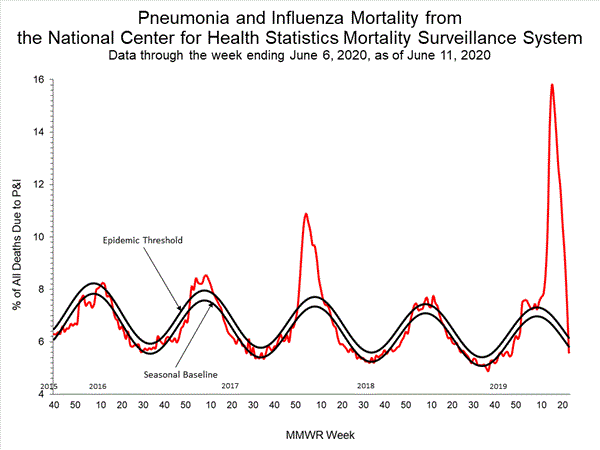
COVID emphatically was not circulating in numbers in november. We would have noticed, same as the chinese did, from the massive increase in pnuemonia clusters. Genetic analysis backs this up. You don't know what you're talking about, again.
But even if you don't know anyone who died from it, you can still know people who are ill. My ex-brother-in-law has been in and out of the hospital 4 times for COVID-19.
In many countries, old people are less likely to get infected, because those countries take special effort to protect old people. Some countries didn't or messed up, which has lead to massacres in elderly care homes.
Though the real big risk here is: it's possible to carry the virus without having any symptoms. So you can transmit it to other people without ever realising.
Outrageous claims require outrageous proofs, you need to volunteer your sources if you want to convince anybody that 55 and younger are large share of deaths.
"From what I have heard" is not an outrageous proof on HN.
https://www.worldometers.info/coronavirus/coronavirus-age-se...
Unfortunately, I'm unable to find good global statistics on absolute number of deaths broken down per age group.
I have come across the claim I mentioned in response to a claim that young people almost never die from this. That is simply not true: young people do die, but it looks like half is indeed an exaggeration. Even so, the claim that it's in the double digits is also false; in the US, 610 people under 44 have died[0]. Claims that young people are perfectly safe are dangerous, even if the danger is a lot higher for older people.
[0] https://www.worldometers.info/coronavirus/coronavirus-age-se...
But you do realise over 120 THOUSAND died in the US in total. 610 out of 120,000+ is a mere half percent.
You are incorrect. COVID is largely a disease that affects the elderly and those with pre-existing conditions. Here are the actual numbers from England (England only, not to be confused with the overall UK):
- All COVID deaths, age 0-59: 2,210
- All COVID deaths, age 60+: 25,721
And of those 2,210 people under 60 who died, only 261 didn't have known pre-existing conditions.
Also, the older age groups are actually smaller populations than the younger age groups. So the death rate is even higher than the raw numbers suggest.
If you define "young" as anyone under 40, the difference is even more stark:
- All COVID deaths, age 0-39: 224
- All COVID deaths, age 0-39, no pre-existing condition: 36
Note: Obviously the young and healthy should still avoid exposure to avoid infecting others and also because there is of course always some risk of both death and long-term damage.
My point is merely: don't think you're immune just because you're young. More young people have died from this than most people think.
15 - 44 = 27
45 - 64 = 589
75 - 84 = 1356
85 + = 1761
If you are under 40 your risk of dying seems to be very very low.
Based on the figures you provided I make that close to 0.7%. It is low but I wouldn't describe it as very very low :-)
The populations of those are ranges are different sizes. There are many fewer people alive who are in the 85+ group than there are in the 15-44 group. So if you work that out based on the relative population sizes, you'll get a much lower death rate for the under 40 group.
South Korea: 5539, deaths = 5 = 0.09%
Switzerland: 8874, deaths = 5 = 0.05%
Italy: 37139, deaths = 84 = 0.22%
Netherlands: 8207, deaths = 14 = 0.17%
This is from wikipedia for the respective countries, some countries figures are more up to date than others.
But one thing that is easy to explain is your point about not knowing anyone who was infected:
- At the peak of this epidemic in hard-hit places like the UK, something like only 1 in 400 people are known to have been infected at a time.
- Many younger people (as much as 70%) show absolutely no symptoms when they are infected.
- The disease is astronomically worse for elderly people. One study said that for young person, getting COVID was as risky as going for a ~200 mile car drive but as a 90 year old it was as risky as flying a WWII bomber mission. Nearly everyone who is dying is 70+ and mostly 80+. Obviously some younger people do die, but the numbers are much, much lower. We are talking 10s of people total under 40 in most countries.
So unless you are hanging out with a social circle of 80-90 year olds, you actually aren't very likely know anyone directly affected! But that doesn't mean tons of people weren't dying. They just aren't the people you would know. It's a different social circle.